In the present day, healthcare systems are becoming smarter and more secure. Thanks to blockchain technology, organizations can manage huge volumes of data in their highly interconnected digital ecosystems. Furthermore, this technology has played a key role in transforming the state of medical care globally.
Blockchain technology in healthcare basically brings forth a decentralized, immutable ledger that is secure, tamper-proof, and transparent. Here, information is shared and stored across different nodes, and unauthorized access to them is difficult. This is why blockchain helps ensure better data integrity, cybersecurity, interoperability, patient privacy, and record management.
While these are certain benefits that healthcare organizations can look forward to, this list goes on to be much longer in practice. For these reasons, there is a growing adoption of this technology globally. A latest Markets and Markets report shares that the global blockchain market is projected to compound at a CAGR of 64.2% (2026-2030). That being said, its value in 2025 was USD 32.99 billion, and it is expected to reach USD 393.45 billion by 2030.
With this in discussion, this guide answers business leaders’ questions around its enterprise-wide benefits, use cases, practical examples, and future trends that they can look forward to in the coming times.
Understanding Blockchain Technology in Healthcare
Simply speaking, a blockchain is a collection of blocks connected by a hashing algorithm. Here, each link in the chain consists of time-stamped data records containing sensitive, financial, and private information that needs to be kept private. All data is available to users on a distributed ledger to improve transparency. Moreover, all private information is encrypted using RSA-256 and other cryptographic techniques.
Discussing its use case in the industries, we know that the healthcare sector was the first to transform following the pandemic. So, in this case, blockchain was trusted as the preferred solution for increasing security and achieving better patient outcomes and broader service accessibility.
As its usage is evolving, there are now several blockchain applications in healthcare that have the potential to significantly improve the security, effectiveness, accessibility, and dependability of health data systems. Leading ones developed by blockchain healthcare app development experts are Smart Contract Tools, Hyperledger, API frameworks, Ethereum, and more. Overall, these help improve the medical industry’s functioning from services to supply chain tracking.
Benefits of Blockchain in Healthcare
Undoubtedly, blockchain technology in the healthcare market contributes to better patient care outcomes. Precisely, it includes benefits like improved data security, transparency, and effective claims processing.
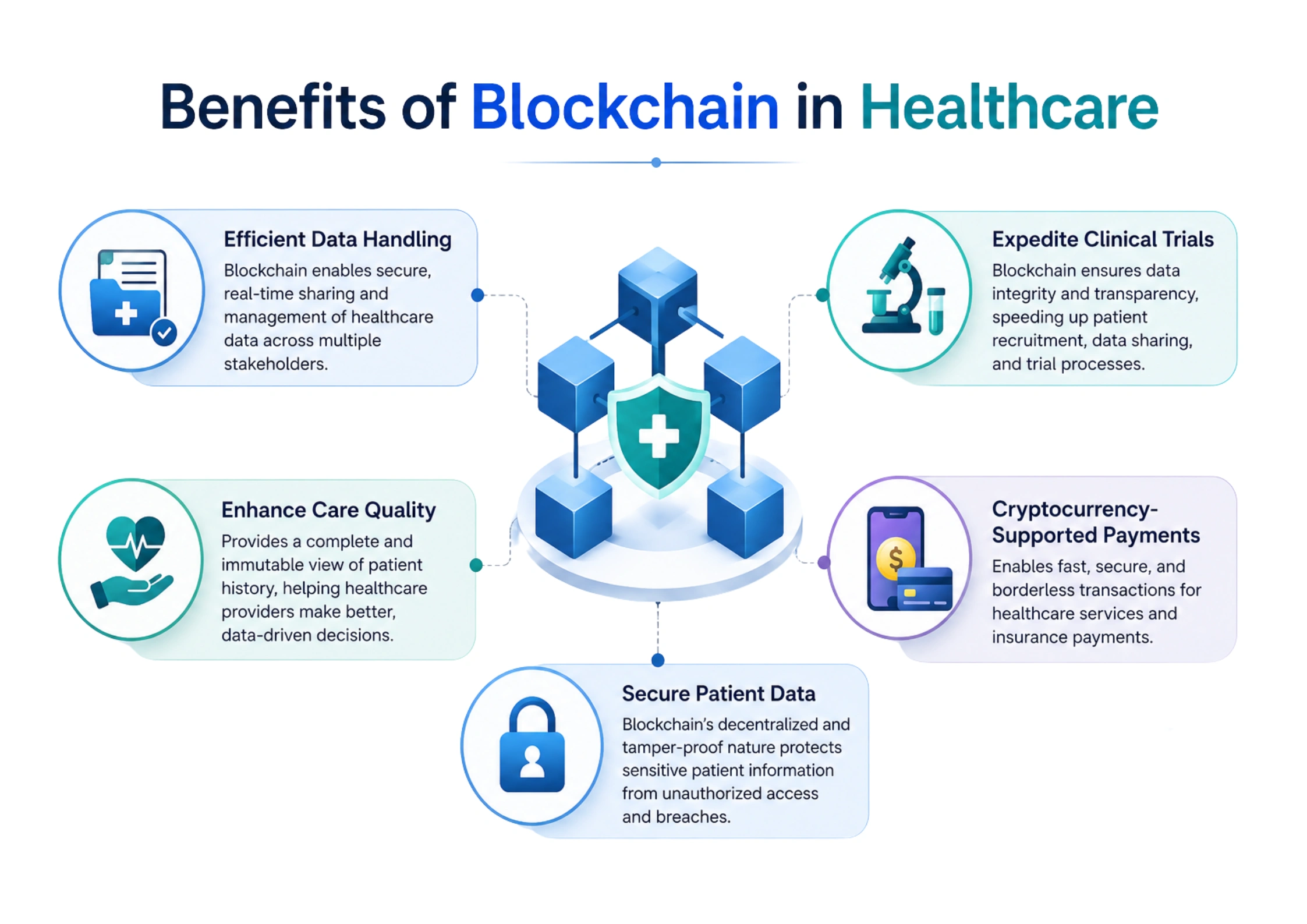
That being said, let’s look at the top benefits of blockchain in healthcare.
-
Efficient Data Handling
A key advantage of blockchain in healthcare is that it is ideal for mitigating traditional workflow issues when collaborating on large-scale infrastructure projects. Its decentralized nature resolves the issue of improved data dispersion. Essentially, this enables medical facilities and organizations to demonstrate how to protect patient privacy and provide access to data management.
So, clinics can manage healthcare databases efficiently by implementing international compliance, such as HIPAA. In fact, an expert company providing blockchain development services for healthcare can build medical apps, keeping in mind the organizations’ need for scalability, sustainability, and customer trustworthiness.
-
Expedite Clinical Trials
Considering blockchain for healthcare, clinical trials that generate massive amounts of data can easily manage the sharing of data across physicians, sponsors, hospitals, clinics, drug manufacturers, researchers, and more. So, you can integrate this technology to make the clinical trial procedure more transparent and streamlined. In fact, it enables researchers to work more efficiently while analyzing studies with protocols, and forbidding their publication.
Overall, this blockchain technology in healthcare supports better management of all healthcare-related documentation. Furthermore, for more professional guidance, you can hire Blockchain app developers. This will help your team get the right long-term partnership that can help develop the right blockchain-based solutions to achieve these outcomes.
Blockchain provides numerous benefits for the healthcare industry, such as improved data security, transparency, and effective claims processing. Let’s look at the top benefits of blockchain in healthcare.
-
Enhance Care Quality
Numerous security layers are necessary in the healthcare industry to ensure the security of patient data. For this reason, contemporary security systems use blockchain technology to increase patient safety. Because of blockchain protection, digital fraud has already been avoided, and trust has grown.
Doctors do not have to constantly contact patients to review their entire medical history because patients can provide access to their sensitive data only if they want it. This improves patient treatment and streamlines care facilities.
-
Payments With Cryptocurrency
Healthcare institutions can create data-portable and interoperable digital medical solutions using the blockchain ledger. Hospitals, governments, pharmacies, and research institutes are among the many healthcare organizations currently using blockchain’s two- or three-layer security and authentication features. This facilitates businesses in building a safer and more practical method of carrying out medical procedures.
The cryptocurrency method enhances the payment process’s accountability and facilitates payments more quickly and easily. Blockchain-based payment systems for healthcare enable efficient payment management, invoice sending, cost reduction, enhanced patient experience, and easier front desk jobs.
-
Secured Patient Data
Patient data security is one of blockchain’s main benefits in the healthcare industry. As a result, healthcare intuitions and clinics are now future-proofing patient records using smart contracts. This ensures that the data is safe from fraud and minimizes the difficulties that physicians and hospital management systems have in diagnosing the patient’s illness.
According to recent studies, over 176 million patient records were breached from 2009 to 2017. The hackers also took financial and credit card information, which they used for fraud. The blockchain is a distributed, immutable, and tamper-proof technology, making hacking nearly impossible.
Top Blockchain Use Cases in Healthcare
Blockchain in the healthcare industry has many use cases, from improving patient data management to medical supply chain management and healthcare payment.
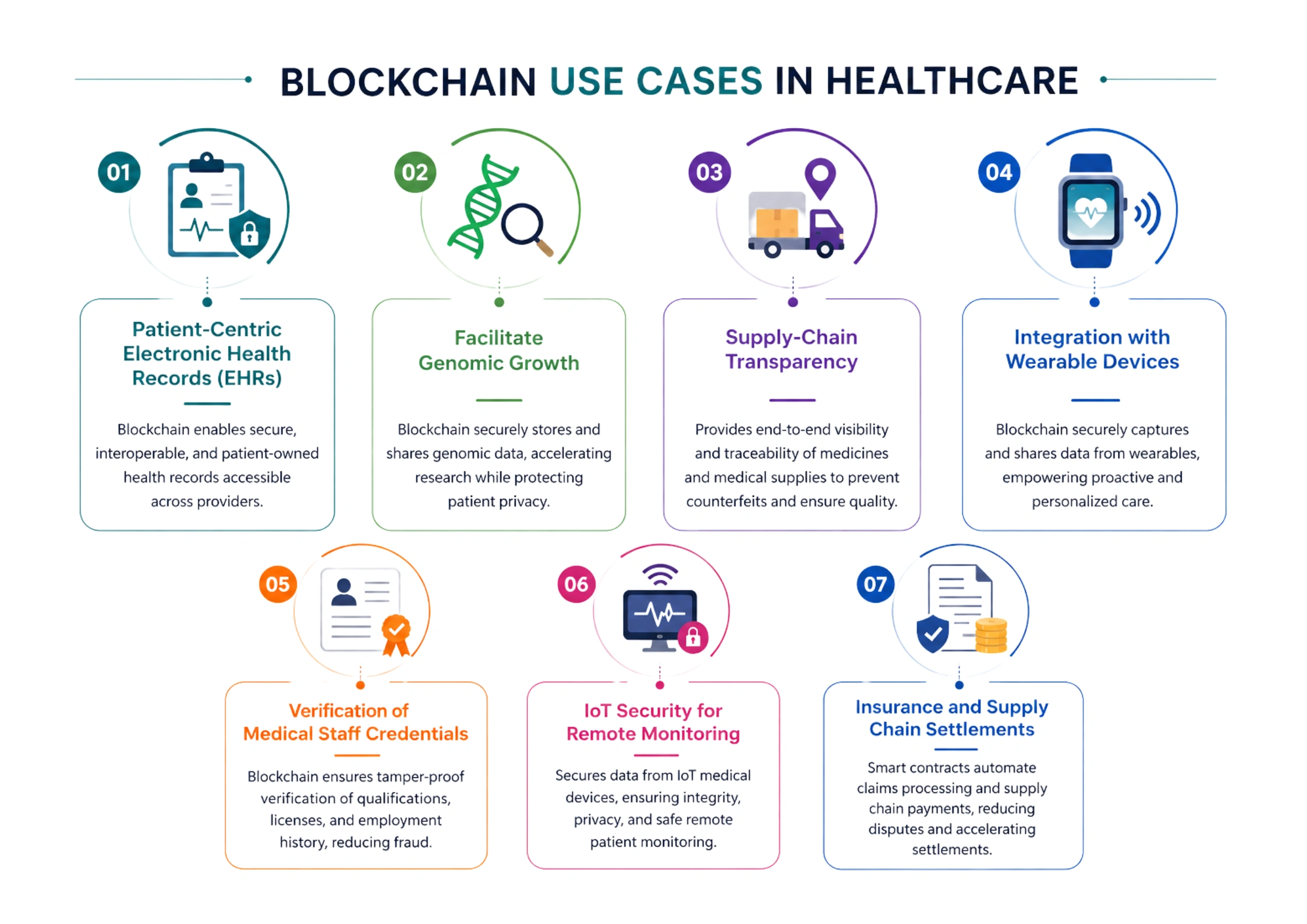
Below, we have mentioned the top use cases of blockchain in the healthcare industry.
-
Patient-Centered Electronic Health Records (ERHs)
The issue of data silos is one that clinics and healthcare institutions worldwide are facing. This implies that each time a patient visits a doctor, the doctor and patient only have a partial overview of each other’s medical history. This tends to result in treatment errors, making the process more difficult and time-consuming.
According to a 2016 Johns Hopkins University study, medical errors resulting from poorly coordinated care such as incomplete or missing planned actions inaccurately entered patient medical histories, or a lack of prior treatment data—were the third most common cause of death in the United States.
-
Facilitate Genomic Growth
Genomic sequencing costs decreased from $10,000 to $1,000, and some companies claim to do the task for around $200. These kinds of activities empower professionals and scientists to participate in genome-related research. However, the main question is where and how to secure such a large dataset. This is where blockchain for healthcare becomes helpful.
Blockchain enables participants to save and store billions of genome data points, maintain ownership, and exchange them safely with other parties. You can easily monetize your genomic information without including mediators. The best aspect is that the blockchain app development cost remains under budget, so business owners do not have to spend much on development.
-
Supply Chain Transparency
One of the most significant challenges facing the healthcare industry is ensuring the provenance of medical goods to assure validity. A blockchain-based system can facilitate tracking goods from the producer to the pharmacy or clinic. Throughout the process, supplies may be traced, giving all involved parties complete visibility and transparency over the products patients purchase and receive.
This has swiftly risen to the top of the healthcare domain’s priority list, particularly in developing countries, where fake prescription drugs cause millions of deaths a year. Due to the rapid proliferation of medical equipment, blockchain is becoming increasingly popular in the supply chain for these devices, attracting more hackers.
-
Integration with Wearable Devices
One of blockchain’s most outstanding abilities is its use with wearable Internet of Things devices. Blockchain can offer an efficiently authenticated, secure platform to incorporate data with wearable devices like fitness, health, or activity trackers. Just like patients, even physicians and healthcare professionals can access this secured and updated data. With that, doctors can easily track patients’ health progress anytime. Therefore, you must focus on a unique healthcare app development as the usage of wearable devices is skyrocketing daily.
-
Verification of Medical Staff Credentials
The blockchain ledger is also used to track the qualifications and experience of medical experts. It allows leading healthcare organizations to record staff members’ credentials, making monitoring and validating expertise and degrees easy. These systems have already been established; the US ProCredEx credential verification system, which uses the R3 Corda blockchain technology, is among many examples.
-
IoT Security for Remote Monitoring
Remote monitoring technologies are a critical use case of blockchain in healthcare. These technologies remotely take a patient’s vital signs and deliver additional information about the patient’s health-related data to healthcare professionals. It is currently one of the most significant developments in the healthcare industry, enabling more proactive and preventive treatment.
-
Insurance and Supply Chain Settlements
Blockchain is most commonly used in supply chain settlements and insurance. Numerous businesses provide blockchain-based systems that make it simple for different organizations, including insurance companies, clinics, pharmaceutical firms, and medical device manufacturers, to validate their identities. These identities may record contract information, monitor service transactions, and handle payment settlements for products and services. Blockchain-based ecosystems enable trading partners and insurance companies to operate on fully digital and, in certain situations, automated contract terms.
Future of Blockchain in Healthcare
As healthcare technology continues to rapidly evolve, there are many trends that are taking place in the backdrop of the intelligent and interconnected healthcare ecosystems.
This section discusses some of these emerging trends as follows:
-
Blockchain-Powered AI Validation
As AI strengthens the face of blockchain healthcare app development, emerging companies can expect better diagnostics and clinical decision-making. What’s more, AI and blockchain in patient care can help clinics verify the authenticity of EHRs that are used in model training workflows.
-
Tokenized Healthcare Ecosystems
Well, the tech-driven healthcare platforms may begin using token-based systems for sharing loyalty rewards and research participation. Overall, this also helps improve data privacy in blockchain-driven healthcare apps, while meeting the industry’s regulatory requirements mandated by HIPAA and GDPR.
-
Digital Twins in Healthcare
Blockchain solutions for healthcare may also integrate digital twin technology to comprehensively secure the management of its real-time patient data simulations. Mainly, this helps clinics in enhancing their predictive treatment planning and personalized medicine.
-
Federated Healthcare Data Networks
Instead of storing all EHR files centrally, blockchain in the healthcare segment can support federated models. Mainly, these play a key role in helping institutions perform better by securely collaborating on data files without entirely moving their sensitive patient data records.
-
Blockchain-Based Consent Management
One of the examples of blockchain in healthcare is that they are shaping the future by helping create a dynamic patient consent system. Essentially, this allows patients to share their consent, thereby controlling and tracking who can access their medical information in real time.
-
Integration with Web3 Healthcare Platforms
As decentralized internet technologies evolve, leading blockchain healthcare companies may also invest in Web3-based healthcare applications. Functionally, these solutions are highly focused on patient ownership, transparency, and decentralized collaboration.
-
Autonomous Healthcare Workflows Through Smart Contracts Development
What’s more, smart contract development is another evolving aspect of blockchain healthcare applications. These mainly help automate operational workflows like claims approvals, compliance checks, provider credentialing, and multi-party healthcare agreements, thereby helping in workflow improvements.
Final Thoughts
Wrapping up, we can say that blockchain is gradually becoming an increasingly adopted smart healthcare security solution. Not only does it help build a connected, transparent ecosystem. But also, it has a long-lasting impact on the medical company’s patient-centric outcomes.
From offering more data security to improving interoperability to even automation, blockchain technology can do wonders. Thus, its successful adoption in the healthcare industry can help accelerate your innovation, scalability, and compliance-readiness while meeting the operational needs at the same time.
So, from a healthcare perspective, this means that blockchain integration is a practical solution towards improving data security and patient care, and not only that, it can also help support a company’s long-term digital transformation goals.

Want to build a Blockchain-based Healthcare App?
Frequently Asked Questions
How does blockchain improve healthcare data security?


Blockchain technology helps improve data integrity and privacy by working on aspects like encryption, decentralized storage, immutable records, and controlled access permissions. This makes the patient data records tamper-proof, thereby preventing unauthorized access.
Can blockchain improve patient care in healthcare systems?
Yes, one of the outcomes of blockchain integration in healthcare is improving patient care. In practice, this is done by improving access to accurate medical records and improving interoperability between providers, which helps reduce delays caused by conventional healthcare systems.
Why is blockchain important for Electronic Health Records (EHRs)?
Comprehensively, blockchain technology makes EHR systems more secure, transparent, and interoperable. What’s more, it allows healthcare providers to securely exchange patient records while maintaining data integrity and patient privacy, which is why it is essential to manage EHRs.
Can blockchain help reduce healthcare fraud?
Yes, blockchain helps create a transparent and secure healthcare ecosystem, which can avoid the possibility of issues like insurance fraud, counterfeit drugs, data manipulation, and unauthorized record modifications.
What challenges affect blockchain adoption in healthcare?
Among the key challenges in this roadmap, we have issues like managing scalability, regulatory compliance concerns, and integration with legacy healthcare systems. Apart from these, companies need to evaluate the implementation costs for blockchain in healthcare.
How is blockchain used in healthcare supply chain management?
Undoubtedly, blockchain helps healthcare organizations track medical equipments, pharmaceuticals, vaccines, and devices more transparently across the supply chain. In this way, it helps improve the traceability in the system, while also reducing the chances of fraud and theft.