The world stands at a climate inflection point, and technology is the most powerful lever we have. Green technology is no longer a niche investment; it is a global economic force.
According to Grand View Research, the global green tech and sustainability market stood at $23.10 billion in 2024. It is on track to nearly quadruple to $79.65 billion by 2030, expanding at a 23.1% CAGR over the next five years.
Greentech software development occupies the intersection of environmental responsibility and digital innovation. It is redefining how businesses build, deploy, and manage software in harmony with the planet.
From intelligent energy grids to carbon footprint-tracking apps, from greentech renewables platforms to circular-economy logistics tools, green tech software is powering the sustainability revolution across every sector.
In this guide, we break down what green tech software development is, why it matters in 2026, which green tech technology trends are driving it, and how your business can harness it for a competitive advantage.
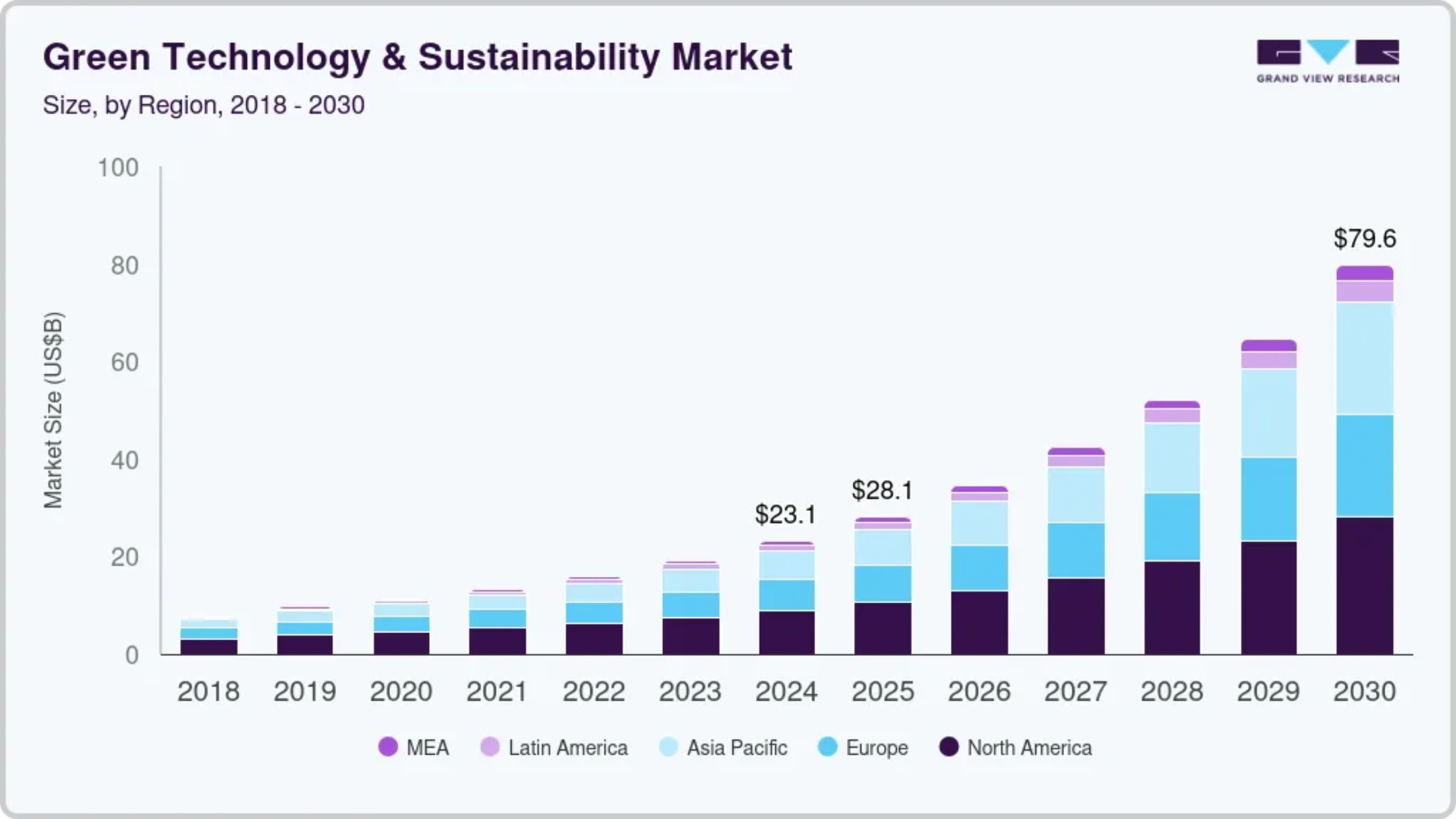
Image Source: Grand View Research
What Is Green Tech?
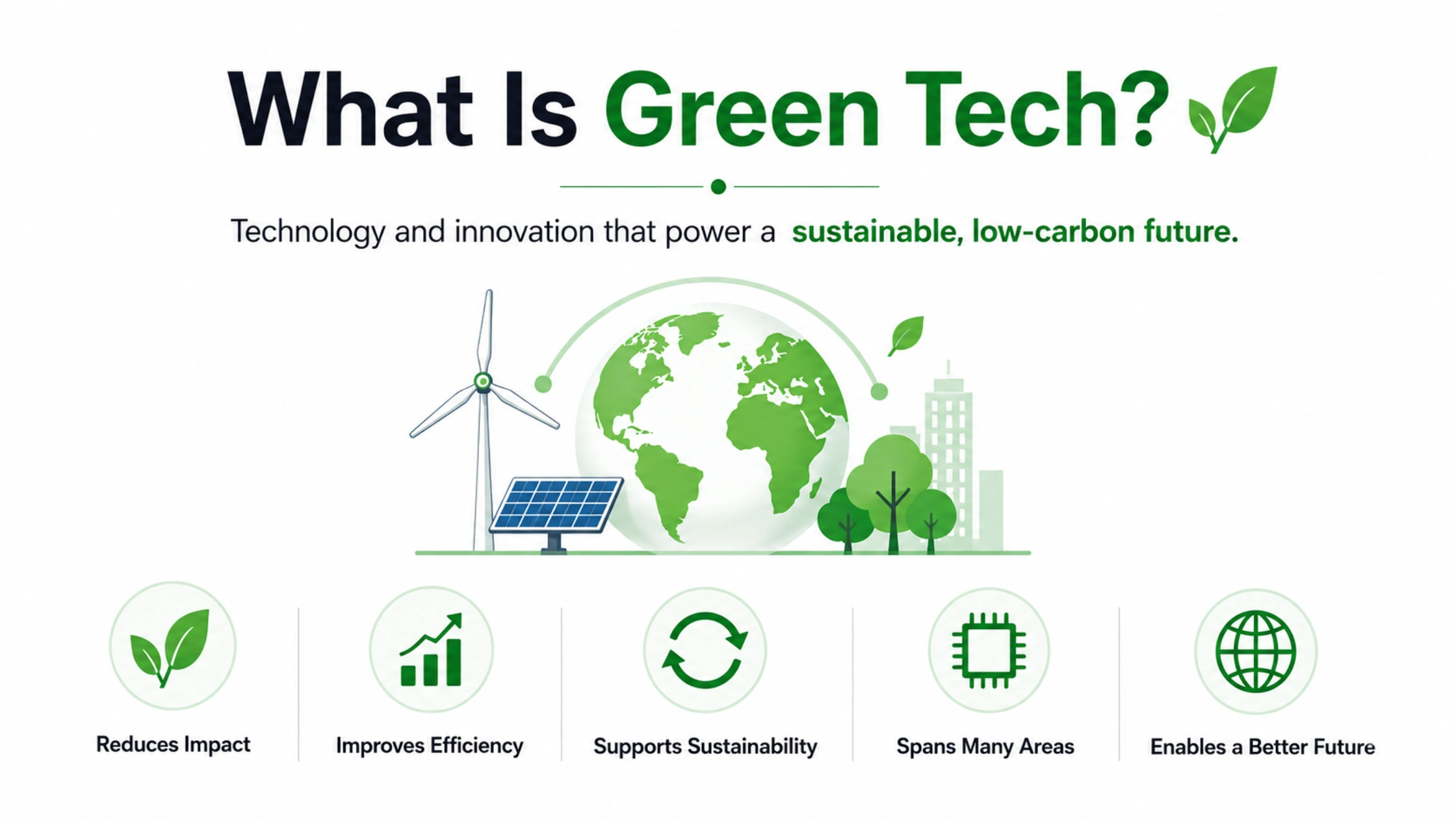
Green technology (or greentech) refers to any technology that uses innovation to reduce negative environmental impact, improve resource efficiency, or support sustainable practices. Green tech spans hardware, software, infrastructure, and greentech IT services designed to enable a low-carbon, circular economy.
Why Green Technology Matters in 2026
Green tech touches every sector, from renewable energy management and smart grid software to precision agriculture, EV infrastructure, water conservation, and environmental monitoring.
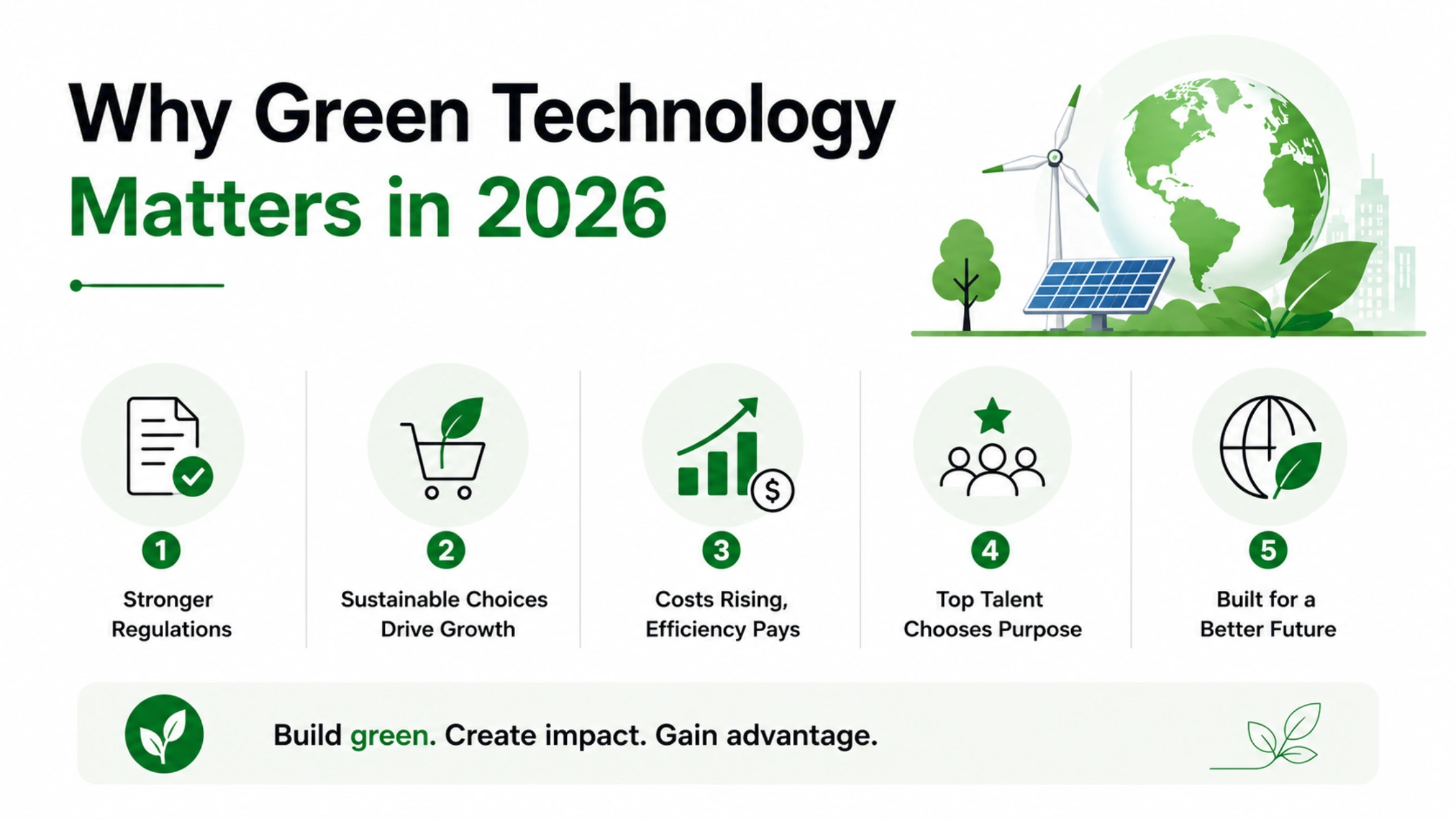
The urgency is real, the regulations are tightening, and the market is moving fast. Here is why green technology matters right now:
- The EU’s CSRD and the SEC’s climate disclosure rules now require companies to report and reduce their environmental impact.
- Buyers increasingly choose brands with verified sustainability credentials, giving greentech-powered products a measurable commercial edge.
- Energy costs and carbon taxes are rising. Businesses that build software to monitor, reduce, and offset consumption protect their margins as carbon pricing expands globally.
- Greentech companies attract and retain top engineering talent faster than traditional tech firms, lowering recruitment costs and accelerating delivery.
Whether you build a consumer-facing green tech app or enterprise green tech systems, purposeful design that measures, reduces, or offsets environmental impact gives your product a durable market advantage.
Greentech vs Cleantech: Understanding the Difference
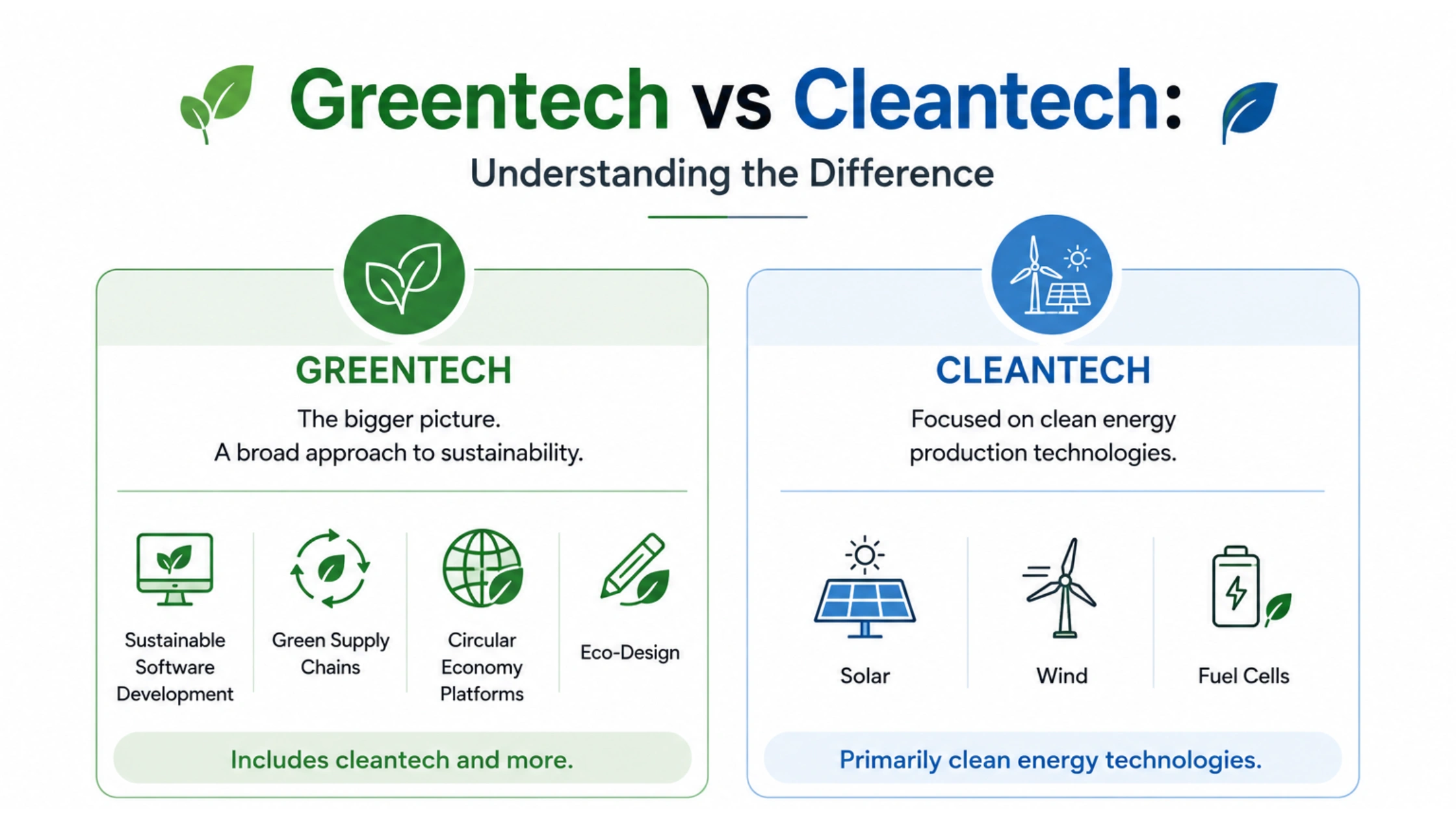
While the terms are often used interchangeably, greentech and cleantech have a subtle but important distinction. Cleantech primarily refers to clean energy production technologies such as solar, wind, and fuel cells.
Greentech is a broader umbrella that includes cleantech but also extends to sustainable software development, green supply chains, circular economy platforms, and eco-design. For businesses developing custom software development solutions, green tech addresses both product sustainability and the sustainability of the development process.
The Rise of Green Tech Sustainable Solutions: Market Overview & Key Stats
Regulatory pressure, investor mandates, and consumer demand are converging to accelerate green tech development. The numbers below tell a compelling story:
Key Market Statistics and Growth Drivers
- $1.96 trillion: The total global clean investment reached in 2025, an all-time high that reflects accelerating capital flows into renewable energy, sustainable infrastructure, and low-carbon technologies.
- 45% of Fortune 500 companies plan to be net zero or to set sustainability targets by 2050.
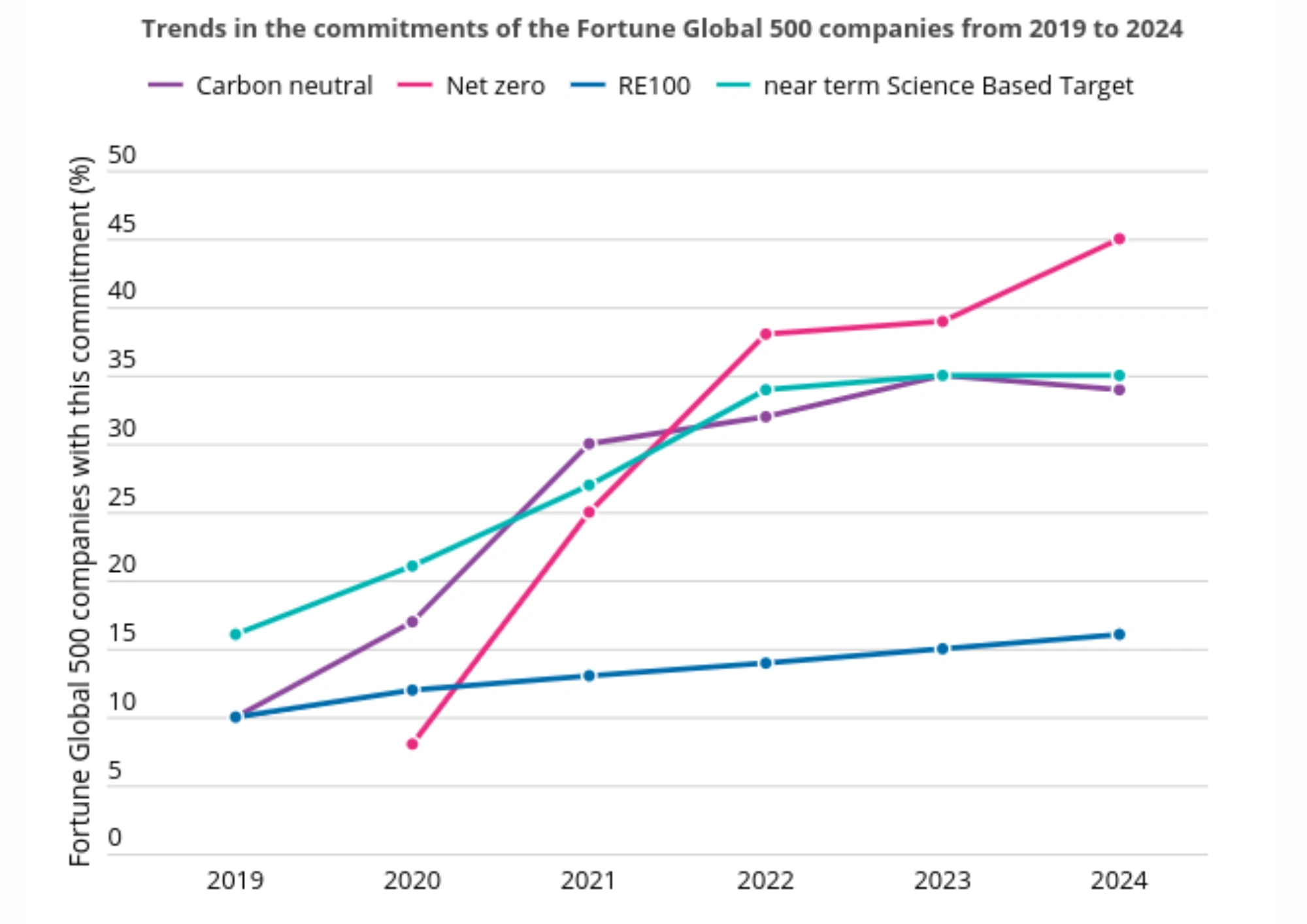
Source Image: Climate Impact
- 3x Faster Hiring: Demand for green tech developers and sustainability engineers is growing with a 5.9% average annual increase between 2021 and 2024, compared to general software roles.
These numbers confirm that green tech companies, from the largest players like Tesla to emerging startups, are collectively transforming every industry vertical. The software layer powering these companies drives the greatest value creation.
Core Areas of Green Energy Tech in Software Development
Successful green energy tech projects require thoughtful software architecture, responsible engineering practices, and sustainability-aware design systems working in concert. Here is how each pillar breaks down:
Greentech Engineering: From Architecture to Deployment
Greentech engineering means building software that is functional, scalable, and environmentally conscious at every layer. This includes:
- Energy-efficient algorithms: Optimizing code to reduce CPU and memory consumption, directly cutting data center energy use.
- Green cloud architecture: Prioritizing cloud computing powered by renewable energy. Google Cloud, AWS, and Azure now also provide carbon footprint dashboards.
- Serverless & edge computing: Reducing idle compute cycles through on-demand, event-driven infrastructure.
- Carbon-aware scheduling: Timing compute-intensive workloads to run when the grid carries the cleanest energy mix.
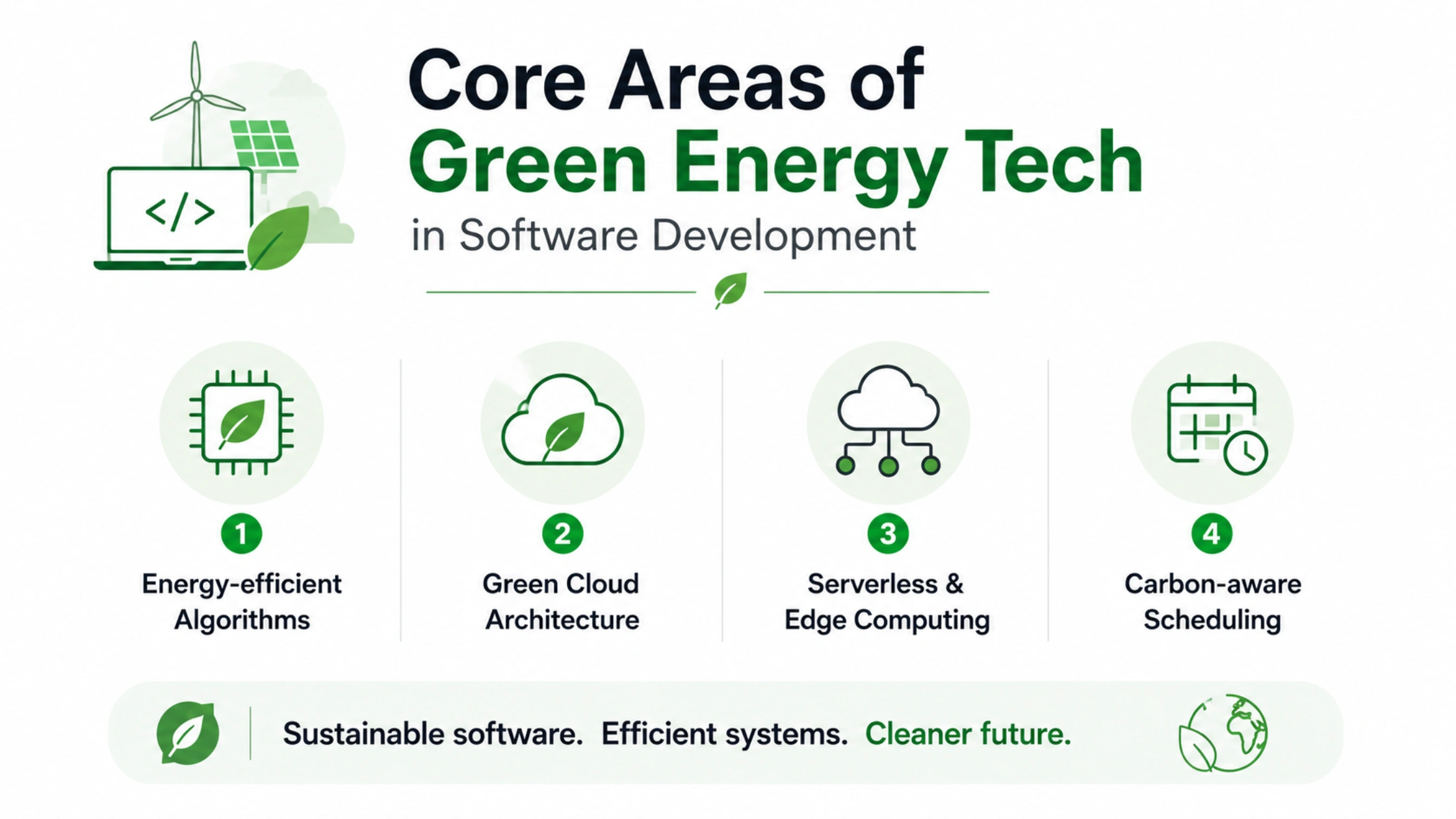
Skilled greentech engineers integrate these principles from the first line of code, ensuring green tech software is sustainable by design, not patched in as an afterthought.
Green Tech Tools and Platforms Powering Sustainable Apps
The ecosystem of greentech software development is maturing rapidly. Let’s look at the key platforms and frameworks greentech developers use to build the software:
| Tool/Platform | Type | Description |
| Green Software Foundation SCI spec | Open standard | An open standard for measuring the carbon cost of software (Software Carbon Intensity) |
| Cloud Carbon Footprint | Open source | Visualizes and tracks cloud emissions across AWS, GCP, and Azure |
| Kepler (Kubernetes eBPF exporter) | Open source | Real-time energy consumption monitoring for containerized workloads |
| Climatiq API | Commercial API | Emissions data API for embedding carbon calculations into any application |
| Arduino + Raspberry Pi + IoT SDKs | Hardware / SDK | Hardware integration for environmental monitoring green tech products |
| AWS / GCP / Azure Sustainability Dashboards | Commercial | Native cloud dashboards that report carbon footprint per service and region |
| Salesforce Net Zero Cloud | Commercial | Enterprise ESG and carbon accounting platform with supplier engagement tools |
| SAP Sustainability Control Tower | Commercial | Tracks and reports Scope 1, 2, and 3 emissions across the enterprise value chain |
| Microsoft Cloud for Sustainability | Commercial | Unified data model for recording, reporting, and reducing environmental impact across the Microsoft stack |
Green Tech Designs: UI/UX for Sustainability-First Products
Green tech software designs serve both visual and environmental goals. Sustainable UX reduces unnecessary data transfer by optimizing images and enabling lazy loading. It also uses dark-mode interfaces to save screen energy, and nudges users toward sustainable behaviors through choice architecture.
Greentech design principles include minimalist data payloads, accessibility-first layouts that avoid unnecessary re-renders, and real-time sustainability dashboards that make green impact visible and measurable.
GreenTech Software Development Solutions Across Industries
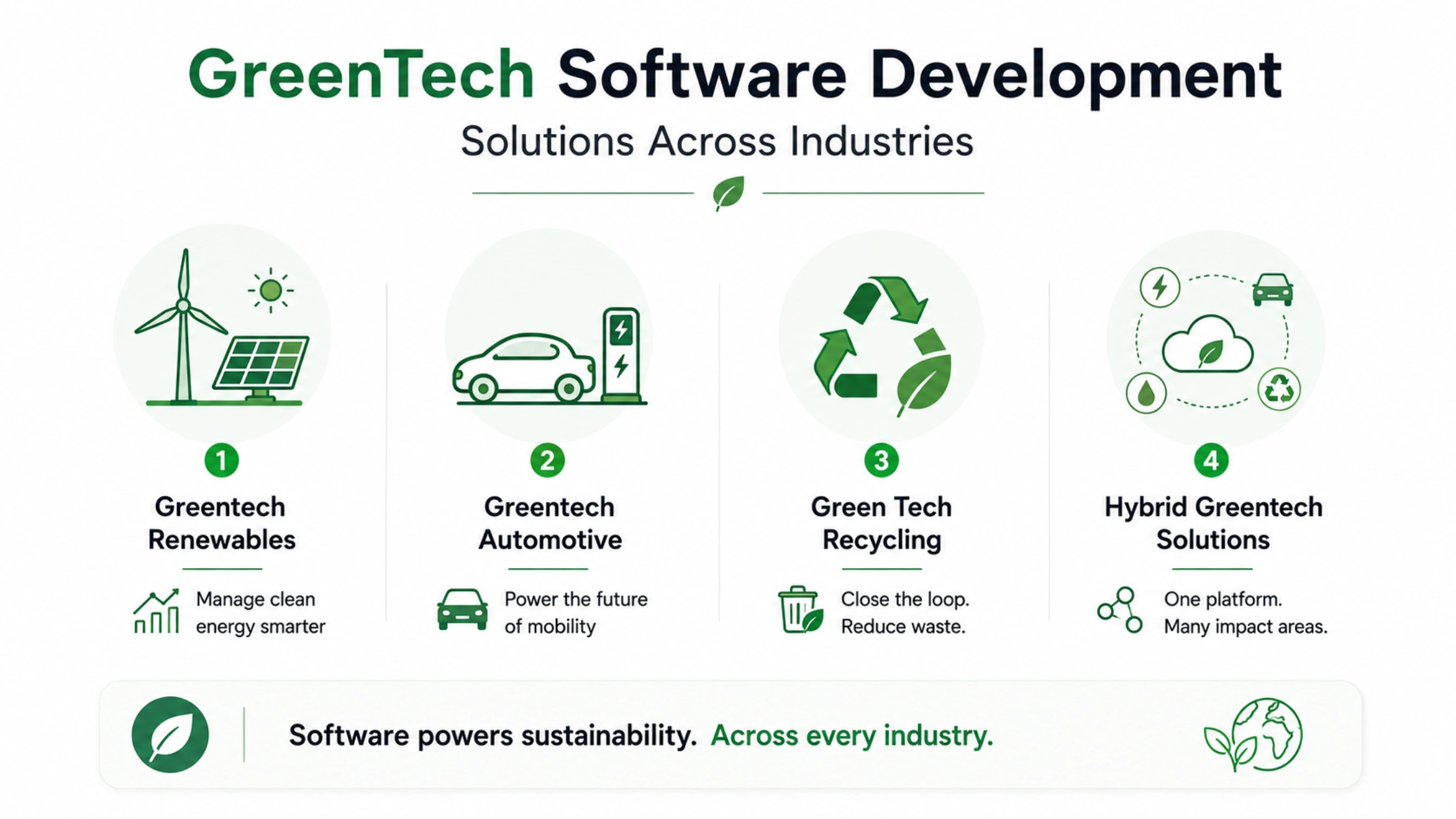
Green tech solutions reach far beyond energy companies. Across greentech industries, from agriculture to finance to logistics, software is the backbone of sustainability transformation.
-
Greentech Renewables (Solar, Wind & Grid Software)
Greentech renewables software development brings order to the complexity of intermittent energy generation, enabling reliable, data-driven grid management.
Key applications include SCADA systems for wind farms, AI-powered solar yield forecasting platforms, and virtual power plant (VPP) aggregation software that balances distributed energy resources in real time.
-
Greentech Automotive (EV Charging & Fleet Management)
Greentech automotive software development spans the entire electric vehicle value chain: battery management systems (BMS), EV charging network management platforms (like ChargePoint’s cloud software), route optimization for electric fleets, and predictive maintenance using sensor data.
Unified greentech platforms are increasingly common, supporting mixed fleets of electric, hybrid, and hydrogen vehicles under a single software system
-
Green Tech Recycling (Waste Tracking & Circular Economy Apps)
Green tech recycling platforms digitize waste management, giving manufacturers, municipalities, and logistics companies full visibility into material flows across the circular economy.
Examples include digital product passports (required under EU regulations by 2026), e-waste tracking systems, and AI-powered sorting automation software for recycling facilities.
The EU’s Digital Product Passport regulation mandates that by 2030, most goods sold in Europe must carry a digital record of their recyclability and carbon footprint. This rule will create a massive end-to-end software development opportunity.
-
Hybrid Greentech Solutions for Multi-Sector Enterprises
Many enterprises require hybrid greentech services that combine energy, mobility, waste, and water management under a single integrated platform. Large software companies like Salesforce, SAP, and Microsoft are building modular greentech IT solutions through platforms such as Net Zero Cloud, Sustainability Control Tower, and Microsoft Cloud for Sustainability.
Green Tech Examples: Real-World Case Studies
Green tech software development does not succeed in theory alone. It succeeds when developers, designers, and product engineering teams translate sustainability goals into working systems that deliver measurable outcomes at scale.
The following examples of greentech software development span industries, geographies, and technology stacks, but they share one common thread: software was the critical lever that turned environmental ambition into real-world impact.
- Uplight built a greentech SaaS platform serving 80+ utilities, reliably generating 1.3 to 1.8% energy savings per household and selling over 500,000 devices through utility marketplaces in 2023.
- Puget Sound Energy deployed an AI-driven DERMS and VPP software platform to target 100 MW of aggregated distributed energy capacity by 2025. This will eliminate the need for fossil-fuel peaker plants during demand spikes.
- Envision Energy’s EnOS AI wind farm software coordinates turbines as a network rather than isolated machines, with early results showing roughly 15% more energy generation than conventional turbines. Its Chifeng green hydrogen project was named a global benchmark by the World Economic Forum.
- Salzburg AG built a peer-to-peer renewable energy trading app that enables Austrian citizens to buy and sell surplus solar energy directly within their communities. They delivered a validated cross-platform prototype in 2 months.
GreenTech Software Development Process
Building sustainable software for the greentech industry requires more than clean code. It demands a structured, sustainability-aware process at every stage. Here is what the green tech software development process looks like.
1. Discovery and Sustainability Audit
Every greentech project begins with a product discovery, clear understanding of business goals, target users, and environmental objectives. A sustainability audit of existing systems helps identify carbon hotspots, inefficiencies, and opportunities to embed green principles.
2. Architecture and Green Design
Greentech engineers create scalable, energy-efficient UI/UX designs and prototypes tailored to the platform requirements. They select a cloud region based on renewable energy availability and choose lightweight frameworks that reduce compute load.
3. Agile Development
Development happens in iterative sprints, delivering working green tech software at every milestone. Each sprint includes a sustainability checkpoint that measures energy efficiency, code performance, and resource consumption against agreed benchmarks.
4. Carbon-Aware Testing and QA
Quality assurance in greentech goes beyond functionality. The QA process covers performance under load, security vulnerabilities, software composition analysis, regulatory compliance, and environmental impact. It ensures the platform meets both technical and sustainability standards before launch.
5. Deployment on Green Infrastructure
Deployment on cloud infrastructure powered by renewable energy reduces the product’s carbon footprint. Carbon-aware scheduling, auto-scaling, and real-time energy consumption monitoring are standard parts of a responsible greentech software deployment.
6. Managed Support and Continuous Optimization
Post-launch infrastructure monitoring ensures the platform stays aligned with evolving regulations, user demands, and environmental goals. Regular performance reports and sustainability impact updates keep greentech solutions optimized over the long term.
How Much Does GreenTech Software Development Cost?
The cost of Greentech Software development varies widely based on complexity, features, and team location. Whether you are building a carbon tracking MVP or a full-scale enterprise ESG platform, understanding the price helps you plan smarter and invest with confidence.
Here’s the price breakdown:
| MVP | Simple software | Medium software | Enterprise Software |
| $20K–$40K | $40K–$80K | $80K–$160K | $160K–$300K+ |
| 6–12 weeks | 3–6 months | 6–12 months | 12–24 months |
Now, let’s look at what features and components a green tech company will get if they choose different software development tiers based on complexity:
| Feature/component | MVP | Simple | Medium | Enterprise |
| Core Functionalities | ||||
| User authentication | Basic login/signup | Social login + roles | SSO + MFA + permissions | Enterprise SSO, SAML, LDAP |
| Dashboard | 1–2 basic KPI views | Custom charts + filters | Multi-panel analytics | Real-time BI + custom reports |
| Data collection | Manual entry / CSV import | API data pull | IoT sensors + APIs | IoT at scale + edge computing |
| Reporting | PDF / CSV export | Scheduled reports | ESG / GRI templates | CSRD / SEC regulatory reports |
| GreenTech Specific Features | ||||
| Carbon tracking | Scope 1 only | Scope 1 + 2 | Scope 1, 2 + 3 | Full value chain + offsets |
| Energy monitoring | Static usage display | Real-time meter data | Predictive consumption | AI grid optimization |
| Sustainability alerts | — | Email threshold alerts | Push + SMS alerts | AI anomaly detection |
| Renewable integration | — | Solar / wind API feeds | Grid + storage mgmt VPP | DERMS capable |
| Compliance modules | — | Basic GHG protocol | GRI + ISO 14001 | CSRD, SEC, TCFD, SBTi |
| Technical Infrastructure | ||||
| Cloud architecture | Shared hosting / PaaS | Single-region cloud | Multi-region cloud-native | Multi-cloud + edge nodes |
| AI / ML | — | Pre-built ML APIs | Custom ML models | Full AI pipeline + LLM |
| Integrations | 1–2 third-party APIs | 5–10 integrations | ERP / CRM + IoT SDKs | Full enterprise ecosystem |
| Security | HTTPS + basic auth | GDPR-ready + encryption | SOC 2 Type I ready | SOC 2 Type II + ISO 27001 |
| Team and Cost Drivers | ||||
| Team size | 2–3 devs + designer | 4–6 devs + PM | 8–12 cross-functional | 15–30+ specialists |
| Platforms delivered | Web or mobile (one) | Web + mobile | Web + mobile + API | Web, mobile, API, IoT |
Note: Costs are estimates for custom software development. Offshore teams (India and Eastern Europe) typically reduce costs by 40–60% compared to US/UK rates. Ongoing maintenance typically adds 15–20% of build cost annually.
Green Tech Trends Shaping the Future of Software Development
To stay ahead, you need to understand the macro forces reshaping greentech software development, from regulatory shifts to breakthrough technologies. Let’s look at the trends of greentech software:
Emerging Green Tech Software Trends
Three converging forces are accelerating emerging green tech:
-
Artificial Intelligence
AI optimizes energy grids in real time, predicts wind turbine equipment failures, and automates carbon accounting. Google’s DeepMind reduced data center cooling energy by 40% using AI, a benchmark that companies across the industry are now replicating.
-
Internet of Things (IoT)
Billions of connected sensors enable precision monitoring of energy, water, air quality, and supply chain emissions, feeding real-time data into sustainability dashboards.
-
Blockchain
Distributed ledgers create tamper-proof records for carbon credit trading, renewable energy certificate (REC) verification, and circular-economy material tracing, thereby solving the trust problem in sustainability data.
The Green Tech Future: 2026 and Beyond
Looking at the future of green tech, several developments will reshape the software landscape:
- Carbon-negative cloud computing will become a procurement requirement for enterprise software buyers by 2027.
- Mandatory ESG software reporting (SEC in the US, CSRD in the EU) will drive mass adoption of sustainability management platforms.
- AI-powered life-cycle assessment (LCA) tools will automate product carbon footprinting, enabling sustainability analysis 10x faster.
- Greentech software development standards, analogous to ISO 27001 for security, will emerge, requiring greentech service providers to be certified.
- Quantum computing will crack previously unsolvable optimization problems in energy grid management and materials science.
Conclusion
Greentech software development is not a future trend; it is the present imperative. As regulatory mandates tighten, investor expectations shift, and consumers increasingly choose purpose-driven brands, the companies that embed sustainability into their digital foundations today will be tomorrow’s market leaders.
The opportunity is vast, the technology is mature, and the business case is clear. Whether you are defining the green tech future for your industry or taking your first steps toward digital sustainability, the right software partner makes all the difference.
How Can SparxIT Help You with GreenTech Software Development?
SparxIT Solutions is your end-to-end greentech software development partner, combining deep technical expertise with a genuine commitment to sustainability. As a trusted green tech software company, we deliver custom platforms for energy management, carbon tracking, ESG reporting, and EV infrastructure.
Our greentech engineers specialize in IoT integration, AI-powered analytics, and cloud-native architecture optimized for green energy tech. Whether you need a green tech app, a full-scale enterprise platform, or managed IT for greentech operations, we cover the entire product lifecycle management.
From strategic green tech digital consulting to rapid MVP development and ongoing greentech IT services, SparxIT helps green tech companies translate sustainability ambitions into production-ready digital products. Ready to build your greentech software platform? Contact SparxIT, a trusted green tech software firm with a proven track record.

Partner with Experts
Frequently Asked Questions
What is greentech software development?


It is the practice of building digital platforms, including energy management tools, carbon trackers, ESG dashboards, and sustainability apps, while making the development process itself environmentally responsible.
How is green tech different from cleantech?
Cleantech focuses on clean energy production (solar, wind). Green tech is broader, encompassing sustainable software, circular-economy tools, green supply chains, and eco-design across all sectors.
What industries benefit most from greentech software development?
Energy, automotive (EV), manufacturing, logistics, and real estate see the highest impact. Any green tech company tracking emissions, energy use, or resource efficiency benefits significantly.
How much does it cost to develop a greentech software?
Greentech software development costs range from $15,000 for MVP to $300,000+ for an enterprise platform. The costs depend on features, complexity, team location, and technology stack.
How long does it take to build a greentech software?
A focused MVP takes 6 to 12 weeks. Enterprise platforms with IoT and AI modules typically require 6 to 18 months, delivered in agile phases with working software at every milestone.