Software products rarely become obsolete overnight. They accumulate constraints gradually. A product may still support critical customers even as its architecture becomes harder to change. However, its technology stack becomes more expensive to maintain, and its integrations become increasingly difficult to extend.
Additionally, releases take longer, engineers spend more time working around legacy dependencies, and security or compliance requirements become harder to satisfy.
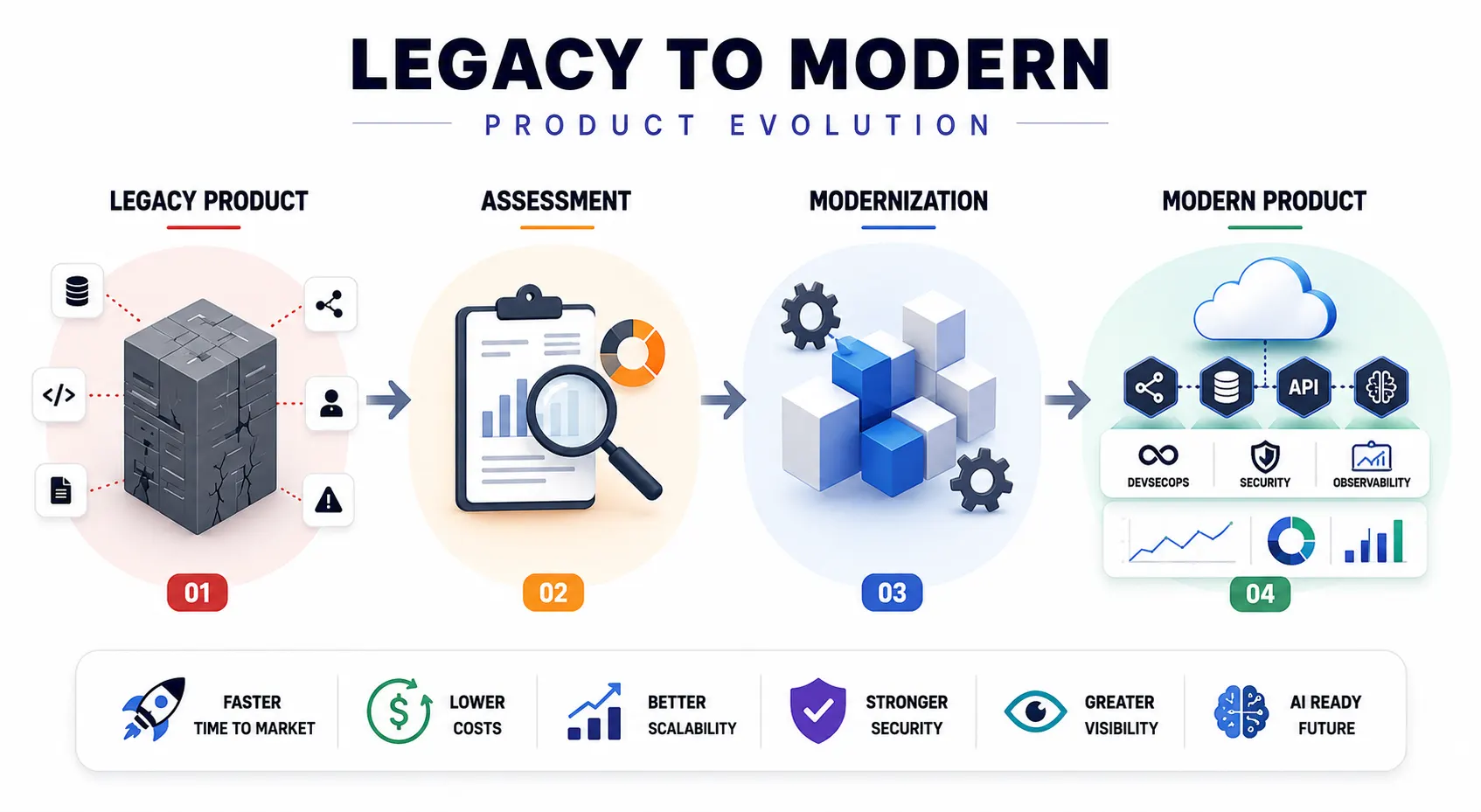
This is where software product modernization addresses the above-mentioned gap by evolving an existing product’s technology foundation to support current and future business requirements. That may involve refactoring code, rearchitecting components, modernizing data, adopting cloud-native infrastructure, improving DevSecOps practices, or replacing parts of the product that no longer create sufficient value.
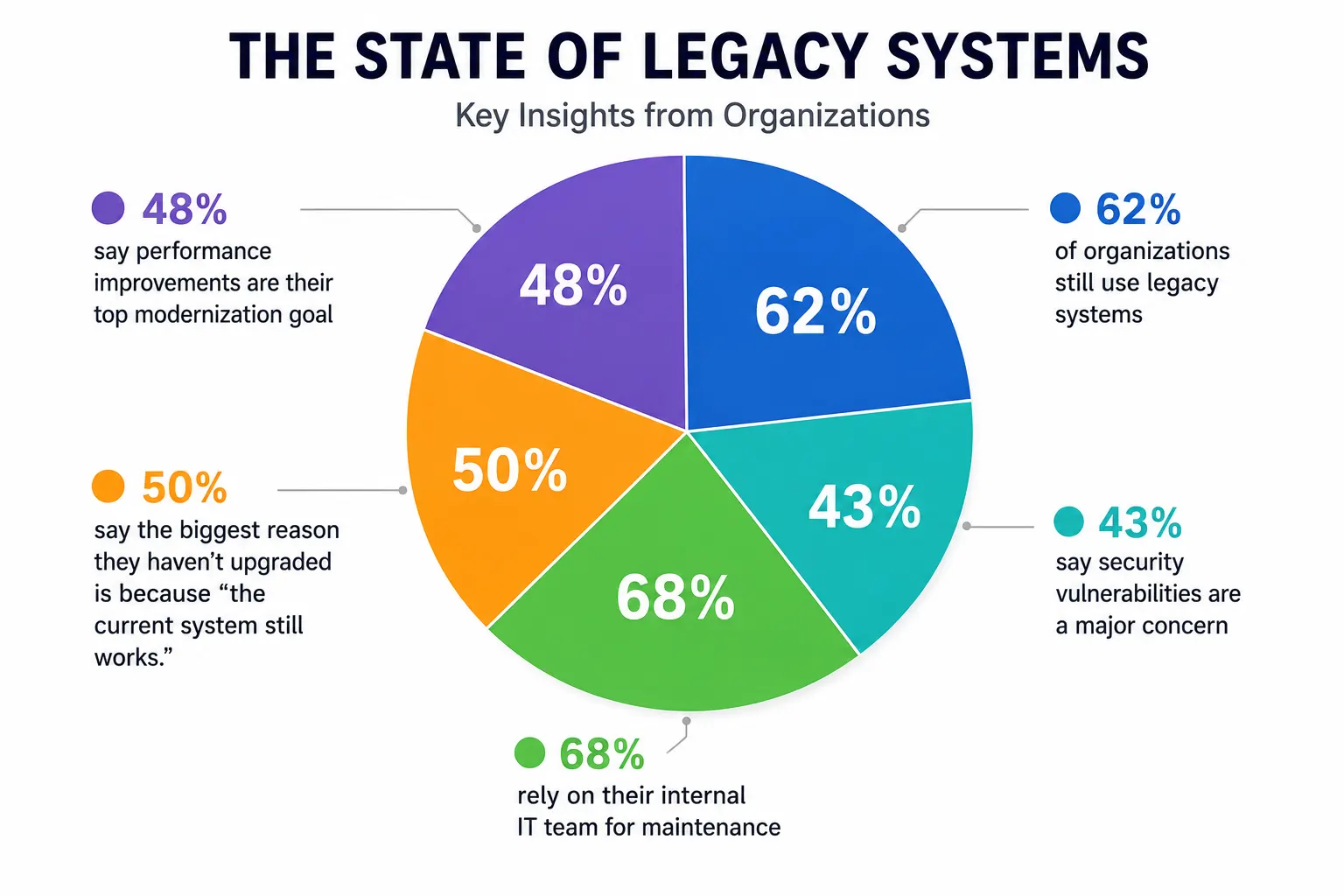
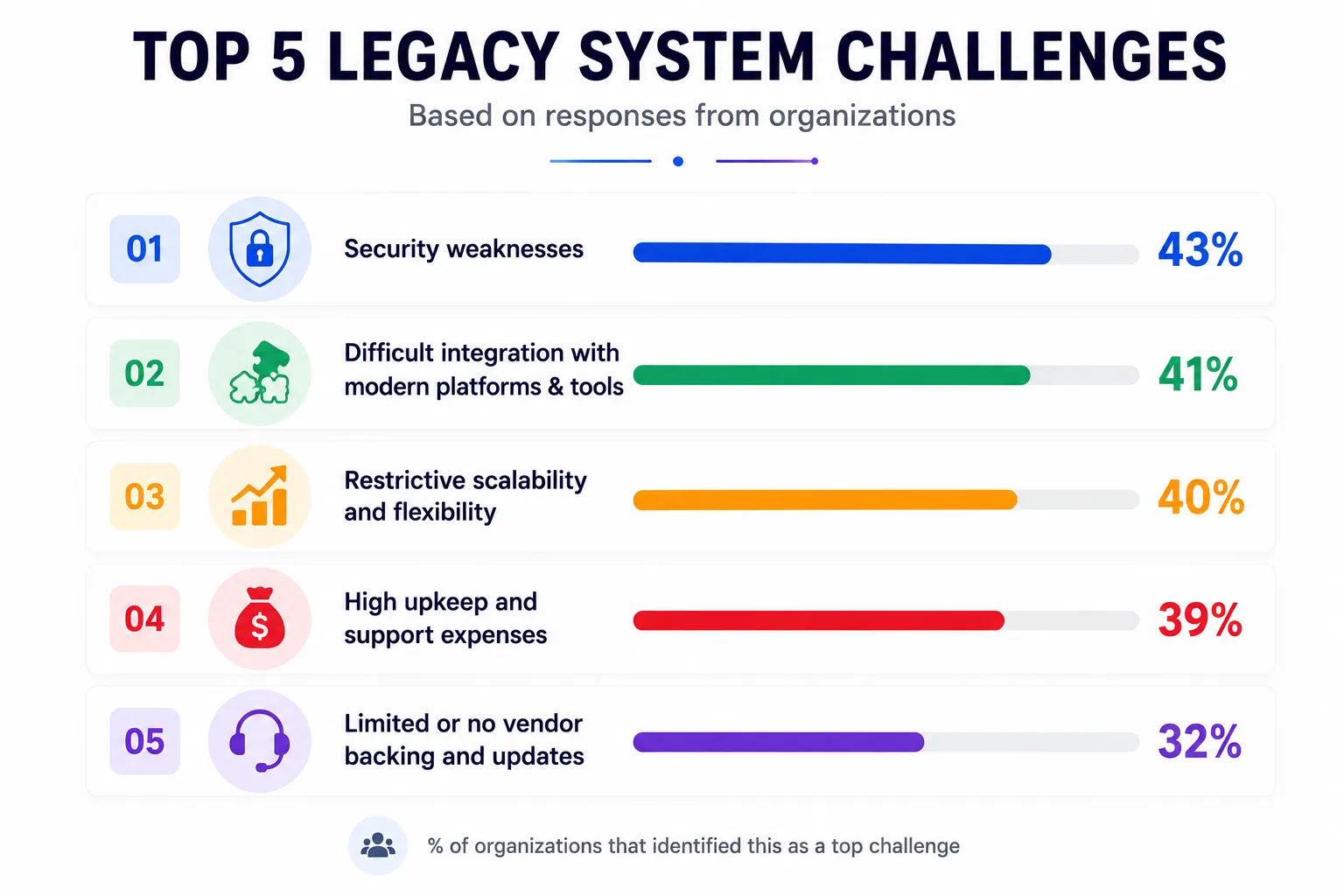
According to a 2025 Saritasa survey of U.S. IT professionals, 62% of organizations still run core systems on legacy technology, and 43% cite security vulnerabilities as a major concern. These stats make modernization less of a technology upgrade and more of a strategic business priority.
This guide gives CIOs, CTOs, and enterprise architects a complete software product modernization strategy for assessing readiness, choosing the right approach, modernizing architecture and data, managing risk, and proving ROI to the board. It applies to enterprises of nearly any size or industry pursuing software product modernization.
What Is Software Product Modernization?
Software product modernization is the process of improving an existing product’s architecture, codebase, infrastructure, data layer, integrations, security, engineering practices, and user experience to meet evolving business and technology requirements. The objective is not to replace everything that works. It is to remove the constraints that prevent the product from evolving efficiently.
A modernization initiative can range from targeted changes, such as upgrading unsupported components or containerizing a workload, to broader digital transformation, such as moving from a tightly coupled monolith to a modular or service-oriented architecture. The right scope depends on business value, technical condition, risk, and roadmap, not on what looks impressive in a technology press release.
Software Product Modernization vs. Application Modernization
An enterprise application modernization strategy typically focuses on improving the performance, cost, and maintainability of a specific application or workload. Software product modernization takes a broader product lens. It considers architecture and technology alongside product roadmap, customer experience, release model, integrations, operating model, and commercial objectives.
Software Product Modernization vs. Legacy Modernization
Legacy software modernization is often used as an umbrella term for updating aging systems and infrastructure. Software product modernization overlaps with it, but the scope is more product-centric. The goal is not only to eliminate outdated technology. It is to create a technology foundation that allows the product to evolve with less friction.
Where Modernization Fits in the Product Lifecycle
Modernization is not a one-time event bolted onto a product’s timeline. It is a recurring discipline triggered by market pressure, technical debt accumulation, security exposure, or a new capability the current architecture cannot support.
Products treated as “modernize once and forget” eventually face the multi-year, high-risk overhaul that continuous, planned investment was designed to avoid.
| Term | Primary Scope | Owner | Success Measured By |
| Application Modernization | A single application or workload | IT/application owner | Performance, cost, maintainability |
| Software Product Modernization | The product: architecture, UX, roadmap, commercial goals | Product and engineering leadership | Revenue retention, delivery speed, reliability |
| Digital Transformation | The organization’s operating model | Executive leadership | Business model and operational change |
Why Enterprises Modernize Legacy Software Products
Modernization becomes strategically important when the cost of maintaining a product’s current technology stack exceeds the value of leaving it unchanged. This pressure drives legacy software product modernization programs across nearly every industry. The warning signs are visible in engineering, security, product, and finance well before a crisis forces the decision.
Rising Technical Debt and Maintenance Costs
Technical debt accumulates when short-term implementation decisions, outdated dependencies, and deferred maintenance make future changes more expensive. A product can keep running while debt quietly consumes engineering capacity.
McKinsey puts that consumption at 10 to 20 percent of innovation budgets industry-wide, with 60% of CIOs reporting the debt load has grown over the past three years.
Modernization can reduce technical debt by simplifying dependencies, replacing unsupported components, automating repetitive processes, improving code maintainability, and creating clearer ownership boundaries. The objective is not to eliminate every instance of technical debt. Prioritize debt that materially affects business risk, delivery speed, reliability, security, or cost of maintaining legacy software.
Scalability, Security, and Integration Constraints
Legacy architectures often make selective scaling difficult. A small increase in demand can require scaling an entire application rather than just the component under pressure. This is exactly the pressure that pushes legacy application modernization onto the roadmap as an architectural requirement rather than a retrofitted control applied after an incident.
Security creates another trigger. Unsupported frameworks, weak identity controls, and fragmented monitoring increase exposure and make compliance harder. Apart from that, older integrations may depend on point-to-point connections that are difficult to govern and extend.
AI and Cloud Readiness as Modernization Catalysts
AI adoption changes the modernization conversation. AI-enabled features depend on accessible data, reliable APIs, scalable compute, and secure AI integration patterns. A product with tightly coupled components and inaccessible data may require foundational modernization before AI capabilities can be introduced responsibly.
Cloud adoption can similarly expose architectural constraints. Simply moving an application to cloud infrastructure does not automatically make it cloud-native or operationally efficient. Enterprises should modernize where cloud capabilities provide a clear business or engineering benefit, rather than treating cloud migration as an end in itself.
| Key Insight: Treat AI readiness and cloud migration as outcomes of good modernization, not substitutes for it. Relocating a legacy constraint to a new environment does not remove the constraint. |
Signs You Need to Modernize Your Software Product
Architectural and Technical Warning Signs
Let’s look at the key technical issues that can signal your product needs modernization of legacy systems.
- Monolithic codebase makes even small changes risky.
- Outdated frameworks no longer receive vendor support.
- Defects increase after routine releases.
- Integrating new tools or systems often results in frequent failures.
- Small updates take weeks to deploy instead of days.
- Teams spend more time fixing architecture issues than building new features.
Business and Organizational Warning Signs
Beyond technology, certain business challenges can also indicate the need for legacy system modernization.
- Finding developers for outdated technologies becomes difficult and costly.
- Customer complaints about product experience start increasing.
- Customer churn begins to rise.
- Compliance audits take more time and effort.
- Software product engineering teams spend most of their budgets on maintaining legacy systems.
- Less budget remains for new features and innovation.
How to Assess Software Product Modernization Readiness
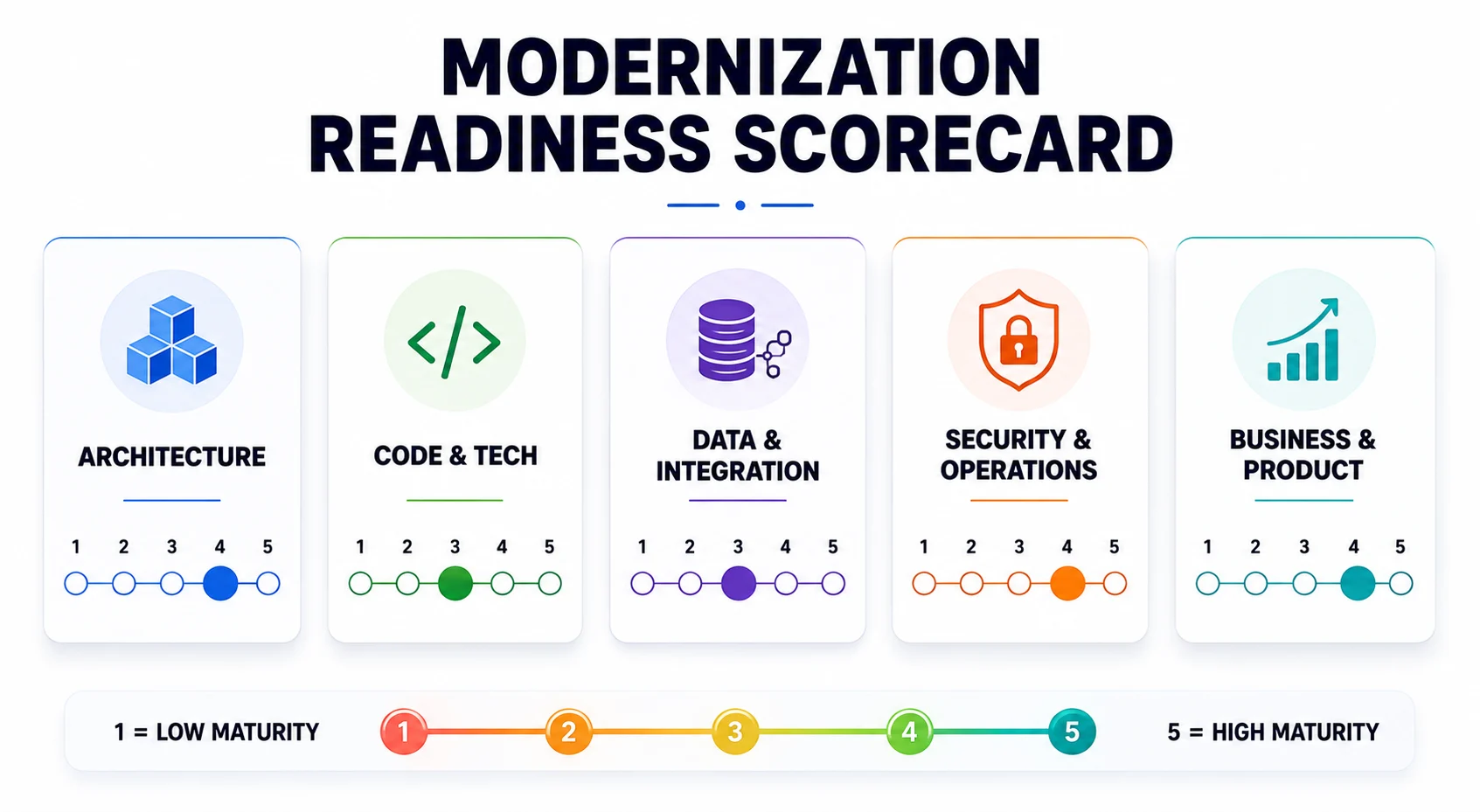
Software product modernization assessment should precede every major modernization decision. Microsoft recommends starting with a thorough view of the digital estate, including applications, data, infrastructure, costs, and organizational readiness.
For enterprise software products, that assessment should also extend to product development and customer considerations. A useful assessment answers four questions:
- What do we have?
- What is limiting us?
- What must change?
- What can remain?
Architecture, Code, and Technology Stack Assessment
Start by examining how your product is built, connected, and deployed.
- Review the overall product architecture and major components.
- Identify outdated frameworks, libraries, and runtime versions.
- Assess code quality and accumulated technical debt.
- Map dependencies between modules and systems.
- Identify tightly coupled components that are difficult to change.
- Check for single points of failure.
- Review the current deployment model and release process.
Legacy system assessment should also flag what already works, since modernization should preserve proven business logic rather than rewriting capabilities simply because the underlying technology is aging.
Data, Integration, Security, and Infrastructure Assessment
Evaluate the systems and connections that support your product behind the scenes.
- Review databases and data storage systems.
- Map how data moves across the product.
- Assess APIs and system integrations.
- Review third-party tools and services.
- Check identity and access management systems.
- Evaluate monitoring and operational tools.
A legacy system technical debt assessment should document where data is duplicated, transformed, or stored in ways that limit modernization.
Security assessment should cover vulnerabilities, authentication and authorization, secrets management, encryption, logging, dependency risks, compliance requirements, and incident response.
An infrastructure assessment should consider capacity, resilience, deployment patterns, observability, and operating costs.
Business Value and Product Assessment
Technical health is only part of the modernization decision. Look at how each product capability supports the business and where modernization can deliver the most value.
- Assess business criticality and strategic importance.
- Evaluate revenue and customer impact.
- Review the cost of maintaining each capability.
- Identify capabilities that limit business growth.
- Consider product roadmap and future requirements.
- Compare business value against technical risk.
A practical portfolio view can rank capabilities by business value and modernization complexity. This helps leadership avoid spending heavily on low-value components while critical constraints remain unresolved.
| Quadrant | Business Value | Technical Risk | Recommended Action |
| Modernize Now | High | High | Immediate investment; top of the roadmap |
| Modernize Next | High | Low | Plan for the next cycle; lower urgency |
| Monitor | Low | High | Contain risk; modernize only if stability is threatened |
| Retire or Replace | Low | Low | Candidate for retirement rather than rebuild |
Software Product Modernization Approaches
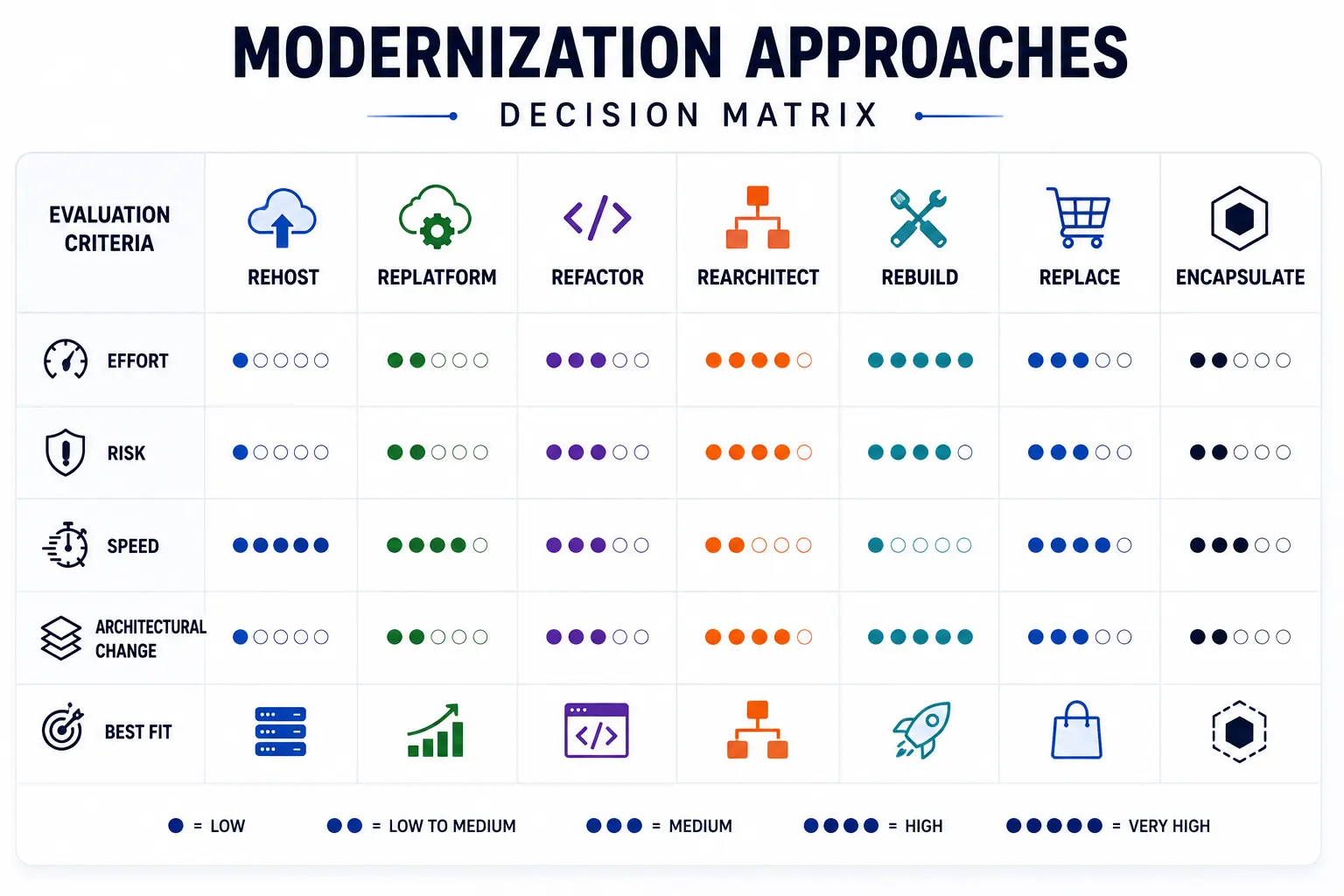
There is no universal modernization strategy. AWS and Microsoft describe multiple migration and modernization paths, and the right choice depends on business need, technical condition, time, resources, and target architecture. Enterprises should evaluate each product component independently rather than forcing one approach across the entire estate.
| Approach | Best Fit | Primary Value | Key Consideration |
| Rehosting | Rapid infrastructure migration with minimal code change | Speed and lower immediate disruption | Legacy constraints largely remain |
| Replatforming | Platform can move with limited architectural change | Cloud/platform benefits with moderate effort | Optimization is narrower than refactoring |
| Refactoring | Code structure needs improvement | Maintainability and reduced technical debt | Requires disciplined testing |
| Rearchitecting | Architecture blocks scale, agility, or resilience | Long-term flexibility | Higher complexity and change risk |
| Rebuilding | Business logic remains valuable, but implementation is too constrained | Clean modern foundation | Significant product and engineering investment |
| Replacing | Existing capability no longer justifies custom maintenance | Potentially faster transition | Data, integration, and product-fit risks |
| Encapsulation | Core system must remain, but capabilities need modern interfaces | Incremental modernization | Underlying legacy constraints remain |
- Rehosting and replatforming prioritize speed.
- Refactoring improves code without changing behavior.
- Rearchitecting changes the system’s structural design to fix poor scalability or excessive coupling.
- Rebuilding suits products whose business logic remains valuable but whose implementation blocks evolution.
- Replacement suits cases where another platform meets requirements at lower risk.
- Encapsulation wraps a legacy core in modern interfaces while surrounding components get modernized incrementally.
How to Select the Right Software Modernization Approach
Choosing a software product modernization approach should depend on your product’s needs, risks, and business priorities, not just AI technology stack preferences.
- Assess the product’s business criticality.
- Evaluate the level of technical debt.
- Consider scalability and performance requirements.
- Review security risks and compliance needs.
- Check integration complexity and dependencies.
- Compare modernization costs and expected time-to-value.
- Assess available skills and resources.
- Consider the product’s importance in your future roadmap.
Software Product Architecture Modernization
Architecture modernization should create clear boundaries around business capabilities, improve the independence of change, and strengthen reliability. The goal is not to introduce a microservices architecture because it is fashionable. It is to select an architecture that matches the product’s scale, team structure, domain boundaries, and operational needs.
From Monolith to Microservices
A monolith is not inherently a modernization problem. A well-structured modular monolith can remain easier to operate than a distributed system. The case for a microservices architecture modernization strategy becomes stronger when teams need independent scaling, deployment, ownership, or technology choices across clearly bounded capabilities.
Where a monolith is heavily coupled, teams can first identify business boundaries and modularize the codebase before extracting services. This reduces the risk of creating a distributed monolith, where network calls replace in-process dependencies.
API-First and Event-Driven Architecture
API-led software product modernization turns isolated capabilities into reusable product services. Well-governed APIs make it easier to connect mobile applications, partner ecosystems, internal platforms, and future channels.
Event-driven architecture can complement APIs where systems need asynchronous processing or decoupled workflows, with attention to delivery guarantees, ordering, idempotency, observability, and failure handling.
Cloud-Native Modernization and Containers
Cloud-native software product modernization can involve containers, managed services, automated infrastructure, elastic scaling, and platform engineering. Containerization improves deployment consistency, but it is not architectural modernization by itself.
A product modernization should highlight cloud-native architectures, microservices, API-first approaches, and Kubernetes-oriented containerization as connected, not interchangeable, practices.
Modernizing Data, Security, and Engineering Practices
A product’s application layer can be modernized while its data, security, and delivery practices stay legacy, creating a new bottleneck. Modernization should therefore treat these layers as connected workstreams.
Data and Database Modernization
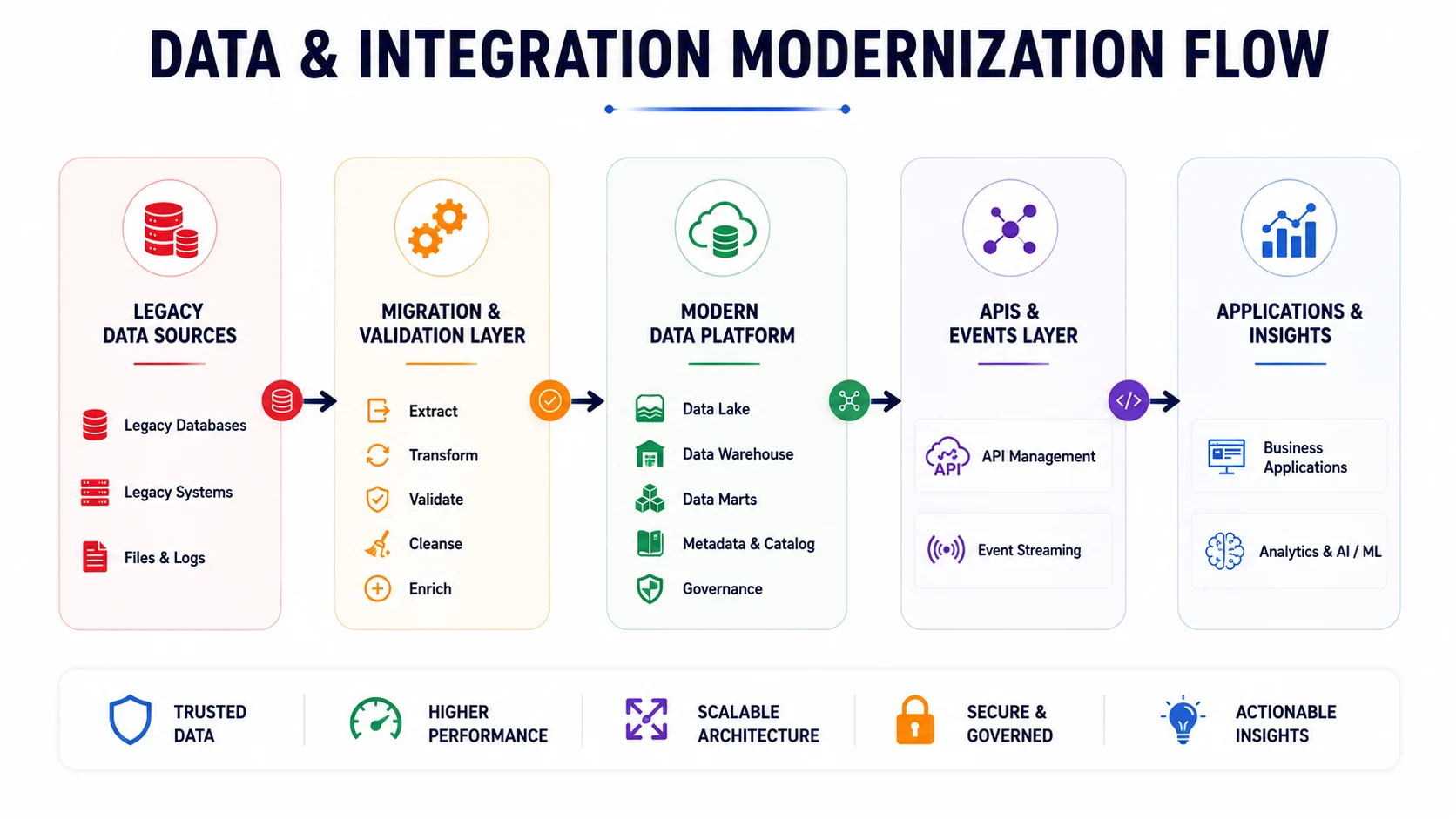
A data modernization strategy for enterprises starts by identifying data ownership, schemas, dependencies, data quality, and downstream consumers. Decide whether to migrate, replicate, consolidate, transform, or retain data based on business and technical requirements.
For high-value products, migration should include reconciliation, validation, rollback planning, backup strategy, performance testing, and a defined cutover approach. Zero-downtime or low-downtime objectives should be treated as engineering requirements, not assumptions.
DevSecOps, CI/CD and Automated Testing
Modernization increases the volume of change, making automation essential. DevSecOps in software modernization means CI/CD pipelines should automate build, unit testing, security checks, integration testing, artifact management, deployment, and rollback wherever practical.
DORA’s current software delivery performance model uses five metrics: change lead time, deployment frequency, failed deployment recovery time, change failure rate, and deployment rework rate. These metrics can help teams evaluate delivery throughput and instability rather than relying on a single productivity measure.
Security, Compliance, and Observability
Security should be embedded throughout modernization. Review identity and access controls, secrets, encryption, dependencies, network boundaries, vulnerability assessment and penetration testing, auditability, and data protection requirements.
Observability should provide enough telemetry to understand system health, performance, dependencies, and failures. Logs, metrics, traces, alerts, service-level objectives, and actionable dashboards become increasingly important as architecture becomes more distributed.
The Software Product Modernization Process
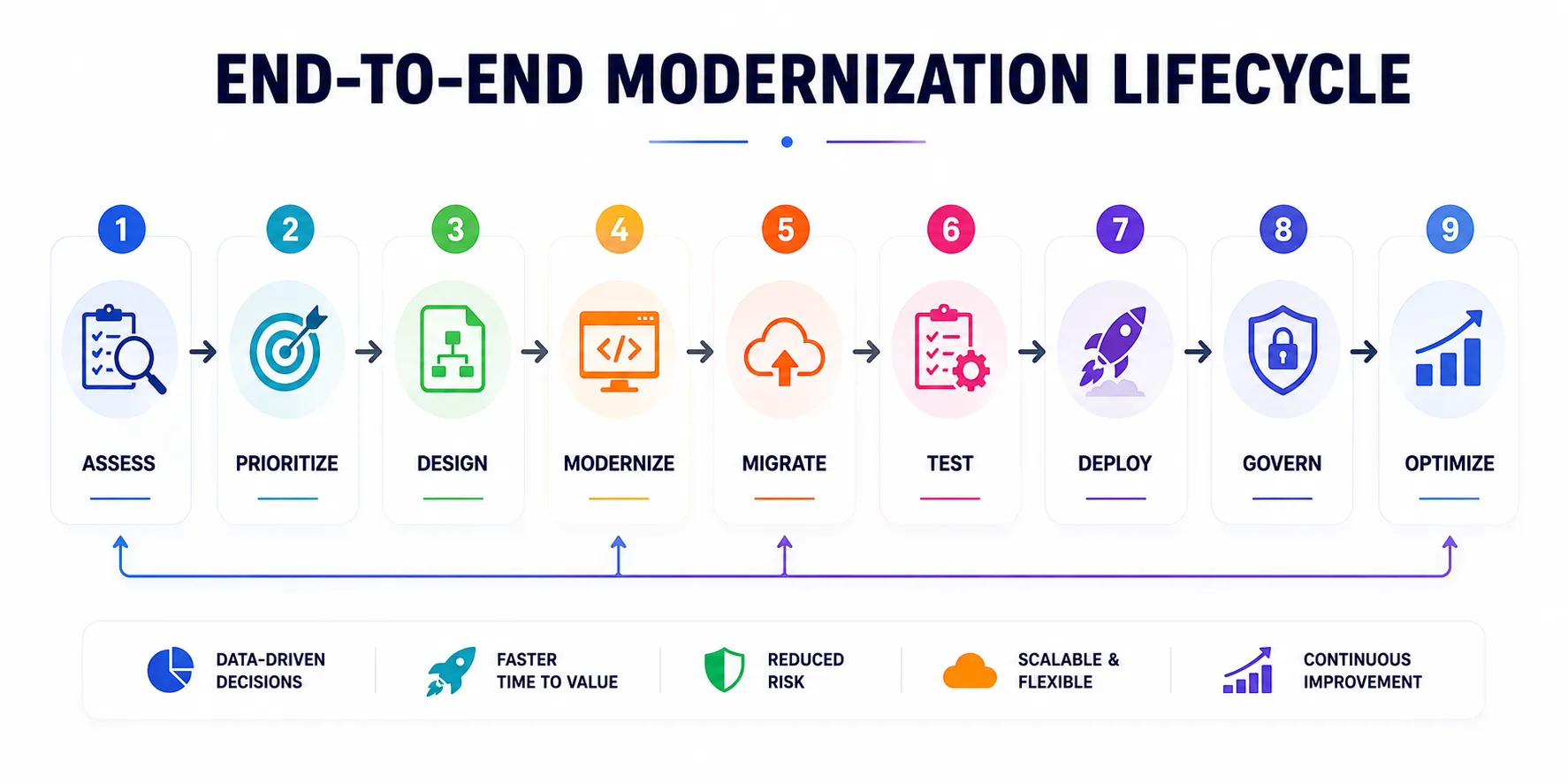
A modernization program should be structured as a sequence of controlled decisions rather than one large business transformation project. An enterprise program typically moves from assessment and prioritization to design, implementation, migration, validation, deployment, and optimization.
Define Goals and Build the Roadmap
Begin with product discovery and strategy to reduce release lead time, improve availability, lower infrastructure costs, or retire unsupported technology. The software product modernization roadmap should define the target architecture, scope, dependencies, sequencing, owners, milestones, and success metrics, aligning the strategy with business goals rather than defaulting to over-modernization.
Modernize in Phases (The Strangler Pattern)
Large products should generally be divided into manageable modernization waves. A phase might target a business capability, the application layer, a database, an integration boundary, or a customer-facing workflow.
The strangler approach is one option for gradually replacing legacy capabilities with modern components. New functionality is introduced around the legacy core, and components are retired as their responsibilities move to the modern architecture.
Phased delivery also creates feedback loops. Teams can validate architecture assumptions, improve tooling, measure operational impact, and adjust later waves before committing the full modernization budget.
Migrate, Validate, and Deploy
Migration planning should account for sequencing, dependencies, data transfer, environment readiness, cutover, rollback, support coverage, and stakeholder communication. Software testing should include functional, integration, performance, security, compatibility, resilience, and user acceptance testing as appropriate.
For business-critical products, consider parallel operation, feature flags, canary releases, blue-green deployment, or other controlled release mechanisms where they reduce cutover risk.
Govern and Continuously Optimize
Modernization does not end at production deployment. Establish ownership for architecture decisions, cloud costs, security controls, platform reliability, technical debt, and engineering standards.
Continuous improvement should use operational data and delivery metrics to identify bottlenecks. DORA recommends using multiple metrics in context rather than turning a single metric into a universal target.
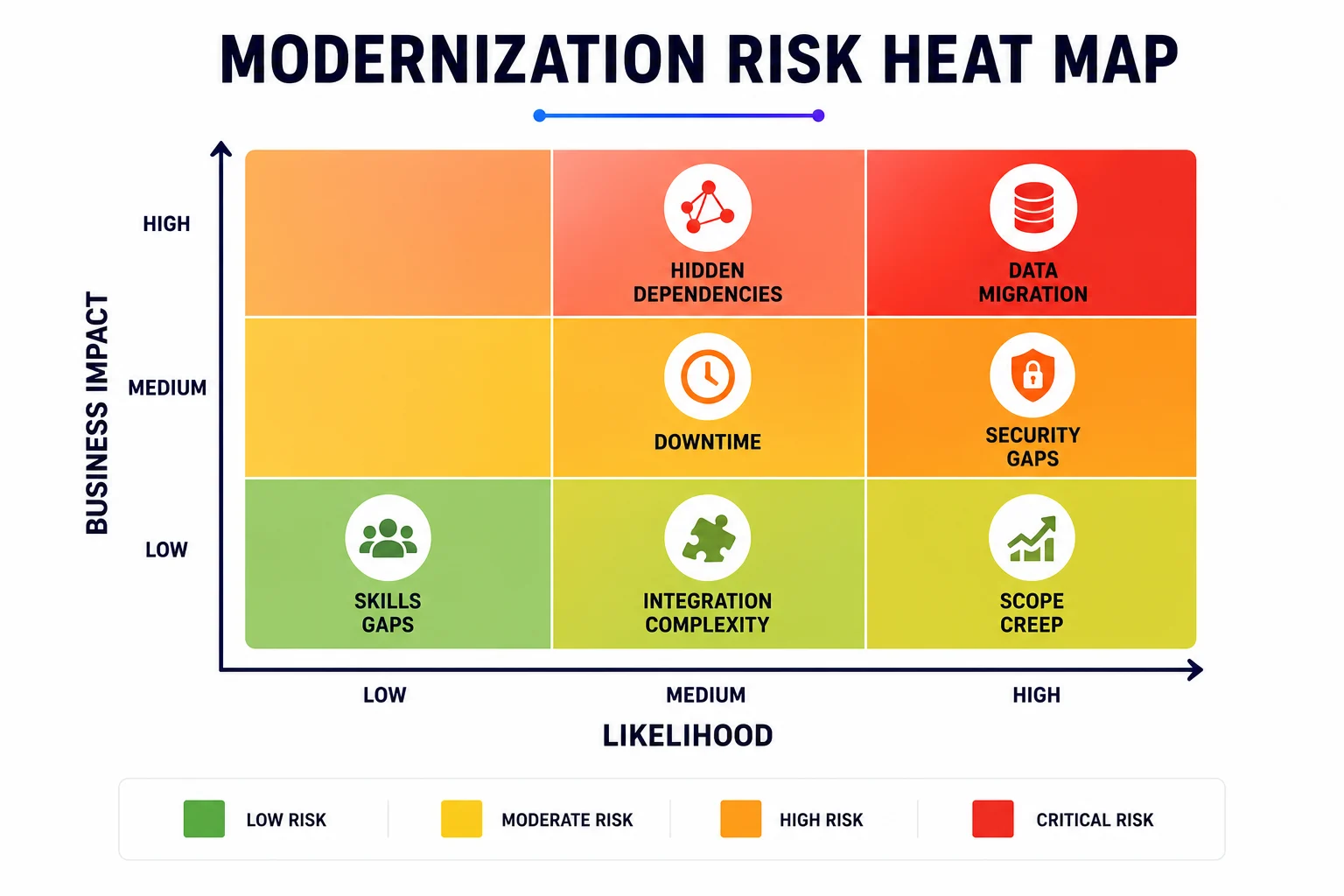
Key Challenges and Risks in Software Product Modernization
Modernization risk usually comes from uncertainty such as undocumented dependencies, incomplete requirements, hidden data relationships, and unrealistic scope. Effective software product modernization risk management surfaces these uncertainties early and addresses them through controlled phases rather than heroics during cutover.
Legacy Dependencies and Business Disruption
Critical products often depend on poorly documented, operationally essential systems. Mapping dependencies before extracting or replacing components prevents failures that only surface in production. Business continuity planning should define acceptable downtime, recovery objectives, and customer communication in advance.
Data Migration and Integration Complexity
Data often outlives the applications that created it. Differences in schemas, identifiers, and synchronization timing can make migration harder than code changes. Explicit contracts, versioned APIs, monitoring, and clear ownership help control the risk when modern services must communicate with legacy platforms.
Budget, Skills, and Change Management
Modernization requires a blend of legacy knowledge and modern engineering skill. Identify capability gaps early, pair domain experts with modernization teams, and budget for discovery, training, parallel operations, and post-launch stabilization, not just the build itself.
Software Product Modernization Cost and ROI
There is no reliable universal price for software product modernization. Cost depends on product size, architecture, code quality, integrations, data complexity, target architecture, security requirements, modernization approach, team composition, testing scope, and migration strategy.
Factors That Influence Modernization Cost
The cost of software product modernization is driven by discovery, architectural design, code transformation, database migration, API development, integration, security remediation, automated testing, DevOps enablement, cloud consumption, and production support.
A useful estimate separates one-time investment from ongoing operating cost, and also models the cost of not modernizing: maintenance burden, outages, security remediation, and missed product opportunities.
| Modernization Scope | Indicative Cost | Typical ROI / Value |
| Basic Modernization | $20K–$50K | Lower maintenance costs and improved performance |
| Moderate Modernization | $50K–$100K | Faster releases, better scalability, and reduced technical debt |
| Advanced Modernization | $100K–$200K+ | Significant architecture improvements and operational efficiency |
| Enterprise-Scale Modernization | $200K–$400K+ | Long-term scalability, lower TCO, stronger security, and faster innovation |
Modeling TCO and Modernization ROI
TCO should compare the current operating model with the expected target state. Include infrastructure, licensing, support, engineering maintenance, incident response, security remediation, and operational overhead. Then add business outcomes such as faster launches, improved customer experience, greater capacity, or new revenue opportunities where they can be measured.
Software product modernization ROI should be tied to a baseline. If the goal is faster delivery, measure lead time and deployment performance before and after the change. If the objective is cost reduction, compare equivalent infrastructure and operational costs over a defined period.
Building the Software Modernization Business Case
A credible software product modernization business case packages assessment findings, roadmap, and TCO/ROI modeling into board-level terms: what modernization costs, what it returns, and what continuing to run the legacy system costs by comparison.
KPIs for Software Product Modernization
A balanced scorecard can combine technical, delivery, operational, financial, and product metrics. Useful measures include:
- Change lead time and deployment frequency
- Change failure rate and failed deployment recovery time (DORA metrics)
- Availability, latency, throughput, and SLO attainment
- Security vulnerabilities and remediation time
- Infrastructure and maintenance cost
- Technical debt indicators and unsupported dependencies
- Time-to-market for priority capabilities
- Engineering effort on maintenance versus new development
- Customer experience, adoption, or support indicators
- Milestones delivered against the approved roadmap
Software Product Modernization Best Practices
Modernization succeeds when technology choices remain subordinate to business outcomes and the program creates a repeatable way to evolve the product after the initial transformation.
Modernize Around Business Priorities
Start with capabilities that matter most to customers, revenue, risk, operational efficiency, or strategic growth. A technically elegant modernization that does not improve a meaningful business constraint is difficult to justify.
Prefer Incremental Modernization Where Appropriate
A phased approach can reduce the blast radius of failures, create early value, and improve estimates for later work. Microsoft recommends dividing complex modernization efforts into logical phases so teams can deliver incremental value and adjust based on what they learn.
Design for Continuous Evolution
The target state should make the next change easier than the last. Favor clear interfaces, modular boundaries, automated delivery, and architecture governance. These are the foundation of software modernization for product teams that need to keep shipping, not just finish a project.
Conclusion
Software product modernization is most effective when treated as a business transformation enabled by technology, not a rewrite project. The strongest programs begin with evidence.
They assess the existing product, prioritize capabilities, select approaches aligned with business needs, and execute in manageable phases. Architecture, data, security, and operations move together rather than becoming isolated workstreams.
Organizations should seek assistance from a trusted legacy software modernization company to build an outsourced software product modernization framework and rarely find themselves facing another decade-old crisis. They are already modernizing the next system.
How SparxIT Helps You Modernize Your Legacy Software Product
We help enterprises modernize legacy software products without disrupting critical business operations. Our legacy software developers combine product assessment, architecture modernization, cloud transformation, API integration, data modernization, DevSecOps, testing, and ongoing support.
As a leading legacy software modernization services provider, we identify technical debt, prioritize high-impact modernization opportunities, and create phased roadmaps aligned with business goals. Our focus remains on improving scalability, security, maintainability, and time-to-market while preserving valuable business logic.

Partner with Experts
Frequently Asked Questions
Why should enterprises modernize legacy software products?


Enterprises typically modernize when technical debt, security risk, scalability constraints, slow delivery, or integration limitations turn the existing technology foundation into a business constraint rather than an asset.
What are the main software modernization approaches?
Common approaches include rehosting, replatforming, refactoring, rearchitecting, rebuilding, replacing, and encapsulating legacy capabilities. The right choice depends on business value, technical condition, risk, cost, timeline, and target state.
How do you choose the right modernization approach?
Assess business criticality, technical debt, scalability needs, security exposure, cost, and team capability, then select the least complex approach, rehost through rebuild, that achieves the required business outcome.
How much does software product modernization cost?
Modernizing a software product costs around $20,000 to $400,000. It depends on product complexity, architecture, codebase condition, data and integrations, target architecture, and team composition.
How does modernization improve AI readiness?
It creates better API access, data availability, scalable infrastructure, and modular architecture, making it easier to integrate and operate AI-enabled capabilities responsibly.
How do you measure software modernization success?
Combine business and engineering metrics: delivery performance, reliability, security, cost, technical debt, and product or customer outcomes, tracked against a defined baseline.
How long does software product modernization take?
Timelines vary significantly. A focused component modernization can take weeks; a product-wide rearchitecture can run a year or more. Reliable estimates require assessment and phased planning.