Global enterprises are moving faster than their ERP systems can support. Demand shifts within hours, supplier disruptions travel across a network in real time, and procurement teams face a volume of decisions no single dashboard can absorb.
Traditional forecasting tools can predict changes, while procurement platforms can execute transactions, but neither automatically coordinates the decisions between them.
This is where a multi-agent AI system for supply chain forecasting and procurement gives enterprises a way to match that pace. They provide specialized software agents that forecast demand, evaluate suppliers, and execute procurement actions in coordination, rather than in isolation.
This article explains what multi-agent AI systems are, where they create value across forecasting and procurement, and how enterprise architects and CIOs can plan an actual build, from reference architecture through governance and ROI.
Key Takeaways
- Multi-agent systems close the gap between forecasting insight and procurement execution, which single-model AI and legacy SCM software cannot do on their own.
- A working system needs three defined agent roles: an orchestrator, domain specialists, and tool agents connected to ERP, WMS, and TMS data.
- Build governance alongside the agents, not after, using a three-tier model of autonomous, approved, and human-led decisions.
- The highest-ROI starting points are demand forecasting, supplier risk monitoring, and logistics exception management.
- Success depends more on data readiness and sequencing than on model selection. Start with one contained pilot, prove the metrics, then scale.
Why Enterprise Supply Chains Need Multi-Agent AI Systems Now
Agentic AI supply chain management has moved from an analyst talking point to a funded initiative. Boards are asking supply chain leaders not whether to adopt it, but which workflow to start with first. So it is important to understand why a multi-agent AI system for supply chain is needed. Let’s take a look.
The Limits of Single-Model AI and Legacy SCM Software
- Single models forecast, score, or recommend, then hand the decision back to a person. That handoff is where value leaks out.
- A forecasting model has no native way to negotiate with a supplier agent or reroute a shipment when conditions shift.
- Rule-based automation breaks the moment a scenario falls outside its programmed logic.
Enterprise Adoption of Multi-Agent AI Is Accelerating
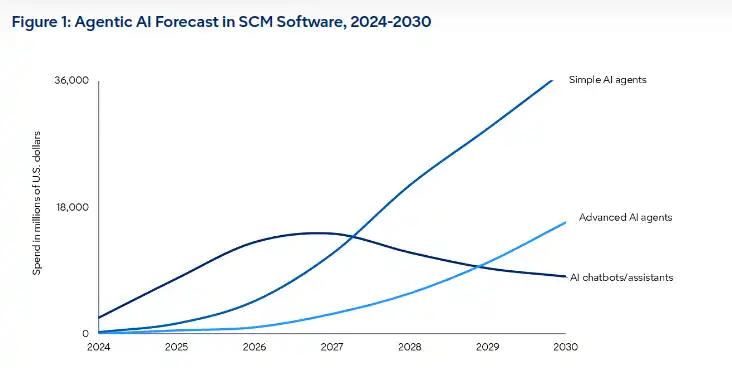
- Gartner projects that spending on SCM software with agentic AI capabilities will grow from less than $2 billion in 2025 to $53 billion by 2030.
- 60% of enterprises are expected to adopt agentic AI features by 2030, up from just 5% in 2025.
- Supply chain forecasting AI, inventory replenishment, and logistics exception management provide the highest-ROI entry points according to 2026 deployment data.
- McKinsey cites AI-powered forecasting error reductions of up to 50% and logistics cost cuts of 5–20% in distribution networks.
The Shift From Insight to Execution
The defining shift in 2026 is not smarter analytics. It is artificial intelligence development that moves from informing a decision to executing one within defined limits, where forecasting signals connect directly to procurement action instead of stopping at a dashboard.
What is a Multi-Agent AI System in a Supply Chain
A multi-agent AI system for supply chain is a group of specialized AI agents that work together to manage different tasks. For example, one agent can forecast demand, another can monitor inventory, another can assess supplier risks, and another can recommend procurement actions.
These types of agents in AI share relevant information and coordinate their decisions to help businesses respond faster and make better supply chain decisions.
Multi-Agent AI vs. Single-Agent AI vs. Traditional RPA
| Approach | How It Behaves | Best Fit |
| Traditional RPA | Follows fixed rules; breaks outside the script | Repetitive, high-volume tasks with no variation |
| Single AI Agent | Handles one task end to end; hands decisions back to a person | Isolated tasks like a single forecast or summary |
| Multi-Agent System | Coordinates specialized agents that share context and act together | Cross-functional decisions like forecast-to-purchase execution |
Core Characteristics of a Multi Agent AI System
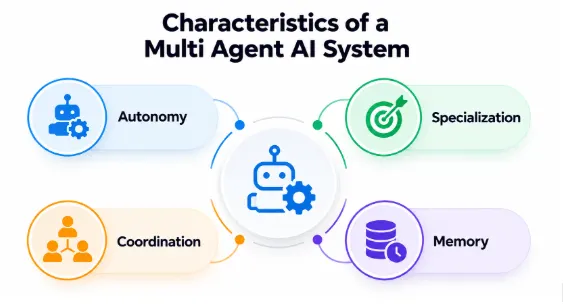
Four traits separate autonomous supply chain agents from earlier automation:
- Autonomy: The agent acts on its own assessment instead of only surfacing a recommendation.
- Specialization: Each agent is scoped to one domain, such as supplier risk or freight routing, improving accuracy and simplifying governance.
- Coordination: Agents communicate, share context, and sometimes negotiate outcomes with each other.
- Memory: The system retains context across interactions instead of treating every query as a fresh session.
Where Multi-Agent Systems Sit in the Supply Chain Technology Stack
These systems do not replace Enterprise Resource Planning (ERP), Warehouse Management System (WMS), or Inventory Management Software. They sit above them as a reasoning layer, which is why deliberate agent orchestration (managing how many agents run, in what sequence, and under what authority) matters more than any single model choice.
Core Use Cases Across AI Supply Chain Forecasting and Procurement
The multi-agent AI use cases for supply chain with the clearest ROI in 2026 combine predictive analytics in procurement with real execution authority, not analytics alone.
Demand Forecasting Agents
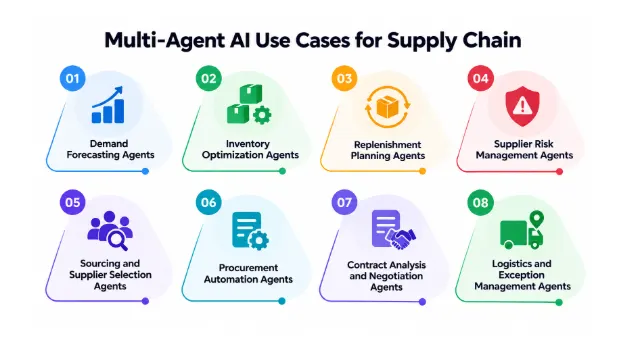
A forecasting agent ingests point-of-sale data, market signals, and historical patterns to produce a continuously updated demand picture, rather than a static monthly forecast. Paired with a planning agent, this becomes AI-driven demand planning: forecast output is translated automatically into replenishment and production recommendations, cutting the lag between a demand signal and a planning response.
Inventory and Replenishment Agents
These agents monitor stock levels across locations and trigger replenishment or redistribution before a shortage or an overstock event occurs. Because they operate continuously rather than on a fixed review cycle, they catch drift between forecast and actual demand days earlier than a manual planning cadence would.
Supplier Risk and Sourcing Agents
Manual scorecards, refreshed quarterly, are already too slow for the volatility enterprises face today. AI agents for supplier risk management in enterprise procurement continuously evaluate supplier signals such as financial health, delivery performance, geopolitical exposure, and compliance status, flagging deterioration in near real time instead of at the next scheduled review.
Procurement and Contract Negotiation Agents
AI agents for procurement can evaluate bids, apply sourcing policy, and in defined scenarios execute a purchase within pre-approved thresholds. More advanced deployments extend this to contract terms, where an agent proposes or adjusts pricing and terms within negotiation parameters a category manager has set in advance.
Logistics and Exception Management Agents
When a shipment is delayed, or a route becomes unviable, an exception-management agent can reroute, rebook, or reprioritize an order without waiting for a person to notice the disruption first. This is consistently cited as one of the fastest-payback use cases, because exceptions are frequent, time-sensitive, and expensive to resolve manually.
Reference Architecture for a Multi-Agent Supply Chain System
Building this system requires a defined enterprise AI agent architecture, not an ad hoc collection of point solutions wired together after the fact.
Agent Roles
A workable multi-agent AI architecture for demand forecasting and procurement typically separates agents in three different roles.
| Role | Function |
| Orchestrator agent | Interprets the objective and routes work to the right specialist agents |
| Domain agents | Hold deep expertise in one function, such as forecasting or supplier risk |
| Tool agents | Handle narrow technical actions, like querying a database or calling an ERP API |
Data Layer
Agents are only as good as the data they can reach. This layer connects internal systems of record, ERP, WMS, and TMS platforms, with external signals such as supplier news, weather, and commodity pricing. It gives agents a current, unified view instead of a batch-refreshed snapshot.
Communication and Coordination Protocols Between Agents
Agents need a defined way to pass context, request input from one another, and escalate conflicts. This is the practical substance of an AI agent orchestration framework. This includes shared message formats, task queues, and rules for how agents hand off partially completed work.
Memory Architecture: Shared Context and Knowledge Graphs
Persistent memory, often structured as a knowledge graph, lets agents understand relationships between suppliers, products, and locations rather than treating each query as isolated. This is what allows a supplier-risk finding to automatically inform a sourcing agent’s next recommendation, without a person manually connecting the two.
Model Selection and Reasoning Layer Considerations
Not every agent needs the same model. A domain-specific, smaller model tuned for compliance language may outperform a general-purpose large language model on cost and accuracy for a narrow task, while the orchestrator benefits from a stronger general-reasoning model to interpret ambiguous objectives. Model selection should follow the task, not the other way around.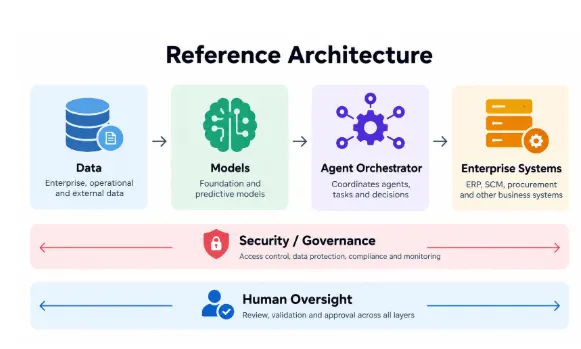
Build the Data Foundation Before Deploying AI Agents for Supply Chain
Data quality determines decision quality. Agents cannot reliably compensate for inconsistent product identifiers, stale supplier records, inaccurate lead times, incomplete inventory positions, or conflicting transaction histories.
Required forecasting data:
- Historical sales and orders
- Promotions and pricing
- Seasonality and product lifecycle
- Inventory and fulfillment history
- Relevant external demand indicators
Required procurement data:
- Supplier master data
- Contracts and commercial terms
- Purchase orders and requisitions
- Supplier performance and quality
- Category and spend data
- Budgets and approval policies
- Retrieval and lineage
Establish ownership, freshness, lineage, and authorization rules. Retrieval should not expose sensitive contracts or financial information merely because the information exists in a connected knowledge base.
Choose the Right Forecasting and Optimization Models
An enterprise agent architecture should be model-agnostic. AI Agents should invoke specialized capabilities instead of forcing every task through a general-purpose language model. Therefore, you must choose the right-fit model for your multi-agent AI system for the supply chain.
Real-Time Demand Signals
Real-time demand sensing can supplement established planning when newer signals demonstrably improve forecast quality or decision speed.
Inventory Policy Models
The inventory policy layer should account for service levels, variability, lead times, minimum order quantities, capacity, and financial objectives.
Supplier risk models
Risk models can combine performance, quality, financial, geographic, capacity, and external signals. Material risk classifications should remain explainable and auditable.
Optimization and simulation
Use mathematical optimization for constrained allocation, replenishment, sourcing, and production decisions. Simulation helps compare alternative futures before executing a recommendation.
Step-by-Step Framework to Develop a Multi-Agent AI System for Supply Chain
Enterprises asking how to build a multi-agent AI system for supply chain operations tend to get the technology right and the sequencing wrong. The framework below orders the work the way successful deployments actually proceed.
Step 1: Define Business Objectives and Decision Scope
Start with the decision, not the technology. Name the specific decision the system will make or support, such as raising a purchase order under a defined dollar threshold, and the business outcome it should improve.
Step 2: Assess Data Readiness and Integration Maturity
Most delays trace back to this step. Audit whether ERP, WMS, and TMS data is clean, current, and accessible through APIs before committing to an agent design that assumes data the organization does not actually have.
Step 3: Design Agent Roles and Task Decomposition
Break the target decision into the smallest set of specialized agents that can handle it, following the orchestrator, domain agent, and tool agent pattern described above. Resist the temptation to build one agent that tries to do everything.
Step 4: Select an Orchestration Framework
Choose the platform or framework that will manage agent communication, task routing, and failure handling. This decision should be driven by AI integration requirements and governance needs, not by which framework is newest.
Step 5: Build, Train, and Test Individual Agents
Build and validate each agent against real historical scenarios before connecting it to the others. An agent that performs well in isolation can still behave unpredictably once it starts coordinating with peers, so performance testing matters as much as usability testing.
Step 6: Implement Governance and Human-in-the-Loop Controls
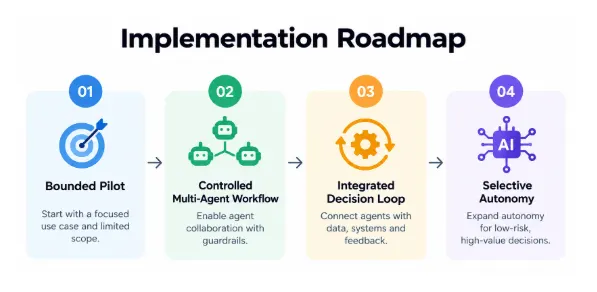
Define which decisions an agent can execute autonomously, which require approval, and which stay fully human-led. Human-in-the-loop AI decisioning should be the default for high-value or high-risk actions until the system has a proven track record.
Step 7: Pilot, Measure, and Scale
Launch on one contained workflow, such as logistics exception management, with clear success metrics defined in advance. Expand to adjacent use cases only after the pilot demonstrates measurable, auditable results.
Governance, Risk, and Decision Accountability for Multi-Agent AI Architecture
None of the above matters without a governance framework for autonomous supply chain AI agents that leadership, risk, and compliance teams actually trust.
The Three-Tier Governance Model: Autonomous, Approved, Human-Led
Mature supply chain AI governance programs classify every agent decision into one of three tiers:
| Tier | Decision Type | Example |
| Autonomous | Low-risk, high-confidence actions executed without approval | Reordering a standard SKU at a set threshold |
| Approved | Moderate-risk actions an agent recommends, a person approves | Selecting a new supplier for a mid-size contract |
| Human-led | High-risk decisions where the agent only supports | Negotiating a strategic, multi-year supply agreement |
Auditability and Explainability Requirements
Every autonomous decision needs a logged record of the data considered and the reasoning behind it. Enterprise AI governance and explainability are not optional in supply chain contexts, where a single flawed procurement decision can carry regulatory or financial consequences.
Regulatory Considerations: EUDR, CS3D, and Data Privacy
Regulations such as the EU Deforestation Regulation and the Corporate Sustainability Due Diligence Directive are making multi-tier supplier transparency a legal requirement. Any agent architecture handling supplier or sourcing data should be built with these obligations in mind from the outset, not retrofitted later.
Technology Stack Powering Multi-Agent AI for Procurement and Forecasting
A robust technology stack connects AI agents, data, forecasting models, enterprise systems, security, and orchestration. Together, these technologies enable accurate predictions, coordinated decision-making, secure integrations, and scalable supply chain operations.
| Technology Layer | Key Technologies / Components | Role in the Multi-Agent AI System |
| AI & LLMs | GPT, Claude, Gemini, open-source LLMs | Enables reasoning, natural-language processing, task planning, and agent decision support |
| Agent Orchestration | LangGraph, AutoGen, CrewAI, Semantic Kernel | Coordinates specialized agents, manages workflows, and handles agent communication |
| Forecasting & Machine Learning | Time-series models, XGBoost, PyTorch, TensorFlow | Supports demand forecasting, demand sensing, anomaly detection, and predictive analysis |
| Optimization Engines | Linear programming, mixed-integer programming, constraint solvers | Optimizes inventory, replenishment, sourcing, supplier allocation, and procurement decisions |
| Data Engineering | Apache Spark, Databricks, Kafka, Airflow | Ingests, transforms, processes, and streams data from multiple supply chain sources |
| Data & Knowledge Storage | Data lakes, warehouses, vector databases | Stores operational data, historical records, supplier information, embeddings, and enterprise knowledge |
| RAG & Knowledge Retrieval | Embeddings, vector search, Elasticsearch, Pinecone, pgvector | Grounds agents in contracts, supplier documents, policies, product data, and enterprise knowledge |
| Enterprise Integration | REST APIs, GraphQL, webhooks, event-driven architecture | Connects agents with ERP, procurement, WMS, TMS, CRM, and supplier systems |
| Cloud Infrastructure | AWS, Microsoft Azure, Google Cloud | Provides scalable compute, storage, networking, AI services, and deployment infrastructure |
| Security & Observability | IAM, RBAC, encryption, OpenTelemetry, AI monitoring | Secures agent access while monitoring workflows, tool calls, performance, costs, and failures |
Measuring ROI and Building the Business Case
A credible business case treats procurement automation AI as an investment with measurable returns, not a technology upgrade justified on faith.
| Metric | What It Measures |
| Forecast accuracy improvement | How much closer predicted demand tracks actual demand over time |
| Exception resolution time | How fast a disrupted shipment or order is rerouted or resolved |
| Supplier risk detection lead time | How early a supplier issue is flagged versus a manual review cycle |
| Autonomous execution rate | Share of decisions completed without human escalation |
Frame the investment around a contained pilot with a defined payback period, not a multi-year transformation budget. Boards respond to evidence from a working pilot far more readily than to a projected enterprise-wide rollout.
Challenges in Implementing Agentic AI for Supply Chain and How to Avoid Them
Data Silos and Legacy System Integration
Roughly 70% of supply chain leaders report a lack of real-time coordination due to data silos, even with modern ERP and WMS systems already in place. Without end-to-end supply chain visibility, agents make decisions on incomplete information, which undermines the entire system regardless of how sophisticated the agent design is.
Change Management and Workforce Readiness
Teams that have run manual processes for years need training and a clear understanding of where their judgment still matters. Skipping this step is one of the most common reasons a technically sound pilot fails to scale.
Agent Sprawl and Orchestration Complexity
Adding agents without a governing architecture creates a maintenance burden that grows faster than the value it delivers. Every new agent should have a clearly defined owner, scope, and decommissioning plan from day one.
Deployment Patterns and Lessons from Production Failure
What Separates Pilot Success from Production Failure
Successful deployments define success metrics before launch, keep the pilot scope narrow, and build the governance layer alongside the agents. Deployments that struggle tend to expand scope mid-MVP or skip functional testing under time pressure.
Sector Lessons: Manufacturing, Retail, and CPG
Manufacturing deployments tend to start with predictive maintenance and demand forecasting agents. Retail and CPG organizations more often start with inventory replenishment and logistics exception management, where transaction volume is high, and the payback window is short. In both cases, the winning pattern is the same. One contained a proven use case before expansion.
How SparxIT Helps Build a Multi-Agent AI for Supply Chain Management
SparxIT works with enterprise supply chain and procurement teams to move from product discovery & strategy to a working system, rather than stopping at a proof of concept. Engagements typically start with a data and integration readiness assessment across ERP, WMS, and TMS environments, followed by a reference architecture tailored to the organization’s decision scope and risk tolerance.
SparxIT’s software product engineering teams design and build the agent layer, orchestrator, domain agents, and tool agents, and connect it to existing systems of record without disrupting operations already in production. Governance is built in from the first pilot, with tiered decision authority, audit logging, and approval checkpoints defined before any agent goes live.
For enterprises still deciding where to start, SparxIT scopes a contained pilot, typically in demand forecasting, supplier risk monitoring, or logistics exception management, with measurable success criteria, then supports the scale-up once that pilot proves out.

Partner with Experts
Frequently Asked Questions
How can AI agents support inventory and forecasting together?


AI agents connect demand forecasts with inventory levels, lead times, supplier capacity, and service targets. They can identify potential shortages or excess stock and recommend replenishment strategies that balance product availability, operational requirements, and inventory costs.
What data does an enterprise need before starting a multi-agent AI pilot?
Enterprises typically need reliable sales, inventory, procurement, supplier, product, logistics, and historical transaction data. Depending on the use case, they may also need external market signals, contracts, pricing information, and supplier performance data.
What are the best 5 frameworks to build multi-agent AI applications?
The five widely used frameworks for developing multi-agent AI apps are as follows:
- LangGraph: Best for building stateful agent workflows.
- CrewAI: Useful for role-based agent collaboration
- AutoGen: This supports multi-agent conversations
- Semantic Kernel: It integrates AI Agents with enterprise apps.
- OpenAI Agents SDK: Supports agents, tools, handoffs, and guardrails.
The right choice will depend on your workflow complexity, integrations, scalability, and governance requirements.
What governance and security controls are essential for AI agents?
For building a multi-agent AI system, essential controls include:
Strong identity management
- Role-based access
- Least-privilege permissions
- Data encryption
- Audit trails
- Human approval workflows
- Continuous monitoring
Enterprises should also validate agent outputs and restrict access to sensitive systems and transactional capabilities.
What are the costs and infrastructure requirements for multi-agent deployments?
Multi-agent deployments need investment in AI models, cloud infrastructure, data analytics, integrations, security, monitoring, and ongoing maintenance.
Below is a table related to costs for multi-agent AI deployments:
| Deployment Stage | Cost Range | Suitable For |
| Proof of Concept (PoC) | $25,000–$60,000 | Single use case with 2–3 agents |
| Production Deployment | $60,000–$150,000 | Multiple workflows with 4–8 agents |
| Enterprise Scale | $150,000–$350,000+ | Organization-wide multi-agent ecosystem |
How long does it take to build a multi-agent system?
The timeline depends on the system’s scope, integrations, data readiness, and number of agents.
- Proof of Concept: 4–8 weeks
- Production Deployment: 3–6 months
- Enterprise Scale: 6–12+ months
A well-defined use case, clean data, and existing APIs can significantly shorten the development timeline.
Which industries benefit most from multi-agent AI systems?
A multi-agent AI system for supply chain is particularly valuable in industries with complex workflows, large datasets, and frequent decision-making.
- Manufacturing: Demand forecasting, production, and supplier management.
- Retail & eCommerce: Forecasting, inventory, and pricing
- Healthcare: Scheduling, patient workflows, and resource planning
- Banking and Finance: Risk analysis, fraud detection, and compliance
- Logistics: Route planning, tracking, and exception management
The biggest benefits come from industries with interconnected processes that require coordinated decisions.