In the era of hybrid cloud and AI-driven ecosystems, seamless data liquidity is a core competitive advantage. At the enterprise level, robust API development provides the foundation that connects systems, applications, and data across the organization. However, organizations often struggle with fragmented legacy systems, growing technical debt, and increasingly complex security and compliance requirements.
These challenges do more than delay projects. They increase operational risk and slow time-to-market. To overcome these challenges and accelerate digital transformation, forward-thinking leaders need a standardized, scalable framework that supports long-term growth.
This comprehensive API development guide outlines the strategies and best practices for transitioning from disconnected systems to a unified, secure, and developer-friendly ecosystem. By aligning API architecture with business goals, businesses can turn their integration layer into a driver of innovation, efficiency, and scalable growth.
Key Takeaways
|
What is an API?
An API (Application Programming Interface) is a set of rules that allows software applications to communicate and share data and functionality. Think of it as an agreement that defines what one application can request and what another application will return.
APIs speed up software development by enabling developers to reuse existing data, services, and features rather than building everything from scratch. They also provide application owners with a secure, controlled way to share data and functionality with internal teams, partners, and external developers.
The Evolution of APIs
Although APIs power modern software, developers have used them for decades. They have used some form of program-to-program communication since the 1960s. Early APIs were simple library calls inside a single program.
The rise of the internet transformed how developers used and shared APIs. By the early 2000s, companies like Salesforce and eBay exposed APIs that external developers could access over the internet. During this period, SOAP emerged as a widely adopted standard for API communication. REST followed a few years later, offering a simpler and more flexible approach and becoming the dominant API architecture for modern applications.
The biggest change in recent years has been the scale and strategic importance of APIs. According to Postman’s 2025 State of the API Report, 43% of fully API-first organizations generate more than 25% of total revenue from APIs. APIs have evolved from backend infrastructure into strategic assets that drive innovation, integration, and business growth.
Important API Development Terminologies You Need to Know
Before diving deeper into how to develop an API, let us first understand a few common terms. These concepts appear throughout the API software development lifecycle and provide the foundation for designing, building, testing, and managing APIs effectively.
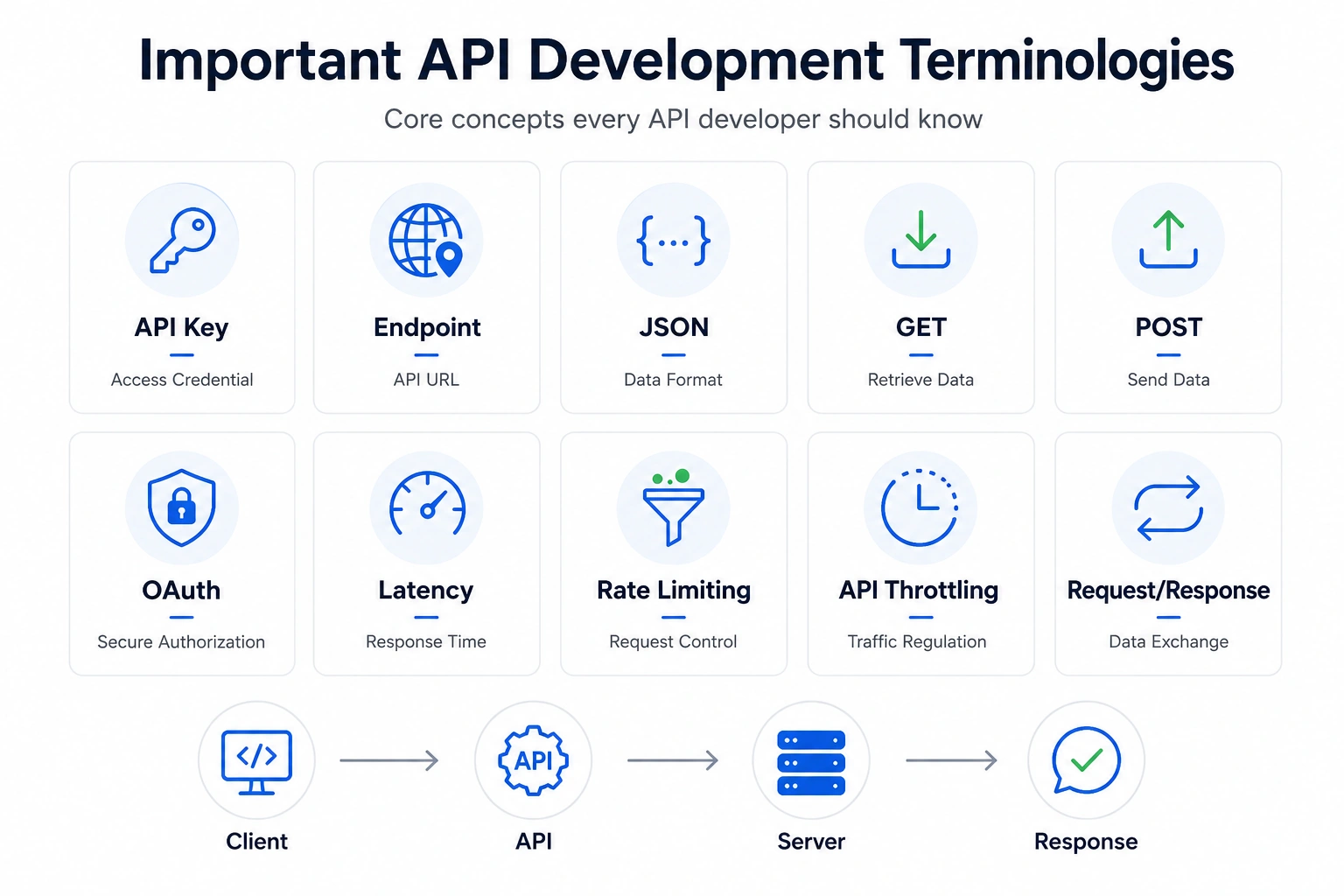
| Terms | Definiton |
| API Key | A unique identifier that verifies the application or user making an API request. This helps APIs control access and track who is using their services. |
| Endpoint | A specific URL where applications send requests to access API resources or services. Each endpoint typically performs a particular function, such as retrieving user information or creating an order. |
| JSON | JavaScript Object Notation(JSON) is a lightweight and widely used format for exchanging data between applications and systems. Its simple structure makes it easy for both humans and machines to read and process. |
| GET | It is an HTTP method used to retrieve information from a server. For example, a weather app may use a GET request to fetch the latest weather data. |
| POST | An HTTP method used to send or create new data on a server. Applications commonly use POST requests to submit forms, create accounts, or place orders. |
| OAuth | Secure authorization protocol that allows applications to access resources without exposing passwords. For example, it enables users to securely sign in to a website using their Google or Facebook account. |
| Latency | The time it takes for an API request to receive a response. Lower latency results in faster application performance and a better user experience. |
| Rate Limiting | It is a mechanism that restricts the number of API requests allowed within a specific time period. It helps prevent abuse, improves stability, and protects server resources. |
| API Throttling | A technique that slows API requests to manage traffic and prevent system overload. Instead of blocking requests completely, it controls the rate at which they are processed. |
Core Components of API Development
Every successful API, whether built in-house or through an external API development service, relies on five core components. Let’s look at the key elements of modern API development.
-
Endpoints
An endpoint is a specific URL that applications use to send requests to access a particular API resource or service. A single API usually has many endpoints, each one tied to a specific resource, such as `/users` or `/orders/123`. A well-designed API organizes related endpoints consistently, making them easier for developers to understand and navigate.
-
Requests and Responses
A request sends information from a client to a server, including the method, endpoint, and any data required to complete an action. A response returns the result of the request, including a status code, headers, and the requested data. Most modern APIs use JSON for requests and responses because it is lightweight, readable, and easy for applications to process.
-
Authentication and Authorization
Authentication verifies a user’s identity, while authorization determines what actions or resources that user can access. A logged-in user might be authenticated, but only an admin account is authorized to delete records. Confusing authentication and authorization can create security gaps and access control issues in an API.
-
API Documentation
API documentation explains how developers can use the API, including available endpoints, required inputs, and expected responses. Clear documentation reduces support costs, accelerates onboarding, and improves API adoption across teams and partners. Many teams generate documentation directly from their codebase to keep it accurate and up to date as the API evolves.
-
Error Handling
A well-designed API clearly explains why a request failed. A clear error message with a specific status code helps developers identify and resolve issues more efficiently. Strong error handling improves security by preventing the exposure of sensitive system information that attackers could exploit.
How do APIs Work?
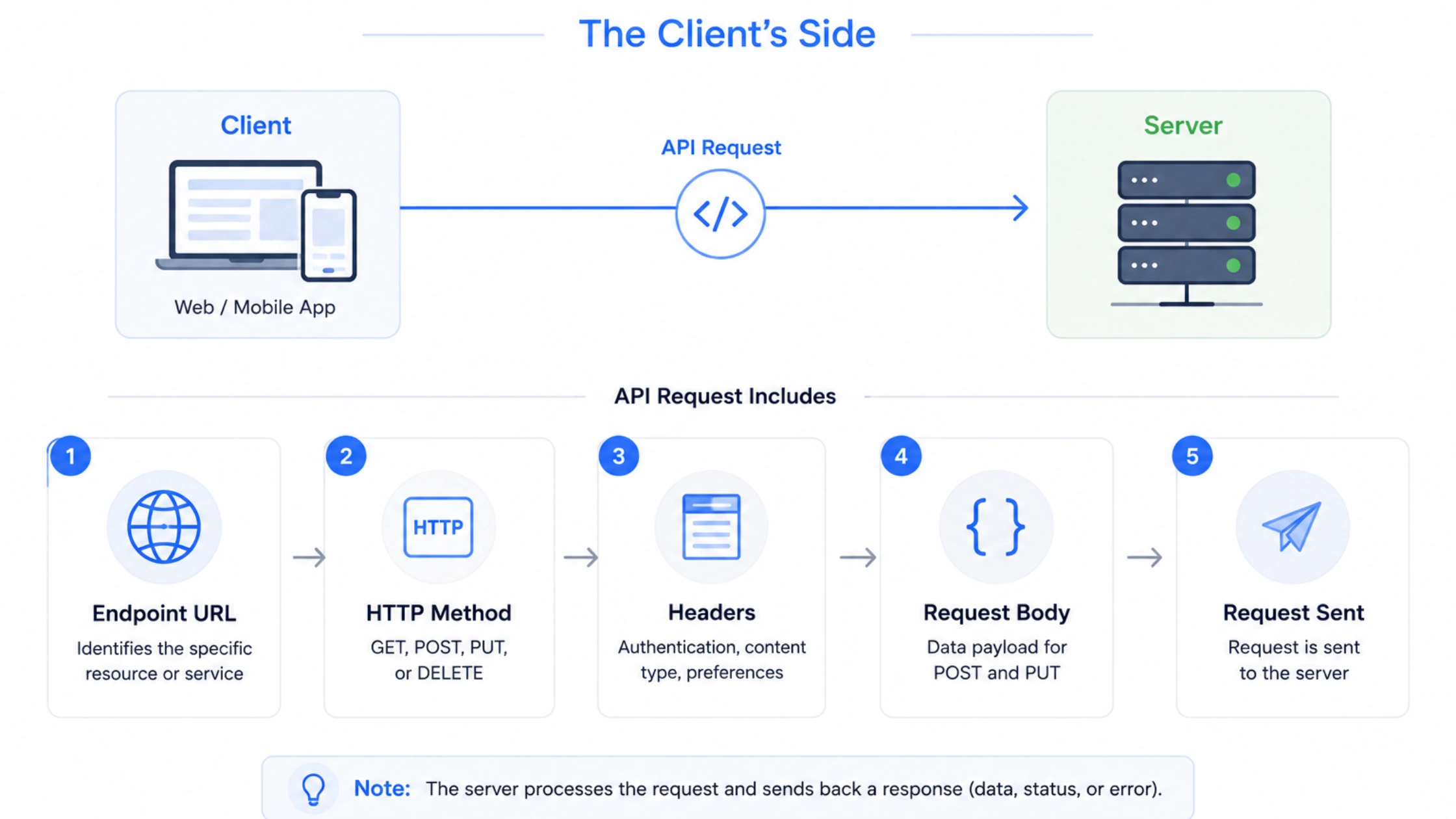
Most APIs follow a client-server model, where one application sends a request and another application processes it and returns a response. Understanding this exchange helps developers design, troubleshoot, and optimize APIs more effectively
The Client’s Side
The client, such as a web application or mobile app, creates and sends the request to the server. That request includes:
- The endpoint URL, which identifies the specific resource or service the client wants to access.
- The HTTP method, such as GET, POST, PUT, or DELETE.
- Headers, which provide additional details such as authentication credentials, content type, and request preferences.
- A request body, commonly used with POST and PUT requests, that contains data such as user information, form submissions, or order details.
The Server’s Side
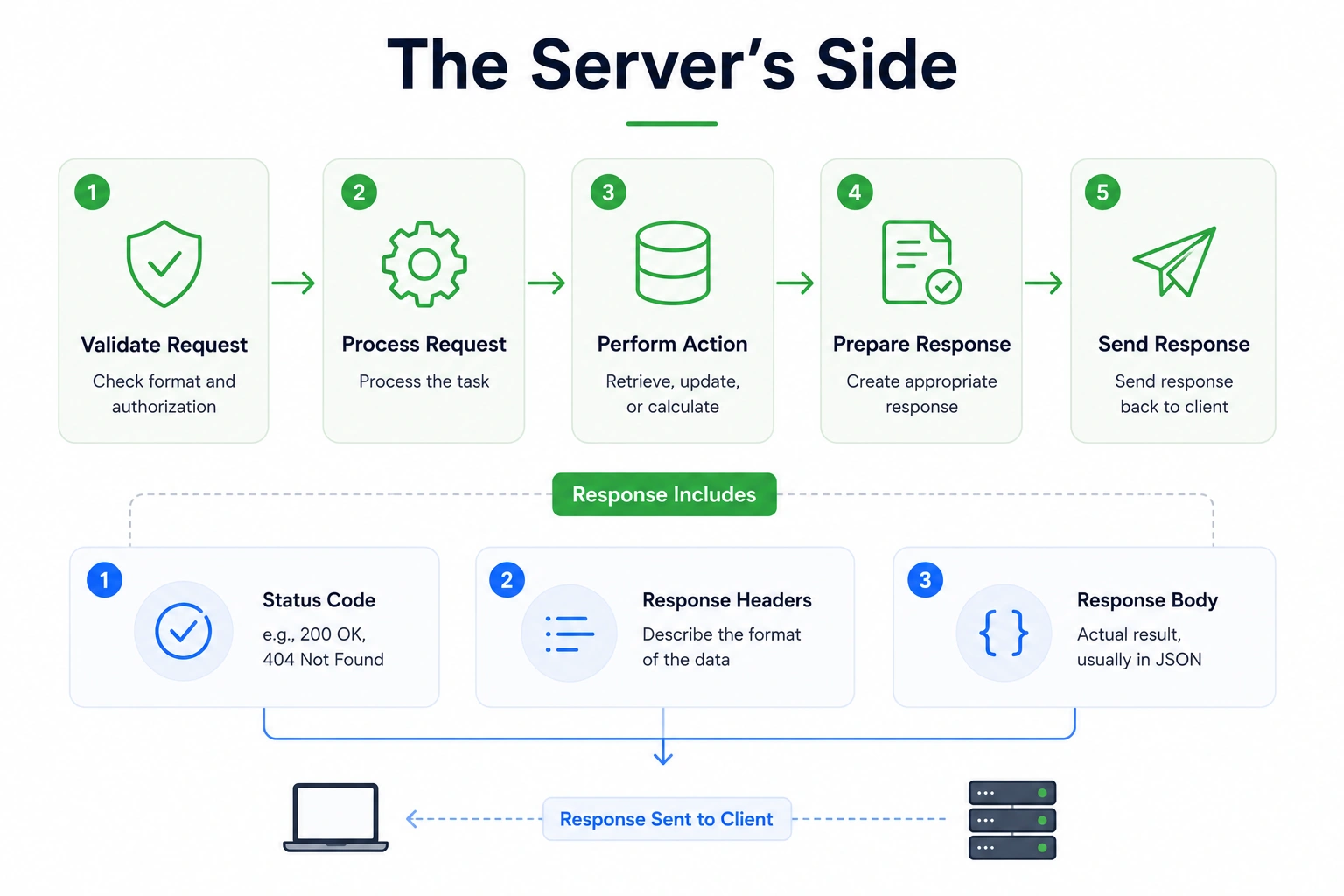
After receiving the request, the server validates, processes, and prepares the appropriate response. First, the server validates the request to ensure it is properly formatted and authorized. Then it processes the task, whether that means pulling data from a database or running a calculation. It then performs the requested action, such as retrieving data from a database, updating records, or running calculations.
- A status code, like 200 for success or 404 for not found.
- Response headers, which describe the format of the data returned.
- A response body, which holds the actual result, is usually formatted in JSON.
A Full Request Cycle
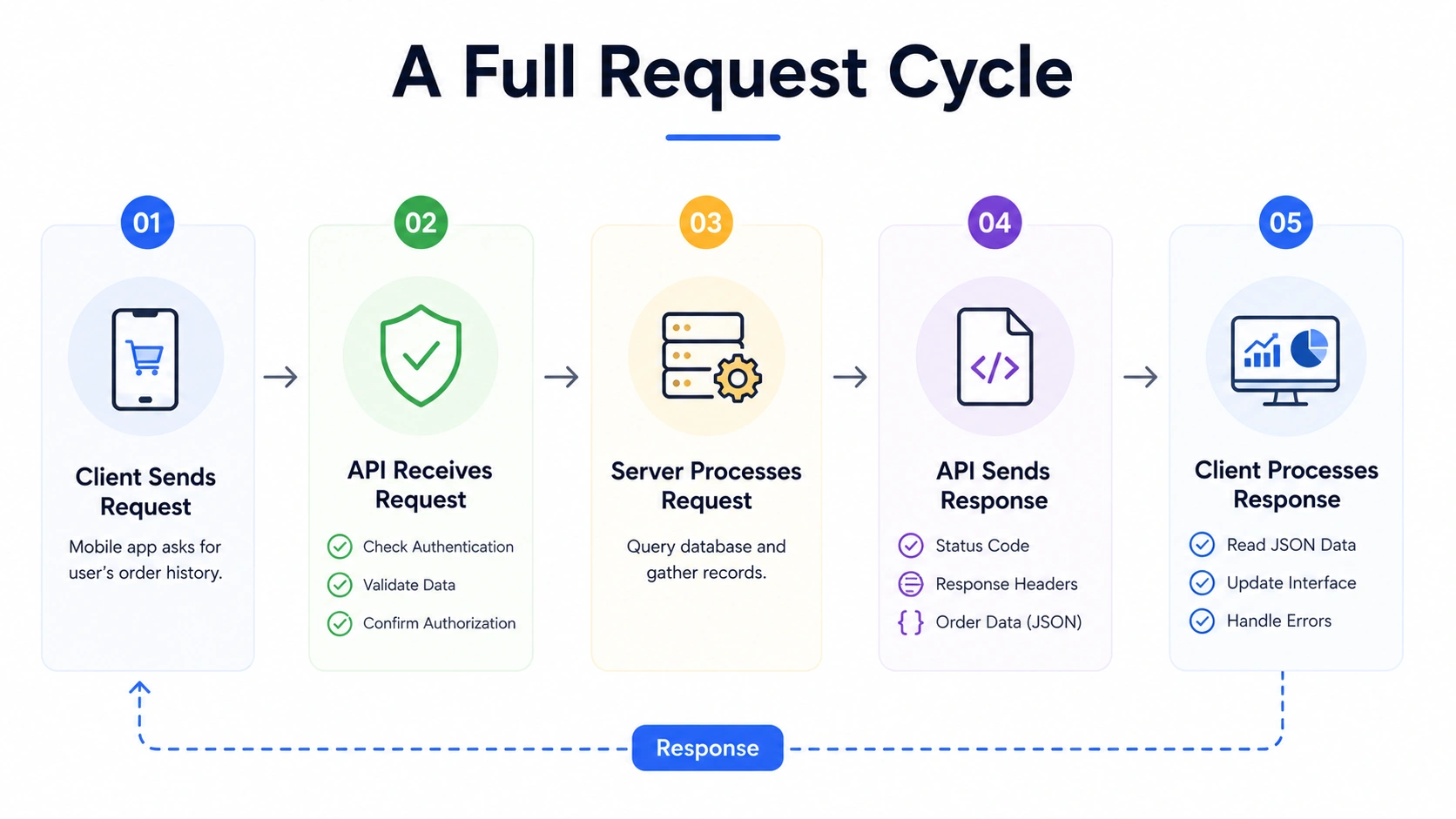
- The client sends a request. A mobile app asks for a user’s order history.
- The API receives the request. It checks authentication (is this a real, logged-in user?), validates the data (is the request properly formatted?), and confirms authorization (can this user see this data?).
- The server processes the request. It queries the database and gathers the needed records.
- The API sends a response containing a status code, response headers, and the requested order data.”
- The client processes the response by reading the JSON data, updating the interface, and handling any errors.
The following example illustrates how a typical API request and response cycle works in practice
A weather app calls `GET /weather?city=Mumbai`. The server verifies the API key, validates the request, and retrieves the latest weather data from its database. It replies with a 200 status code and a JSON body containing temperature, humidity, and wind speed. The app reads that JSON and updates the screen in under a second. The same process applies across virtually all APIs, whether they provide weather updates, banking information, or shipment tracking data.
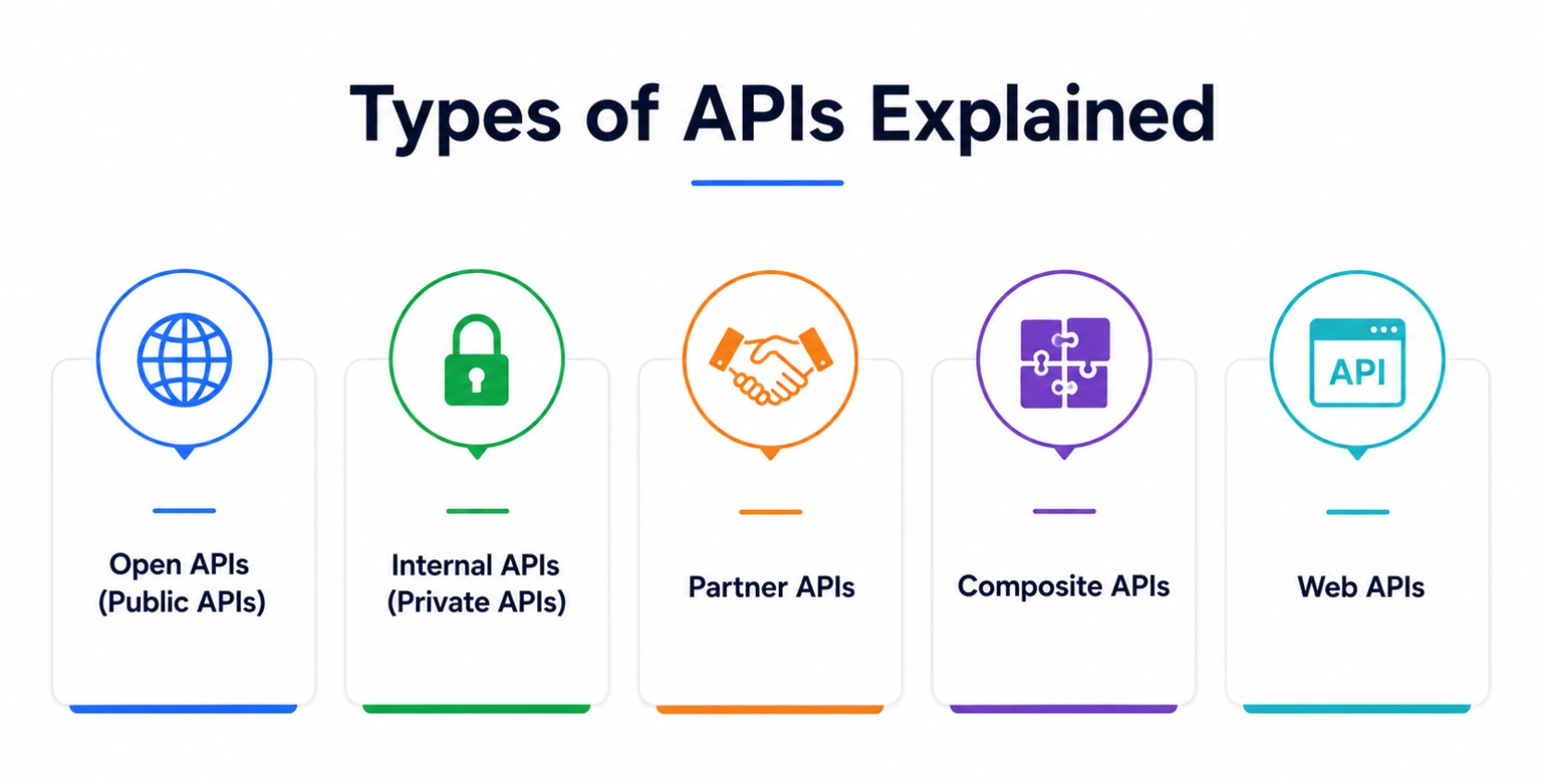
Types of APIs Explained
Different types of APIs serve different business and technical needs, from internal system integration to partner collaboration. Most APIs fall into four primary categories, with web APIs serving as the most common delivery method.
-
Open APIs (Public APIs)
Open APIs are available to external developers and often offer free or paid access for building applications and integrations. The Google Maps API and OpenWeather API are popular examples that help developers add mapping and weather functionality without building those features from scratch.
-
Internal APIs (Private APIs)
Internal APIs are used exclusively within an organization to connect systems, applications, and services, with no external access. For example, a retailer might use an internal API to synchronize inventory data between its warehouse and point-of-sale systems in real time.
-
Partner APIs
Partner APIs are shared with approved business partners under specific agreements and are commonly used in supply chain, travel, and payment integrations. One common example is airlines sharing real-time seat availability with travel booking apps.
-
Composite APIs
Composite APIs combine multiple API requests into a single call, reducing network traffic and improving performance. These APIs are commonly used when multiple backend systems must work together. For example, a checkout process may need to access inventory, payment, and shipping services through a single request.
-
Web APIs
Web APIs differ from the categories above because they describe how an API is delivered rather than who can access it. A web API is any API that uses HTTP to exchange data, making it the most common way APIs are delivered today. When developers refer to a web API, they are usually describing how the API communicates rather than its access model.
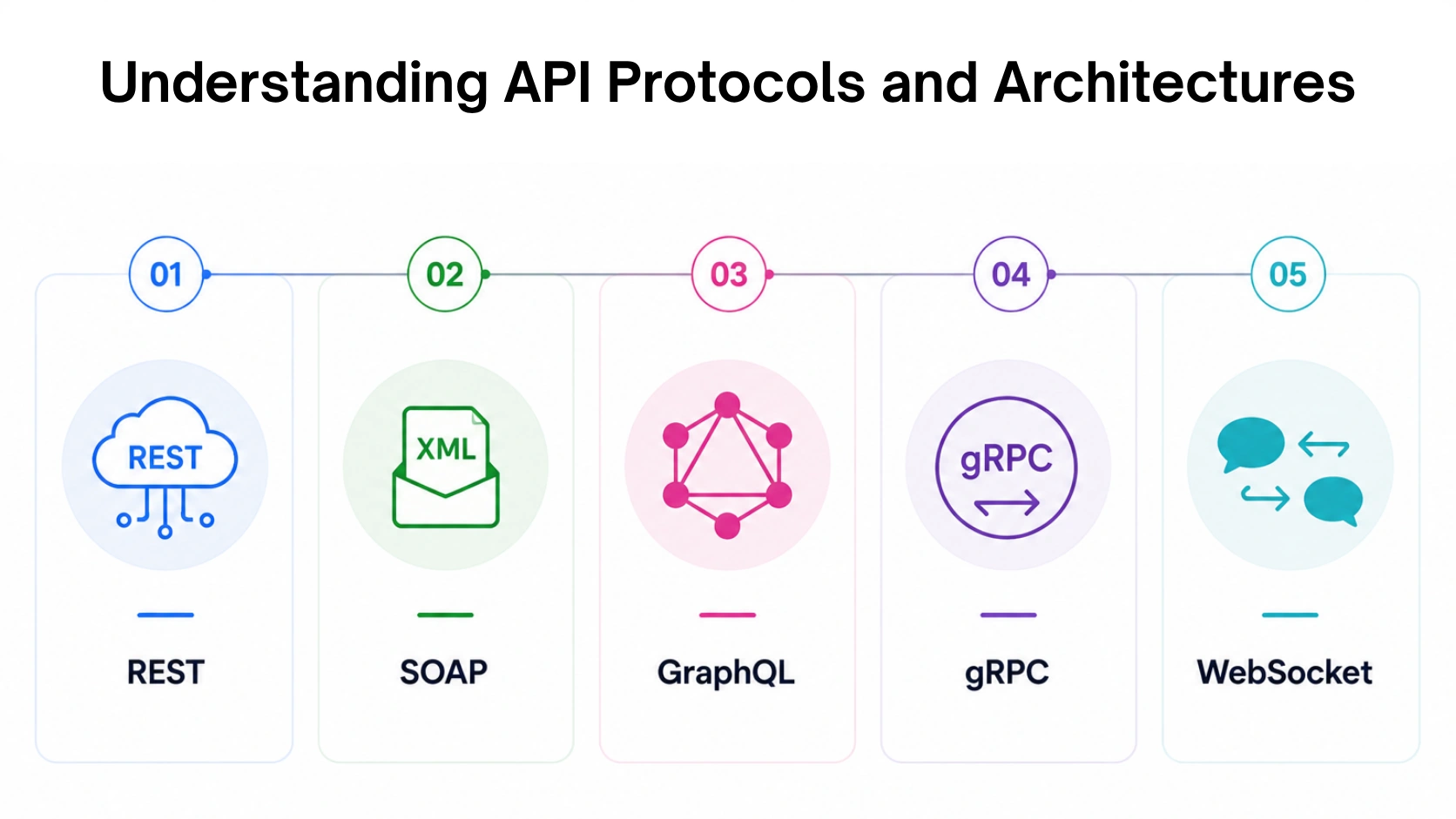
Understanding API Protocols and Architectures
Before selecting an API architecture or protocol, it is important to understand how each one works. While some prioritize simplicity and broad compatibility, others focus on performance, security, or real-time communication. The table below compares the most common options and their ideal use cases.
| Architecture / Protocol | Definition | Best For | Key Advantage | Common Use Cases |
| REST | REST (Representational State Transfer) is an architectural style that uses standard HTTP methods to enable communication between applications. | Public APIs | Simple, scalable, and widely supported | Web applications, mobile apps, SaaS platforms |
| SOAP | SOAP (Simple Object Access Protocol) is a protocol that uses XML-based messaging and strict standards for secure data exchange. | Enterprise systems | Strong security and formal contracts | Banking, healthcare, government systems |
| GraphQL | A query language and API architecture that allows clients to request only the data they need. | Complex data requirements | Reduces over-fetching and improves efficiency | Social networks, dashboards, and content platforms |
| gRPC | A high-performance communication protocol developed by Google that uses binary data formats for fast service-to-service communication. | Internal microservices | Low latency and high performance | Distributed systems, cloud-native applications, enterprise platforms |
| WebSocket | A communication protocol that maintains a persistent connection for real-time, two-way data exchange. | Real-time applications | Instant updates without repeated requests | Chat apps, live dashboards, gaming platforms, trading systems |
As a general guideline: Use REST for public APIs, GraphQL for flexible data retrieval, gRPC for high-performance service-to-service communication, and WebSocket for real-time applications.
Essential Features of a Well-Designed API
A functional API and a well-designed API deliver very different outcomes. A basic API may respond to requests successfully, but that alone does not guarantee reliability, performance, or scalability.
On the other hand, a high-performing API requires more than functional endpoints. The following features improve performance, scalability, security, and maintainability while ensuring a better experience for both web api development services providers and end users.
| Feature | Purpose | Business Benefit |
| Fast Response Times | Ensure the API processes requests quickly and remains accessible during peak traffic. | Improves user experience, reduces downtime, and increases customer satisfaction and retention. |
| Pagination & Sorting | Break large datasets into smaller chunks and organize results efficiently. | Enhance application performance, reduce server load, and deliver faster results to users. |
| Caching | Store frequently requested data temporarily to avoid repeated processing. | Reduces infrastructure costs, increases response times, and supports higher traffic volumes. |
| API Versioning | Manage API updates without affecting existing integrations | Enables continuous innovation while preserving compatibility for current users and partners |
| Detailed Logging | Record API activity, requests, responses, and system events | Simplifies troubleshooting, improves monitoring, and supports security and compliance audits |
| Accurate Documentation | Provide clear instructions on how developers can use the API | Accelerates adoption, reduces support requests, and shortens integration timelines. |
| Authentication & Authorization | Verify user identities and control access to API resources | Protects sensitive data, reduces security risks, and ensures regulatory compliance |
| Error Handling | Return clear and consistent error messages when requests fail | Speeds up issue resolution, improves developer experience, and reduces maintenance effort |
| Monitoring & Analytics | Track API performance, availability, and usage patterns in real time. | Helps identify bottlenecks, optimize resources, and maintain reliable service quality. |
Benefits of Investing in API Development
APIs have evolved beyond technical integrations and now play a critical role in digital transformation strategy. They drive measurable business outcomes by improving efficiency, scalability, and customer experiences. As a result, many organizations treat API development services as a strategic investment rather than a side project.
-
Improved Integration
APIs connect disconnected systems and enable seamless data sharing across applications. A retail company can link its inventory management software directly to its online store, cutting manual data entry and reducing errors. Without automated integration, teams often rely on manual updates, increasing the risk of errors and data inconsistencies.
-
Scalability and Flexibility
Well-designed APIs enable businesses to scale operations and launch new services without extensive system redevelopment. Organizations can introduce new features, integrations, or partner connections with minimal disruption to existing systems. A company that starts with one mobile app development can usually reuse the same API when it later launches a second app or a partner portal.
-
Better User Experiences
APIs power features such as real-time order tracking, live chat support, and personalized recommendations, improving customer experiences. Although users rarely interact with APIs directly, API performance significantly impacts their overall experience. When a payment API fails, businesses risk abandoned transactions and lost revenue.
-
Cost and Time Savings
Reusable APIs reduce development effort by allowing teams to use the same functionality across multiple applications. A single payment API can support websites, mobile applications, and partner portals, eliminating the need to build and maintain separate payment systems. A centralized microservices architecture also simplifies maintenance because security updates and improvements only need to be implemented once.
-
Access to New Technology
APIs enable organizations to integrate emerging technologies, such as GenerativeAI and analytics platforms, without rebuilding core systems. According to Postman’s 2025 report, 65% of organizations generate direct revenue from their API programs. This shift has transformed APIs from operational infrastructure into strategic business assets.
API Development Tools and Technologies
The right API development tools help teams design, test, secure, deploy, and manage APIs more efficiently throughout the development lifecycle. Many enterprises rely on specialized integration platforms to connect modern APIs with legacy systems, reducing complexity and accelerating implementation. Let’s look at the necessary tools and the technology stack for developing an API.
| Tool Category | Purpose | When to Use It | Popular Tools |
| API Gateways | Manage traffic, security, and routing. | When exposing APIs to external or internal consumers. | Kong, AWS API Gateway, Apigee |
| Documentation Tools | Create API specifications and guides. | When developers need clear integration instructions. | Swagger, Redoc |
| Testing Platforms | Test API functionality and reliability | Before deployment and during ongoing maintenance. | Postman, Insomnia |
| Authentication Services | Manage user identity and access control. | When APIs handle protected resources or sensitive data | Auth0, Okta |
| Monitoring Tools | Track API health and usage. | After deployment, maintain performance and availability. | Datadog, New Relic |
| Version Control Platforms | Manage code changes and releases. | Throughout the API development lifecycle. | GitHub, GitLab |
| Integration Platforms | Connect APIs with external systems. | When integrating legacy applications or multiple services. | MuleSoft, Boomi |
Many enterprises now lean on platforms built for custom api integration development, since connecting a new API to a decade-old legacy system rarely works with off-the-shelf settings alone.
How to Develop an API: Step-by-Step Process
Successful API development follows a structured process that helps teams build secure, scalable, and reliable APIs regardless of project size.
-
Define the purpose
Identify the problem the API will solve, its target users, and the business goals it should support. Clear objectives prevent unnecessary features, reduce complexity, and ensure the API delivers real business value.
-
Design the architecture
Select an API architecture or protocol, define endpoints, plan data models, and establish request and response formats. A strong design improves usability, scalability, and maintainability while reducing future development challenges.
-
Pick the right tech stack
Select programming languages, frameworks, databases, and infrastructure based on project requirements and team expertise. The right tech stack improves performance, accelerates website development, and simplifies long-term maintenance.
-
Document as you build
Create and update API documentation alongside development, rather than waiting until the end. Accurate documentation speeds up adoption, reduces support requests, and improves the developer experience.
-
Add Authentication and Authorization
Define how users and applications will authenticate and what resources they can access. Early cybersecurity planning protects sensitive data and reduces security vulnerabilities later in the project.
-
Test thoroughly
Perform unit testing, integration testing, security testing, and load testing before deployment. Testing helps identify issues early, improves reliability, and prevents costly production failures.
-
Deploy and integrate
Release the API to production and connect it with applications, databases, and third-party services. Proper deployment ensures smooth integration and allows users to start benefiting from the API.
-
Monitor and improve
Track performance, usage patterns, errors, and security events after launch. Continuous infrastructure monitoring helps teams optimize performance, fix issues quickly, and adapt to changing business needs.
Many teams refer to this process as the API development lifecycle because it extends beyond the initial launch. After deployment, teams continuously monitor performance, address issues, release updates, and add new capabilities to keep the API secure, reliable, and aligned with evolving business requirements.
API Development Best Practices
Following established best practices helps teams build secure, scalable, and reliable APIs that perform well over time.
- Keep API designs simple:
Focus on solving the core business requirement and avoid unnecessary complexity that increases maintenance and development effort.
- Prioritize security from the beginning:
Implement authentication, authorization, encryption, and access controls early to reduce vulnerabilities and compliance risks.
- Create clear and comprehensive documentation:
Ensure developers can understand endpoints, request formats, and responses without relying on additional support.
- Optimize performance early:
Address latency, database efficiency, and response times during development to avoid costly performance issues later.
- Design for scalability:
Build APIs that can accommodate increasing traffic, users, and integrations without major architectural changes.
- Implement API versioning:
Introduce new features and updates without disrupting existing integrations or affecting current users.
- Provide meaningful error messages:
Use clear status codes and descriptive messages to help developers quickly identify and resolve issues.
- Automate testing wherever possible:
Use automated unit, integration, and performance tests to improve reliability and reduce the risk of human error.
Professional api development services that consistently follow these best practices build APIs that are more secure, maintainable, scalable, and easier to support over the long term.
API Security Essentials
According to the 2025 State of API Security Report from Traceable and the Ponemon Institute, 57% of organizations experienced an API-related data breach in the past two years. Among those organizations, 73% reported three or more incidents. Only 21% rated their ability to detect API attacks as highly effective, highlighting a significant gap in API security readiness.
These findings demonstrate why API security should be a core part of the API development process rather than an afterthought.
A few practices can significantly reduce API security risks:
- Use strong authentication mechanisms:Implement OAuth 2.0, JWTs, or signed tokens to verify identities and prevent unauthorized access.
- Encrypt sensitive data:Use TLS for data in transit and encryption at rest to protect information from interception and unauthorized exposure.
- Implement rate limiting and throttling:Restrict excessive requests to reduce the risk of abuse, automated attacks, and service disruption.
- Monitor and log API activity:Track requests, authentication attempts, and system events to identify suspicious behavior and respond quickly to threats.
- Follow the OWASP API Security Top 10:Use this industry-standard framework to identify and mitigate common API vulnerabilities before they become exploitable.
A leading custom API development services provider now integrates security practices into every stage of the API development lifecycle, rather than treating security as a final pre-launch task. This proactive approach reduces risk, strengthens compliance, and helps organizations defend against common API attack vectors.
Enterprise API Use Cases Across Industries
APIs power critical business operations across nearly every industry by connecting applications, automating workflows, and enabling seamless data exchange between modern and legacy systems. Let’s look at the use cases for API development and integration services across various industries and the value they bring.
| Industry | Common API Use Cases | Business Value |
| Fintech | Real-time payment processing, account aggregation, fraud detection, and digital banking integrations. | Improves customer experiences, accelerates transactions, and enables secure financial services. |
| Healthcare | Patient record sharing, appointment scheduling, telehealth platforms, and insurance integrations. | Enhances care coordination, improves patient experiences, and supports regulatory compliance. |
| Logistics | Shipment tracking, route optimization, warehouse management, and delivery updates. | Accelerates operational efficiency, visibility, and delivery accuracy. |
| Retail & eCommerce | Inventory synchronization, payment processing, order management, and personalized recommendations. | Reduces stock discrepancies, increases conversions, and improves customer satisfaction. |
| Manufacturing | Factory sensor integration, production monitoring, supply chain visibility, and predictive maintenance. | Increases productivity, reduces downtime, and supports data-driven decision-making. |
| Travel & Hospitality | Flight, hotel, and vehicle booking aggregation, reservation management, and travel updates. | Delivers seamless booking experiences and expands service offerings. |
| Education | Learning management systems, grading platforms, student information systems, and virtual classrooms. | Streamlines administration and improves access to educational resources. |
| Real Estate | Property listing syndication, CRM integrations, virtual tours, and lead management. | Expands property visibility and improves sales and marketing efficiency. |
| Energy & Utilities | Smart meter integrations, grid monitoring, usage analytics, and billing automation. | Strengthens operational efficiency and provides better visibility into energy consumption. |
| Media & Entertainment | Content delivery, subscription management, user authentication, and recommendation engines. | Streamlines content accessibility, engagement, and subscriber retention. |
Common Challenges in API Development and How to Solve Them
Even experienced api development companies encounter common challenges throughout the API development lifecycle. These challenges are common in modern API environments and can affect organizations of any size. They typically emerge as APIs scale, support additional integrations, and handle increasing traffic volumes. Let’s look at some major API development challenges and how to overcome them.
Challenge 1: Designing Flexible Yet Consistent APIs
APIs need to support changing business requirements while maintaining a consistent structure for developers. Without clear standards, different teams may create endpoints that behave differently, making integrations harder to maintain.
Solution:
Establish organization-wide API design guidelines, naming conventions, and documentation standards to ensure consistency across all services.
Challenge 2: Security Gaps
Weak authentication, excessive permissions, and poor access controls can expose sensitive data and create security vulnerabilities.
Solution:
Implement strong authentication, authorization, encryption, and continuous usability testing throughout the development lifecycle.
Challenge 2: Meeting Compliance Requirements
Organizations operating in regulated industries must comply with standards such as GDPR, HIPAA, PCI DSS, and other data protection requirements.
Solution:
Build compliance requirements into the API architecture from the beginning rather than attempting to address them after deployment.
Challenge 3: Managing Versioning Complexity
Introducing new features without disrupting existing integrations becomes increasingly difficult as API adoption grows.
Solution:
Use clear versioning strategies, maintain backward compatibility where possible, and communicate deprecation timelines well in advance.
Challenge 4: Third-Party API Dependencies
External APIs can become unavailable, experience performance issues, or change unexpectedly, impacting dependent applications.
Solution:
Implement fallback mechanisms, retry logic, monitoring, and contingency plans to minimize disruptions when external services fail.
Challenge 5: Maintaining Low Latency
Users expect fast responses, but inefficient queries, network delays, and increasing workloads can introduce performance bottlenecks.
Solution:
Optimize database queries, leverage caching, deploy regional infrastructure, and continuously monitor response times.
Challenge 6: Supporting Multiple Platforms
Modern APIs often need to serve web applications, mobile apps, partner systems, and IoT devices simultaneously.
Solution:
Use consistent data formats, standardized endpoints, and platform-agnostic design principles to simplify integration across channels.
How Much Does API Development Cost?
The cost to create an API varies significantly based on project scope, complexity, integrations, and security requirements. Three factors drive most of the cost difference:
- Complexity
More endpoints, integrations, workflows, and data sources require additional design, development, testing, and maintenance effort.
- Security and Compliance Requirements
Industries such as healthcare, finance, and insurance often require advanced security controls, audits, and regulatory compliance reviews.
- Team Structure
Costs vary based on whether development is handled by an in-house team, freelancers, offshore developers, or a custom API development company in USA.
There is no single fixed price, but most APIs fall between $2,000 and $120,000+. Here’s an API cost table for your reference.
| API Type | Typical Timeline | Estimated Cost |
| Simple Internal API | 1–3 weeks | $2,000–$10,000 |
| Business API with Multiple Integrations | 1–2 months | $10,000–$30,000 |
| Customer-Facing API | 2–4 months | $30,000–$60,000+ |
| Enterprise API Platform | 3–6+ months | $60,000–$120,000+ |
The actual price of API development depends on factors such as integration complexity, security requirements, compliance obligations, and ongoing maintenance needs. While internal APIs generally cost less because they serve a limited audience, enterprise APIs often require advanced security, scalability, monitoring, and long-term support, which significantly increases development investment.
Build In-House or Outsource API Development?
One of the most important decisions in any API project is whether to build it in-house or partner with an external custom API development company. The right choice depends on factors such as budget, timeline, available expertise, and long-term business goals.
| In-House Development | Outsourced Development |
| Greater control over development and priorities | Faster access to specialized API expertise |
| Knowledge stays within the organization | Faster time-to-market |
| Better suited for long-term API initiatives | Ideal for one-time or short-term projects |
| Requires hiring, training, and ongoing management | Reduces recruitment and resource overhead |
Organizations that plan to build and maintain multiple APIs over time often benefit from developing in-house capabilities. This approach provides greater control over architecture, security, and future development decisions while keeping technical knowledge within the business.
Outsourcing is often the better choice when speed, specialized expertise, or resource flexibility is the priority. Hire API development specialists to accelerate delivery, reduce implementation risks, and help organizations launch projects without expanding their internal workforce.
Neither approach is inherently better. The best decision depends on your organization’s long-term strategy, available resources, and future API process development needs.
API Monetization Strategies
API monetization allows organizations to turn digital capabilities into revenue-generating assets. By providing controlled access to data, services, or functionality, businesses can create new revenue streams, expand partner ecosystems, and increase the value of their custom API development investments.
-
Usage-Based Pricing
Customers pay based on API consumption, such as the number of requests processed. This model aligns revenue directly with customer usage and scales as adoption grows.
-
Freemium Access
Users receive limited free access while premium plans unlock higher usage limits, additional features, or advanced capabilities. This model encourages adoption while creating opportunities for upgrades.
-
Revenue Sharing
Partners receive a percentage of the revenue generated through API-driven transactions. This approach encourages adoption and creates mutually beneficial partnerships.
Companies such as Stripe and Twilio have built highly successful businesses by offering APIs as core commercial products, demonstrating how APIs can become significant revenue drivers.
The Future of API Development
The future of API development is being shaped by automation, AI, security, and growing demands for integration. Increasingly, APIs are designed not only for human developers but also for AI-powered systems and applications.
- API-First Development
More organizations are designing APIs before building applications, leading to greater scalability, consistency, and integration opportunities.
- AI-Driven APIs
APIs are increasingly being built for both AI agents and human users. As AI adoption accelerates, organizations are adapting their APIs to support automated decision-making, data retrieval, and tool execution.
- Model Context Protocol (MCP)
Emerging standards such as MCP are making it easier for AI systems to discover, understand, and interact with APIs without extensive manual configuration.
- Low-Code and No-Code Platforms
These platforms enable smaller teams to build, connect, and manage APIs faster, reducing the need for extensive API development resources.
- Security-First API Design
Security is becoming a core design requirement rather than a post-development consideration, driven by rising API-related threats and compliance demands.
- Multi-Cloud and Hybrid Architectures
Organizations increasingly require APIs that work seamlessly across cloud providers, on-premises systems, and hybrid environments.
- Real-Time APIs
Demand for real-time communication continues to grow as users expect instant updates, live notifications, and interactive digital experiences.
- API Observability and Monitoring
Advanced monitoring and analytics tools help teams identify performance issues, security threats, and usage trends before they affect users.
Many legacy systems were not designed to support modern API requirements, AI integrations, or multi-cloud environments. As a result, organizations continue to invest in API modernization development services to improve interoperability, security, and long-term scalability.
Build Your API the Right Way with SparxIT
Successful API development requires more than writing code. Organizations need scalable architectures, strong security controls, reliable integrations, comprehensive documentation, and continuous monitoring to ensure long-term performance.
Case Study: API-Driven Automation for Niva Bupa
Niva Bupa UNO faced delays, manual errors, and compliance challenges in its employee onboarding process due to disconnected systems and manual workflows.
We developed an API-enabled automation solution powered by Robotic Process Automation (RPA) and Natural Language Processing (NLP) that connects onboarding, assessment, and compliance systems through secure integrations and real-time data exchange.
Results:
- 45% reduction in onboarding time
- 35% reduction in processing errors
- 100% secure audit trail
As a leading API development company, we help businesses design, develop, modernize, and integrate APIs that support digital transformation initiatives across industries.
Our team specializes in building secure, scalable, and high-performance APIs that connect applications, automate workflows, and enable seamless data exchange across complex technology ecosystems.
Ready to build or modernize your APIs? Connect with SparxIT to discuss your requirements and explore the right API solution for your business.

Want to Build an API?
Frequently Asked Questions
What does API stand for?


API stands for Application Programming Interface, a set of rules that allows different software applications to communicate and exchange data seamlessly.
What is API development?
API development is the process of designing, building, testing, securing, and maintaining APIs that enable communication between software systems and applications.
What are the security considerations in API development?
Key API security measures include authentication, authorization, encryption, rate limiting, input validation, access controls, and continuous monitoring for vulnerabilities.
How long does it take to build an API?
API development timelines vary based on complexity, integrations, security requirements, and scalability needs. Typical project durations include:
- Simple API: 1 – 3 weeks
- Medium-complexity API: 4 – 8 weeks
- Enterprise API: 3 – 6+ months
How much does it cost to build an API?
API development costs depend on project scope, features, integrations, infrastructure, and maintenance requirements. Typical cost ranges include:
- Simple API: $2,000 – $10,000
- Medium-complexity API: $10,000 – $40,000
- Enterprise API: $40,000 – $120,000+
What is REST API development and SOAP API?
REST APIs use lightweight HTTP protocols and flexible data formats, while SOAP APIs follow strict messaging standards with built-in security and reliability features.
What is the purpose of an API in software development?
APIs connect applications, automate data exchange, integrate services, improve scalability, and enable developers to add functionality without building everything from scratch.
How does using an API for mobile apps enhance user experience?
APIs enable real-time data access, faster performance, seamless integrations, personalized experiences, and consistent functionality across devices and platforms.