Modern fleets do not run on vehicles alone. They run on data: telematics feeds, driver logs, maintenance records, fuel transactions, route histories, compliance filings, and customer delivery windows. Each stream tells part of the story, but none of it tells an operations leader what to do next.
That gap between raw signals and operational decisions is the real problem fleet management software solves. It is not simply a tracking layer bolted onto a dashboard. It is the operating system that turns scattered vehicle and driver data into dispatch decisions, maintenance schedules, cost controls, and audit-ready compliance records.
The stakes are higher than they were even a few years ago. According to Fortune Business Insights research, the global fleet management software market was valued at $10.01 billion in 2025 and is expected to reach $47.81 billion by 2034, growing from $11.61 billion in 2026 at a 19.4% CAGR during the forecast period.
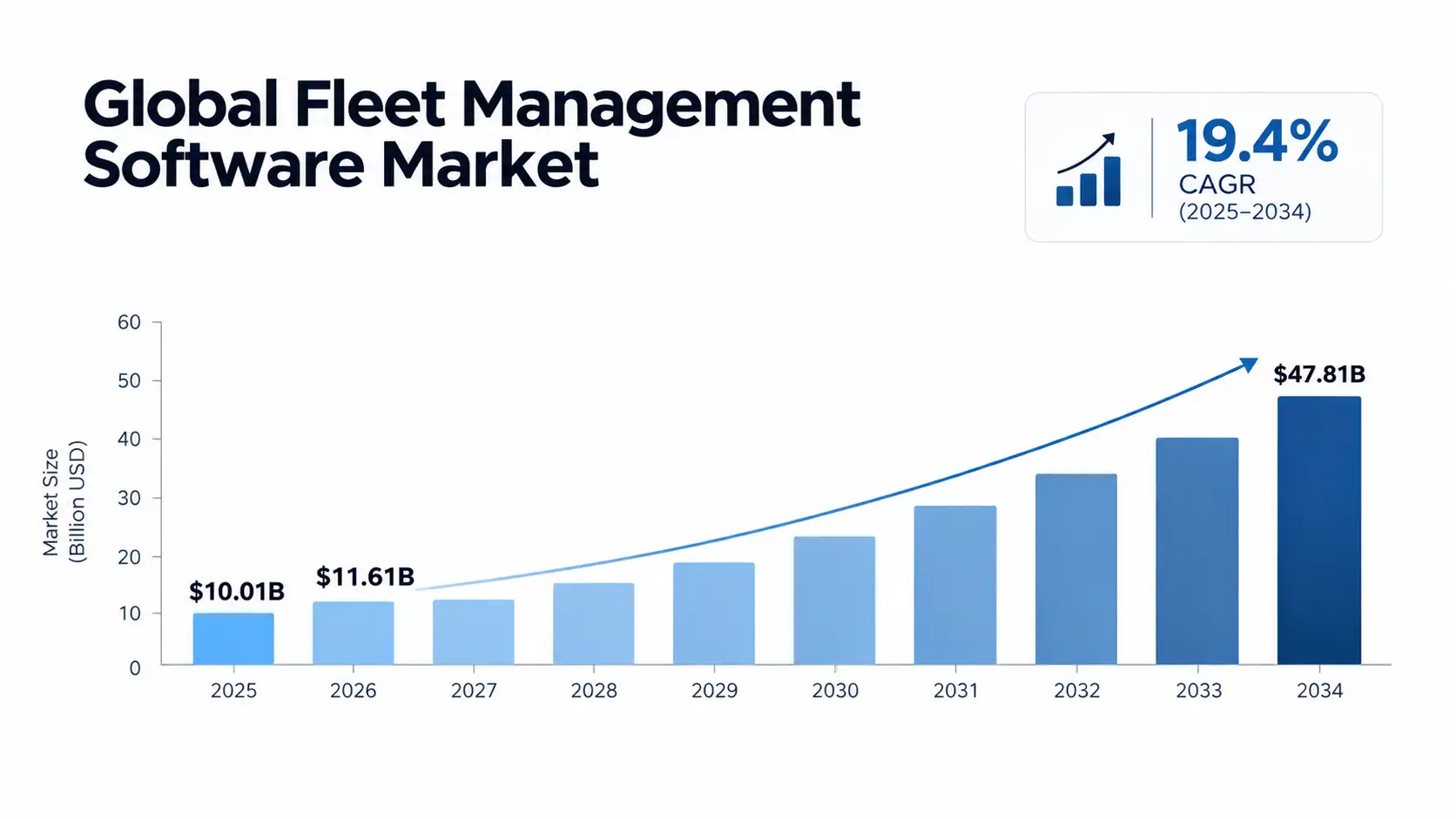
The main drivers of this change are fuel volatility, tightening compliance mandates, and driver shortages, which have turned fleet operations from a back-office function into a board-level cost-and-risk conversation.
This guide walks through the full picture, including capabilities, architecture, development, cost, compliance, AI, ROI, and the build-versus-buy decision every fleet-owning enterprise eventually has to make.
Key Takeaways
|
What Is Fleet Management Software and Why Does It Matter?
A fleet management platform centralizes the management of vehicles, drivers, routes, maintenance, fuel, compliance, and operational performance. It commonly combines web dashboards, mobile experiences, APIs, administrative controls, analytics, and connections to vehicle hardware or third-party data providers.
What Does Fleet Management Software Do?
Its operational role is to sit between raw vehicle data and the people who make decisions from it. For example:
- A dispatcher uses it to see where every vehicle is right now.
- A maintenance manager uses it to know which trucks are due for service before a breakdown happens.
- A compliance officer uses it to produce audit-ready driver logs on demand.
In practice, this means the fleet management system software continuously collects data from vehicles and drivers, processes it into something usable, and pushes the right information to the right person at the right time.
What impact does a fleet management system create?
The value shows up in decisions that used to depend on guesswork. For instance:
- Instead of a dispatcher calling drivers to check status, the system already knows.
- Instead of a maintenance team reacting to a breakdown, the platform flagged the warning signs days earlier.
That shift, from reactive to proactive operations, is the real reason enterprises invest in fleet management solutions.
Fleet Management Software vs. Vehicle Tracking Software
A common misconception is treating fleet tracking software as a synonym for the full platform. Tracking answers one question: where is the vehicle?
A complete fleet management app answers a much broader set of questions:
- Is this vehicle due for service?
- Is this driver operating safely?
- Is this route the most efficient one available?
- Is this fleet compliant with current regulations?
“GPS tracking is a data source inside the platform. It is not the platform itself.”
This distinction matters commercially and technically. Vendors marketing pure tracking tools as complete fleet solutions tend to underdeliver once a business needs maintenance workflows, compliance records, or dispatch automation.
Buyers who understand this difference ask sharper questions during vendor evaluation and avoid paying for a narrow tool that cannot grow with the operation.
When Does a Business Need a Fleet Management System?
Not every fleet needs enterprise-grade software on day one. The decision point usually arrives when one or more of these situations show up:
- Fleet size or route complexity has outgrown manual dispatch and spreadsheet tracking
- Vehicle, driver, and maintenance data live in disconnected systems that do not talk to each other
- Fuel costs are rising without a clear reason accessible to finance or operations
- Unplanned maintenance downtime is affecting delivery or service commitments
- Compliance exposure (HOS violations, missing inspection records) is becoming a real risk
- Dispatchers lack visibility into live vehicle locations and driver availability
- Reporting is manual, inconsistent, or arrives too late to act on
If two or more of these are true, the business case for a fleet management software investment is already forming
How Fleet Management Software Works?
Before reviewing features, it is important to see how the data flows underneath them. A useful mental model runs like this:
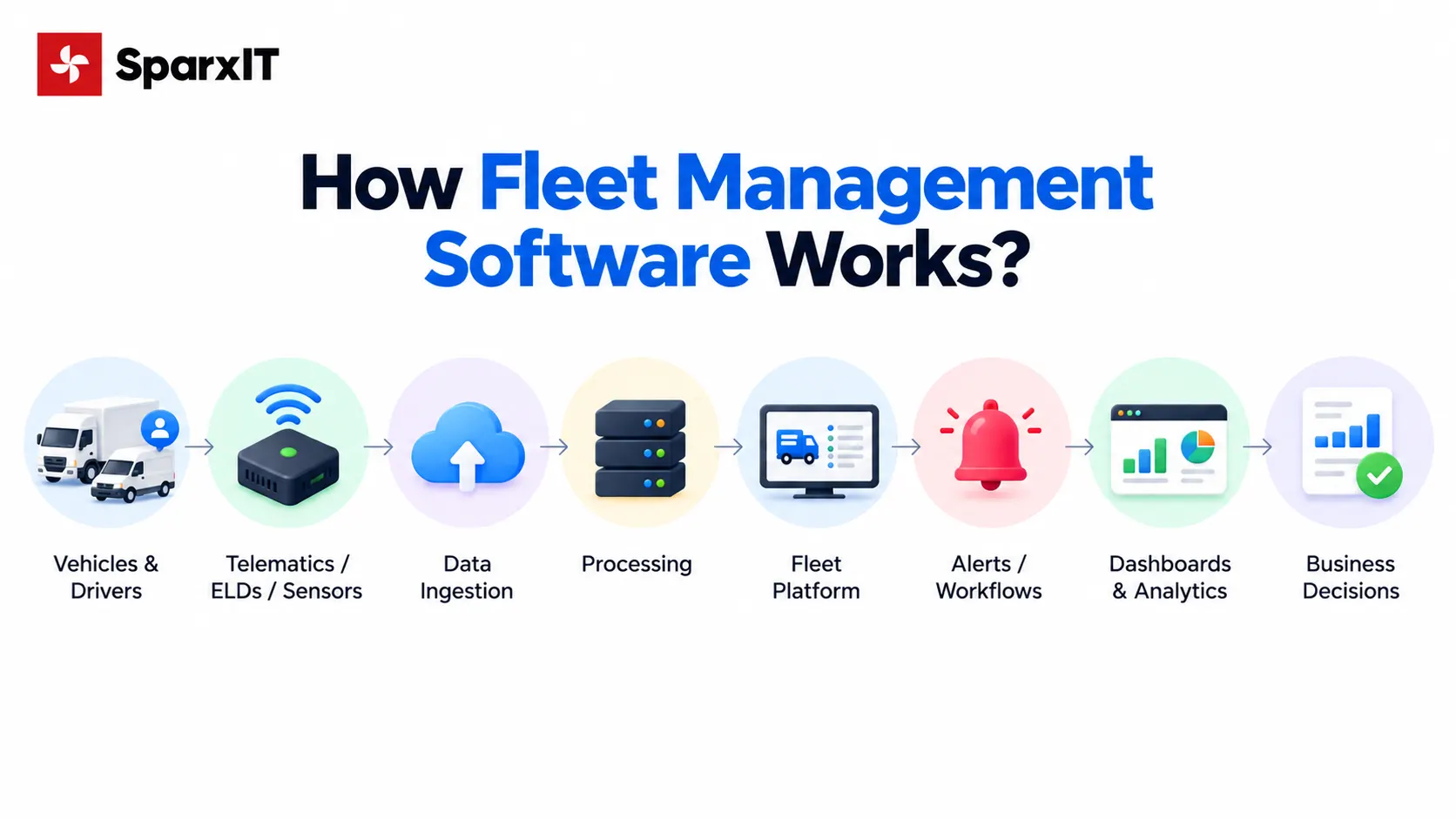
Where does the data come from?
The platform is only as good as its inputs. Common inputs include:
| Layer | Typical Role |
| Data sources | GPS, Telematics, ELDs, sensors, mobile apps, fuel systems |
| Ingestion | APIs, gateways, message queues, device protocols |
| Processing | Validation, event rules, geofencing, calculations |
| Operational layer | Trips, dispatch, maintenance, compliance, alerts |
| Analytics | KPIs, trends, forecasting, anomaly detection |
| Experience | Web console, driver mobile app, executive dashboards |
From Fleet Data to Operational Action
Collecting data is the easy part. The differentiator is what happens next: raw signals need to become alerts, dispatch decisions, maintenance work orders, driver coaching notes, route changes, compliance records, and executive-level reports.
“A fleet management software development that stops at dashboards, without driving action, leaves most of its value on the table.”
Fleet Management Software Types and Industry Fit
Not all platforms serve the same purpose. Enterprises typically encounter five broad types of fleet management software.
1. Fleet Tracking Software
Focused primarily on location visibility, geofencing, and trip history. Useful as a starting point, but limited as a standalone system for complex operations.
2. Fleet Maintenance Software
Built around preventive maintenance scheduling, service history, and repair workflows. Strong fit for asset-heavy fleets where downtime is the biggest cost driver.
3. Vehicle Fleet Management Software
A broader category covering the full vehicle lifecycle, from acquisition and utilization tracking through to disposal, alongside day-to-day operations.
4. Fleet Management App
Mobile-first tools that put dispatch, inspections, and driver communication directly in the hands of field staff, often as a companion to a larger platform.
5. Specialized Fleet Management Tools
Purpose-built fleet management tools for niche needs, such as cold-chain monitoring, hazardous materials compliance, or construction equipment utilization.
Industries That Use Fleet Management Software
Fleet operations vary across industries, but the need for visibility, cost control, safety, and timely vehicle utilization remains consistent. Let’s look at fleet management software use cases across industries.
| Industry | Primary Use Case |
| Logistics & Transportation | Dispatch, routing, delivery visibility |
| Construction | Asset utilization, maintenance scheduling |
| Field Services | Scheduling, technician tracking |
| Retail & Distribution | Delivery and route optimization |
| Automotive | Vehicle lifecycle and connected operations |
| Public Sector | Compliance, utilization, fleet visibility |
Essential Fleet Management Software Features
Rather than a flat feature list, organizations should adopt essential features of fleet management software that help the system serve its purpose.
Vehicle and Asset Tracking
- GPS vehicle tracking and live location
- Geofencing and boundary
- Trip history and
- Real-time asset status
Driver Management and Safety
- Driver profiles and credentials
- Driver behavior monitoring (harsh braking, speeding, idling)
- Safety scoring
- Incident tracking and driver coaching workflows
Route and Dispatch Management
- Route planning and route optimization
- Automated dispatch assignment
- ETA calculation
- Delivery scheduling
Fleet Maintenance Management
- Preventive maintenance scheduling
- Digital inspections and
- Service reminders and work
- Maintenance history and fault alerts
Fuel Management
- Fuel consumption tracking
- Fuel management and fuel card integration
- Fuel anomaly and theft detection
- Fuel cost reporting by vehicle or route
Compliance Management
- ELD integration
- Hours of Service (HOS) tracking
- Inspection documentation
- Audit-ready trail generation, covering compliance (ELD/DOT/HOS) requirements end to end.
Reporting and Fleet Analytics
- Operational dashboards
- KPI tracking by vehicle, driver, or
- Custom report building
- Trend analysis across fleet performance
Administration and Access Control
- Role-based access control (RBAC)
- User and permission management
- Audit logs
- Multi-location and multi-business-unit support
Core Modules an Enterprise Fleet Management Platform Should Connect
Treating the platform as an isolated product is a common mistake. In an enterprise environment, it needs to sit inside a wider ecosystem.
| Integration | Role in Fleet Management Software |
| Telematics and GPS | Provides core data on vehicle location, engine health, and driver behavior. |
| ERP and Finance | Connects fleet cost data with budgeting, asset depreciation, and financial reporting |
| TMS and Dispatch | Exchanges route and load data with transportation management systems for end-to-end operational visibility. |
| Fuel Card Platforms | Reconciles transaction-level fuel purchases with vehicle and driver activity. |
| Maintenance Systems | Synchronizes work orders, parts inventory, maintenance schedules, and service history. |
| CRM and Customer Portals | Shares delivery status and estimated arrival times with customer-facing teams and self-service portals. |
| BI and Analytics Platforms | Feeds operational fleet data into enterprise dashboards for leadership reporting and decision-making. |
Fleet Management Software Architecture and Technology Stack
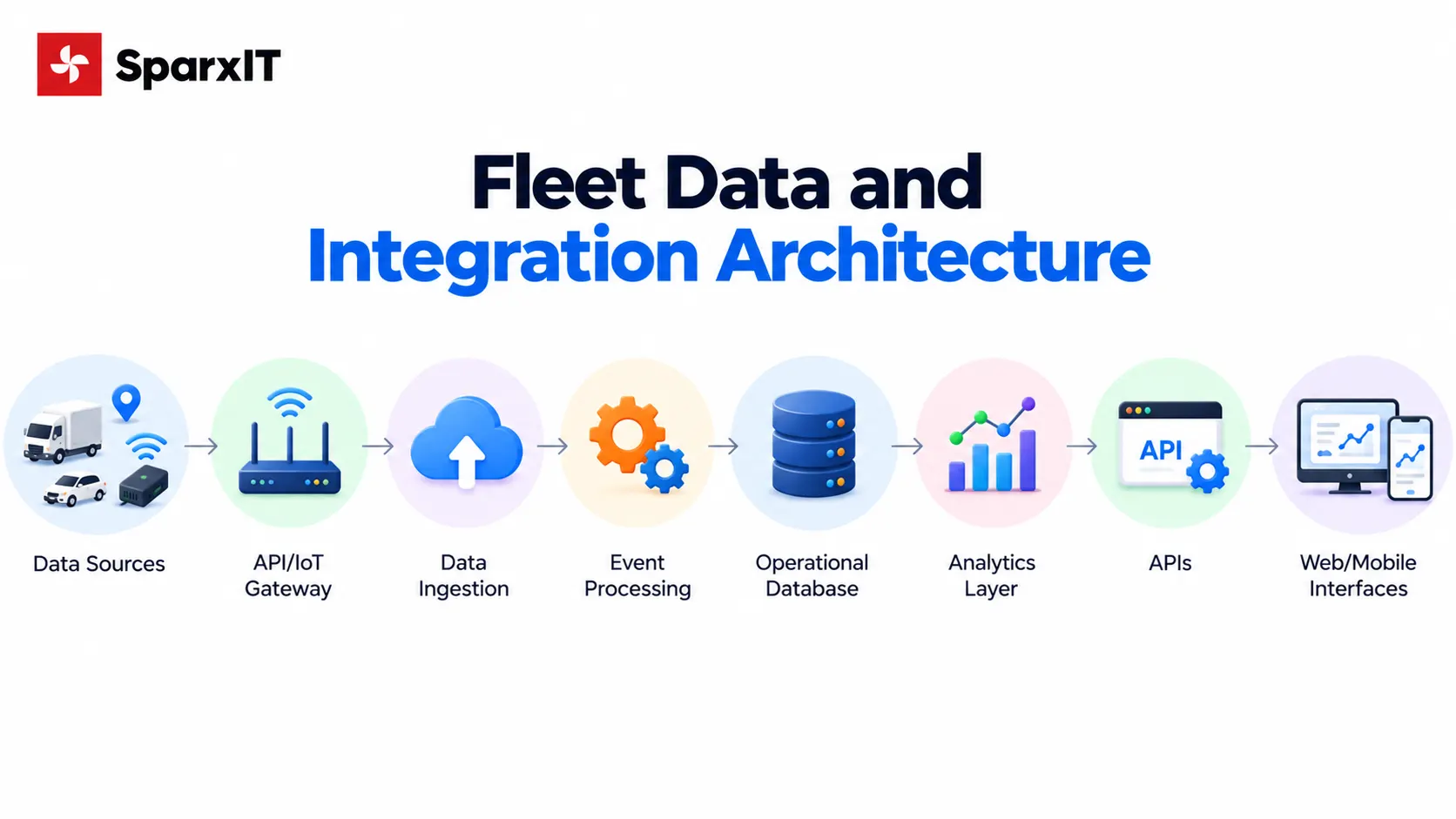
Fleet management architecture must support real-time data processing, secure integrations, scalable infrastructure, and reliable enterprise performance
Fleet Data and Integration Architecture
A typical enterprise architecture flows as follows:
Real-Time vs. Analytical Workloads
This distinction matters more than most buyers realize.
- Real-time workloads (live location, alerts, dispatch) demand low-latency processing and cannot tolerate delay.
- Analytical workloads (trend reports, KPI dashboards, historical analysis) can run on a separate, batch-oriented path.
Architecting these as one undifferentiated pipeline is a common source of performance and cost problems later.
APIs and Third-Party Integrations
Enterprise fleets rarely operate a single system. APIs must support two-way data exchange with ERP, TMS, fuel platforms, and telematics hardware vendors without creating brittle, point-to-point dependencies.
Recommended Technology Stack for Fleet Management Software
| Layer | Typical Choices | Why It Matters |
| Frontend | React, Angular, or Vue | Responsive dashboards for dispatchers and managers |
| Backend | Node.js, Java, or .NET | Handles business logic and integration orchestration |
| Databases | PostgreSQL, MongoDB, TimescaleDB | Separates transactional data from time-series telemetry |
| Cloud | AWS, Azure, or GCP | Elastic scaling for fleets with variable data volume |
| APIs | REST, GraphQL, Webhooks | Connects telematics, ERP, and fuel systems |
| IoT | MQTT, IoT Gateways | Ingests sensor and ELD data reliably at scale |
| Analytics | Spark, Kafka Streams, BI tools | Powers reporting without slowing real-time operations |
| Mobile | React Native, Flutter | Supports driver and field-technician apps |
| Security | OAuth2, TLS, encryption at rest | Protects location, driver, and compliance data |
AI and IoT in Modern Fleet Management Software Development
IoT captures real-time fleet data, while AI transforms it into actionable insights for maintenance, safety, routing, and fleet performance. Let’s see how both technologies are used.
AI Use Cases
Applied correctly, AI in fleet management software supports specific, measurable operations rather than vague transformation claims:
- Predictive maintenance based on sensor and usage patterns
- Driver risk analysis from behavioral data
- Route optimization at scale across hundreds of vehicles
- Fuel anomaly detection
- Demand forecasting, an area closely tied to AI in Supply Chain Management
- Dispatch recommendation engines
IoT and Telematics
Sensors and connected hardware are what make real-time fleet visibility possible in the first place. This is a core part of the broader shift toward IoT in Automotive, where vehicles increasingly function as connected data sources rather than isolated machines.
Data Prerequisites for AI
AI models are only as reliable as the data feeding them. Before investing in predictive features, keep these pointers in mind:
- Fleets need consistent telematics coverage
- Clean historical maintenance records
- Enough data volume to train models with statistical confidence.
Skipping this step is why many “AI-powered” fleet claims underdeliver in practice.
ELD Compliance, HOS, and Data Governance for Fleet Management System Software
Compliance requirements should shape the architecture from day one, not get bolted on after launch. They influence data retention policies, integration choices, and even workflow structure.
ELD Compliance
Electronic Logging Device integration is a baseline requirement for most commercial fleets operating under federal mandates, not an optional add-on.
Hours of Service Requirements
HOS tracking needs to be accurate to the minute and resistant to manual tampering, since it underpins both safety and legal exposure.
Data Retention and Auditability
Regulators expect historical driver logs and inspection records to be retrievable on demand, often for several years.
Compliance by Geography and Fleet Type
Requirements vary by region and vehicle class, so a custom fleet management software serving multiple jurisdictions needs configurable compliance rules rather than a single hardcoded standard.
Security Requirements to Build a Software for Fleet Management
With vehicle, driver, location, and operational data flowing through the platform, security cannot be treated as an afterthought.
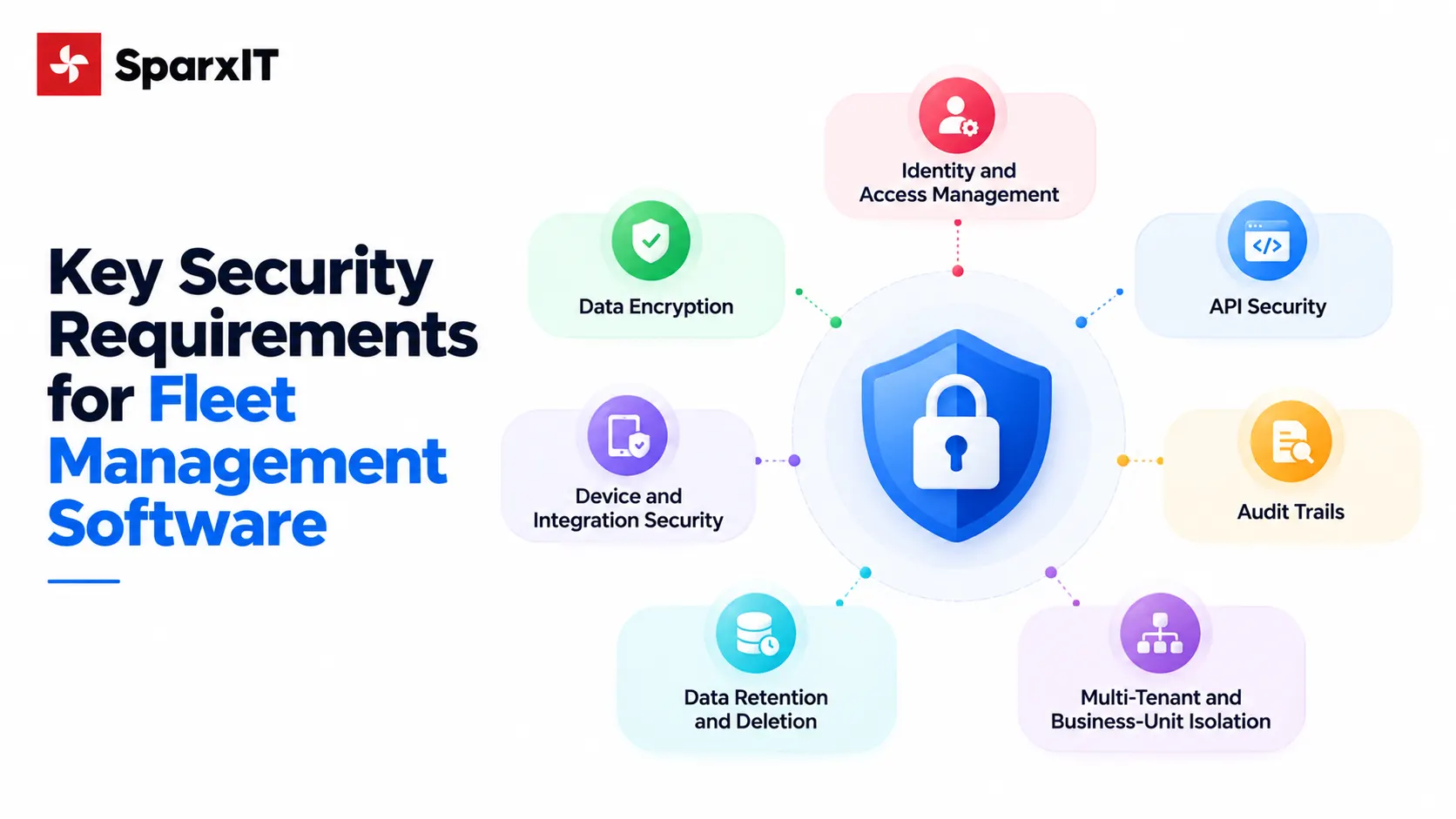
- Identity and Access Management: Role-based permissions that reflect real organizational structure, not a flat admin-versus-user model.
- Data Encryption: Encrypt location, driver, and financial data in transit and at rest.
- API Security: Token-based authentication, rate limiting, and strict scope controls on every integration endpoint.
- Device and Integration Security: Validate and monitor hardware and third-party connections, since ELDs and telematics devices are common attack surfaces.
- Audit Trails: Log every system action and attribute it to the responsible party to support security reviews and compliance reporting.
- Data Retention and Deletion: Clear policies for how long you keep data and how you permanently remove it when it’s no longer required.
- Multi-Tenant and Business-Unit Isolation: For enterprises running multiple brands or regions, data must stay properly segmented between business units.
How to Develop Fleet Management Software: Step-by-Step Process
Building fleet management software takes more than coding features. A clear development process helps turn operational needs into a scalable platform.
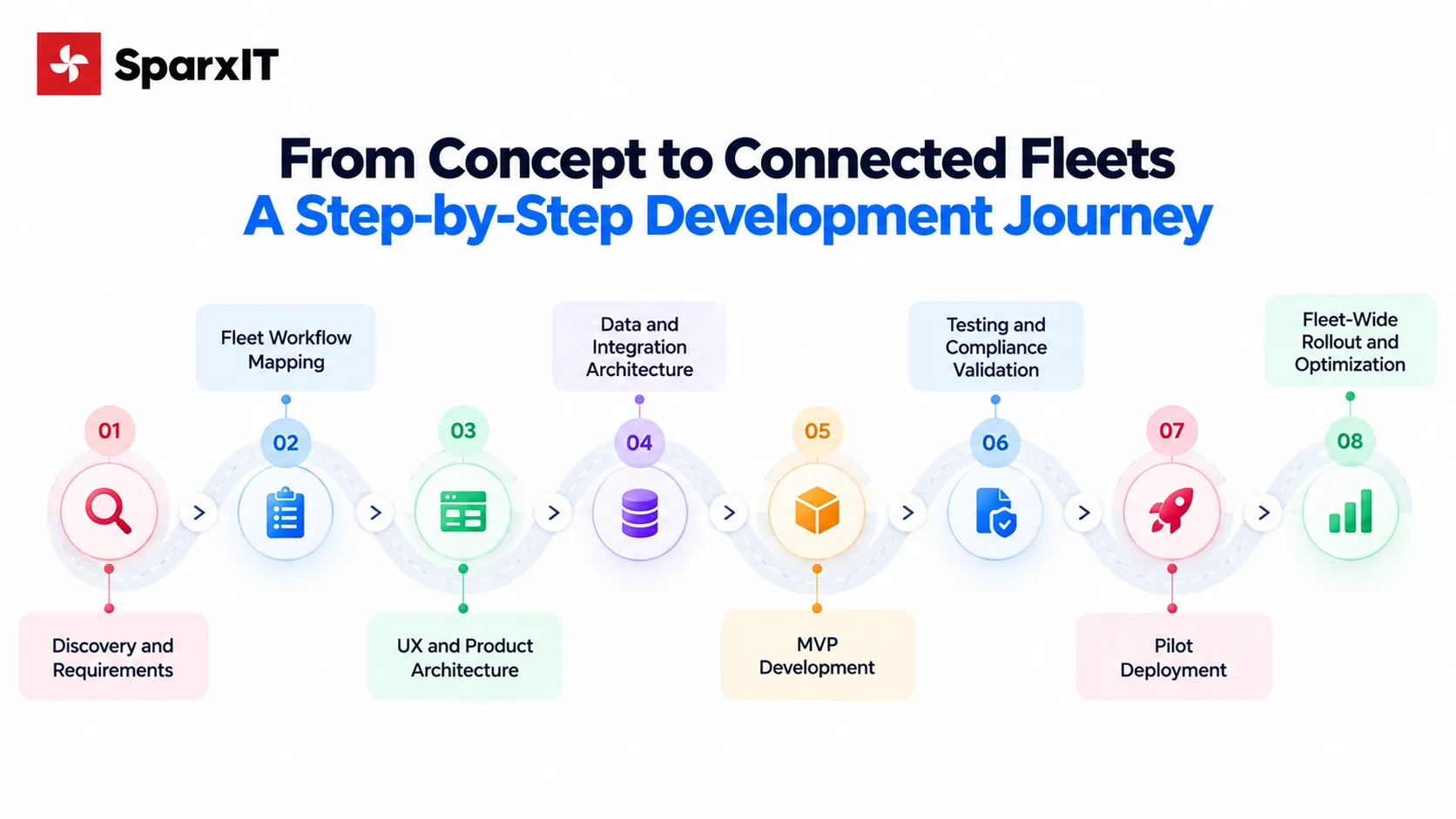
1. Discovery and Requirements
Define business goals, fleet size, vehicle types, user roles, and operational pain points before writing any code. Identify workflows that need improvement and prioritize requirements by business impact.
2. Fleet Workflow Mapping
Document how dispatch, maintenance, driver management, and compliance work today, including manual steps and system dependencies. This helps uncover workflow gaps and ensures the software reflects actual fleet operations.
3. UX and Product Architecture
Design around dispatchers, drivers, fleet managers, and administrators as distinct users with different responsibilities. Map their key workflows, permissions, dashboards, and actions before translating them into product screens.
4. Data and Integration Architecture
Decide how telematics, GPS, ERP, fuel systems, maintenance platforms, and other data sources will connect before building the application. Define APIs, data flows, synchronization rules, and real-time requirements upfront.
5. MVP Development
Build an MVP around the highest-value workflows first, such as vehicle tracking, dispatch, maintenance, and driver management. Keep the initial scope focused so the core platform can be validated before adding advanced capabilities.
6. Testing and Compliance Validation
Test the platform against real-world fleet scenarios, including HOS, ELD, GPS, device connectivity, permissions, and data synchronization. Validate both functional performance and compliance requirements before moving into production.
7. Pilot Deployment
Run the fleet management software with a representative subset of vehicles, drivers, and fleet operations before a full rollout. Use pilot feedback to identify usability issues, integration gaps, data inconsistencies, and workflow problems.
8. Fleet-Wide Rollout and Optimization
Expand deployment across the fleet using the lessons from the pilot. Monitor system performance, adoption, operational KPIs, and user feedback, then continuously refine workflows and capabilities as fleet requirements evolve.
Fleet Management Software Development Timeline
There is no fixed development timeline for fleet management software. As the duration varies based on features, integrations, fleet size, and the level of customization required.
| Development Stage | Indicative Duration |
| Discovery | 2–4 weeks |
| UX & Architecture | 3–6 weeks |
| MVP Development | 8–14 weeks |
| Integrations & Compliance | 4–10 weeks |
| Testing & Pilot | 3–6 weeks |
| Enterprise Rollout | Depends on fleet scale |
These are planning ranges based on typical enterprise engagements, not fixed delivery commitments.
Fleet Management Software Development Cost in 2026
No single honest number exists here, and any vendor quoting one without qualification should raise questions. The cost to build fleet management software depends far more on scope and integration depth than on team size alone.
Major Cost Drivers
- Feature scope and depth
- Fleet size and geographic spread
- Number and complexity of integrations
- Real-time data volume
- Compliance and regulatory scope
- Security requirements
- AI and predictive analytics features
- Cloud infrastructure choices
- Post-launch support and maintenance
A three-level pricing structure would make the cost easier to understand while keeping the figures clearly illustrative:
| Development Level | Estimated Cost | Typical Scope |
| Focused MVP | $15,000–$30,000 | GPS tracking, driver management, basic reporting |
| Advanced Software | $30,000–$80,000 | Real-time tracking, analytics, integrations |
| Enterprise Software | $80,000–$200,000+ | AI, IoT, deep integrations, multi-region compliance |
Off-the-shelf subscriptions look cheaper at first glance, and for many mid-sized fleets they are the right call. The calculation changes once an enterprise needs deep ERP integration, proprietary workflows, or ownership of the underlying data.
At that point, a custom fleet management app often costs less over a five-year horizon than the cumulative licensing fees, add-on modules, and integration surcharges that come with a rigid SaaS platform.
Fleet Management Software Pricing Models
Understanding fleet management software development cost structures helps set realistic budget expectations:
- Subscription /SaaS licensing
- Per-vehicle pricing
- Per-user pricing
- Usage-based pricing
- Custom licensing for large enterprises
- Custom development, priced by scope rather than a per-seat model
Total Cost of Ownership
A development quote alone understates the real investment. Total cost of ownership includes:
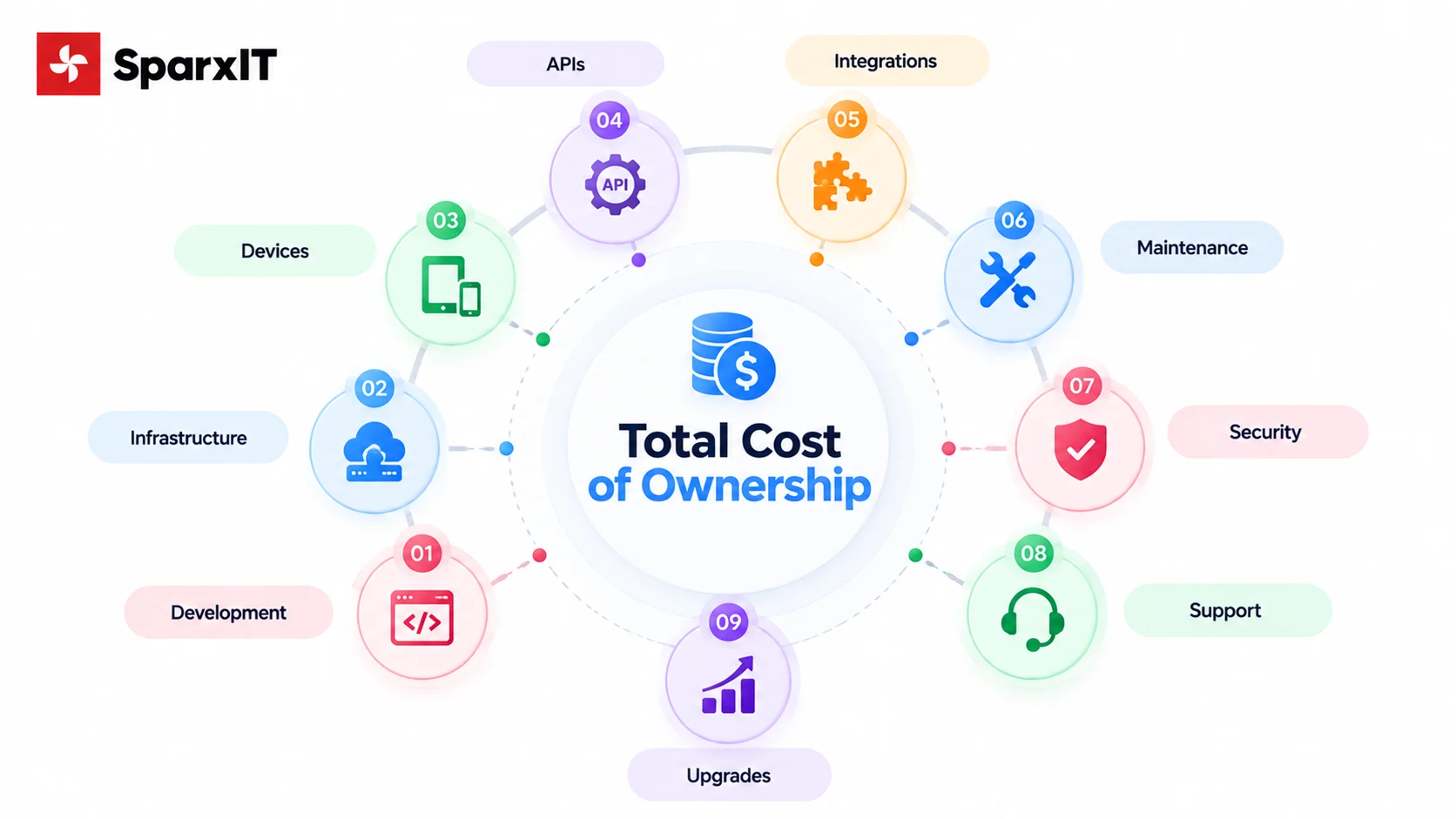
Enterprise buyers evaluating the cost of fleet management software should request a TCO breakdown, not just an initial build estimate, before committing a budget.
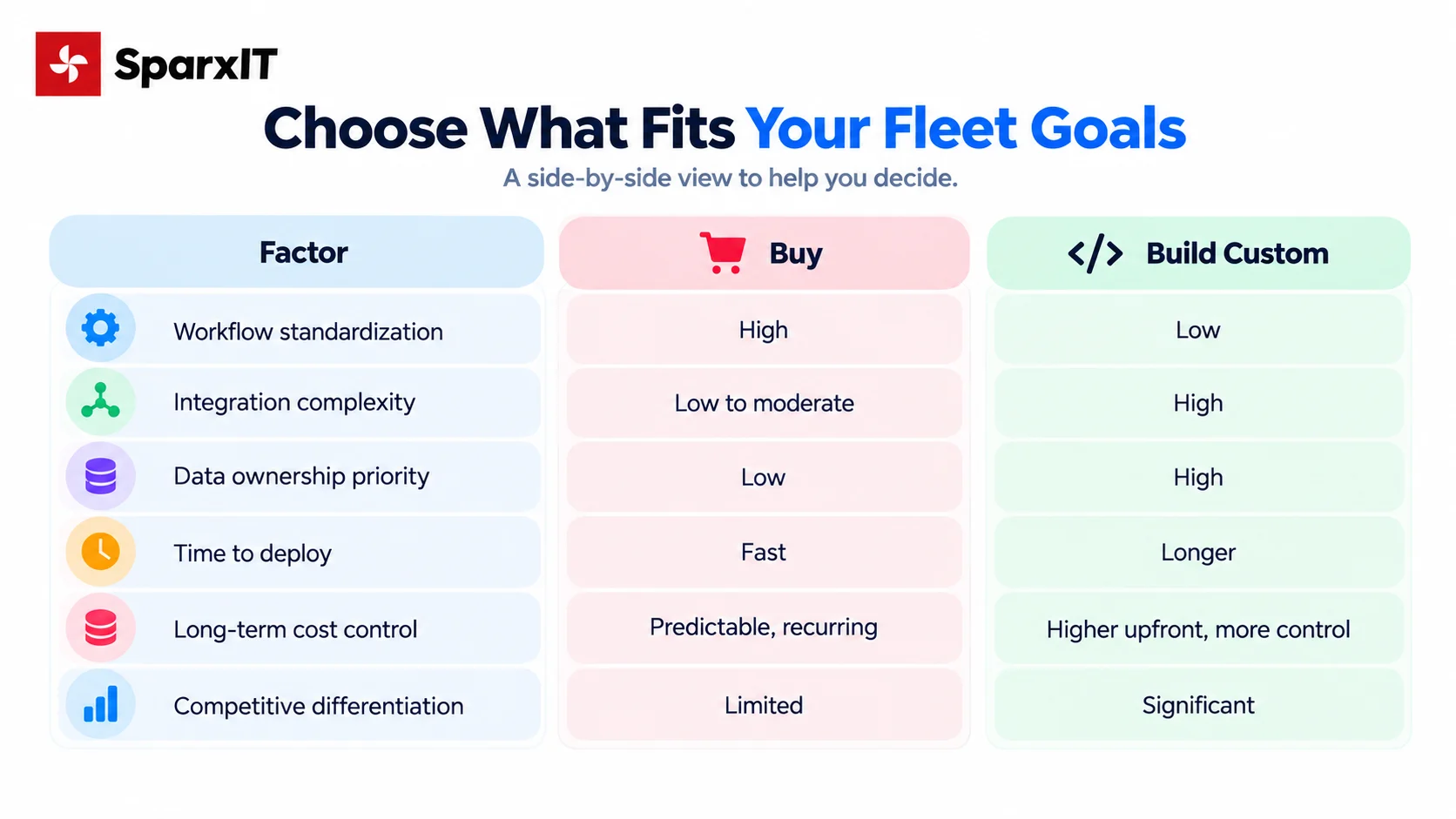
Build vs. Buy: Choosing the Right Fleet Management Approach
With cost, capability, and architecture now clear, the natural next question is whether to build or buy.
When to Buy
Standardized operations with common workflows are usually well served by established fleet management software solutions already on the market. Buying makes sense when speed to deployment matters more than deep customization, and when the fleet’s processes resemble those of most other fleets in the same industry.
When to Build Custom Fleet Management Software
Custom software for fleet management makes sense when workflows are genuinely unique, when deep integration with proprietary systems is required, or when data ownership and control are strategic priorities rather than a preference. Enterprises operating across multiple regions, business units, or vehicle types often reach this point once off-the-shelf configuration options run out.
When to Extend an Existing Platform
A middle path: extend a proven platform with custom modules or integrations rather than building the entire system from scratch. This works well when the core platform already fits most requirements and only a handful of specialized workflows or integrations are missing.
Build vs. Buy Decision Matrix
A development quote alone understates the real investment. Total cost of ownership includes:
How to Evaluate Fleet Management Software Before Development
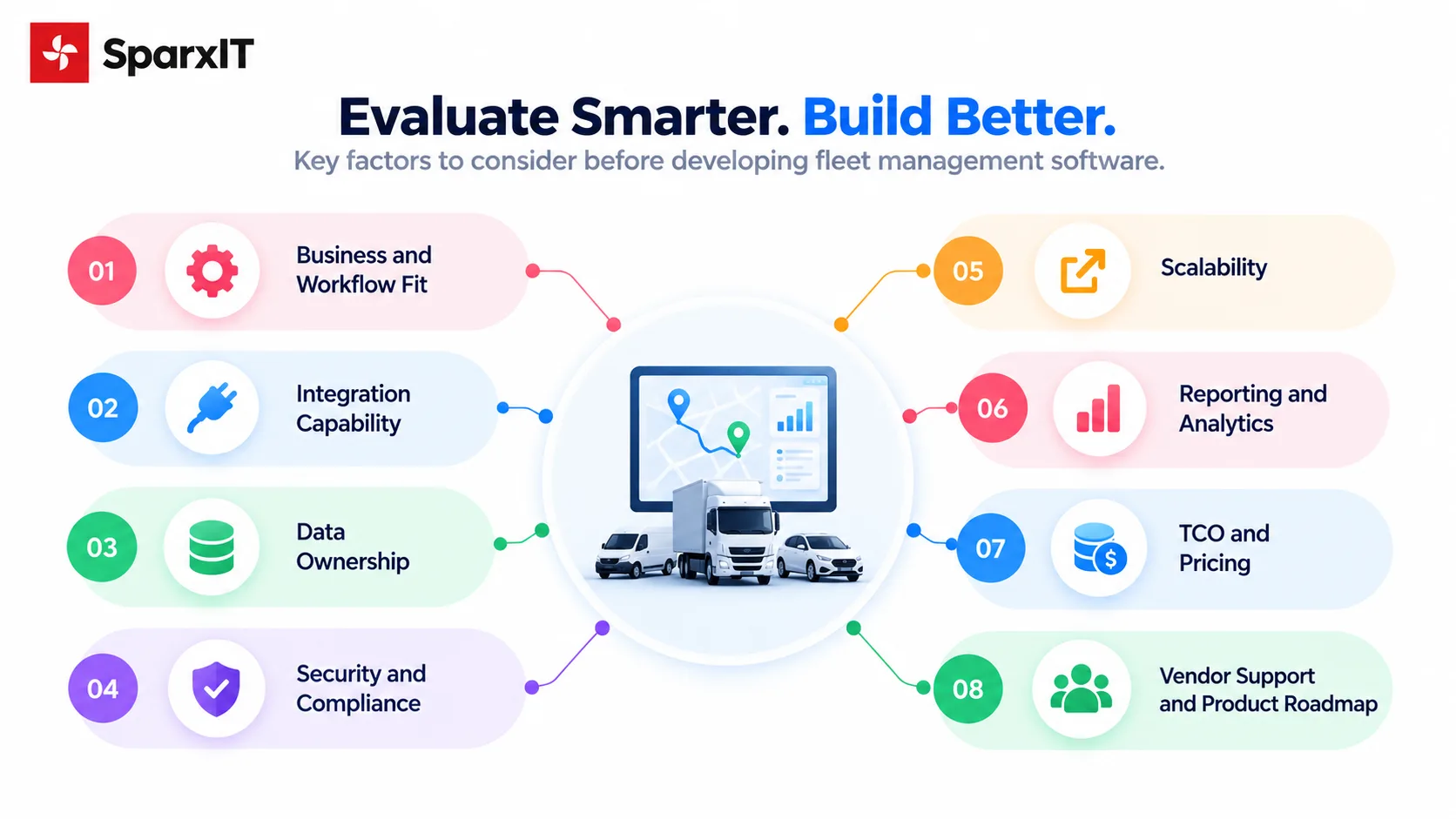
Before comparing vendors, evaluate against outcomes rather than feature counts. This is also where reviewing the best fleet management software on the market against your own workflows pays off.
Business and Workflow Fit
Does the platform match how your operation actually runs, not a generic industry template? A demo that looks impressive but ignores your specific dispatch or maintenance process will create friction after go-live.
Integration Capability
Can it connect cleanly with ERP, TMS, and fuel systems already in place? Ask for evidence of prior integrations with your specific systems, not just a general claim of “open APIs.”
Data Ownership
Who owns the data generated, and what happens to it if you switch vendors? Contracts should explicitly spell out data export rights and retention terms.
Security and Compliance
Does it meet the regulatory requirements for every region the fleet operates in? Compliance gaps rarely surface until an audit, which is the worst time to discover them.
Scalability
Will it hold up as fleet size, data volume, or geographic footprint grows? A platform that performs well at 200 vehicles may struggle at 2,000 without architectural changes.
Reporting and Analytics
Does it produce the specific KPIs leadership actually tracks? Generic dashboards that require manual export and reformatting defeat the purpose of automation.
TCO and Pricing
Is the full cost of ownership transparent, not just the sticker price? Ask vendors to itemize implementation, integration, training, and support costs separately from the base license.
Vendor Support and Product Roadmap
Is the vendor actively investing in the platform, or maintaining it at a minimum? A stagnant product roadmap is an early warning sign of a platform nearing end of life.
How to Choose a Fleet Management Software Development Company
Among the many fleet management software companies and development partners in the market, the strongest ones share a common profile. Evaluate a partner on:
- Fleet and domain expertise
- Integration experience across ERP, TMS, and telematics
- IoT and telematics engineering capability
- Cloud architecture maturity
- Security and compliance track record
- AI and data engineering depth
- QA and testing rigor
- Post-launch support commitments
- Scalability planning
- Delivery governance and communication
A genuine partner should be able to speak to fleet workflows specifically, not just general software delivery. Apply this standard whether you’re evaluating fleet management software development services for a full build or a more limited integration project.
References matter more here than in most software categories. Ask a prospective partner for examples of fleets similar in size and complexity to yours, and ask directly how those projects handled compliance validation and post-launch support. A partner who cannot answer specifically has likely not done this work before at the scale you need.
ROI and Building the Business Case
A software investment of this scale needs a business case that survives finance scrutiny, not just operational enthusiasm. That case starts with the right KPIs, measured before you deploy a single feature.
Fleet KPIs to Measure
- Fuel cost per mile or per vehicle
- Vehicle utilization rate
- Maintenance cost trends
- Unplanned downtime
- Route efficiency
- On-time delivery or service performance
- Safety incident rate
- Administrative hours spent on manual reporting
How to Calculate Fleet Software ROI
A straightforward framework:
ROI = (Measured Benefits − Total Cost of Ownership) / Total Cost of Ownership × 100
The reliability of this number depends entirely on having accurate baseline KPIs before implementation, not estimates made after the fact.
Avoiding False ROI Assumptions
No universal ROI percentage applies across every fleet. Treat claims like “cut fuel costs by 20%” without context skeptically. Real ROI depends on your baseline, fleet size, and operational maturity before implementation.
Build Software for Fleet Management With SparxIT
SparxIT helps enterprises build and scale fleet management platforms around their operational requirements. Our team supports the development lifecycle, from discovery and product engineering to integrations, cloud infrastructure, data, AI, quality assurance, security, and ongoing support.
We bring experience across automotive software development services and mobility software, helping businesses connect fleet data, streamline workflows, and improve operational visibility. Our approach focuses on building secure, scalable platforms that support real-world fleet operations and evolving business needs.
Whether you need a complete fleet management software or a targeted integration, we focus on the workflows, users, and outcomes that matter most. Our engineering approach combines scalable architecture, practical automation, and flexible integrations to help fleet platforms grow with your business.

Partner with Experts
Frequently Asked Questions
How does fleet management software work?


It collects data from vehicles, drivers, and sensors through telematics and ELDs, processes that data centrally, and delivers alerts, dashboards, and reports that drive dispatch, maintenance, and compliance decisions.
How much does fleet management software cost?
The development cost depends on the platform’s scope and complexity, starting at $15,000–$30,000 for a focused MVP, $30,000–$80,000 for advanced software, and $80,000–$200,000+ for an enterprise platform.
How long does it take to develop fleet management software?
A typical enterprise build takes roughly 20 to 40 weeks, covering discovery, architecture, MVP development, integrations, testing, and pilot deployment; enterprise-wide rollout timing depends on fleet scale.
What is ELD compliance in fleet management software?
ELD compliance means the platform integrates with Electronic Logging Devices to accurately track driver Hours of Service and produce audit-ready records required by regulators.
What ROI can I expect from fleet management software?
ROI depends entirely on your baseline KPIs before implementation. There is no universal percentage; a reliable estimate requires measuring fuel cost, downtime, and utilization before and after deployment.
Can fleet management software help with maintenance and repairs?
Yes. Preventive maintenance scheduling, digital inspections, service reminders, and fault alerts reduce unplanned downtime and extend vehicle service life.
Can AI be integrated into fleet management software?
Yes, for specific use cases such as predictive maintenance, driver risk analysis, route optimization, and fuel anomaly detection, provided the fleet has enough clean historical data to support model training.