A product team launches a customer-facing chatbot in six weeks. Three months later, Legal asks two simple questions: What data trained the model? Who approved its release? Nobody has a clean answer.
Versions of this story play out in companies of every size. AI now drives decisions in lending, hiring, claims, support, and pricing, and those decisions often move faster than the review processes built around them. Models drift. Employees paste sensitive data into public tools. Regulators and enterprise buyers expect evidence, not good intentions.
AI governance closes that gap. It gives leaders a repeatable way to approve, monitor, and defend every AI system they run. This guide explains what AI governance includes, who owns it, which laws and standards matter, and how to build a program that protects your business without slowing your teams down.
Key takeaways
- Governance turns AI principles into owners, policies, controls, and evidence across the full lifecycle.
- The right governance framework helps businesses balance innovation with regulatory compliance, operational efficiency, and customer trust.
- Risk-based governance ensures every AI system receives the right level of oversight, from internal productivity tools to high-impact business applications.
- Strong governance connects people, processes, and technology to prevent AI risks before they become compliance failures or business disruptions.
- Generative AI and autonomous agents demand stronger safeguards for data privacy, output reliability, human oversight, and automated actions.
- A scalable AI governance strategy helps organizations move from fragmented AI adoption to secure, transparent, and accountable AI operations.
What Is AI Governance?
Artificial intelligence governance is the set of policies, roles, processes, and technical controls that keep AI systems lawful, safe, fair, and aligned with business goals from design to retirement. It defines who can build or buy AI, how risk is judged, and what evidence proves a system behaves as intended.
Three Layers That Make It Work
Most AI governance models organize the work into three layers:
- People: an executive sponsor, a cross-functional review group, and a named owner for every system.
- Process: intake, risk review, approval, change management, and incident response. This is where AI operational governance happens day to day.
- Technology: an AI inventory, a model registry, monitoring, and guardrails that enforce policy automatically.
How It Differs From Related Disciplines
| Discipline | The question it answers | Typical owner |
| AI ethics | What should we do, and what should we never do? | Leadership, ethics board |
| Responsible AI | How do we build those values into design and testing? | Product and data science teams |
| AI regulatory compliance | Which laws apply, and can we prove we meet them? | Legal and compliance |
| Data governance | Is our data accurate, lawful, and secure? | Chief data officer |
| Governance (the umbrella) | Who decides, under which rules, with what evidence? | Governance committee and AI lead |
In practice, AI ethics and governance work best as one program. Ethics sets the intent, governance makes it enforceable, and data management supplies trusted inputs.
Why Does AI Governance Matter Now?
Four pressures have turned governance from a policy discussion into an operating requirement.
Regulation now has teeth
The EU AI Act allows fines of up to EUR 35 million or 7% of worldwide annual turnover for prohibited practices. It reaches companies outside Europe when their AI systems or outputs are used in the EU. Since February 2025, it has also required organizations to ensure adequate AI literacy among staff who operate or use AI systems.
Ungoverned AI is already causing losses
IBM’s Cost of a Data Breach Report 2025 found that 13% of organizations reported breaches of AI models or applications. Of those, 97% lacked proper AI access controls. Shadow AI, meaning AI tools employees use without approval, made breaches costlier. Organizations with high levels of it paid about USD 670,000 more per breach on average.
Boards want answers
AI risk now sits alongside cyber and financial risk, putting corporate AI governance on board agendas. IBM’s Institute for Business Value reports that 80% of organizations now dedicate part of their risk function to AI or generative AI.
Trust affects revenue
Enterprise procurement teams increasingly add AI questions to vendor security reviews. Vendors that can produce model documentation, test results, and approval records clear those reviews with less friction and close deals faster.
Good AI governance risk management treats these four pressures as one connected problem, not four separate projects.
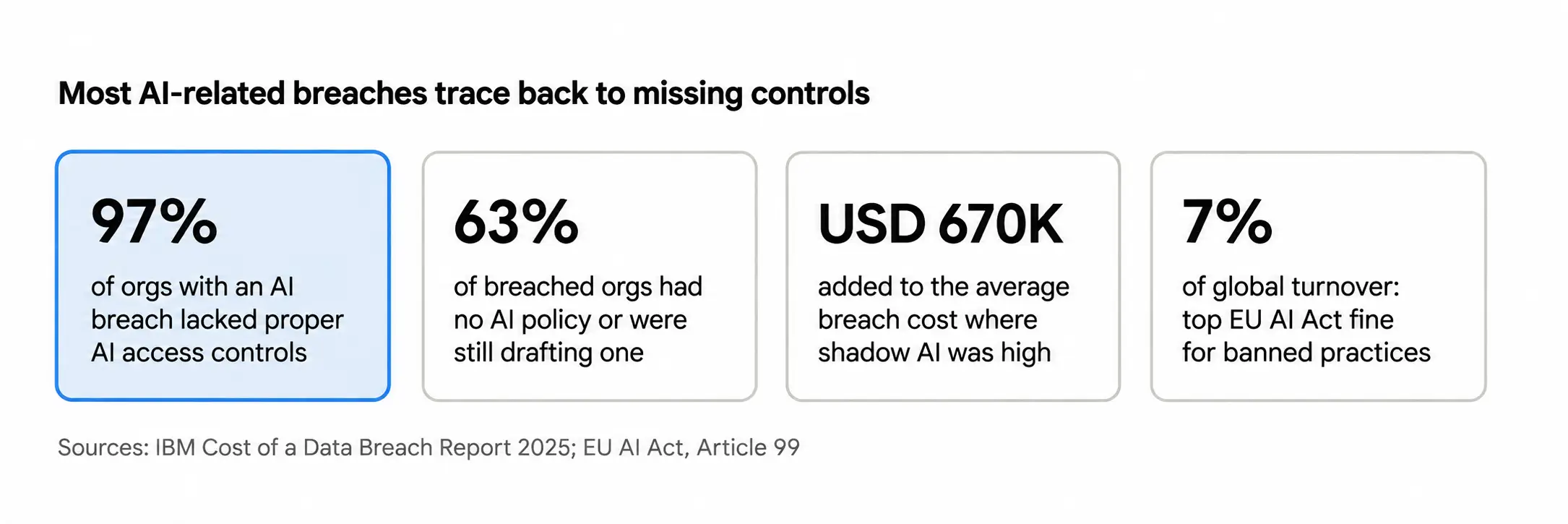
The common thread isn’t sophisticated hacking. It’s missing basics, such as access controls and a clear list of approved tools.” Move it directly after the shadow AI sentence.
Who Is Responsible for Ethical AI Governance?
Ultimate accountability for ethical AI governance sits with the CEO and senior leadership. They decide how much risk the company will accept, and they are the only people who can back a team that says a launch isn’t ready. The board comes next. It reviews the program through audits and regular risk discussions, the same way it already treats cyber and financial exposure.
Below that, the work divides by function. Responsible AI governance holds up only when each leader knows which part is theirs:
- General counsel: legal and regulatory exposure, including which laws apply to each system and what the contracts with AI vendors say.
- CFO: the financial exposure, including what a failed or withdrawn system would cost the business.
- Chief data officer: coordinating the program as it grows, along with data quality, lineage, and consent.
- CIO or CISO: access controls, model security, and shadow AI.
- Business owner of each system: the outcomes it produces, good or bad.
Four Working Roles Inside the AI Lifecycle
Leadership sets direction, but four working roles touch every model before it reaches a customer. The business owner defines the goal, the success measures, and limits such as bias thresholds and the level of explainability required. The data scientist builds the model against those requirements. An independent model validator then tests it on different data and checks the owner’s metrics, much like a QA team would. Once the model is approved, an AI operations engineer deploys it, watches production performance, and tells the right people when the numbers slip.
Most governance failures happen at the handoffs rather than inside any one role. The validator never saw the owner’s bias threshold. The operations engineer doesn’t know who to alert. Writing each handoff into a RACI chart, which shows who is Responsible, Accountable, Consulted, and Informed, closes those gaps.
Insight: Pick any AI system your company runs and ask who gets the call if it fails tomorrow. If you hear three different names, or none, fix ownership before anything else.
The Principles Behind Every Governance Decision
A principle matters only when it maps to a control someone runs and evidence an auditor can check. This table turns AI governance principles into daily practice.
| Principle | Control in practice | Evidence it works |
| Fairness | Bias tests across relevant user groups before release and after major updates | Bias test report with thresholds and sign-off |
| AI transparency | Tell users when they interact with AI, publish intended use and known limits | Model card, user-facing notice |
| AI explainability | Tools such as SHAP that show which factors drove a high-impact decision, plus plain-language reasons when someone is turned down | Sample explanations reviewed by domain experts |
| AI accountability | A named business owner per system and approval gates tied to risk tier | Ownership record, approval log |
| Privacy and security | Data minimization, role-based access, red-team exercises | Privacy impact assessment, access reviews |
| Safety and robustness | Stress tests, fallback paths, rollback plans | Test results, incident runbook |
| Human oversight of AI | People review or can override high-impact outputs | Override and escalation logs |
Insight: If a principle has no control and no evidence, it is a slogan. Auditors and regulators read the evidence column first.
How Should You Measure AI Governance?
A governance program with no numbers is hard to defend, whether you’re facing a board, an auditor, or a customer’s security team. Some measures will be handed to you by regulators and customers, such as bias test results, incident records, and documentation. Others you choose yourself so they reflect how your business actually runs.
These are the AI governance KPIs most teams should consider:
| Area | What to measure | Example metric |
| Data | Lineage, provenance, and quality of training and input data | Share of production models with documented data sources |
| Security | Access to models, tampering, and misuse of AI environments | Unauthorized access attempts, tools with no access controls |
| Cost and value | What the data and models cost against the value they deliver | Cost per production model versus revenue earned or hours saved |
| Bias | Selection and measurement bias, tracked continuously instead of once | Outcome gap between user groups against the tier threshold |
| Accountability | Who used a system, when, and for which decisions | Systems with a named owner and an approval record |
| Audit | Evidence collected as work happens, so reviews don’t depend on memory | Time needed to assemble an audit pack for one system |
| Time | Every metric above, tracked over a period | Month-over-month trend for each metric |
The last row matters more than it looks. A single reading tells you little, while a six-month trend shows whether a model is drifting before customers notice.
Measure the program as well as the models. Inventory coverage (how many of your AI systems are actually on the list), the share of high-risk systems reviewed on schedule, and incidents per quarter give leadership a quick read on whether governance is working.
Insight: Start with three or four metrics you can pull today. A dashboard of twenty numbers nobody trusts does less than a short list someone actually reads every month.
How to Choose an AI Governance Framework
No single standard covers everything. Most global companies pair one binding law with one or two voluntary AI governance standards, then map each control once and reuse it across all of them.
| Framework | Type | Certifiable? | Best for |
| EU AI Act | Binding, risk-based regulation | No, high-risk systems need conformity assessment | Any company selling AI into the EU or using it there |
| NIST AI RMF | Voluntary framework built on Govern, Map, Measure, Manage | No | A practical operating baseline, especially in the US |
| ISO/IEC 42001 | International AI management system standard | Yes | Proving a working program to customers and auditors |
| OECD AI Principles | Intergovernmental principles | No | Setting values and policy direction |
The EU AI Act in Brief
The Act sorts AI systems into four risk tiers:
- Unacceptable: banned outright, such as social scoring and manipulative techniques.
- High: uses such as hiring, credit scoring, education, and critical infrastructure. These need risk management, documentation, human oversight, and conformity assessment.
- Limited: transparency duties, such as telling users they are talking to a chatbot.
- Minimal: no new obligations, such as spam filters.
Map every system to a tier early. AI governance compliance costs far less at design time than after launch.
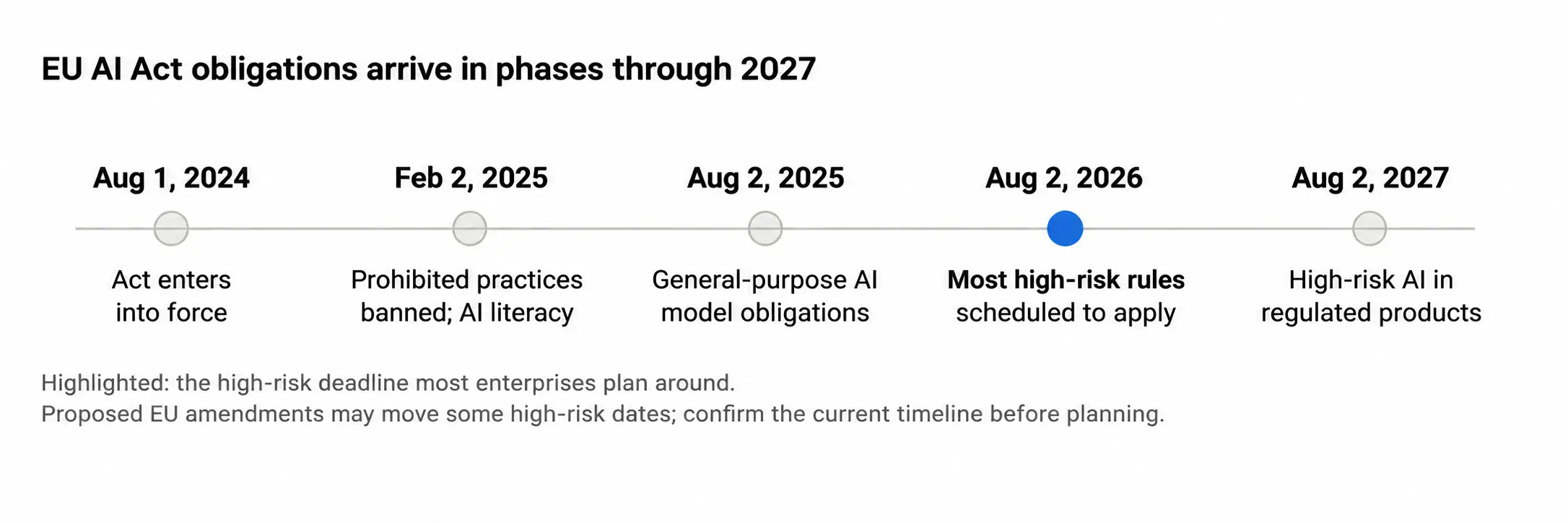
Obligations arrive in stages, so a company can be compliant today and out of step next year without changing a single model.
India and Other Markets
India has favored guidance over a standalone AI law. The Digital Personal Data Protection Act, 2023 governs personal data used by AI systems, and MeitY’s India AI Governance Guidelines, released in November 2025, set out principles built on existing laws. In the US, states such as Colorado have passed AI-specific legislation, while the UK relies on sector regulators applying shared principles. In financial services, supervisors extend existing model risk guidance to AI, which makes AI model risk management a regulatory expectation for banks.
Certification for Organizations and Professionals
For organizations, AI governance certification usually means ISO/IEC 42001, an auditable AI management system. For individuals, credentials such as the IAPP’s AIGP show practitioner competence. Certification is worth pursuing when enterprise customers or regulators ask for independent proof.
The Six Different Levels of AI Governance
Governance maturity builds in stages, numbered here from zero to five. Each level adds one capability to the one before it, so knowing where you stand tells you what to build next. Most companies climb this AI governance maturity model one level at a time, and trying to skip a level usually means coming back to rebuild it.
Level 0: No Governance
Every team picks its own tools, and nothing is written down centrally about how models get built or released. That’s common for companies just starting out, and it gives teams freedom. The price shows up in production. Without a shared framework, there’s no way to size risk, and adding data scientists doesn’t multiply output, because everyone works differently.
Level 1: Policies Exist
The company has written some rules, such as acceptable uses or review expectations, but it lacks common tools and a shared way to check them. Many organizations stop here, since writing a policy feels like the end of the job.
Level 2: A Common Set of Metrics
Every team now evaluates models with the same agreed metrics and monitoring tools, so results can be compared across projects. Everyone reads the numbers the same way, which speeds up troubleshooting and makes policy decisions easier to defend. A central validation team usually enforces the standards at this stage, and it’s where productivity gains start to show.
Level 3: An Enterprise Data and AI Catalog
Metadata from level two feeds a single catalog that holds data, models, code pipelines, and lifecycle metrics, along with data quality and provenance. Any model can be traced back to its sources and versions, enabling a full audit. A chief data officer or chief risk officer gets one place to see AI risk and judge how the strategy is going.
Level 4: Automated Validation and Monitoring
Information from the lifecycle is captured automatically instead of being typed in by data scientists after the fact. Validators receive complete evidence, sometimes with AI-assisted suggestions, and fewer mistakes slip through because no metric, dataset, or version gets left out of the record. Teams at this level can move models to production quickly and consistently.
Level 5: Fully Automated Governance
Policies are enforced automatically across the whole lifecycle of every model, and documentation for regulators and customers is produced without a manual push. People can then spend their review time on the riskiest systems.
Governance by Design: Controls Across the AI Lifecycle
Governance works best when it is part of how AI gets built. Treat AI lifecycle management as a series of gates, each with a clear control and an artifact the next stage can rely on.
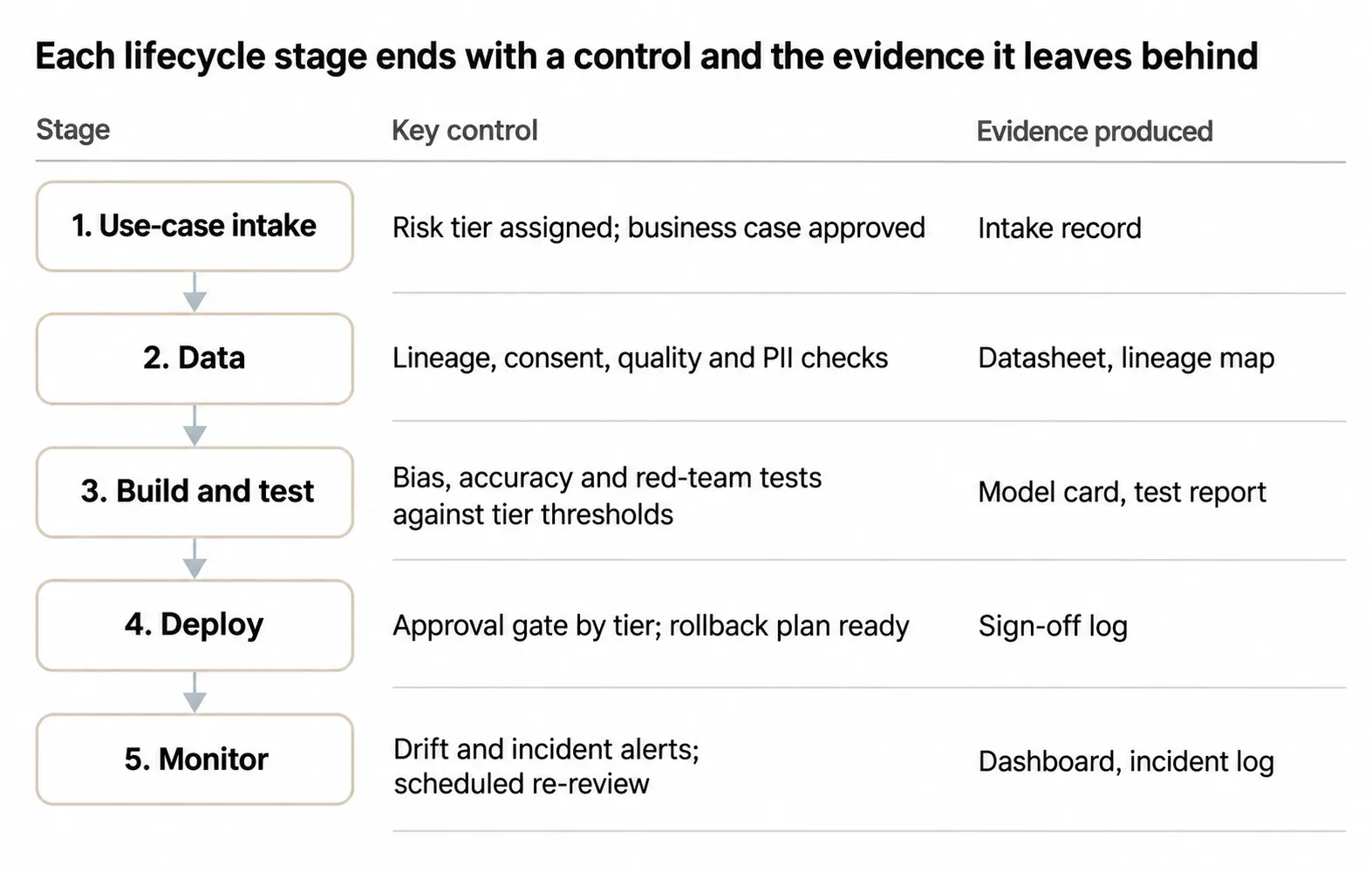
Each artifact feeds the next gate, so an auditor can trace any production model back to the decision that approved it.
Start With Trusted Data
Many model failures start with data. Data governance for AI extends classic data management with training-data provenance, consent checks, PII handling, and dataset versioning, so every model can be traced to its sources. Mature AI and data governance programs share one catalog and one set of data owners.
Model Governance and Validation
AI model governance adds versioning, approval history, and performance baselines for every model in production. Before release, AI governance validation confirms the model meets its tier’s thresholds. Human validation by domain experts then catches what the metrics miss, such as tone, context, and edge cases. A useful model card records intended use, training data sources, evaluation results by user group, known limits, the owner, and the approval date.
Insight: use vendor terms that exclude training on your data.
Governing Generative AI and AI Agents
Generative AI governance deals with risks that predictive models rarely raised. Outputs are open-ended, and agents can take actions in other systems on a user’s behalf. Teams scaling generative AI for business need these controls in place before usage spreads across departments.
Generative AI Risks and Matching Controls
- Hallucinations: ground answers in approved sources with retrieval-augmented generation (RAG), and run evaluation suites before every release.
- Prompt injection: filter inputs, isolate untrusted content, and red-team on a schedule.
- Data leakage: redact sensitive data, block unapproved tools, and choose vendors whose contracts bar them from training models on your data.
- IP exposure: vet training and retrieval sources, and keep provenance records.
Track a small set of evaluation metrics for every release: groundedness against source documents, harmful-output rate, sensitive-data leakage rate, and correct refusals. NIST’s Generative AI Profile (NIST AI 600-1) maps these risks to the AI RMF and works as a practical checklist for teams building on large language models.
Controls for AI Agents
- Least-privilege access to tools and data
- Limits on spend, volume, and scope of actions
- Human approval for high-impact actions such as payments or record deletion
- A kill switch that stops the agent immediately
- Complete logs of every action and tool call
For third-party models, ask vendors about data retention, training on customer data, hosting region, and independent certifications. Record the answers in your inventory so each renewal review does not start from zero.
Insight: Contextual AI governance matters most here. The same model may need light controls as an internal drafting aid and strict controls when it answers customers or moves money.
AI Governance Tools: What to Evaluate Before You Buy
A written policy and a well-kept spreadsheet can govern a handful of systems. Once you run dozens of models, or even a single high-risk use case, spreadsheets stop keeping up. At that scale of enterprise AI governance, AI governance automation starts to pay for itself.
Most AI governance solutions cover one or more of five jobs:
- AI inventory and model registry
- Risk assessment and compliance workflow
- Model monitoring and observability
- Guardrails and filtering for large language models
- Data lineage and cataloging
An AI governance platform brings several of these jobs into one system. Targeted AI governance software can be the better fit when you already run mature data and MLOps tooling. Either way, pilot the tool on two or three real systems, including one high-risk use case, before signing a multi-year contract.
Evaluation checklist:
- Integrates with your ML pipelines, cloud environment, and ticketing tools
- Maps controls to the EU AI Act, NIST AI RMF, and ISO/IEC 42001
- Generates audit-ready evidence automatically
- Covers third-party and generative AI, not only in-house models
- Offers role-based views for legal, risk, and engineering teams
Best Practices and the Mistakes That Undermine Them
These AI governance best practices address the gaps that most often separate working programs from programs that exist only on paper.
| Common AI Governance Mistake | Recommended Fix |
| Policy with no clear owner | Assign every policy a named owner and a review date. Keep AI governance policies short and version-controlled. |
| Governance only at launch | Monitor AI systems after release and re-review them whenever major model or data changes occur. |
| Ignoring vendor AI | Include SaaS AI features and third-party APIs in the AI inventory and risk assessment process. |
| Paperwork without technical controls | Enforce key governance rules through pipelines, access management, and technical guardrails. |
| One rule set for every risk level | Scale governance controls according to risk tiers and specific business contexts. |
Two habits hold the rest together. Tie AI governance accountability to the performance goals of system owners. Give AI governance oversight a fixed slot in board or executive risk reviews, so issues surface before they become incidents.
AI Governance Checklist: A Quick Self-Audit
Use this list as a quick audit of your program. Any item you can’t tick is your next task.
- Assign an executive sponsor, governance committee, and business owner for every AI system.
- Maintain an AI inventory and classify systems by risk level.
- Define approved AI tools, prohibited uses, and data-handling rules.
- Conduct bias, security, and validation checks before deployment.
- Track model performance, risks, and incidents after launch.
- Align controls with relevant regulations and frameworks, such as the EU AI Act and NIST AI RMF.
- Educate employees on AI policies, ethics, and safe AI usage.
- Evaluate governance controls quarterly and update them as needed.
Turn Your AI Governance Strategy Into Action with SparxIT
You don’t need a perfect program on day one. You need to know what AI you run, who owns it, and which systems could hurt customers or the business if they fail. Everything else builds from there. Then establish policies, approval processes, and technical safeguards that keep every system aligned with business goals and regulatory requirements.
Revisit your AI governance framework as models, data, regulations, and business needs evolve. Regular reviews, documented evidence, and ongoing employee training help maintain accountability and build trust as AI adoption grows.
If you’re not sure where your program stands, SparxIT can help you map your AI systems, rate their risk, and build a governance plan your teams will actually follow. SparxIT’s AI consulting and development teams help businesses design governed AI solutions with risk assessments, documented data lineage, pre-release testing, and continuous monitoring. We turn governance requirements into practical controls that support responsible AI adoption and long-term business growth.

Partner with Experts
Frequently Asked Questions
Is AI governance mandatory for every company?


Not everywhere by law, but often in practice. The EU AI Act sets binding duties for high-risk and certain other systems, sector regulators expect model controls, and enterprise customers ask for proof. A lightweight program is a sensible baseline for any company using AI.
How is AI governance different from AI risk management?
Risk management identifies and reduces specific AI risks. Governance is broader: it sets the decision rights, policies, and accountability that risk management operates within. The NIST AI RMF reflects this by making Govern the function that supports Map, Measure, and Manage.
How long does it take to set up a governance program?
It depends on how many AI systems you run and how risky they are. A company with a few systems can often put a basic policy, inventory, and risk tiers in place within 4–6 weeks, while monitoring and automation usually take 6-9 months.
Who should lead governance efforts?
Ultimate accountability for AI governance in organizations sits with the CEO, but day-to-day leadership usually goes to an executive sponsor such as the CIO, chief data officer, or chief risk officer, supported by a cross-functional committee. Each AI system also needs a business owner accountable for its outcomes.
What does a governance committee do?
It reviews high-risk use cases before launch, approves policy exceptions, settles disputes between teams, and tracks incidents and metrics. Effective committees include legal, security, data, risk, and business leaders, meet on a fixed schedule, and publish their decisions so teams know the rules.
Does the EU AI Act apply to companies outside Europe?
Often, yes. It covers providers that place AI systems on the EU market and, in many cases, providers or deployers outside the EU whose AI output is used in the EU. Map your EU exposure early.