


In today’s cut-throat competition, accurately predicting customer demand has become more challenging than ever. Shifting consumer behavior, global supply chain disruptions, shorter product lifecycles, and economic uncertainty have all increased demand volatility by 30-50% across industries. This growing unpredictability clearly highlights the need for demand forecasting that goes beyond intuition and historical averages.
For years, businesses relied on spreadsheets and static forecasting models to estimate demand. While these methods worked in relatively stable environments, they struggle to keep up with real-time market signals and complex demand patterns. Manual forecasting is slow, reactive, and error-prone, often resulting in excess inventory, stockouts, or missed revenue opportunities.
This is where AI Based demand forecasting comes into play. By leveraging demand forecasting, enterprises can learn from data, adapt to change, and manage demand volatility proactively. AI-driven automation not only improves forecast accuracy but also delivers several benefits of automation in the workplace. It enables teams to focus on strategic decision-making rather than manual number-crunching.
In this blog, you’ll learn how AI-powered demand forecasting works, the models and techniques behind it, real-world enterprise use cases, implementation best practices, and how organizations can successfully adopt AI to transform demand planning.
What is Demand Forecasting?
Demand forecasting is the process of predicting future customer demand for products or services using historical data, market trends, and business insights. The purpose of demand forecasting is to enable organizations to plan effectively, reduce uncertainty, and make informed decisions across operations, finance, and strategy.
A strong forecasting approach helps businesses align supply with demand while minimizing risk and waste. In fact, forecast accuracy improvements of just 5% can reduce inventory costs by up to 10% in large enterprises.
Key forecasting horizons include:
- Short-term forecasting: Supports operational planning such as inventory replenishment and workforce scheduling
- Mid-term forecasting: Enables tactical decisions like production planning, procurement, and promotional strategies
- Long-term forecasting: Guides strategic planning, capacity expansion, budgeting, and growth initiatives
As markets become more dynamic, traditional methods often fall short. This has led organizations to adopt AI-enhanced data-driven demand forecasting. It improves accuracy and helps businesses respond faster to changing demand patterns.
Understanding AI Based Demand Forecasting
AI-based demand forecasting uses artificial intelligence to predict future demand by analyzing large volumes of data, identifying patterns, and continuously learning from outcomes. Unlike traditional approaches, AI in demand forecasting goes beyond static formulas and historical averages.
It enables enterprises to anticipate demand shifts with greater accuracy and speed, even in complex and volatile markets. By combining advanced algorithms with business context, AI transforms forecasting from a reactive exercise into a strategic capability.
AI-driven demand forecasting typically leverages:
- Historical data: Past sales, seasonal trends, and demand patterns
- Real-time data: Point-of-sale transactions, inventory levels, and customer behavior
- External data: Market trends, promotions, weather, economic indicators, and events
Instead of relying on fixed rules, AI systems adapt to changing conditions, delivering more accurate insights through predictive demand analytics. This shift from rules-based forecasting to learning systems allows enterprises to respond faster, plan smarter, and make confident, data-driven decisions at scale.
Difference Between AI-Powered Demand Forecasting vs. Traditional Forecasting
Traditional demand forecasting relies on historical sales data, fixed statistical models, and predefined assumptions to estimate future demand. Common methods include–
- Moving averages
- Linear regression
- Time-series analysis
While these approaches work reasonably well in stable environments, they struggle to keep pace with rapid market changes, shifting customer behavior, and complex demand patterns. As a result, organizations often face delays and inaccuracies when demand deviates from past trends.
Key limitations of traditional forecasting include:
- Static models that do not adapt to changing market conditions
- Limited variables, often ignoring external demand drivers
- High manual effort, requiring frequent human intervention and adjustments
In contrast, AI based demand forecasting uses machine learning algorithms and real-time data to continuously refine predictions. Powered by advanced forecasting analytics, AI-driven models deliver significant forecasting accuracy improvement, scale easily across products and locations, and respond faster to volatility.
AI-Powered vs. Traditional Demand Forecasting (Quick Comparison)
| Aspect | Traditional Forecasting | AI-Powered Forecasting |
| Data Used | Historical data only | Historical + real-time + external data |
| Model Behavior | Static, rule-based | Adaptive, learning-based |
| Forecast Accuracy | Moderate | High, improves over time |
| Response to Change | Reactive | Proactive and real-time |
| Scalability | Limited | Highly scalable |
How AI Based Demand Forecasting Works
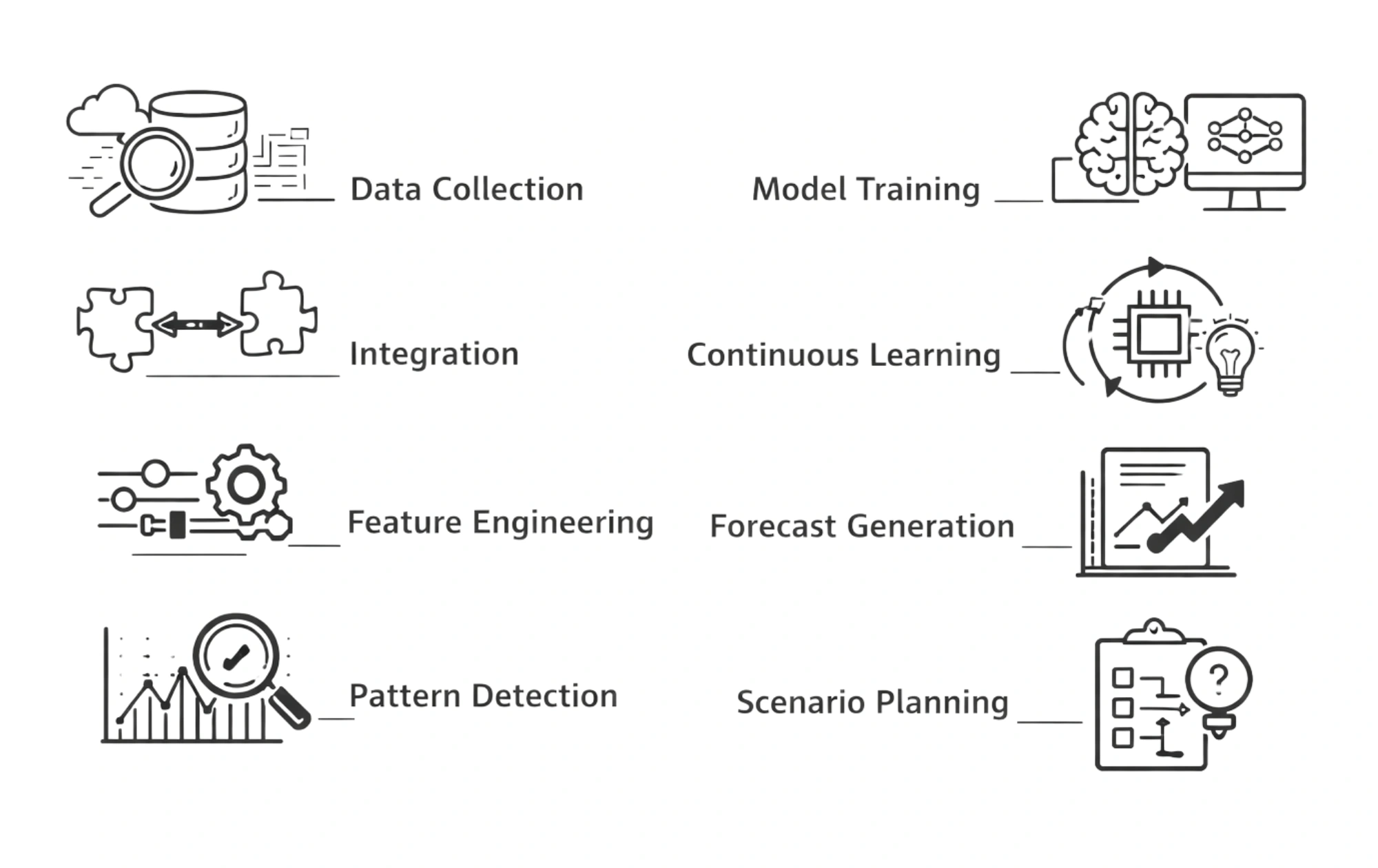
AI-driven demand forecasting follows a structured forecasting pipeline that transforms raw data into actionable insights. Unlike manual approaches, an AI forecasting workflow is automated, adaptive, and designed to support real-time decision-making.
By combining multiple data sources with advanced algorithms, AI enables predictive analytics for demand forecasting, helping businesses anticipate demand shifts before they impact operations. Below are the key components of demand forecasting that work together to improve accuracy and responsiveness.
-
Data Collection and Integration
AI systems ingest large volumes of data from internal systems such as ERP, CRM, and supply chain platforms, as well as external data sources such as market trends, weather, and economic indicators. This stage often relies on big data analytics services to unify and efficiently process structured and unstructured data.
-
Feature Engineering and Pattern Detection
Relevant demand drivers are identified and transformed into features that the model can analyze. AI detects hidden patterns, seasonality, correlations, and anomalies that traditional models often miss.
-
Model Training and Continuous Learning
Machine learning models are trained on historical data and continuously updated as new data flows in. This learning loop allows forecasts to improve over time without manual recalibration.
-
Forecast Generation and Scenario Planning
AI generates forecasts across different time horizons and supports what-if analysis. Techniques like demand sensing and real-time demand forecasting help organizations respond quickly to sudden demand changes.
Key AI Forecasting Models for Demand Prediction
Modern AI demand forecasting models adapt continuously. Enterprises today rely on a mix of traditional, machine learning, and deep learning approaches, often supported by a robust AI tech stack to build reliable, AI-driven forecasting solutions.
1. Traditional Statistical Models
Traditional time-series techniques such as moving averages and exponential smoothing have long been used for demand forecasting. Models like ARIMA demand forecasting analyze historical patterns to project future demand.
Why do they struggle with complexity?
- Assume linear and stable demand patterns
- Limited ability to process multiple influencing variables
- Require frequent manual tuning when conditions change
2. Machine Learning Models
These models represent a significant advancement in demand forecasting using machine learning. Algorithms such as random forest demand forecasting and XGBoost forecasting excel at identifying complex relationships across large datasets.
Key strengths include:
- Handling nonlinear demand patterns
- Incorporating hundreds of internal and external features
- Delivering higher accuracy with less manual intervention
3. Deep Learning Models
For highly complex scenarios, deep learning demand forecasting models provide superior performance. Techniques like LSTM demand forecasting and neural networks forecasting are designed to analyze sequential data and long-term dependencies.
Key advantages:
- Mastery of time-dependent demand patterns
- Effective for high-volume, multi-SKU forecasting
- Strong performance in high-frequency data environments
4. Hybrid and Ensemble Models
To balance accuracy and stability, many enterprises deploy hybrid forecasting models and ensemble demand forecasting approaches. These models combine multiple techniques, such as statistical, machine learning, and deep learning, to reduce risk and improve reliability across varying demand conditions.
AI Forecasting Techniques Used in Demand Planning
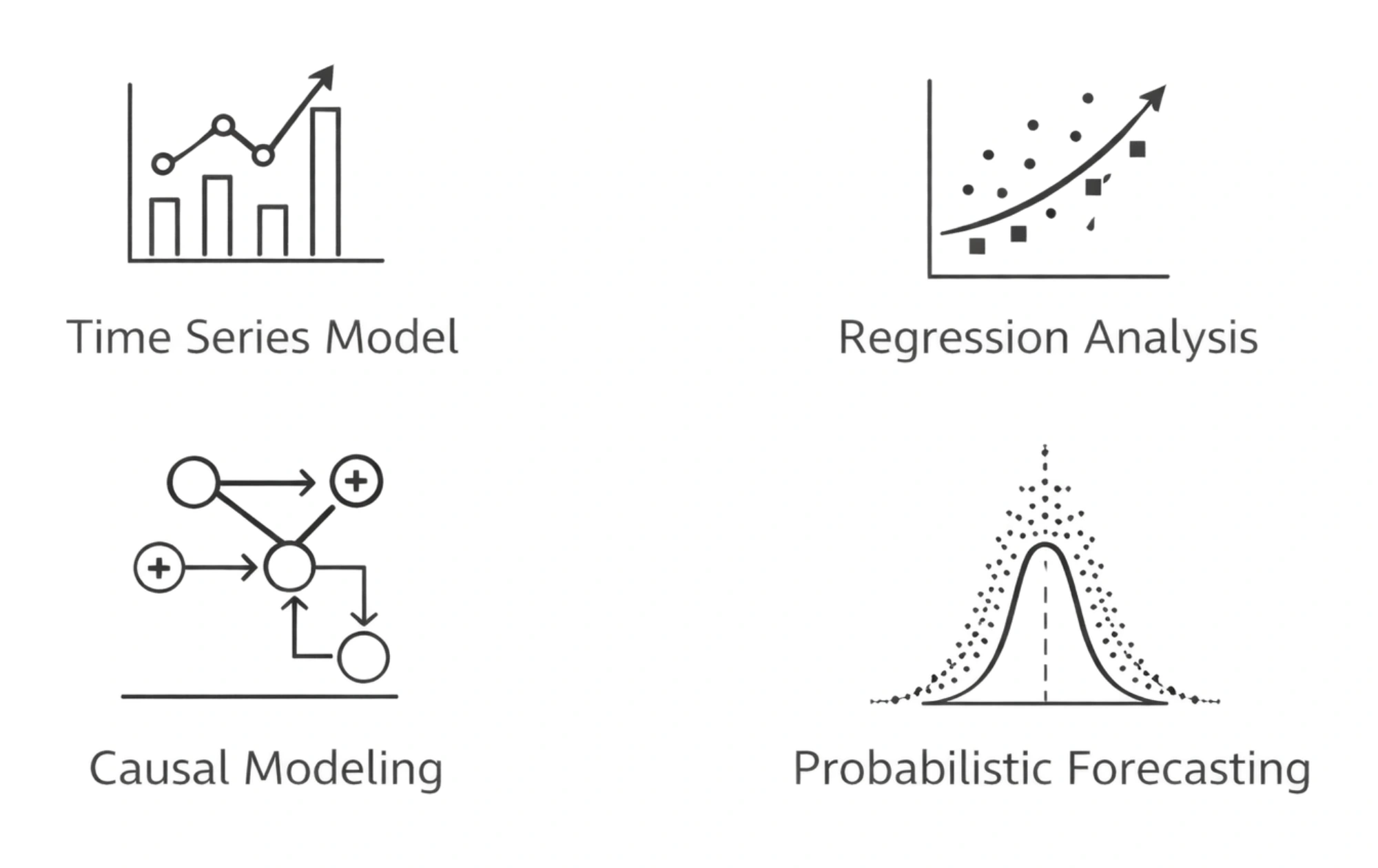
Modern demand planning relies on a range of AI forecasting techniques that go well beyond traditional averages and trendlines. These techniques form the analytical core of intelligent forecasting systems. Let’s look at the multiple demand forecasting techniques in detail.
-
Time Series Model
AI-enhanced time-series pattern recognition techniques identify seasonality, trends, cycles, and anomalies in historical demand data. This technique adapts quickly to changing patterns, making it effective in volatile markets.
-
Regression Analysis
Regression-based methods analyze the relationship between demand and multiple influencing variables. AI-powered multivariate analysis processes large numbers of variables simultaneously to uncover diverse demand drivers.
-
Causal Modeling
Causal modeling focuses on understanding why demand changes, not just how it changes. AI evaluates the impact of pricing strategies, promotional campaigns, weather conditions, and external events on demand to understand how specific actions influence outcomes.
-
Probabilistic Forecasting
Instead of producing a single demand number, probabilistic forecasting generates a range of possible outcomes with confidence intervals. This approach helps organizations manage risk, plan for uncertainty, and select the most appropriate response.
These types of demand forecasting methods enable enterprises to build flexible, data-driven forecasting systems that adapt to real-world complexity and deliver consistent business value.
Benefits of AI in Demand Forecasting
Enterprise demand forecasting becomes more accurate, scalable, and responsive to market changes with the help of AI. These AI forecasting business benefits help organizations move from reactive planning to proactive, data-driven execution.
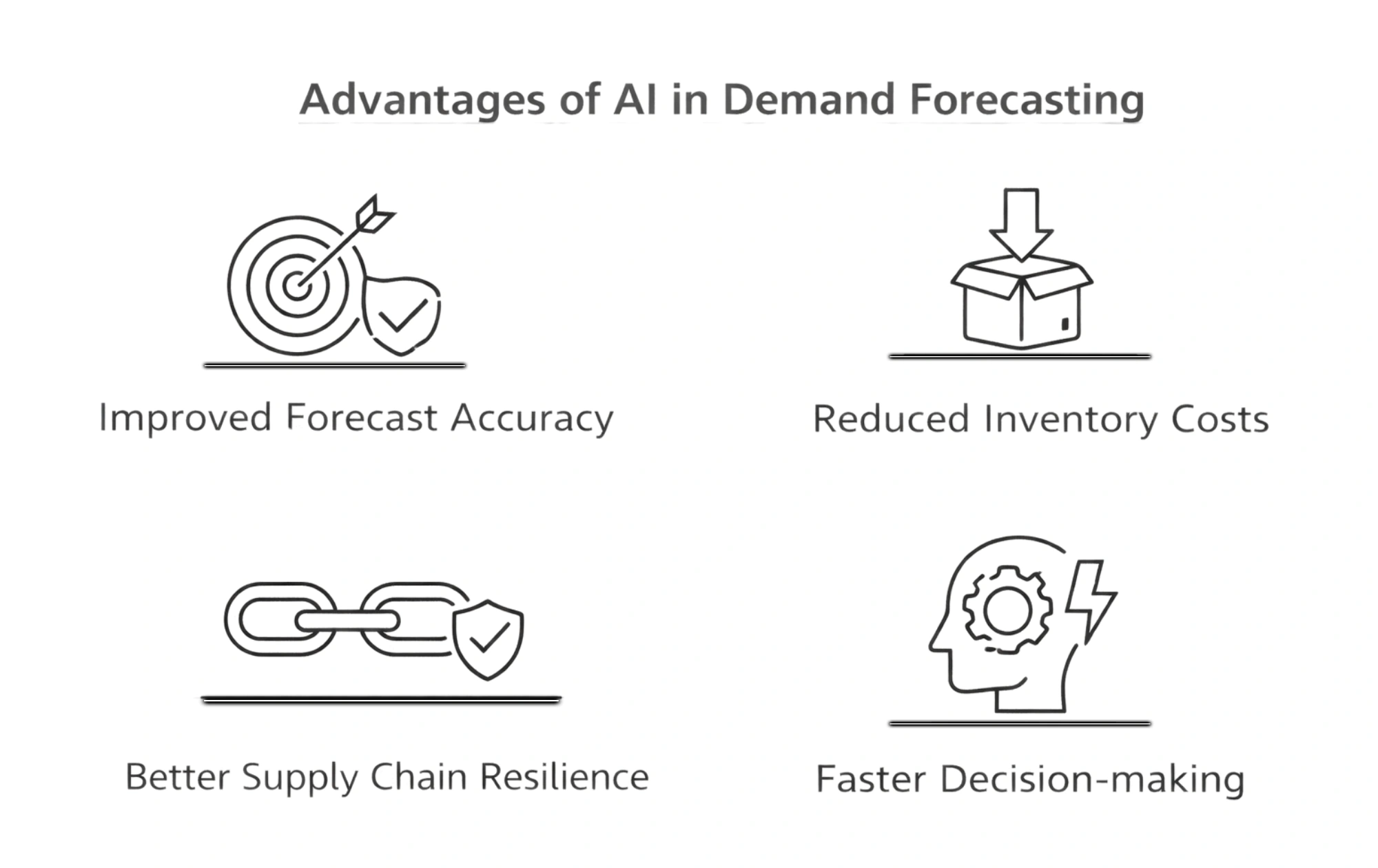
Key advantages of AI based demand forecasting include:
-
Improved Forecast Accuracy
AI models analyze complex patterns and real-time signals, significantly reducing errors compared to traditional approaches
-
Reduced Inventory Costs
Accurate predictions enable inventory optimization using AI, lowering excess stock, minimizing stockouts, and improving cash flow
-
Better Supply Chain Resilience
AI-driven forecasts help organizations anticipate disruptions and adjust procurement, production, and logistics proactively
-
Faster Decision-making
Automated insights allow leaders to act quickly, supporting real-time planning and execution
These advantages also strengthen adjacent business functions such as AI in sales and marketing, where accurate demand signals improve campaign planning, pricing strategies, and revenue forecasting. Over time, organizations realize the expanding scope of demand forecasting beyond supply chain planning into enterprise-wide decision-making.
Real-World Use Cases of AI Based Demand Forecasting
Across industries, AI-led demand forecasting is transforming how enterprises anticipate demand, reduce uncertainty, and make faster decisions. Let’s explore the applications of AI based demand forecasting.
-
Retail and E-commerce
In retail, AI demand forecasting use cases focus on predicting customer demand across channels, regions, and product categories. Using retail demand forecasting AI, businesses analyze:
- Historical sales
- Browsing behavior
- Promotions
- Seasonality
AI also enables omnichannel forecasting, ensuring consistent inventory availability across online stores, marketplaces, and physical outlets. These demand forecasting examples help retailers reduce stockouts, avoid overstocking, and respond quickly to shifting consumer preferences using advanced AI forecasting tools.
-
Manufacturing
The growing role of artificial Intelligence in manufacturing highlights how AI-driven forecasting manages fluctuating demand. Through manufacturing demand forecasting, AI models support accurate production planning by considering:
- Order histories
- Lead times
- Supplier constraints
- Market signals
This allows manufacturers to optimize capacity utilization, reduce material waste, and improve on-time delivery.
-
Supply Chain and Logistics
In supply chain operations, AI enhances visibility and coordination across complex networks. AI supply chain forecasting enables logistics teams to predict demand at:
- Different nodes
- Plan transportation needs
- Manage warehouse capacity
By combining forecasts with inventory optimization, enterprises can balance service levels with cost control. These enterprise AI forecasting applications enhance resilience by enabling proactive responses to disruptions, including delays, demand spikes, and supplier issues.
-
Healthcare and Pharmaceuticals
Healthcare organizations use healthcare demand forecasting to anticipate patient needs, medical supply usage, and treatment demand. In pharmaceuticals, pharma forecasting AI helps:
- Predict drug demand across regions
- Account for regulatory requirements,
- Seasonal illnesses
- Population trends
AI-driven automated demand forecasting reduces medicine shortages, minimizes wastage, and supports better planning for critical healthcare resources.
-
BFSI and Energy
In BFSI, AI supports financial forecasting by predicting:
- Customer demand for loans
- Insurance products
- Digital services.
Similarly, energy providers rely on AI for energy demand forecasting to:
- Balance supply and demand
- Manage peak loads
- Support sustainability goals
These industries increasingly depend on enterprise forecasting software to deliver accurate, real-time forecasts that support regulatory compliance and long-term planning.
How to Implement AI Based Demand Forecasting
Implementing AI-based demand forecasting requires a structured approach that aligns business goals, data readiness, and technology to deliver accurate forecasts. Let’s look at the implementation steps in demand forecasting for term operational value.
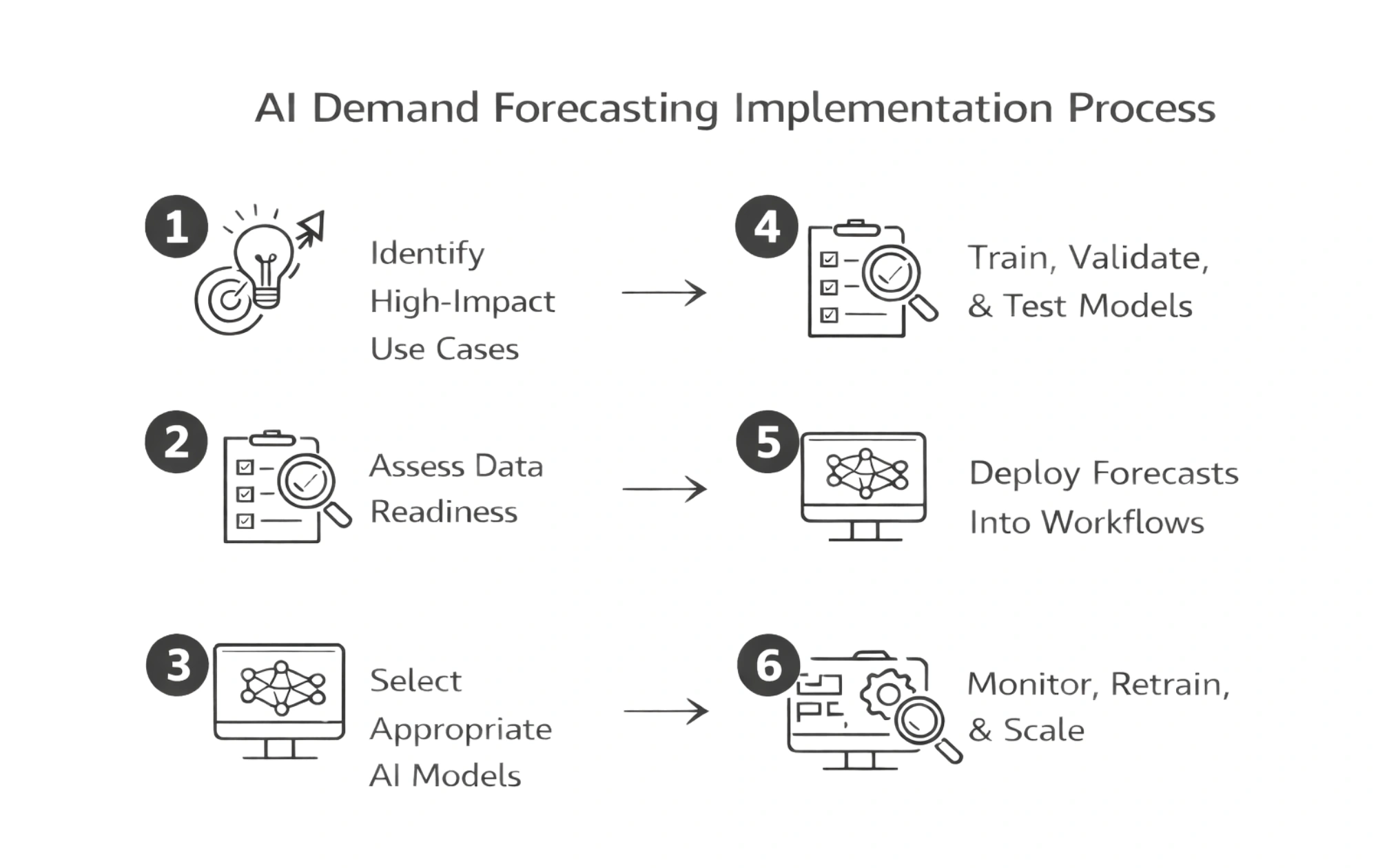
Step 1: Identify High-Impact Demand Forecasting Use Cases
Begin by defining where AI demand forecasting can create immediate business value. Prioritize use cases with high demand volatility, revenue impact, or inventory risk to ensure faster returns.
Step 2: Assess Data Readiness and Integrate Data Sources
AI forecasting depends on clean, unified data. Integrate ERP, CRM, and SCM systems to build a strong foundation for AI-powered planning systems. Address data gaps, inconsistencies, and silos early.
Step 3: Select Appropriate AI Models
Choose forecasting models based on data volume, demand complexity, and planning horizons. The goal is not the most complex model, but rather one aligned with real business needs and predictive demand-planning objectives.
Step 4: Train, Validate, and Test Models
Train models using historical data and validate results against real outcomes. Testing ensures accuracy, reliability, and trust before scaling the AI demand forecasting implementation.
Step 5: Deploy Forecasts Into Workflows
Embed AI-generated forecasts into dashboards and planning tools so teams can act on insights in real time rather than treating forecasts as standalone reports.
Step 6: Monitor, Retrain, and Scale Gradually
Continuously monitor performance and retrain models as demand patterns evolve. Strong cross-functional collaboration between supply chain, sales, IT, and analytics teams is critical for adoption and change management.
Many enterprises partner with experienced AI development companies to start small, prove value quickly, and scale AI-driven demand forecasting across the organization with confidence
Challenges in AI Based Demand Forecasting and Their Solutions
Despite its advantages, demand forecasting using AI presents challenges related to data, systems, and people that enterprises must address to achieve reliable forecasts.
Challenge 1: Data Quality and Bias
One of the most common AI demand forecasting challenges is poor data quality. Incomplete, inconsistent, or biased data leads to unreliable predictions and amplifies uncertainties in demand forecasting.
Solution:
Establish strong data governance, standardize data sources, and continuously audit datasets.
Challenge 2: Model Explainability
Many AI models function as “black boxes,” making it difficult for business users to understand or trust predictions. This is a key limitation of AI forecasting.
Solution:
Adopt explainable AI techniques that clearly show demand drivers and reduce demand forecasting risks.
Challenge 3: Integration with Legacy Systems
Integrating AI solutions with existing ERP, SCM, and legacy platforms remains one of the major factors affecting demand forecasting effectiveness.
Solution:
A well-defined IT transformation strategy enables seamless system integration, ensures data continuity, and supports scalable AI deployment.
Challenge 4: Change Management
Resistance to new processes and tools can slow adoption and limit the impact of AI’s demand forecasting.
Solution:
Promote cross-functional collaboration, provide user training, and introduce AI gradually so forecasts are trusted, used, and continuously improved.
Best Practices for Accurate AI Based Demand Forecasting
Accurate demand forecasting depends on more than algorithms. It requires the right data foundation, business alignment, and disciplined execution to ensure forecasts are trusted, actionable, and scalable.
Demand forecasting best practices include:
- Focus on areas with clear business value, such as high-volume SKUs or volatile demand segments.
- Reliable forecasts depend on high-quality, integrated data and supply chain systems that support AI-powered planning.
- Balance accuracy with interpretability to accelerate adoption across teams involved in predictive demand planning.
- Forecasts must integrate seamlessly into planning workflows so stakeholders can act confidently
- Successful AI in forecasting requires strong governance, monitoring, and alignment with enterprise goals.
When supported by expert AI transformation services, organizations can operationalize these practices effectively and scale forecasting initiatives without disrupting existing processes.
Future Scope of Demand Forecasting using AI
The future of demand forecasting lies in intelligent, self-learning systems that adapt in real time, automate decisions, and continuously evolve.
Key trends in AI based demand forecasting include:
-
Generative AI in Forecasting
Generative models enable advanced scenario simulation, demand sensing, and what-if analysis, making generative AI in demand forecasting a powerful tool for planning under uncertainty.
-
Real-time Adaptive Forecasting
Enterprises are moving toward real-time demand forecasting, where AI continuously updates predictions as new data streams in.
-
AI-driven decision automation
Forecasts increasingly trigger automated actions across procurement, production, and distribution, accelerating autonomous demand planning.
-
Self-learning supply chains
With AI agents for demand forecasting, systems learn from outcomes, optimize planning cycles, and improve accuracy without manual intervention.
As AI forecasting trends continue to evolve, organizations will rely more on AI-driven forecasting solutions to anticipate demand shifts earlier, respond faster to disruptions, and build resilient, future-ready supply chains capable of operating at scale.
Leverage SparxIT’s Expertise in AI Development Services for Demand Forecasting
SparxIT helps enterprises transform demand planning with custom and scalable AI solutions that improve forecast accuracy, automate planning workflows, and align forecasting outcomes with real business objectives.
How SparxIT supports AI based demand forecasting:
- We offer AI-based demand forecasting app development tailored to industry-specific demand patterns and enterprise workflows
- Our developers design and deploy AI-powered forecasting solutions that adapt to changing market conditions
- We also integrate with ERP, CRM, and supply chain platforms to deliver enterprise forecasting software with real-time insights
- Our experts provide end-to-end AI demand forecasting implementation, from data strategy and model development to deployment and optimization.
Backed by proven AI development services, SparxIT enables organizations to start small, scale confidently, and operationalize AI-driven demand forecasting with measurable business impact.

Partner with Experts
Frequently Asked Questions
What is AI forecasting?


AI forecasting uses machine learning and advanced analytics to predict future outcomes by learning from historical, real-time, and external data, continuously improving accuracy as conditions change.
How is AI transforming demand forecasting?
AI transforms demand forecasting by replacing static models with adaptive systems that sense demand changes early, automate analysis, and deliver faster, data-driven insights for better planning decisions.
How accurate is AI-based trend forecasting?
AI-based trend forecasting is significantly more accurate than traditional methods, often improving forecast accuracy by 20–40%, especially in volatile markets with complex demand patterns.
Can AI agents for demand forecasting work with limited data?
Yes, AI agents can work with limited data by using transfer learning, hybrid models, and external data sources to generate reliable forecasts even in early-stage or low-volume scenarios.
How does AI improve project timeline forecasting?
AI analyzes historical project data, dependencies, and resource utilization to predict delays, optimize schedules, and adjust timelines dynamically as conditions change.
How long does it take to implement AI based demand forecasting?
A pilot implementation typically takes 8–16 weeks, while a full enterprise rollout may take 3–6 months, depending on data readiness and system integrations.
Is demand forecasting using AI suitable for startups?
Yes, startups can benefit by starting small with focused use cases, gaining early accuracy improvements, and scaling AI forecasting as data volume and business complexity grow.