A company can approve an AI tool in a week and spend the next six months trying to make it useful. The data may sit in separate systems. Employees may not know when to trust an answer. Security teams may discover that sensitive information is being sent to a service they have not reviewed. An AI readiness checklist for business teams can expose these issues before the organization commits to a rollout.
These problems often appear when an organization starts with the technology and works backward to the business need. A better starting point is to assess what the business wants to improve and what must be in place to support that change.
This checklist of business readiness for AI gives leaders, technology teams, and finance stakeholders a practical way to review those conditions. It covers eight areas, from the problem being solved to the people who will operate the system.
Additionally, you will also find a simple score, a way to rank gaps, and a 30/60/90-day plan. The goal is to make a sound decision for a specific use case, whether that means starting a pilot, closing a few gaps, or waiting.
Key Takeaways
|
What Is AI Readiness?
AI readiness is an organization’s ability to adopt AI safely and profitably. It spans strategy, leadership and budget, data, technology, security, governance, people, and day-to-day operations. Because a company can be ready for one AI project and not another, readiness is always judged against a specific use.
Think of it as an AI project’s pre-flight check. A flight crew confirms fuel, instruments, and weather before take-off, because a problem found on the ground costs far less to fix than one found in the air.
Readiness is easy to confuse with an AI maturity model. A maturity model describes how advanced your current use of AI is. Readiness is the go/no-go check you run before investing in the next project.
Why Run an AI Readiness Checklist Before You Invest?
Costly surprises in AI projects tend to surface after the budget is spent, when they are hardest to fix. A short assessment up front helps in four ways:
It keeps pilots from stalling. A pilot is a small, time-limited trial, and many stall because they lack data or a clear owner from day one.
It avoids paying for the same data work twice: once to rush a demo, and again to make it fit for real use.
It brings compliance costs into view while they can still be planned and budgeted.
It gives the leadership team one shared baseline and shows which project to start with.
The research backs this up. Gartner predicts that by 2026, organizations will abandon 60% of AI projects that ignore data governance.
Cisco’s 2025 AI Readiness Index shows how far ahead the best-prepared companies are. Read each row as the share of companies that have a capability in place.
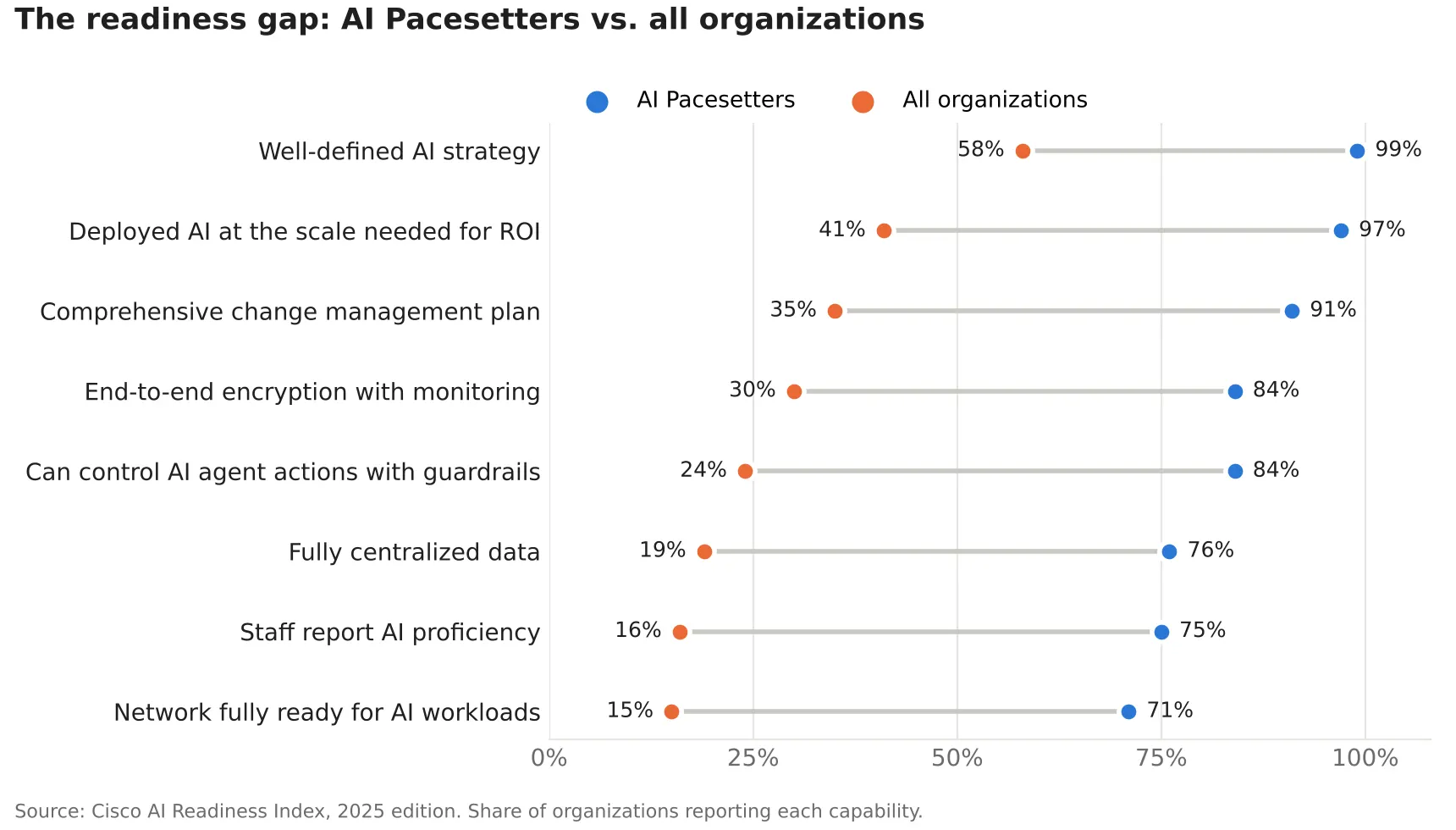
Blue marks the leading group Cisco calls Pacesetters.
Orange marks all organizations surveyed.
Using the AI readiness checklist leads to clearer investment decisions. Leaders can compare expected benefits with the work and risk required to achieve them, then consult an AI development company with fewer unknowns.
The 40-Point AI Readiness Checklist: 8 Areas to Assess
The checklist has eight areas, each with five questions. Together they form a simple AI readiness framework. Use it as an AI readiness assessment checklist that your leadership team can complete in one sitting.
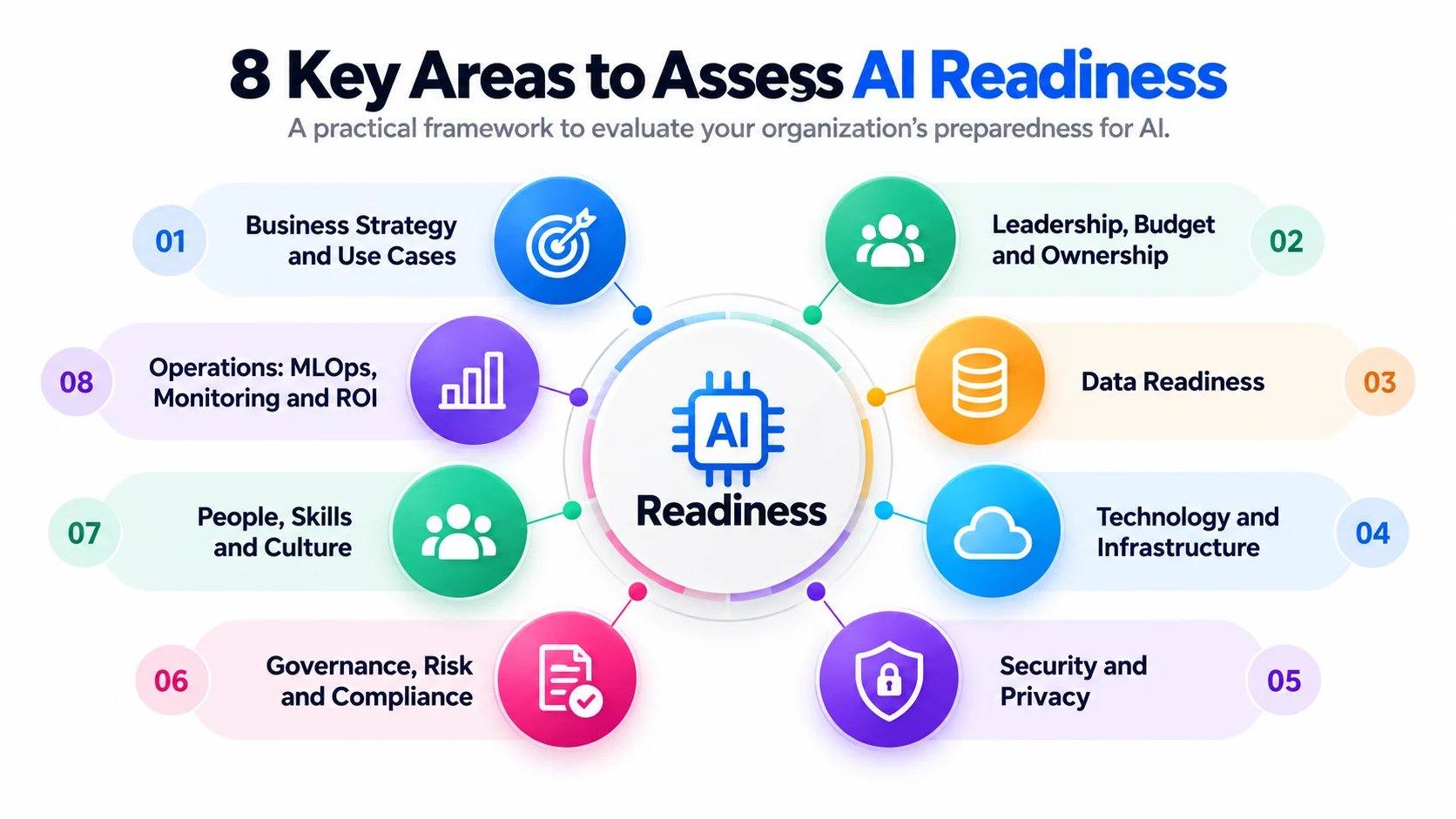
1. Business Strategy and Use Cases
A use case is one specific job you want AI to do, such as reading invoices or answering customer questions.
1.1 Do we have three to five written use cases, each tied to a business problem rather than a tool?
1.2 Does each one have a measurable target, such as cost, time, revenue, or error rate?
1.3 Have we rated each one for value and for how hard it will be to deliver?
1.4 Is there a named business owner for each use case?
1.5 Do we know what success looks like for a 90-day pilot?
2. Leadership, Budget and Ownership
AI projects cut across departments, so a senior leader must own decisions and the budget.
2.1 Is there an executive sponsor with the authority to make decisions?
2.2 Is budget approved for data work and staff training, not only for the AI software?
2.3 Is there a steering group that includes business, IT, data, legal, and security?
2.4 Are AI projects linked to the company’s wider plan?
2.5 Is there a clear rule for when to stop or continue a pilot?
3. Data Readiness: Is Your Data AI-Ready?
AI depends on your data. AI-ready data is accurate, reachable by your systems, and legally usable. Whether you have it depends on data quality and governance, data ownership rules, who checks it, and who can use it.
3.1 Do we know where the data for each use case lives and who owns it?
3.2 Can systems reach it automatically through APIs (standard software connections) or data pipelines, instead of manual exports?
3.3 Have we measured its quality: completeness, accuracy, duplicates, and how up-to-date it is?
3.4 Do we have the legal right and customer consent to use it for AI?
3.5 Is there enough historical or labeled data for the use case?
4. Technology and Infrastructure
This is the plumbing. AI infrastructure and systems integration cover the computing power, connections, and environments that let AI run reliably at a predictable cost. If that work is beyond your team, AI integration services can fill the gap.
4.1 Can our cloud or in-house servers handle the extra computing load AI needs?
4.2 Can AI results flow into core systems such as ERP, CRM, or patient records?
4.3 Have we chosen how to source the model: a paid service, open-source, a customized model, or a custom build?
4.4 Do we have separate environments for building, testing, and live use?
4.5 Have we estimated usage fees, the cost each time the AI handles a request, at expected volumes?
5. Security and Privacy
AI tools read and produce sensitive information, so they need the same protection as any system holding customer or financial data.
5.1 Is sensitive data identified and masked before it reaches an AI model?
5.2 Does security review outside AI tools before staff use them?
5.3 Do AI systems control who can access them and keep logs of what they do?
5.4 Have we tested for prompt injection (hidden instructions that trick an AI) and data leaks?
5.5 Does our incident response plan cover AI failures?
6. Governance, Risk and Compliance
Governance means deciding what AI may and may not do, documenting it, and being able to prove it later. It includes human-in-the-loop oversight, where a person checks or approves the AI’s high-impact decisions.
6.1 Is there a written AI use policy that employees know about?
6.2 Is each use case rated by risk level?
6.3 Are models tested for bias, accuracy, and drift (accuracy slipping over time) before launch?
6.4 Does a person review decisions with a high impact on customers or the business?
6.5 Are models, data sources, and decisions documented for audit?
7. People, Skills and Culture
Results depend on the people asked to trust the output, so AI literacy and change management need their own plan and budget.
7.1 Have we compared the skills we have with the skills we need?
7.2 Is there basic AI training for non-technical staff?
7.3 Do employees know how AI will change their roles?
7.4 Do frontline users help design and test solutions?
7.5 Is there a plan to hire, train, or partner to fill the gaps?
8. Operations: MLOps, Monitoring and ROI
Live AI needs routine care, like any critical system. MLOps/LLMOps is the name for that work: managing AI models in production, including updates and fixes. AI model evaluation and monitoring checks weekly to ensure answers remain accurate.
8.1 Can we release new versions of a model, track them, and roll back if needed?
8.2 Do we monitor performance and drift once the AI is live?
8.3 Can users flag poor results so they get fixed?
8.4 Are KPIs tracked against the target set in question 1.2?
8.5 Is there a plan to scale a successful pilot?
How to Score Your AI Readiness Assessment
Score each of the eight areas from 0 to 2. Use the same standard for every area and record why you assigned the score. A team should not receive full credit for a capability that exists only in a plan.
| Score | Meaning | What counts as evidence |
| 0 | Not in place | No clear owner, process, control, or documented capability exists yet. |
| 1 | Partly in place | Some work has started, but the approach is incomplete, inconsistent, or not supported by evidence. |
| 2 | In place and evidenced | The capability is documented, operating, and supported by records, tests, or clear ownership. |
Add the eight scores for a maximum of 16 points. These bands are practical guidance, not an industry certification or universal standard:
- 0–5: Foundational gaps. Clarify the goal and address basic data, ownership, and control gaps before a pilot.
- 6–10: Priority gaps remain. Resolve the highest-impact gaps and reassess before committing to a pilot.
- 11–13: Potentially pilot-ready. Consider a narrow pilot with safeguards, clear measures, and active oversight.
- 14–16: Stronger starting point. Consider a scoped deployment after critical risks and operating ownership are confirmed.
Keep a short scorecard for each area. It should record the score, evidence, gap, owner, and next action. Repeat the review when the use case changes, a new vendor or data source is introduced, or the operating environment changes.
KNOCKOUT ITEMS
Three questions can stop a project on their own. If 1.4 (a named business owner), 3.4 (the legal right to use the data), or 5.2 (a security review of AI tools) scores 0, pause the project, whatever the total.
Is Your Organization Ready for Generative AI and AI Agents?
Generative AI and AI agents need six extra checks, because they create content and can act on their own. Generative AI writes text, images, or code. AI agent development services goes a step further and carries out tasks, such as updating a record or issuing a refund.
A standard AI adoption checklist rarely covers these risks, so use the six checks below alongside the main 40:
- Your knowledge base is clean enough for RAG, the method that lets AI answer from your own documents.
- An approved list of AI tools limits shadow AI, staff using unapproved tools.
- Answers are tested for hallucinations, meaning confident but wrong answers.
- The system is tested against prompt injection and data leaks.
- Agents get only the system access they need for their task.
- A person approves any action that moves money, changes data, or affects customers.
- Gartner predicts that over 40% of agentic AI projects will be canceled by the end of 2027, citing rising costs, unclear business value, or weak risk controls.
EXAMPLE: An internal assistant that answers HR policy questions is a sensible first project because it’s easy to spot and correct a wrong answer. An agent that issues customer refunds should wait until security and governance score close to full marks.
Which AI Regulations Should Your Readiness Plan Cover?
Most companies should check four frameworks. Two are laws with penalties, and two are voluntary standards that provide a tested structure for AI governance and responsible AI.
| Framework | Applies to | What to check |
| EU AI Act | Businesses that offer or use AI in the EU | The risk tier of each use case and the obligations that come with it |
| NIST AI RMF | Voluntary, widely used in the US | Its four functions: Govern, Map, Measure, and Manage |
| ISO/IEC 42001 | Companies that want certifiable AI management | An AI management system and its controls |
| India DPDP Act 2023 | Personal data of people in India | Consent, limits on how data is used, and individuals’ rights |
The penalties are large enough to matter at board level. For the most serious breaches, EU AI Act fines can reach €35 million or 7% of worldwide annual turnover, whichever is higher.
This section is general guidance, not legal advice. Confirm your obligations with legal counsel, and see our DPDP compliance services for India’s data protection rules.
How to Prioritize AI Use Cases After the Assessment
Rate each candidate project on two things: the value it would create, and how feasible it is with the readiness you have today. This simple grid is the core of use-case prioritization and AI ROI planning.
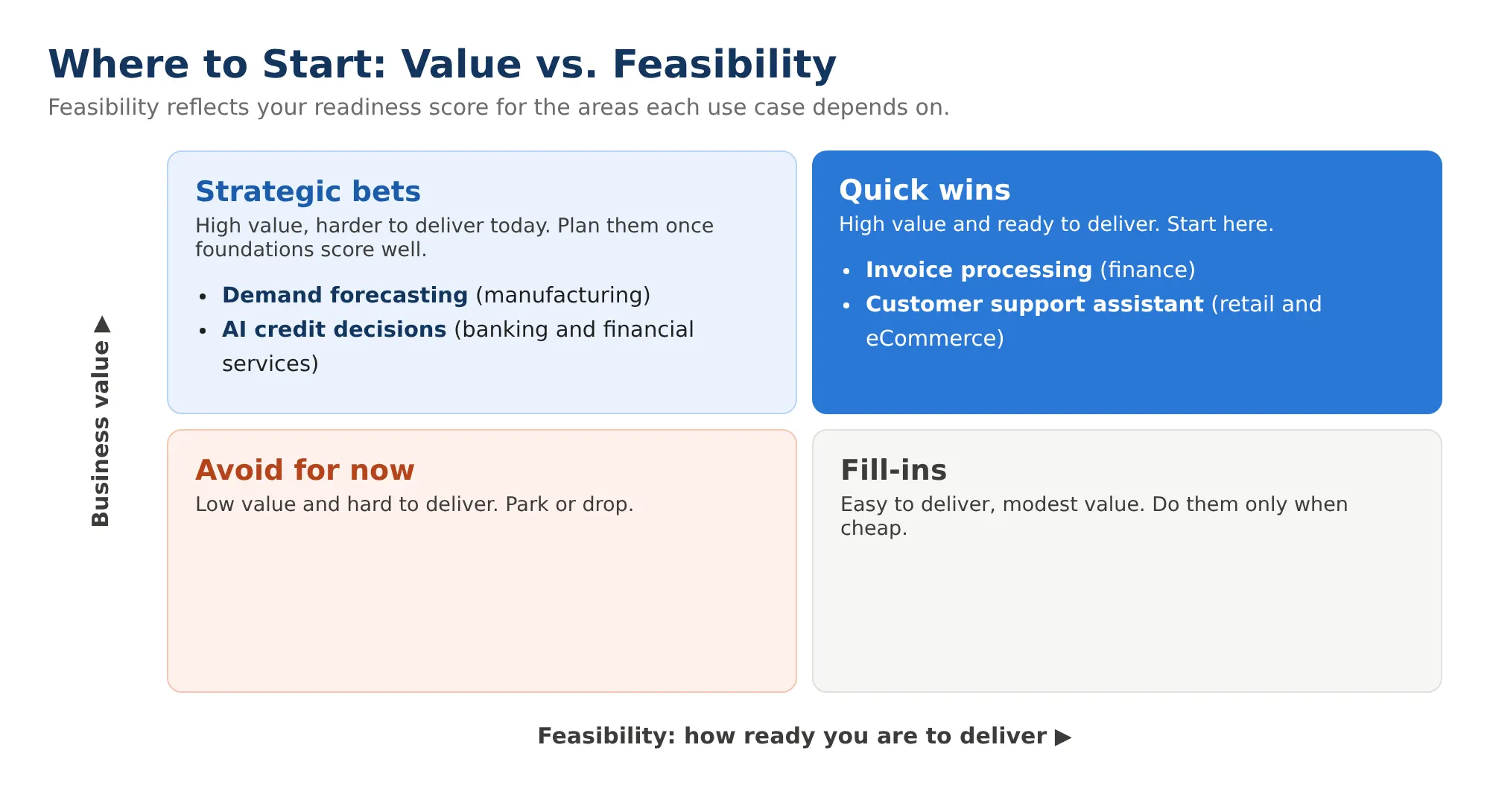
- Invoice processing in finance is usually a quick win: the documents are digital, the rules are clear, and time saved is easy to measure.
- A customer support assistant in retail or eCommerce can also be a quick win when product and policy content is current.
- Demand forecasting in manufacturing is a strategic bet, because it needs years of clean sales and supply data.
- AI credit decisions in banking are also a strategic bet. The value is high, but the EU AI Act treats individual credit scoring as high-risk.
Build, Buy or Partner: What Fits Your Score and Budget?
Your score points to the right route:
- Build when you score high and have your own AI team.
- Buy when the need is standard, and your data isn’t unique.
- Partner when two or more areas score low, or when speed matters.
Whichever route you choose, plan for six cost lines: data cleanup, infrastructure, AI usage fees, staff or partner fees, security and compliance, and training.
In McKinsey’s 2026 survey, 20% of respondents said operating costs limit their use of AI. Ask every vendor for the monthly running cost and the build price so the budget covers the cost of keeping the system running.
Four Questions To Ask an AI Partner
- How do you protect our data, and which certifications back that up?
- What have you delivered in our industry?
- Who owns the models, code, and other work you build for us?
- What support do you provide after launch?
A 90-Day Roadmap From Assessment to First AI Pilot
A first AI pilot can go from assessment to a measured result in about 90 days. Treat the three phases below as your AI implementation checklist, and finish each one before the next begins.
Days 1–30: Choose the problem and assess readiness
- List candidate use cases and choose one business problem with a clear owner.
- Map the current workflow, systems, and data needed for the task.
- Record baseline measures, such as processing time, error rate, or cost per case.
- Complete the checklist and identify blockers involving permissions, security, ownership, or data quality.
Days 31–60: Close gaps and prepare the pilot
- Address the highest-priority gaps and confirm vendor, security, and governance requirements.
- Prepare representative test cases, including unusual or difficult examples.
- Set acceptance thresholds and define what will cause the team to stop or roll back.
- Train pilot users and explain where human review remains necessary.
Days 61–90: Test, measure, and decide
- Run the pilot with a limited user group and controlled access.
- Compare results with the baseline and gather user feedback.
- Review incidents, operating costs, quality, and support needs.
- Decide whether to stop, improve the pilot, or expand it based on the evidence.
At each stage, keep the decision record short: what was tested, what the team learned, what remains unresolved, and who approved the next step. If the pilot misses its target, investigate the cause before increasing the budget.
Which KPIs Prove Your AI Readiness Is Paying Off?
Track two kinds of KPIs: leading indicators that show readiness improving, and lagging indicators that show time and money saved.
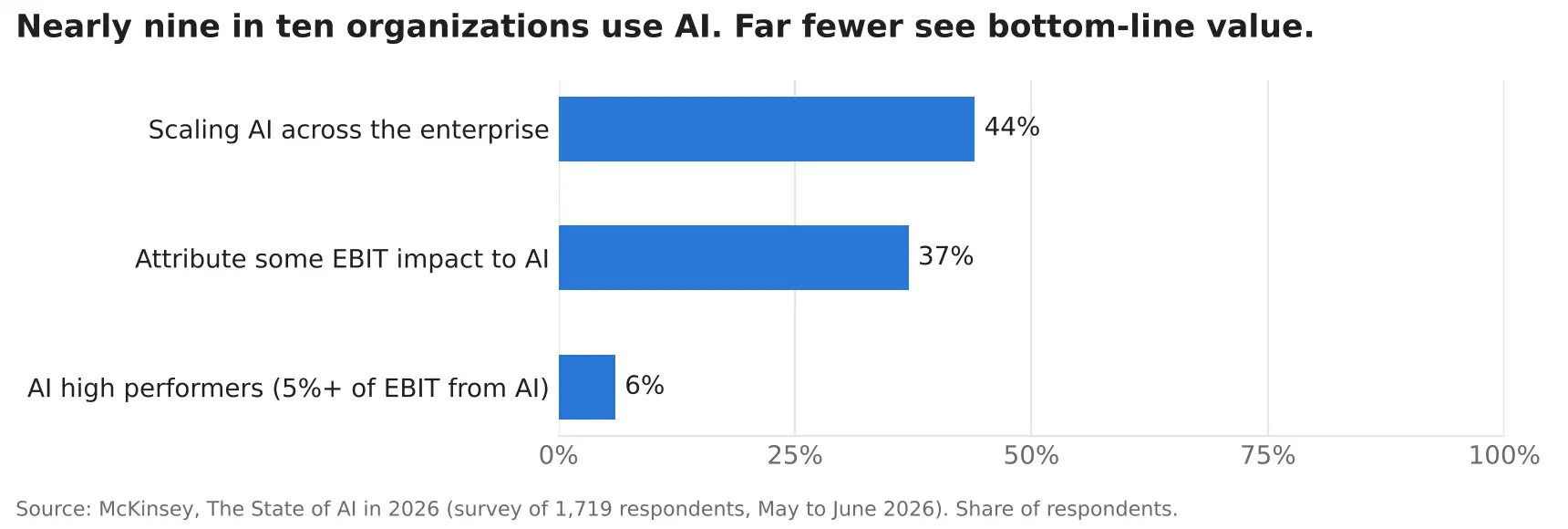
Measurement is part of what separates the leaders. McKinsey’s 2026 survey found that nearly nine in ten organizations use AI regularly, but only 37% attribute any operating profit (EBIT) to it. Top performers are twice as likely as others to have clear ways to measure AI’s impact. Our guide to generative AI for business covers the case in more detail.
- Leading indicators: the share of priority data sources your systems can reach, the number of staff trained in AI basics, and the number of use cases with an owner and a baseline.
- Lagging indicators: time or cost saved per process, how many intended users actually use the tool, accuracy in live use, and payback period.
FOR THE CFOs
Payback period = total project cost divided by monthly net savings. If a pilot costs $120,000 and saves $10,000 a month after running costs, it pays back in 12 months.
Common AI Readiness Mistakes to Avoid
- Choosing a tool before defining the business problem and the person accountable for the result.
- Assuming data is ready because it exists somewhere in the organization.
- Treating a demo as proof that a system can operate reliably in production.
- Ignoring employees’ use of unapproved AI tools, which may expose company or customer information.
- Underestimating integration, evaluation, training, monitoring, and support costs.
- Leaving security, human oversight, and testing until late in the project.
- Expanding the pilot before the team has met agreed acceptance criteria.
A short review at each decision point can catch these mistakes before they become expensive. Be candid about what is missing. A realistic score gives leaders a better basis for funding and sequencing the work.
Turn Your AI Readiness Assessment Into an Action Plan with SparxIT
A useful readiness review ends with a decision and a named owner for the next step. Review the scores with business, technology, finance, and risk stakeholders. Resolve any critical blocker, then choose a use case with a measurable baseline and a realistic path to testing.
Revisit the AI readiness checklist when the data, vendor, scope, or operating conditions change. That keeps the decision connected to the way the system will actually be used.
If your team needs support turning assessment findings into an implementation plan, we can help you. SparxIT’s AI consulting services team runs readiness assessments with leadership teams and turns the results into a prioritized, cost plan. We provide clear scope, expected output, and decision to support.

Partner with Experts
Frequently Asked Questions
Who should use the AI Readiness Checklist?


Business leaders, IT teams, data specialists, security professionals, and project owners can use it to identify capability gaps, assess risks, and judge whether an AI initiative is feasible across departments.
What is the difference between AI readiness and AI adoption?
AI readiness measures whether strategy, data, technology, skills, and safeguards are in place. AI adoption is the process of introducing AI into workflows and using it effectively across the organization. An AI adoption checklist can help teams track rollout tasks after readiness gaps have been addressed.
What early warning signs indicate my business is falling behind in AI adoption?
Warning signs include stalled pilots, fragmented data, unclear ownership, low employee confidence, unmeasured results, and competitors improving processes while your AI experiments remain disconnected from daily operations and business priorities.
Is security addressed in the AI readiness checklist?
Yes. Review data privacy, access controls, vendor terms, retention, threat exposure, audit logs, incident response, and human oversight. Resolve critical security or compliance risks before deployment or use in production.
What should we do after completing the checklist?
Review scores, document evidence and gaps, assign owners, prioritize blockers, and select a measurable pilot. Set success criteria, timelines, and a review point before expanding the solution widely and safely.
How should organizations prioritize which AI initiatives to fund first?
Rank initiatives by business value, feasibility, data availability, risk, effort, and time to impact. Fund measurable, manageable use cases first, then consider larger investments after pilots demonstrate results with evidence.
What are the most common pitfalls when measuring AI effectiveness?
Common pitfalls include missing baseline metrics, tracking activity instead of outcomes, ignoring operating costs, overlooking user adoption, using unrepresentative tests, and failing to monitor performance after launch in live operations.
What industries are seeing the fastest ROI from early AI readiness assessments?
Results vary by use case and execution. Healthcare, finance, retail, manufacturing, and customer support may benefit when usable data and measurable workflow inefficiencies create clear opportunities for improvement in workflows.