A connected car is no longer simply a vehicle with internet access. In 2026, connected car technology is moving toward vehicles that can sense, communicate, learn, receive software updates, and deliver digital services throughout their lifecycle.
Automakers spent the last two years testing over-the-air updates and monetizable software features in isolated pilots. This year, they moved to global deployment.
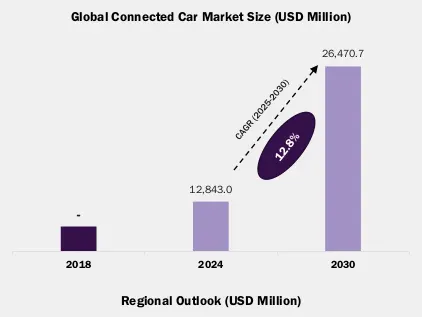
- As per a Grand View Research report, the global connected car market was valued at $12.84 billion in 2024 and is estimated to reach $26.47 billion by 2030, growing at a CAGR of 12.8% between 2025 and 2030.
The growth is not driven by hardware. It is driven by software integrated with technologies like AI, cloud, edge computing, 5G, and V2X communication.
Connectivity is becoming part of the automotive digital transformation, not a standalone infotainment feature. Automakers can use vehicle data to improve safety, personalize experiences, predict maintenance needs, and introduce new software-enabled services.
In this article, we will break down the connected car technology trends in 2026 that matter to enterprise leaders, OEM engineering teams, and fleet operators. These trends also matter to telecom providers and technology partners building the platforms underneath these vehicles.
What Is Connected Car Technology and How Does It Work?
Connected car technology refers to vehicles equipped with sensors, cellular networks, Bluetooth, GPS, Wi-Fi, telematics, or satellite that continuously exchange data with cloud platforms, other vehicles, and surrounding infrastructure. It turns a car from a closed mechanical system into a networked device on wheels.
The stack behind it has five core components:
| Component | What It Does |
| Telematics Control Unit (TCU) | Manages the vehicle’s connection to external cellular, Wi-Fi, or satellite networks |
| Embedded SIM / eSIM | Keeps the connection active without relying on a paired phone |
| Onboard Sensors & ECUs | Capture data from the engine, brakes, tires, and battery |
| Edge Computing Modules | Process time-sensitive data directly inside the vehicle |
| Cloud Backend | Aggregates, analyzes, and stores data at scale |
How Does it Work?
The process can be understood as a continuous data loop:
- Step 1: Onboard sensors capture a signal, such as a drop in tire pressure or an unusual battery temperature.
- Step 2: The telematics control unit transmits that signal over a cellular or satellite network.
- Step 3: Cloud platforms process the data.
- Step 4: Data analytics services and AI identify patterns or events, and the resulting insight triggers an action.
- Step 5: That action might be a maintenance alert, a navigation recommendation, a safety warning, or an OTA software update.
- Step 6: The system pushes an alert or recommendation back to the driver, a fleet manager, or the OEM’s service network.
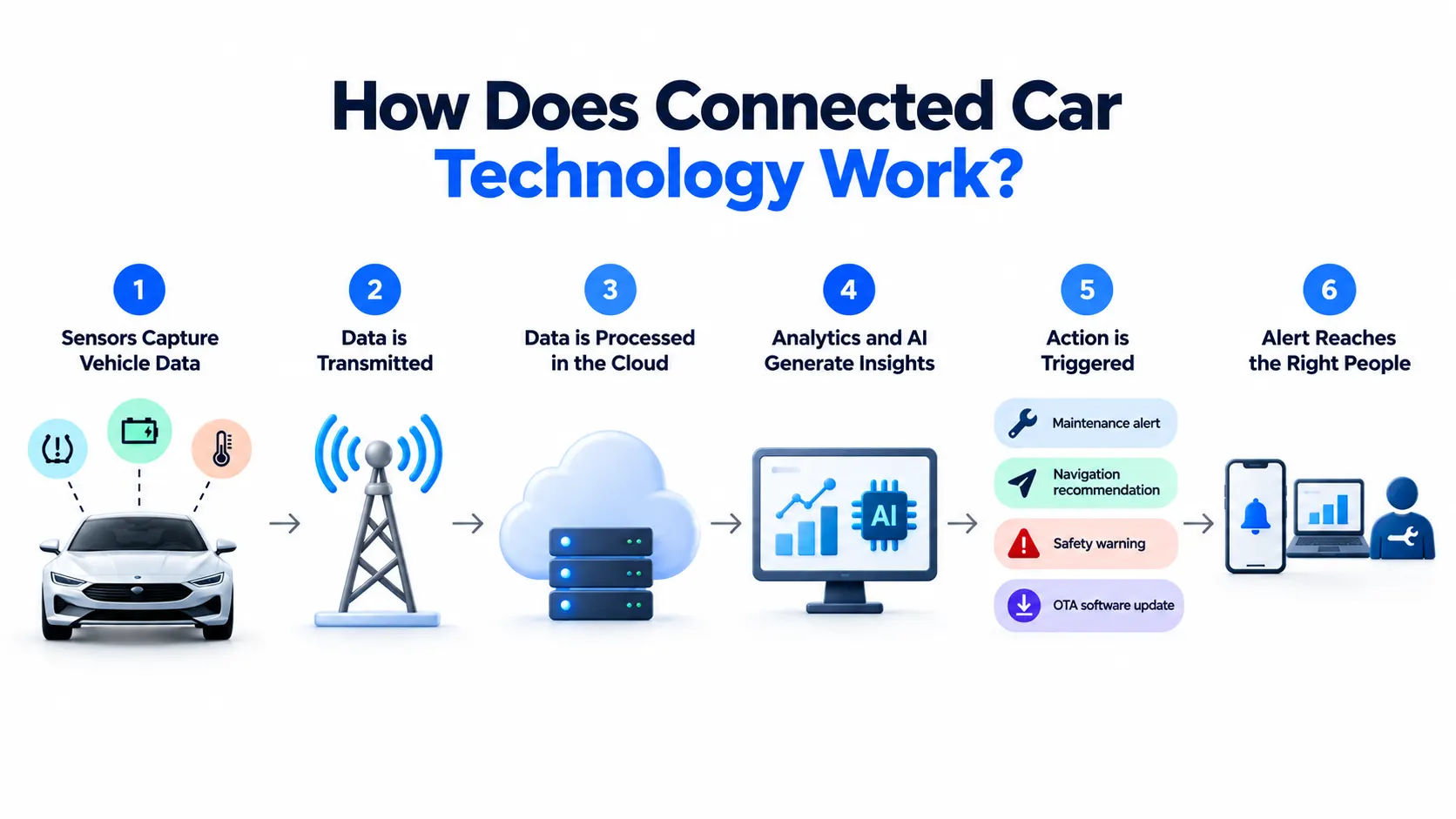
That loop is what makes connected vehicle technology valuable. Predictive maintenance, remote diagnostics, fleet management, driver assistance, personalized cockpits, and over-the-air updates all depend on this same sensor-to-cloud-to-application pathway running reliably across millions of vehicles.
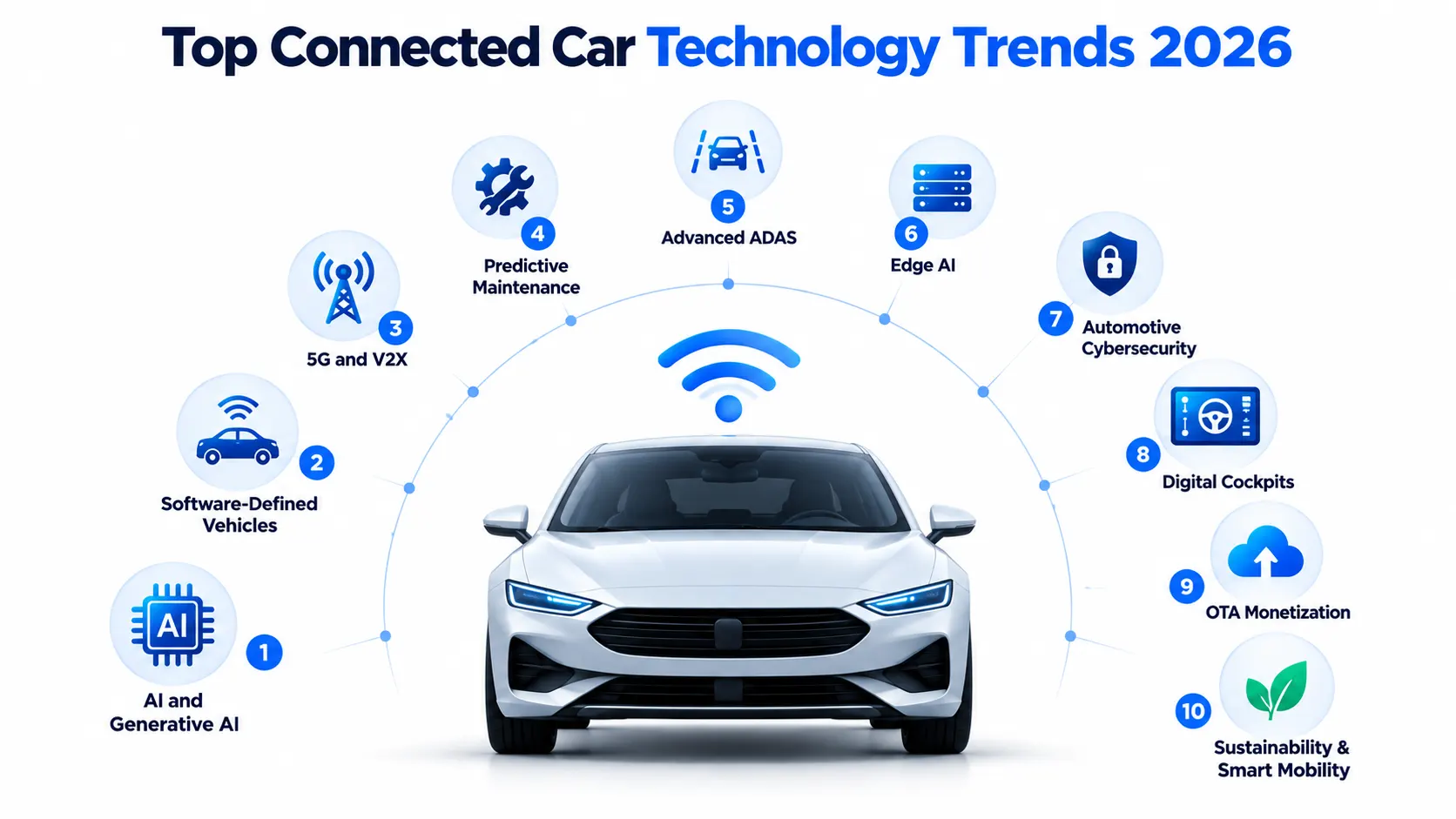
Top 11 Connected Car Technology Trends in 2026
Eleven trends are shaping how enterprises invest in connected vehicles this year:
- Artificial Intelligence and Generative AI
- Software-defined vehicle architecture
- 5G and V2X Connectivity
- AI-Powered Predictive Maintenance
- More capable ADAS
- Edge AI Brings Intelligence
- Tightening cybersecurity mandates
- Personalized Digital cockpits
- OTA-driven monetization
- Convergence of EV and Connectivity data
- Sustainability and Smart City Integration
The common idea behind all these connected car technology trends 2026 is simple. Vehicles are no longer fixed products. They are becoming software-powered platforms that can be updated, improved, and secured even after they leave the factory.
1. AI and Generative AI Transform the Connected Car Experience
Artificial intelligence in connected cars has moved past basic voice commands. AI in connected cars now covers predictive personalization and generative capability:
- Predictive personalization: Models learn a driver’s habits and adjust climate settings, seat position, route preferences, and media choices without a manual prompt.
- Generative AI in automotive: In-cabin assistants built on generative AI in automotive can handle multi-turn, natural-language requests, such as finding a charging station and rescheduling a meeting in the same sentence.
- Diagnostics: AI-generated diagnostic summaries translate raw sensor data into plain-language explanations for drivers and service technicians, cutting diagnosis time.
- Engineering: Generative tools are speeding up software development cycles for infotainment and driver-assistance features inside OEM engineering teams.
A new category is forming around this shift: the AI-defined vehicle (AIDV). Suppliers and connected car technology software companies are pushing the term as the successor to the software-defined vehicle, positioning AI as the layer that decides how a vehicle behaves rather than simply running pre-set software. OEM adoption of the term is still early, but the direction is clear.
For enterprise leaders, the practical takeaway is timing. Investing in the data infrastructure and model-training pipelines that support AI in connected cars now positions a company ahead of the AIDV shift, rather than retrofitting later.
2. Software-Defined Vehicles Become the New Automotive Architecture
Software-defined vehicles represent the biggest architectural shift in the industry since the move to electronic fuel injection. Traditional vehicles distribute intelligence across dozens of separate electronic control units, each running fixed firmware.
Software-defined vehicles consolidate that intelligence into centralized or zonal computing platforms, decoupling software from hardware production cycles.
| Dimension | Traditional ECU Architecture | Software-Defined Vehicle |
| Intelligence | Distributed across dozens of fixed-firmware ECUs | Centralized or zonal computing platform |
| Updates | Requires a dealership visit | Delivered over the air |
| Monetization | Fixed at point of sale | Feature-on-demand, post-sale upsell |
| Recall Handling | Physical recall and part replacement | Remote software patch in most cases |
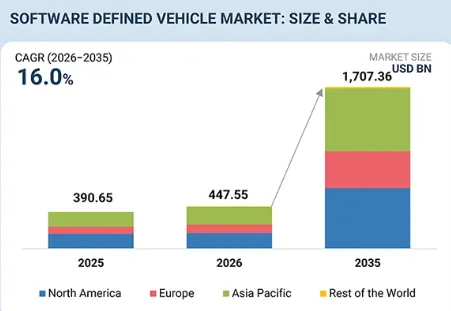
According to a Markets And Markets research report, the global software-defined vehicle market is expected to grow from $447.55 billion in 2026 to $1,707.36 billion by 2035, representing a 16.0% CAGR during the forecast period.
Software-defined vehicles matter commercially for three reasons:
- Monetization: Feature-on-demand monetization lets OEMs sell capabilities like extended range, upgraded driver-assistance tiers, or premium audio after the vehicle has already been sold.
- Recall speed: Faster recall remediation means a software bug that once required a dealership visit can now be patched through an over-the-air update.
- Longevity: Continuous improvement lets a vehicle purchased in 2026 gain new capabilities in 2027 without a hardware refresh.
3. V2X, 5G, and Next-Generation Connectivity Standards
V2X communication, short for vehicle-to-everything, is the umbrella term covering how connected cars talk to each other and to the infrastructure around them.
| Technology | What It Does | Best For |
| V2V (Vehicle-to-Vehicle) | Cars share hazard data directly with each other | Collision avoidance, sudden-braking alerts |
| V2I (Vehicle-to-Infrastructure) | Cars exchange data with signals, road sensors, tolls | Signal timing, hazard anticipation |
| 5G Connected Vehicles | Low-latency data exchange for safety-critical use | Real-time infotainment, cooperative driving |
| 4G LTE | Still carries the bulk of connected vehicle traffic | General telematics, standard connectivity |
| Hybrid Satellite-Terrestrial | Hands off between cellular and satellite coverage | Rural and remote route continuity |
The practical value of V2X communication shows up in scenarios a driver cannot see coming. For instance, if a vehicle several cars ahead brakes suddenly, V2X communication lets that signal reach following vehicles before the driver’s own eyes or sensors would catch it. That extra second of warning is often the difference between a near miss and a collision.
5G connected cars are central to making this real-time exchange work, but adoption is a multi-year rollout rather than a single-year switch. A related development worth watching is hybrid satellite-terrestrial connectivity, which automakers, satellite operators, and mobile carriers are piloting to close coverage gaps on rural and remote routes.
4. Predictive Maintenance and Telematics-Driven Uptime
Predictive maintenance in connected vehicles works by feeding continuous sensor telemetry- engine temperature, battery health, brake wear, and tire pressure into machine-learning models trained to recognize the early signs of component failure.
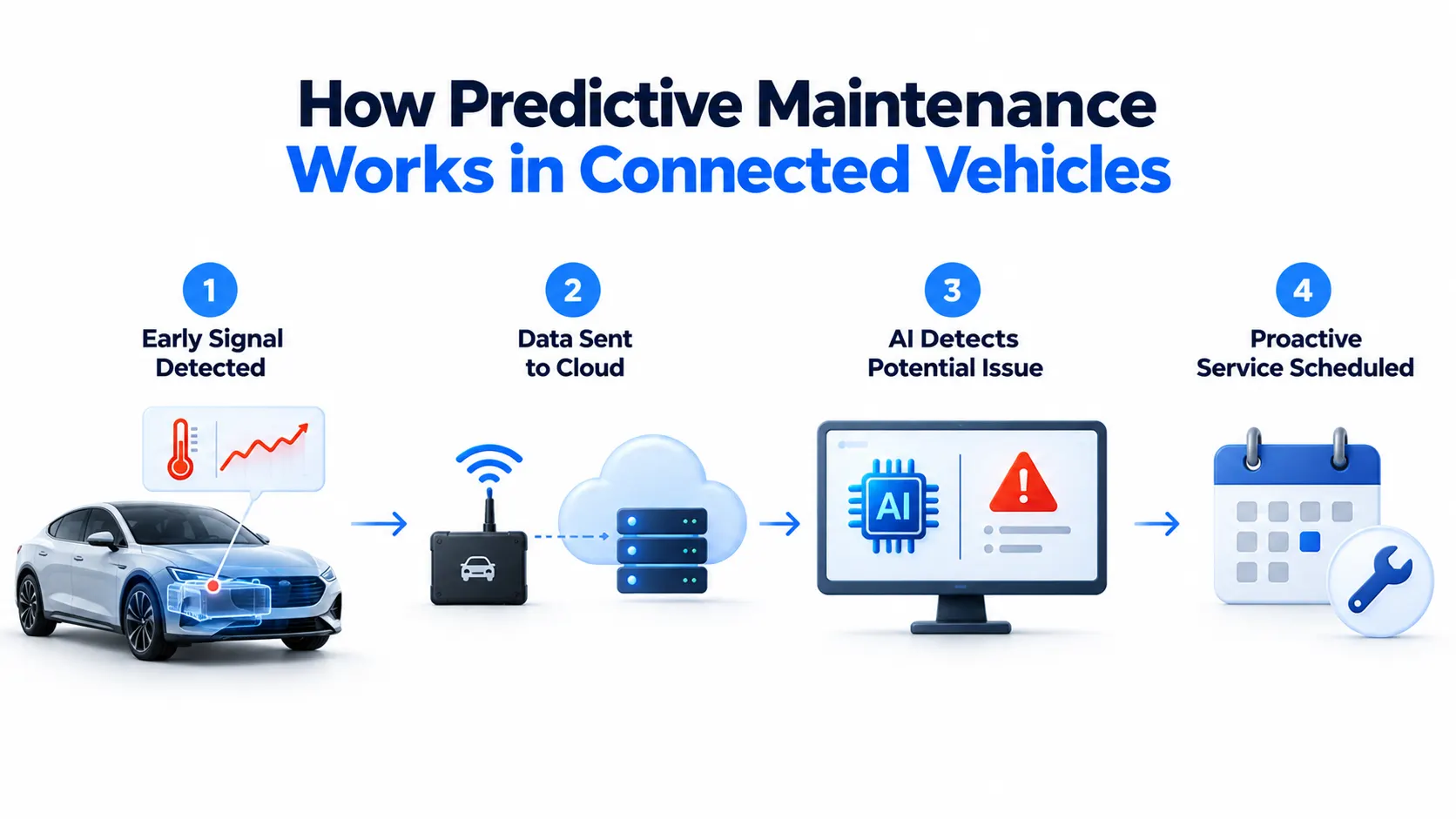
Here is how the workflow looks in practice:
Step 1: A vehicle’s battery begins showing a subtle temperature pattern associated with early degradation.
Step 2: Onboard sensors capture that pattern and send it to the cloud through the vehicle’s telematics unit.
Step 3: The model compares it against known failure signatures and issues an alert, often weeks before the driver would notice any performance change.
Step 4: A fleet manager or the OEM’s service network schedules a repair proactively, on their own timeline.
The business case of automotive telematics is straightforward:
- Reduces unplanned downtime, which matters enormously for commercial fleets where an idle vehicle is a direct revenue loss.
- Lowers warranty costs for OEMs by catching failures before they escalate into more expensive repairs.
- Shifts service scheduling from reactive to proactive across an entire fleet.
For enterprises managing large vehicle fleets, predictive maintenance is quickly becoming table stakes rather than a competitive edge. The real differentiator now is data quality and model accuracy, not whether a fleet has predictive capability at all.
5. Connected Cars Improve ADAS and Driver Safety
ADAS technology in 2026-model vehicles goes well beyond the collision alerts and lane-departure warnings that defined earlier systems.
| ADAS Feature | What It Does |
| Automatic Emergency Braking | Applies brakes when a collision is imminent, and the driver has not reacted |
| Adaptive Cruise Control | Responds to real-time traffic flow rather than a fixed speed |
| V2V-Informed Hazard Warnings | Alerts drivers to hazards reported by vehicles ahead, beyond sensor range |
| V2I Signal Anticipation | Lets vehicles anticipate a signal change or hazard flagged by road infrastructure |
| Supervised Hands-Free Driving | Fuses camera, radar, lidar, and GPS data for specific conditions such as highway driving |
Connectivity is what pushes ADAS technology in cars beyond the limits of onboard sensors alone. A camera or radar system can only see what is directly in its field of view. A connected vehicle equipped with V2V can react to a hazard reported by a car several vehicles ahead, effectively extending a driver’s awareness around corners and past the vehicle directly in front.
It is worth being precise here: most ADAS technology in vehicles in 2026 still requires driver supervision. True hands-off, eyes-off autonomy remains limited to specific models and specific road conditions, not a universal standard.
For enterprise buyers and fleet operators, the safety case for investing in connected car technology solutions with mature ADAS technology is now backed by real deployment data, not just manufacturer claims.
6. Edge AI Brings Intelligence Closer to the Vehicle
Not every automotive decision should depend on a remote cloud service. Safety-critical and time-sensitive applications often require processing close to the vehicle. Edge AI in connected vehicles enables onboard or near-vehicle computing to analyze information with low latency, even with limited connectivity.
This approach supports driver monitoring, sensor processing, anomaly detection, battery management, and selected ADAS functions. Automotive edge computing can also reduce the raw data transmitted to the cloud, lowering bandwidth requirements and supporting privacy.
The emerging model is therefore not edge versus cloud, but edge plus cloud. Edge systems handle immediate decisions and local processing, while automotive cloud computing supports large-scale analytics, model training, fleet intelligence, software distribution, and long-term data management.
7. OTA Vehicle Updates and New Monetization Models
Over-the-air (OTA) updates are the delivery mechanism that makes almost every other 2026 trend possible. Without OTA, feature-on-demand monetization does not work, predictive software fixes cannot ship remotely, and software-defined vehicle architecture loses much of its value.
- Feature unlocks: A customer can purchase a base vehicle and later unlock extended battery range, an upgraded driver-assistance tier, or a premium audio package, all delivered through software.
- Revenue timeline: A car sold in 2026 starts an ongoing relationship where software updates, new features, and subscription renewals generate revenue well past the initial sale.
- Engineering priority: Automakers now structure engineering investment to prioritize updating infrastructure as heavily as manufacturing efficiency.
8. Cybersecurity in the Age of Hyperconnected Vehicles
Every additional connected endpoint in a modern vehicle, the infotainment system, the telematics unit, the OTA update channel, the companion mobile app, is a potential entry point for an attacker. Connected car cybersecurity has moved from a compliance checkbox to a board-level concern.
Regulators have responded accordingly. UN Regulations 155 and 156 now require manufacturers selling into major markets to demonstrate structured cybersecurity management systems and controlled software-update processes across a vehicle’s entire lifecycle.
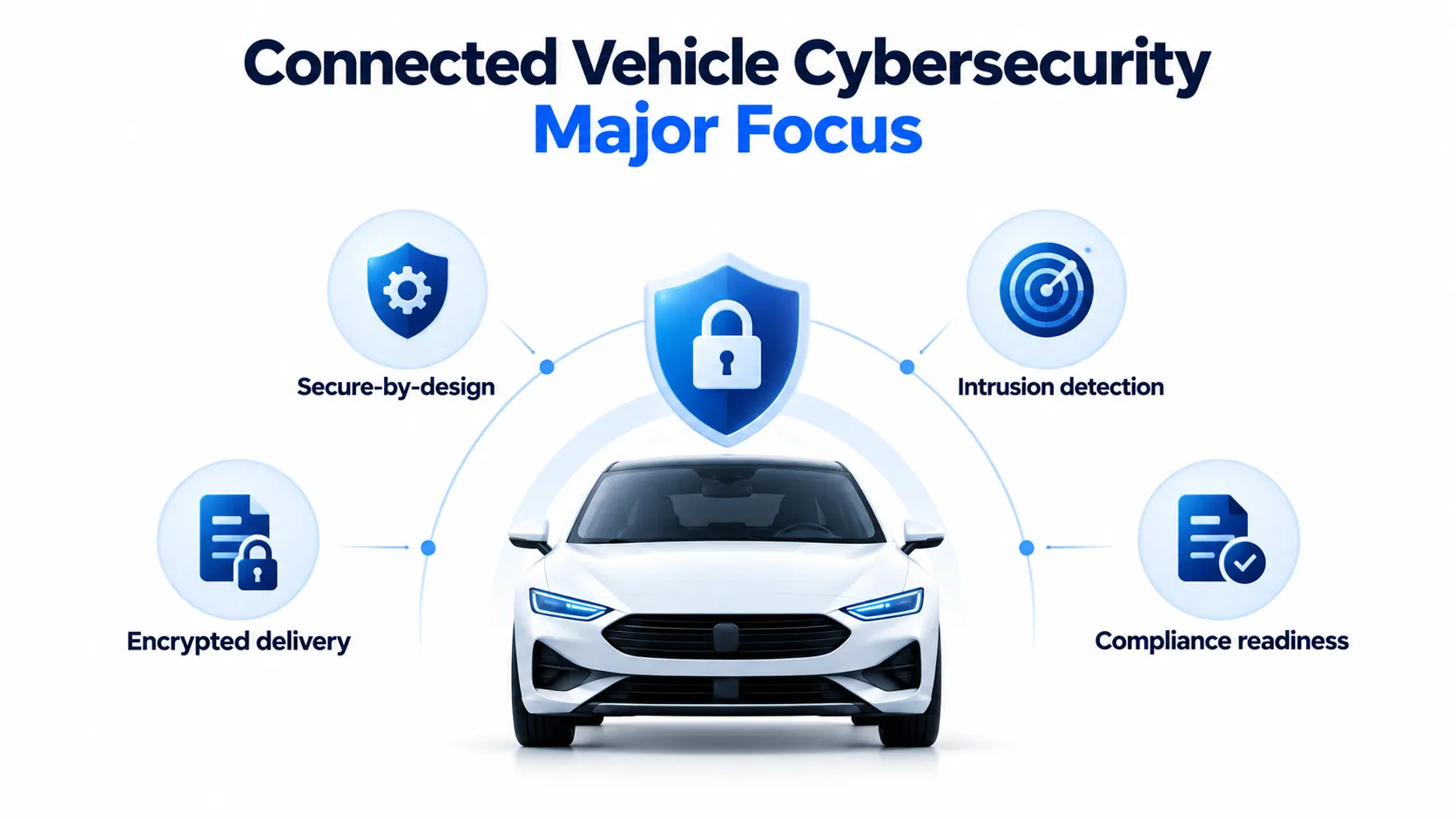
Enterprise priorities for connected vehicle cybersecurity in 2026 center on four practical measures:
- Secure-by-design architecture that segments critical vehicle functions from infotainment systems.
- Encrypted delivery for every over-the-air update.
- Intrusion detection systems that monitor vehicle networks for unusual traffic patterns.
- Compliance readiness built for whichever regional regulations a fleet or OEM operates under.
The cost of getting this wrong is not theoretical. A single vulnerability disclosed after vehicles are already on the road can trigger a recall far more expensive than the security investment.
9. Personalized Digital Cockpits and In-Cabin AI Assistants
Infotainment screens used to be static. The same layout and menu structure, regardless of who was driving. That is changing:
- Digital cockpits in 2026 reconfigure themselves based on driver identity, adjusting layout, voice interaction style, and which content surfaces first depending on context, time of day, or trip type.
- Recent EV and mobility platform launches treat voice interaction and connected services as a default layer.
- Even micromobility platforms have adopted this logic, building AI-integrated voice interaction into lightweight electric vehicles.
For enterprise product teams, the shift means digital cockpit design now sits closer to connected car technology software solutions than traditional automotive interior design. Update cycles, user testing, and iteration speed matter in ways they never did when a dashboard was fixed at the factory.
10. EV-Connectivity Convergence and Smart Charging
Connected car and electric vehicle data platforms are converging quickly:
- Real-time battery state, range estimation, and charging-station routing run through the same connected infrastructure that powers predictive maintenance and cockpit personalization.
- A driver can check remaining range, locate a charging station along their route, and schedule a charge during off-peak pricing, all through the same connected automotive software.
- Vehicle-to-grid (V2G) pilots let electric vehicles feed stored battery energy back into the grid during peak demand, turning parked EVs into a distributed energy resource.
For enterprises in the EV and charging infrastructure space, electric vehicle software development services can help connect charging networks, utility partners, and vehicle OEMs through shared data standards instead of isolated systems.
11. Sustainability and Smart City Integration
Connected vehicle data does more than optimize a single car’s performance. When integrated with smart city infrastructure, it delivers measurable gains:
- Cities piloting connected infrastructure use aggregated, anonymized vehicle data to adjust traffic signal timing in real time based on actual congestion.
- Fleet operators apply the same data to reduce unnecessary mileage and idle time across delivery and logistics routes.
- Smoother traffic flow and efficient routing lower fleet-wide emissions.
This is an area most connected car content covers only in passing, but it represents a genuine opportunity for enterprises that combine EV adoption with V2G participation and smart mobility data-sharing, especially as environmental reporting requirements tighten.
Benefits of Connected Car Technology for Automotive Businesses
The advantages of connected car technology extend beyond improved infotainment. Connected systems can change how automakers create value across the entire vehicle lifecycle.
-
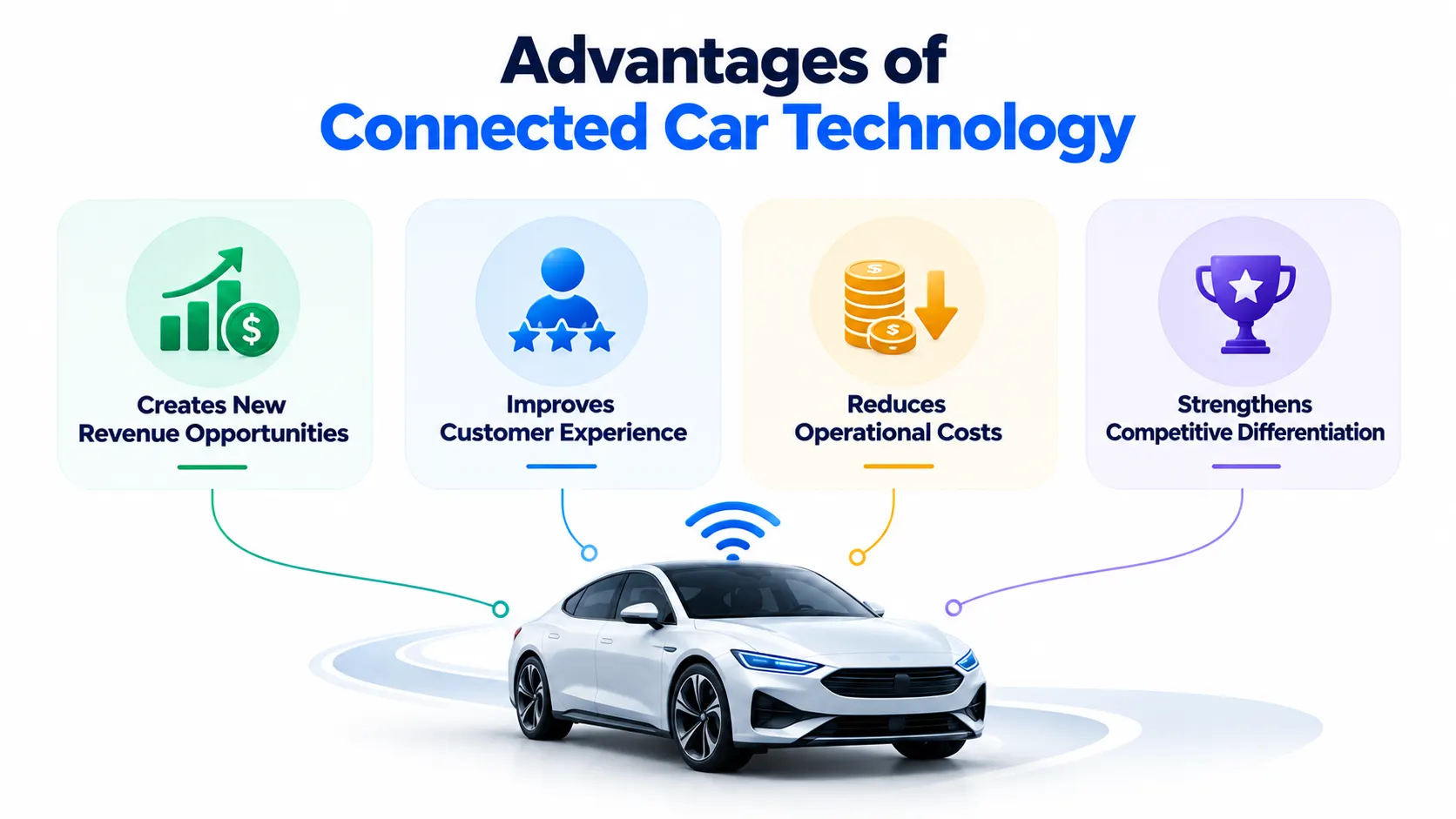
Creates New Revenue Opportunities
Connected car services can support subscriptions, feature-on-demand offerings, premium digital experiences, fleet services, and software upgrades. The opportunity is strongest when the service solves a clear customer problem rather than simply adding another digital feature.
-
Improves Customer Experience
Remote vehicle functions, intelligent vehicles, AI agents in cars, proactive maintenance alerts, personalized settings, and digital service journeys can reduce friction. A connected experience can continue after purchase, helping manufacturers maintain an ongoing relationship with vehicle owners.
-
Reduces Operational Costs
Remote diagnostics and OTA car updates can reduce unnecessary workshop visits, while predictive maintenance can improve planning and vehicle uptime. Fleet operators can also use automotive connectivity to improve utilization and operational decision-making.
-
Strengthens Competitive Differentiation
As hardware platforms become more similar, software and digital experience can become important differentiators. Deloitte’s 2026 global automotive consumer study shows that many consumers are open to AI-driven personalization and OTA-enabled improvements, while safety and security remain especially important connected features.
Key Challenges in Implementing Connected Car Technology Trends
Connecting vehicles at scale involves more than adding new technologies. Automotive businesses must overcome integration, security, software, and customer adoption challenges.
Challenge 1: Legacy Vehicle Systems
Older vehicles often rely on fragmented ECUs, outdated software, and systems that were never designed to communicate with modern cloud platforms.
Solution: Use phased legacy software modernization, middleware, and API-based integration to connect legacy systems without replacing the entire vehicle architecture.
Challenge 2: Cybersecurity and Data Privacy
Connected car technology generates sensitive data and creates more entry points through apps, APIs, cloud platforms, and vehicle systems.
Solution: Build security into the architecture with encryption, secure APIs, access controls, threat monitoring, and regular security testing services.
Challenge 3: Software Development Complexity
Connected-car projects require expertise across automotive software, cloud, AI, IoT, data engineering, and cybersecurity. Managing all these capabilities can stretch internal teams.
Solution: Build cross-functional teams or work with a specialized automotive software development company to accelerate development while maintaining technical consistency.
Challenge 4: System Interoperability
Vehicles must often communicate with charging networks, mobile apps, telecom providers, cloud platforms, infrastructure, and third-party services.
Solution: Adopt open APIs, standardized data models, and integration frameworks that allow different systems to exchange data reliably.
Challenge 5: Consumer Trust and Monetization
Customers may not pay for every connected feature, especially when its value is unclear, or data privacy concerns remain.
Solution: Prioritize features that solve clear customer problems, communicate their value transparently, and give users greater control over their data.
Acknowledging these constraints upfront, rather than treating connected car technology trends as friction-free, separates a credible digital transformation strategy from a marketing pitch.
How Can Automotive Companies Prepare for the Future of Connected Cars?
The connected car market is evolving rapidly, making technology decisions more important than ever. Automotive companies need scalable architectures, secure systems, and future-ready digital capabilities.
1. Build a Scalable Connected-Vehicle Architecture
Start with a modular, API-driven, cloud-connected architecture that can support multiple vehicle programs and digital transformation services. Avoid building isolated applications that create new silos.
2. Establish an SDV Foundation
Invest in centralized or zonal computing, automotive operating systems, OTA infrastructure, software platforms, and an app development process that supports continuous delivery.
3. Create a Unified Vehicle Data Foundation
Bring vehicle, customer, service, and operational data together with appropriate governance. A unified data layer makes it easier to build analytics, AI, personalization, and predictive services.
4. Prioritize High-Value AI Use Cases
Begin with problems where AI can deliver measurable outcomes, such as predictive maintenance, intelligent diagnostics, driver safety, energy optimization, and personalization.
5. Embed Cybersecurity From the Beginning
Treat security as an architectural requirement across development, testing, deployment, OTA updates, monitoring, and incident response.
6. Build Strategic Technology Partnerships
Cloud providers, AI companies, telecom operators, Tier 1 suppliers, mobility platforms, and a custom software development partner can help accelerate capabilities that are difficult to build alone.
How Can SparxIT Help You Build Automotive Software for a Connected Car Experience?
Every connected car technology trend covered above points to the same underlying need: enterprises require a technology partner who can build the software, cloud, and AI infrastructure that connected vehicles depend on, not just the vehicle itself.
SparxIT can help automotive businesses turn connected-car capabilities into practical digital experiences through scalable automotive software development services. We offer the following services:
| Connected experience layer | What it can connect | Example customer value |
| Mobile app development | Vehicle + user + services | Remote monitoring and control |
| Backend & APIs | Cloud + vehicle platforms | Secure real-time data exchange |
| AI & Data analytics | Telemetry + diagnostics | Personalization and proactive service |
| IoT & location | Sensors + GPS + infrastructure | Context-aware mobility experiences |
In automotive software, we add features such as vehicle monitoring, remote commands, real-time status updates, GPS and location services, maintenance alerts, and personalized experiences. With the right architecture, these capabilities can connect to existing automotive platforms and third-party services through secure APIs.
Our goal is to help automotive businesses improve customer engagement, operational efficiency, and connected-service opportunities while creating a foundation that can evolve with emerging vehicle technologies.
Looking to build a connected automotive experience? Contact us to turn your connected-car vision into a scalable digital solution.

Partner with Experts
Frequently Asked Questions
What are the biggest connected car technology trends in 2026?


The biggest connected car trends in 2026 include AI and generative AI, software-defined vehicles, 5G and V2X connectivity, predictive maintenance, connected ADAS, edge AI, OTA updates, automotive cybersecurity, digital cockpits, and EV connectivity.
What is connected car technology and how does it work?
Connected car technology connects vehicles to the internet, cloud platforms, mobile apps, infrastructure, and other vehicles. Sensors collect vehicle data, which connected systems process and analyze to enable features such as navigation, remote control, diagnostics, safety alerts, and predictive maintenance.
How are AI and generative AI transforming connected cars in 2026?
AI and generative AI are making connected cars more intelligent and personalized. They power voice assistants, natural-language interactions, predictive insights, personalized recommendations, intelligent diagnostics, and advanced driver assistance features.
What role do software-defined vehicles play in connected car technology?
Software-defined vehicles use software to control and improve many vehicle functions. They enable over-the-air updates, new digital features, personalization, faster software improvements, and software-based services throughout the vehicle’s lifecycle.
How does connected car technology support predictive maintenance?
Connected cars continuously collect data from sensors and vehicle systems. AI and analytics analyze this data to detect unusual patterns and predict potential problems, allowing drivers or fleet operators to schedule maintenance before major failures occur.
How are connected cars improving driver safety and ADAS capabilities?
Connected cars enhance ADAS by combining onboard sensor data with real-time information about traffic, road conditions, hazards, and nearby vehicles. This additional context can support collision warnings, hazard alerts, driver assistance, and emergency safety services.