A CFO approves a $250,000 budget for a new customer platform. Nine months later, the build is 40% over budget, the launch has slipped a quarter, and nobody can explain exactly where the money went. This scenario is common, and the cause is rarely bad engineering. It usually starts with an estimate that priced the features but ignored integrations, testing, cloud spend, and the years of ownership that follow launch.
Pricing software is hard because the product does not exist yet. Requirements shift, vendors quote in different formats, and a low hourly rate can hide a high total bill. Leaders end up comparing numbers that were never built on the same assumptions.
This guide gives you a defensible way to plan software development costs in 2026. It covers planning ranges by complexity and software type, regional rate benchmarks, a five-step estimation method, and a three-year view of operating costs. Every figure states its assumptions so you can adapt it to your own project.
Key Takeaways
|
How Much Does Custom Software Development Cost in 2026?
For a typical business application, expect to invest $40,000 to $1 million or more. A focused MVP sits at the low end. A multi-tenant platform with heavy integrations and compliance controls sits at the top. The average cost of software development for a moderately complex product, built by a blended onshore and offshore team, falls between $100,000 and $300,000.
How to read these ranges
These are planning bands, not quotes. They assume US dollars, 2026 pricing, a blended team rate of about $71 per hour, and a scope that includes design, development, QA, and deployment. We cover hosting and maintenance separately in the ownership section.
Cost by Project Complexity
| Tier | Typical scope | Complexity markers | Typical buyer | Effort (hours) | Indicative cost (USD) | Timeline |
| Simple | 5–10 screens, one user role, standard workflows | 0–2 off-the-shelf integrations; no regulated data | Startup MVP, internal tool | 600–1,400 | $40K–$100K | 3–4 months |
| Moderate | 15–40 screens, 3–5 roles, custom workflows, reporting | 3–6 integrations (payments, CRM, SSO); audit logging | SMB product, customer portal | 1,400–4,300 | $100K–$300K | 4–8 months |
| Complex | Multi-tenant platform or enterprise suite, 50+ screens | Legacy migration, real-time data, regulated data, high availability | Enterprise, scaled SaaS | 4,300–14,000+ | $300K–$1M+ | 9–18 months |
The hour ranges are the real anchor. Multiply them by your own blended rate, and the dollar figures adjust to your sourcing model.
Cost by Software Type
| Software type | Indicative cost (USD) | Typical timeline | Biggest cost driver |
| Internal business tools | $40K–$150K | 3–6 months | Integration with legacy systems and data cleanup |
| Customer portals | $60K–$200K | 3–7 months | Single sign-on and role-based permissions |
| SaaS platforms | $120K–$500K | 5–12 months | Multi-tenancy, subscription billing, usage metering |
| eCommerce and marketplaces | $80K–$400K | 4–10 months | Payment flows, seller onboarding, search |
| Mobile apps (iOS and Android) | $50K–$250K | 3–8 months | Offline sync and native device features |
| Enterprise systems and modernization (ERP, CRM, HRMS) | $300K–$1.5M | 9–24 months | Data migration and running old and new systems in parallel |
Subscription products have their own cost profile, covered in our guide to SaaS development cost. Healthcare, financial services, and education software usually land toward the upper end of each band because of compliance, audit, and data-protection work.
Average Cost of Software Development by Region: Hourly Rates
Rates are the most visible part of a quote and the easiest to misread. The table shows indicative 2026 vendor rates, blended across engineering roles.
| Region | Junior | Mid-level | Senior |
| USA and Canada | $90–$120 | $120–$160 | $160–$220 |
| Western Europe | $60–$90 | $80–$120 | $110–$160 |
| Eastern Europe | $35–$50 | $45–$65 | $60–$90 |
| Latin America | $30–$45 | $40–$60 | $55–$80 |
| India and Southeast Asia | $20–$30 | $28–$45 | $40–$60 |
In-house hiring follows different math. The US Bureau of Labor Statistics reports a median wage of $64.44 per hour for software developers, QA analysts, and testers (May 2025). Benefits make up 30% of private-industry compensation (BLS, June 2026). That puts the fully loaded cost to hire software developers in the US at about $92 per hour before recruiting, equipment, and office costs.
Onshore, Nearshore, or Offshore: Where the Savings Hold
Offshore software development can cut labor costs by 50% to 70% on paper. Realized savings are usually smaller because distance adds work that a rate card doesn’t show.
- Time-zone gaps slow decisions. A question raised at 4 p.m. in New York may not get an answer until the next morning.
- Vague requirements create more rework when the team cannot clarify them in real time.
- Someone on your side still has to own the product, review work, and accept each release.
Nearshore teams in Latin America overlap most of the US workday, which cuts that hidden coordination overhead for a moderate rate premium.
The Hybrid Model
Many US companies keep product leadership, architecture, and client-facing roles onshore and place build and test capacity offshore. On a typical moderate project, a 25/75 onshore-to-offshore split of hours brings the blended rate to about $71 per hour.
Insight: Compare vendors on total delivered cost for the same scope. A $45-per-hour team that needs 30% more hours costs more than a $55-per-hour team that does not.
What Factors Affect Software Development Cost?
The cost of software development moves with effort and risk. We’ve grouped the factors below by where they hit your budget, and the table ranks them by impact.
Scope, Features, and User Roles
Feature depth matters more than feature count. A simple approval step is a day of work. A multi-level approval chain with delegation, escalation, and audit history can take weeks, and each extra user role multiplies screens, permissions, and test cases.
Architecture, Integrations, and Data Migration
Integrations are the most underestimated line in most budgets. Payment gateways, CRMs, ERPs, and identity providers each bring their own APIs, rate limits, and failure modes. Legacy systems add incomplete documentation, inconsistent data, and migrations that need validation runs before cutover.
Platforms, UI/UX, and Accessibility
Supporting web, iOS, and Android natively means building and maintaining three front ends. Cross-platform frameworks such as React Native or Flutter reduce that effort. Starting from an existing design system costs far less than bespoke interaction design, and building to WCAG accessibility standards from day one is cheaper than retrofitting.
Security, Compliance, and Non-Functional Requirements
Regulated data changes the scope. A US healthcare product handling patient records falls under HIPAA, enterprise buyers often expect a SOC 2 report, products serving EU residents must meet GDPR, and card payments bring PCI DSS. Price in only the frameworks that apply to your product.
Availability targets add cost too. A 99.9% uptime commitment allows roughly 9 hours of downtime a year, against more than 3.5 days at 99%. Meeting it requires redundancy, monitoring, and tested recovery procedures.
Technology Stack and Cloud Environment
Mainstream stacks have deeper talent pools, lowering hiring costs and vendor risk. Commercial licenses, managed services, and cloud architecture choices shape monthly run costs after launch.
Team Composition and Delivery Model
Senior engineers cost more per hour but often deliver faster and with fewer defects. A team weighted heavily toward junior developers can look economical in a proposal and expensive in production.
| Cost driver | Budget impact | Why it matters |
| Integrations and data migration | High | External dependencies and data quality are hard to predict |
| Compliance and security | High | Adds controls, documentation, audits, and testing |
| User roles and workflow depth | High | Multiplies screens, permissions, and test cases |
| Platforms supported | Medium | Each platform adds build and maintenance effort |
| Team location and seniority mix | Medium | Changes rates, speed, and rework |
| UI/UX customization | Medium | Bespoke design takes longer than a design system |
| Technology stack | Low to medium | Affects licensing, hosting, and talent availability |
Software Development Cost by Lifecycle Stage
A software development cost breakdown by phase shows where effort actually goes. The chart shows a sample 2,720-hour project in the moderate complexity tier.
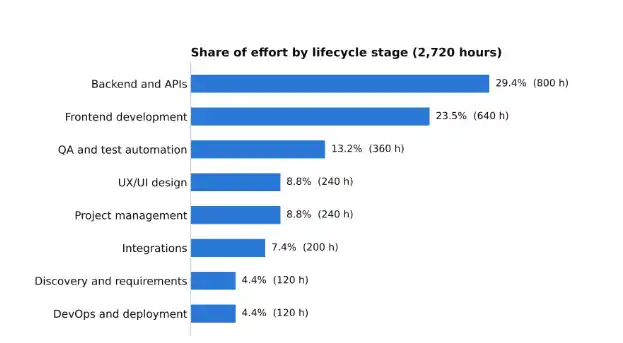
Coding takes about 60% of the effort when you combine frontend, backend, and integrations. The remaining 40% covers discovery, design, QA, DevOps, and project management across the software development lifecycle (SDLC). Quotes that are thin on these phases are usually thin on quality.
Watch for: If QA is below 10% of total hours or project management is missing, ask why. Those costs return later as defects and delays. CISQ estimated the cost of poor software quality in the US at $2.41 trillion in 2022.
How to Estimate Software Development Cost: A 5-Step Method
Reliable cost estimation for software development follows the same sequence every time. Each step narrows uncertainty before you commit a budget.
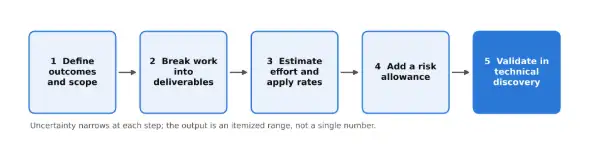
Step 1: Define Outcomes and Scope
Write down the business goal, the users, and the core workflows. List platforms, integrations, and compliance needs. Then list what is out of scope for release one.
Step 2: Break the Work into Deliverables
Turn the scope into a work breakdown structure (WBS): epics, then features, then tasks small enough to estimate in hours. Anything you cannot break down is not understood well enough to price.
Step 3: Estimate Effort and Apply Rates
Estimate hours for each task by role, then apply the rate for that role.
Estimated cost = Σ (role hours × role rate) + non-labor costs + contingency
Non-labor costs include third-party licenses, testing tools, security assessments, and pre-production cloud environments. Express the result as a range.
Step 4: Add a Risk Allowance
Contingency covers known unknowns, such as integrating with poorly documented systems or using a dataset of uncertain quality. Tie it to named risks, typically 10% to 25% of labor. Padding is unexplained margin; a good estimate shows contingency as its own line.
Step 5: Validate Through Technical Discovery
The Cone of Uncertainty, popularized by Steve McConnell, shows that estimates made at the initial concept stage can be off by 4x in either direction. A two- to six-week discovery phase that tests architecture, integration access, data readiness, and acceptance criteria is the most effective way to narrow that range.
Software Development Cost Estimation Techniques Compared
The five-step method sets the process. The techniques below produce the hours in Step 3, and mature teams usually combine two or more.
| Technique | How it works | Best stage | Effort to apply |
| Work breakdown structure (WBS) | Estimate each task bottom-up and sum the results | Detailed planning and final quote | High |
| Analogous (top-down) | Scale the actual cost of a similar past project | Early budgeting | Low |
| Parametric (COCOMO II) | Calculate effort from software size and weighted cost drivers | Large programs with historical data | Medium |
| Three-point (PERT) | Combine optimistic, most likely, and pessimistic estimates | Any stage with uncertain tasks | Medium |
| Use case points (UCP) | Score use cases and actors, then adjust for technical and team factors | Requirements-heavy enterprise projects | Medium |
The PERT formula:
Expected effort = (Optimistic + 4 × Most likely + Pessimistic) ÷ 6
COCOMO II, developed by Barry Boehm and colleagues at the University of Southern California, derives effort from size in thousands of lines of code or function points, adjusted by factors such as team capability and product complexity. Use case points, introduced by Gustav Karner in 1993, suit projects documented as use cases.
Practical pairing: Use analogous estimation to set an early budget. Use WBS with PERT ranges to produce the final quote.
What Does It Cost to Add AI to Your Software?
AI adds two kinds of cost: the build itself, and a usage bill that arrives every month after launch.
AI Feature Tiers
| Feature tier | Typical approach | Relative build effort |
| Assistant or chatbot over your content | Hosted LLM API with retrieval (RAG) | Low to medium |
| Recommendations or scoring | Pretrained or classic ML models on your data | Medium |
| Document processing | LLM or vision APIs plus human validation steps | Medium |
| Custom models | Training or fine-tuning on proprietary data | High |
Running Costs
- Model usage fees, billed per token or per request, which scale with adoption
- Vector database and data pipeline hosting
- Evaluation, monitoring, and guardrails to catch inaccurate or unsafe output
- Periodic re-indexing and model upgrades
API, Fine-Tune, or Build
Start with a hosted model API for most use cases; it is the fastest and cheapest way to prove value. Fine-tune when you need consistent domain behavior at high volume. Build custom models only when the data is proprietary and the capability is core to your product.
Hidden Software Development Costs and Three-Year Ownership
Launch day is roughly the midpoint of a three-year budget. The lines below are the ones most software development cost estimates leave out.
Costs Most Budgets Miss
- Cloud hosting, storage, and data transfer
- Third-party APIs and SaaS licenses that scale with users
- App store commissions on digital sales (Apple’s Small Business Program rate is 15%)
- Monitoring, logging, and periodic security testing
- Backups and disaster recovery
- Framework upgrades and dependency patches
- User training and change management
- Internal time for product ownership and acceptance testing
Three-Year Ownership Cost
Total cost of ownership (TCO) combines the initial build with the cost to run, support, and improve the system. The chart applies typical run-rate assumptions to a moderate-tier product with a $245,500 hybrid build: hosting and infrastructure at $24,000 a year, maintenance at 18% of the build ($44,190 a year), and support and licenses at $12,000 a year.
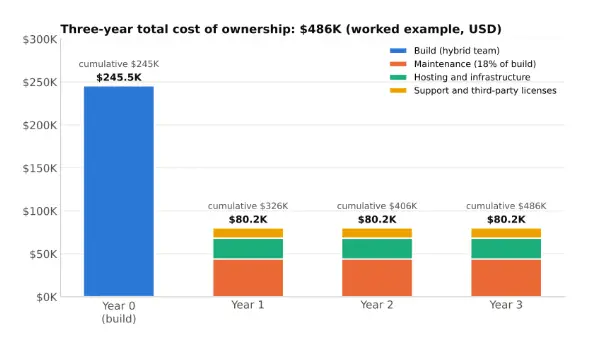
Three years of operation cost about $240,600, almost exactly the $245,500 build. Hosting choices and maintenance scope move the total most. On AWS, Savings Plans can cut compute costs by up to 72% compared with On-Demand prices.
Budget rule: Fund year-one operating costs before you approve the build. An unfunded product starts to degrade within months of launch.
How to Choose a Sourcing and Pricing Model for Software Development
In-House, Outsourced, or Freelance
| Factor | In-house team | Outsourced partner | Freelancers |
| Direct cost | Highest (salary plus about 30% benefits) | Medium; varies by region | Lowest per hour |
| Time to start | Months per role | A few weeks | Days to weeks |
| Management effort | High | Medium | High |
| Control and IP | Highest | High with clear contracts | Varies by contract |
| Continuity | Strong if retention is good | Strong with a dedicated team | Weak |
| Best for | Core, long-lived products | Speed and scale without hiring | Small, well-defined tasks |
Fixed Price, Time and Material, Dedicated Team, or Staff Augmentation
The four common software development pricing models allocate risk differently.
| Model | Best for | Budget control | Flexibility | Who carries the risk |
| Fixed price | Small, stable, well-documented scope | High | Low | Vendor (priced into the bid) |
| Time and material | Evolving products, agile delivery | Medium | High | Client |
| Dedicated team | Long-term roadmaps | Medium; predictable monthly cost | High | Shared |
| Staff augmentation | Filling specific skill gaps | Medium | High | Client |
Fixed cost software development works when requirements are stable and fully documented. Vendors build a risk premium into fixed bids, so on an uncertain scope you often pay for risk that never materializes.
Build vs Buy vs Low-Code
Before you price a custom build, confirm you need one. Our guide to build vs buy software covers the full decision; here is the cost view.
| Option | Upfront cost | Ongoing cost | Time to launch | Long-term control |
| Buy (SaaS) | Low | Per-user subscription that grows with headcount | Days to weeks | Low; vendor sets the roadmap |
| Low-code platform | Low to medium | Platform licenses; possible lock-in | Weeks | Medium |
| Custom build | Highest | Hosting and maintenance | Months | Full |
- Buy when the process is standard and does not set you apart from competitors.
- Use low-code for internal workflows with modest scale and integration needs.
- Build when the software is core to how you compete or serve customers.
For large user bases, the cost of custom software development often compares well with per-seat subscriptions over five years, because license fees grow with every hire and a custom system does not.
How to Reduce Software Development Cost Without Increasing Risk
Effective cost optimization in software development removes waste without pushing risk downstream. The levers below cut spend at three points: before the build, during it, and after launch. Each one carries a trade-off you should plan for.
Paid discovery
A short discovery phase validates requirements, architecture, and integrations before development begins, which prevents costly rework later. Expect it to add two to six weeks before the build starts.
MVP and phased releases
Launching a focused first version defers features until real users confirm they need them. Some stakeholders will wait a release or two for their features, so agree on the roadmap upfront.
MoSCoW prioritization
Sorting features into must-have, should-have, could-have, and won’t-have keeps the first release limited to what drives value. It works only with a product owner empowered to say no.
Reusable components and open-source libraries
Proven building blocks for login, payments, and notifications prevent you from rebuilding common functions. Each one needs a license and security review before use.
Test automation and CI/CD
Automated tests and deployment pipelines catch defects early and shorten release cycles. They require upfront setup effort that pays off over the product’s life.
Cloud cost reviews
Regular reviews right-size resources and apply commitment discounts to compute spend. This requires ongoing FinOps attention rather than a one-time cleanup.
Scope change control
A formal process for evaluating new requests stops unplanned work from expanding the budget. The trade-off is a slower response to mid-project ideas.
What Should a Software Development Quote Include?
A quote is only as useful as the assumptions behind its software development cost. Use this checklist when you compare proposals; a quote that misses several items cannot be compared fairly with one that includes them.
- Scope, deliverables, and explicit exclusions
- Assumptions behind the estimate
- Team roles, seniority, and hours per role
- Milestones and acceptance criteria
- Change request process and pricing
- Security and compliance responsibilities
- Intellectual property and source code ownership
- Warranty period and post-launch support terms
- Payment schedule tied to milestones
Red flags: A single total with no breakdown, no discovery phase, no QA or project management hours, or a timeline far shorter than every other bid.
How SparxIT Estimates Your Project
You’ve seen where budgets go wrong. Here’s how we keep yours from becoming the CFO story at the top of this page. At SparxIT, we estimate costs by understanding your business goals, evaluating technical requirements, and defining a development scope aligned with your priorities.
You’ll know where every dollar goes, which decisions move the number, and what your project needs before you sign anything. As a top software development company, we have delivered software for clients across the US, India, and beyond, and we run your estimate through four stages that map directly to the method above.
- Requirements call to understand goals, users, and constraints
- Discovery workshop to validate architecture, integrations, and data readiness
- Itemized estimate with roles, hours, assumptions, and a PERT-based range
- Proposal with milestones, sourcing options, and an engagement model
Every software development cost estimate we produce shows its assumptions, so your finance and technology teams can test it line by line. For KisanKonnect, we scoped and rebuilt a grocery ordering platform that was losing users to slow performance. Then split the result into separate figures, such as “5x revenue growth” and “5x more app installs.
Get a clearer understanding of your software development budget before committing to a project. Share your requirements, expected features, target platforms, integrations, and business goals with SparxIT. Our team will review it and send back an itemized estimate with roles, hours, and assumptions, so your finance team can test every line.

Partner with Experts
Frequently Asked Questions
Outsourcing vs. In-house: Which is cheaper?


Outsourcing is usually cheaper for a defined project. A fully loaded US in-house developer costs about $92 per hour before recruiting and overhead (BLS data), while nearshore and offshore vendors commonly bill $28 to $65 per hour for mid-level engineers. In-house becomes competitive for core products that need years of continuous development.
How long does it take to build a software application?
A simple application takes about 3 to 4 months, a moderately complex one 4 to 8 months, and a complex enterprise platform 9 to 18 months or longer. Integrations, approval cycles, and team size affect the timeline more than the number of features.
How to calculate custom software development costs?
To estimate software development cost, break the scope into tasks, estimate hours for each task by role, and multiply by each role’s hourly rate. Add non-labor costs and a 10% to 25% contingency, then apply a three-point (PERT) range to reflect uncertainty.
How much should I budget for software maintenance after development?
A common planning assumption is that annual software maintenance costs 15% to 20% of the initial build, plus hosting and third-party licenses. Products with frequent releases, many integrations, or strict uptime targets tend to be on the higher end.
How much does it cost to develop software for a startup MVP?
For startups, MVP development cost usually falls between $40,000 and $100,000 for a focused web product with one or two integrations, built over 3 to 4 months. Adding native mobile apps or regulated data moves the figure higher.
Can I get an accurate fixed quote before discovery?
Only for small, well-documented projects. For anything larger, a fixed quote before discovery either carries a large risk premium or excludes work that later returns as change requests.