Your online shop has just experienced a flash sale, but you have just survived. It was a slow checkout, product catalog outages to thousands of customers, and your operations team worked through the night, fire-fighting. Sound familiar? If it does, you are not alone.
Most of the online retailers that saw rapid expansion hit the same threshold: their systems were not equipped to handle the growing business. Certain features unrelated to deployment are broken each time new code is deployed. When the traffic reaches the peak, the entire site stops working, and a new payment gateway must be tested to the full extent. These are not just technical pains that directly translate into missed revenue, unhappy clients, and engineering departments spending time on maintenance rather than on value creation.
This is where ecommerce microservice architecture comes into the picture. Microservices are autonomous services that can be deployed independently and represent a single business capability, unlike a bulky monolithic application that tries to do it all. The result is an extensible platform that can scale when it needs to, recover fast when failures occur, and build as fast as your business needs.
This guide will walk you through the fundamentals: what microservices are, how the architecture works, examples of patterns, the most frequently used tools, the trade-offs, and, lastly, how businesses can successfully transition to microservices with the assistance of companies.
What is Ecommerce Microservice Architecture?
Ecommerce microservice architecture is an online retail platform design that uses small and loosely coupled services that can be deployed independently. Each service serves a specific business operation, such as product catalog service, order management service, payments service, inventory service, or user authentication service, and communicates with other services through APIs.
All you have to do is imagine that it is more of a mall than a department store. The stores (services) do not depend on each other, and when any of them is busy or experiences issues, the rest continue operating.
How It Differs from Traditional Ecommerce Architecture
In a classical monolithic ecommerce website, all functionality, such as catalog, cart, checkout, user accounts, etc., exists in a single application and database. This means there is a single deployment controlling the entire system, and the bug can affect only a single system.

The ecommerce monolith is divided into a collection of independent services in an ecommerce microservice architecture, including Product, Order, and Payment. The platform is more flexible and scalable, whereby each service is developed, deployed, and scaled separately.
Microservice Ecommerce Architecture Diagram (Explained)
A typical ecommerce microservice architecture diagram illustrates the flow of a user request from the browser to the system. The following is a stratified account of the appearance of the architecture:
ARCHITECTURE LAYERS (Top to Bottom)
Client Layer ↓ API Gateway / Load Balancer ↓ Microservices Layer ↓ Event Bus (Kafka / RabbitMQ) ↓ Data Layer ↓ Infrastructure Layer |
This layered ecommerce microservices architecture diagram illustrates one of the most important principles: the separation of concerns. The roles of each layer are different, and each service in the microservices layer interacts only through the well-defined interfaces without direct communication with the database.
For B2B ecommerce software architecture, this diagram would also include additional services for bulk ordering, quote management, account hierarchy, and ERP/CRM integrations, all plugged into the same event bus and gateway pattern.
Detailed Comparison of Monolithic vs. Microservice Architecture

Understanding what you are leaving behind and the trade-offs you are making before committing to any architecture is a good idea. The following table provides a clear, side-by-side comparative analysis.
| Aspect | Monolithic Architecture | Microservice Architecture |
| Scalability | Scale the entire app as one unit | Scale individual services independently |
| Deployment | One large deployment unit | Independent, continuous deployments |
| Fault Isolation | One failure can crash the app | Failures contained per service |
| Tech Flexibility | Single tech stack | Polyglot best tool per service |
| Team Structure | One large team per codebase | Small, autonomous feature teams |
| Development Speed | Slower as the codebase grows | Faster teams work in parallel |
| Maintenance | Complex over time | Easier per-service updates |
| Best For | Early-stage / small apps | Growing / enterprise ecommerce |
| 📊 Industry Insight: 74% of surveyed organizations that had adopted microservices in 2025, according to Gather, said they have improved scalability in a short cycle. |
Core Components of Ecommerce Microservice Architecture
A properly designed ecommerce microservice architecture is not merely the division of code into smaller fragments. It involves a deliberate bundle of support factors that enable service partnership in a reliable manner.
1. API Gateway
The API gateway is the single entry point for client requests. It handles routing, authentication, rate limiting, load balancing, and response aggregation. The API-driven architecture has a gateway as its foundation, on which the clients, web, mobile, or third-party integrations communicate with the system without understanding which microservice is going to perform what.
Ratings: Kong, AWS API Gateway, NGINX, Apigee.
2. Individual Business Services
Every service is associated with a limited business environment. Examples of common services in ecommerce are:
- Product Catalog Service: It handles product listings, descriptions, categories, and attributes.
- Inventory Service: Monitors inventory in warehouses and delivery centers.
- Order Management Service: Manages the order life cycle (placement to fulfillment).
- Payment Service: Interacts with payment gateways and manages transaction records.
- User and Auth Service: This manages registration, login, JWT tokens, and session management.
- Cart Service: Stores shopping cart state and computes totals.
- Notification Service: Dispatches transactional mail, SMS, and push notifications.
- Search Service: Powers fast, relevant product discovery, a critical part of the ecommerce search architecture.
- Recommendation Service: Provides individual product recommendations with ML models.
3. Event Bus / Message Broker
Services are likely to have to communicate asynchronously. A non-coupled event bus like Apache Kafka, RabbitMQ, or AWS SNS/SQS can be used to publish and subscribe to events across services. This is the main focus of event-driven architecture ecommerce patterns, in which an event, such as Order Placed, will trigger independent downstream services, such as Inventory, Notifications, and Shipping.
4. Service Discovery
Hard-coded service locations are ineffective when there are dozens of services, each with multiple instances. Services can be configured to dynamically discover the locations of other services using tools such as Consul, Kubernetes DNS, or Eureka.
5. Centralized Logging & Observability
Distributed tracing is needed when a transaction interacts with 10 services. ELK Stack (Elasticsearch, Logstash, Kibana), Jaeger, or Datadog match logs and traces across service boundaries to provide operations teams with one view of system health.
6. Container Orchestration
Containers are practically universal in the deployment of microservices. Kubernetes (K8s) is the industry-standard orchestrator; it automates deployment, scaling, and self-healing of containerized services, making it core infrastructure for any scalable ecommerce architecture.
Key Advantages of Microservice Architecture for Ecommerce
Knowing what the microservice architecture brings to the ecommerce industry, it is not difficult to understand why these platform teams at Amazon, Shopify, and Zalando switched to it several years ago and why larger retailers are following suit today.
-
Independent Scalability
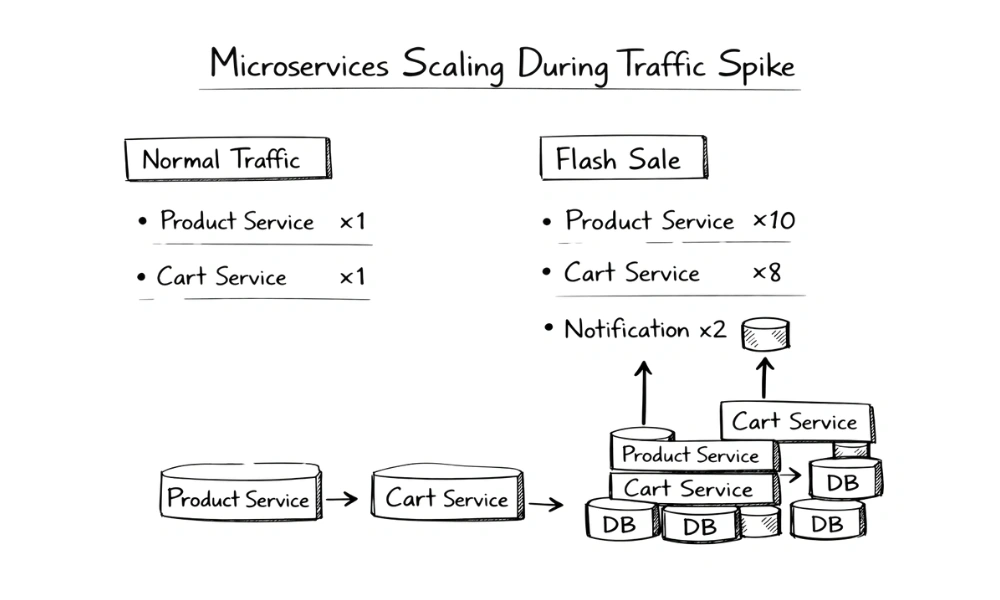
Scaling a monolith implies replicating the entire application. In microservices, scaling occurs only for services that are being accessed. Scaling your Product Service and Cart Service to 50 replicas, and your Notification Service to 2, can be done during a Promotion period. This is the most efficient and least expensive way to handle peak traffic.
-
Faster Time to Market
Stand-alone implementation is a revolution in terms of engineering velocity. Multiple teams can work on different services in parallel. One team ships a new checkout flow while another improves ecommerce site architecture without stepping on each other. This directly accelerates your ecommerce app development lifecycle.
-
Fault Isolation and Resilience
The failure of the Recommendation Service does not prevent products from being displayed, carts from being used, or checkouts from being completed. To prevent localized failures from propagating into platform outages, microservices use circuit breakers and fallbacks (e.g., Hystrix or Resilience4j).
-
Technology Flexibility
Every service can be developed using the most appropriate language and structure. Your ecommerce search architecture might use Elasticsearch with a Python service, while your Order Service is built on Node.js, and your payment integrations run on Java. Such a polyglot strategy is the best way to utilize among developers and tooling applications.
-
Easier Maintenance and Code Ownership
The smaller the codebase, the easier it is to test, understand, and maintain. The feature teams have end-to-end ownership of their services, from development and deployment to on-call monitoring, which creates accountability and minimizes cross-team dependencies.
-
Cost Optimization
The scale-up services on the cloud infrastructure are more accurate since you can pay per service. You will pay per service requirements. This is a key factor in controlling ecommerce development cost at scale, especially for platforms running on AWS, GCP, or Azure.
-
Composable Commerce Enablement
Microservices are the technical foundation for headless and composable commerce. A frontend presentation, divorced from backend commerce logic, allows businesses to change vendors, introduce new touchpoints, and use best-of-breed solutions for each function without changing the entire platform.
Disadvantages of Microservice Architecture
There is no universal superiority of architecture. Being aware of the disadvantages of microservice architecture is essential for making the right decision for your business and for planning properly if you do proceed.
-
Increased Operational Complexity
A mature DevOps tooling stack for container orchestration and observability is needed to run and maintain 20+ services, unlike monoliths.
-
Network Latency
Network-to-network service-to-service communication implies latency, which in-process calls do not. Good architecture reduces synchronous calls between services and uses anything that can be asynchronous.
-
Data Consistency Challenges
As every service has its own database, consistent behavior across service boundaries requires eventual consistency patterns and event-sourcing concepts that demand conscious architecture.
-
Higher Initial Investment
The initial engineering effort to establish CI/CD pipelines, service discovery, API gateways, and monitoring for a microservices platform is more costly than for a monolith. That is why it is important not to jump into a relationship with a new partner.
-
Testing Complexity
Contract testing (Pact), service virtualization, and a structured test environment are more complex than testing a single application because functionality testing across multiple services is required.
Architecture Patterns: Event-Driven, Headless, MACH & More
Ecommerce microservices are not a single pattern and manifest in several architectural styles, depending on how services communicate and how business capabilities are organized.
1. Event-Driven Architecture for Ecommerce
Services in event-driven architecture ecommerce communicate with one another through events. An Order Service also publishes an OrderCreated event when a customer makes a purchase. The Notification Service, the Inventory Service, and the Shipping Service take that event separately and respond to it.
This trend provides almost no service coupling, high resilience, and automatic audit trails. Apache Kafka has become the technology of choice when it comes to high-throughput event streaming in the ecommerce industry and can handle millions of events per second.
2. Headless Ecommerce Architecture
In a headless ecommerce architecture, the frontend (the ‘head’) is completely decoupled from backend commerce logic. All commerce capabilities are cataloged, cart, and checkout via API in the backend. Any frontend (Next.js, React, Vue) or mobile application uses those APIs to deliver the shopping experience.

This allows complete frontend flexibility. You can apply the same business logic across web, mobile, voice, and physical kiosk touchpoints without duplicating business logic. The concept is core to ecommerce microservices and headless platform designs.
3. MACH Architecture for Ecommerce

MACH architecture ecommerce is a modern architecture philosophy championed by the MACH Alliance. It is an abbreviation of Microservices, API-first, Cloud-native, and Headless, and is the best standard of modern composable ecommerce platforms.
| Letter | Stands For | What It Means for Ecommerce |
| M | Microservices | All commerce capabilities (cart, catalog, checkout) are separate services. |
| A | API-first | There are clear APIs between all services; the frontend is decoupled. |
| C | Cloud-native | The infrastructure is elastic, scalable, and geo-distributed. |
| H | Headless | The front end is completely decoupled from the backend logic. |
MACH aligns closely with what is known as composable architecture ecommerce the idea that your ecommerce platform should be assembled from best-of-breed, interchangeable components rather than locked into a single monolithic suite. This is the direction modern ecommerce architecture is headed, and it starts with microservices as the foundation.
-
Saga Pattern (Distributed Transactions)
The Saga pattern is required when a business transaction involves multiple services, such as an order that uses Cart, Inventory, Payment, and Order services. Every service completes its local transaction and signals an event. If one step fails, compensating transactions roll back prior steps and maintain data integrity without distributed locks.
-
CQRS (Command Query Responsibility Segregation)
CQRS divides read operations (queries) and write operations (commands). Read models in high-traffic ecommerce can undergo significant optimization (denormalized, stored in Redis or Elasticsearch), whereas write models focus on transactional integrity. This is especially powerful for ecommerce system design at scale.
Real-World Ecommerce Microservices Architecture Examples
A hypothesis is better with tangible evidence. The following are three real-world examples of how ecommerce microservices architecture is used in major companies and how they implemented these principles.
Example 1: Amazon, The Original Microservices Pioneer
Amazon switched to becoming a microservice in the early 2000s, infamously declaring what came to be known as the API mandate that all teams are required to make their data and functionality publicly available as service interfaces, no exceptions.
A request to an Amazon product page is said to involve hundreds of microservices to build the page. This has enabled releasing new features thousands of times daily, scaling individual services during Prime Day, and running dependably at a planetary scale.
Example 2: Zalando European Fashion Ecommerce
Zalando switched to microservices and left a Java monolith around 2014. They now operate a platform that offers more than 200 independent services, including a catalog, logistics, recommendations, and customer management.
Individual services are owned by separate teams, allowing Zalando to scale engineering to hundreds of developers without coordination bottlenecks. Their real-time nationwide inventory updates are made possible by their event-driven approach using Kafka.
Example 3: Magento Ecommerce Architecture Evolution
Magento ecommerce architecture has traditionally been monolithic, but the ecosystem has evolved significantly. Adobe Commerce (Magento) has also become compatible with headless deployments, in which the Magento backend acts as a layer of commerce API, and bespoke frontends access it through GraphQL.
Teams can use third-party microservice extensions to replace single Magento modules, such as search or checkout, with best-of-breed services, which represents a pragmatic way to migrate a monolith to a composable architecture.
Popular Tools & Technologies for Ecommerce Microservice Architecture
Choosing the right tooling stack is essential when building ecommerce microservices. Here is a practical overview of the technologies that power modern microservices-based ecommerce platforms.
| Category | Tools / Technologies |
| Communication & APIs | REST APIs, GraphQL, gRPC, Apache Kafka, RabbitMQ |
| Infrastructure & Deployment | Docker, Kubernetes (K8s), Helm, Istio / Linkerd |
| API Gateway | Kong, AWS API Gateway, NGINX |
| Databases (Per Service) | PostgreSQL / MySQL, MongoDB, Redis, Elasticsearch |
| Observability & Monitoring | Prometheus + Grafana, Jaeger / Zipkin, ELK Stack, Datadog / New Relic |
| CI/CD & DevOps | GitHub Actions / GitLab CI, Jenkins, ArgoCD |
Best Practices for Building Scalable Ecommerce Architecture
Knowing how to develop a scalable ecommerce architecture is as much about discipline as it is about technology. These best practices are based on real-life applications.
-
Design Around Business Capabilities, Not Technical Layers:
Services must be modeled after the business domain (Product, Order, Customer) rather than at the technical levels (Database, UI, Business Logic). Identify bounded contexts using Domain-Driven Design (DDD).
-
Design for Failure:
Add circuit breakers, exponential backoff retries, and graceful degradation to all services. Suppose that any dependency may fail at any time.
-
Automate Everything with CI/CD:
Independent deployability will only have value when you can deploy at a high rate and with confidence. Services must have a pipeline, automated tests, and deployment steps of their own.
-
Start with a Monolith (or a Modular Monolith):
When you are creating a monolith, start with an organized monolith or a modular monolith and pull out the services as the boundaries become evident. Early development of microservices would be an unnecessary complication.
-
Use Service Contracts and API Versioning:
Use API contracts (OpenAPI/Swagger specifications) and purpose-built APIs. The failure of one service should not cause consumers to be suddenly disrupted.
How to Choose the Right Ecommerce Architecture
Microservices are not required in every business at its beginning. The correct architecture is one that relies on your existing scale, size of team, level of technical maturity, and future growth. The following is a workable decision-making model.
Start with a Monolith If:
- You possess a group of fewer than 10 engineers.
- You are proving the value of a new business model or developing an MVP.
- You need a fast time-to-market and low infrastructure complexity. Consider a well-structured MVP architecture first
- Traffic is low and fairly predictable.
Move Toward Microservices When:
- Difficult-to-change deployments are now a thing, and any modification has the potential to cause unwanted breakages.
- The scaling requirements of different components of your system are very different.
- There are 20+ developers on your engineering team, and velocity is being slowed by coordination overhead.
- You desire to embrace headless commerce, composable architecture, or best-of-breed third-party services.
- You are creating a marketplace or multi-tenant application that requires high service isolation.
Consider Your Platform Carefully
The choice of online marketplace platforms and ecommerce tech stack matters. Whatever platform you are developing on, Magento, Shopify Plus, Commercetools, BigCommerce, or any other custom system, they all have varying extensibility points and migration lines to microservices. An architecture partner will evaluate your position and plan a progressive roadmap rather than suggesting a single big migration.
Conclusion
Ecommerce microservice architecture is not a trend; rather its a response to a real problem that every growing online retailer eventually faces: the limits of monolithic systems in a world that demands speed, reliability, and constant innovation.
The result of breaking up your platform into autonomous, dedicated services that relate via APIs and events managed by Kubernetes, monitored by centralized tooling, you can now scale in the exact amount you need, deploy code on top of it, and come back gracefully when a service fails, which previously used to drive your whole store out of business.
Making the transition to microservices is not a light task. It needs an architectural discipline, investment in DevOps maturity, and clarity about your boundaries. But for businesses serious about an ecommerce platform architecture that can sustain aggressive growth, it is the right long-term investment.
The ideas, patterns, and tools presented in this guide have a strong foundation, whether you are only starting to look at the options of the architecture, you have a migration to plan, or you might be creating a new platform altogether. And once you have the foundation, you are ready to build it into a working system.
Why Choose SparxIT Solutions for Your Ecommerce Architecture Project?
At SparxIT Solutions, we design and build scalable ecommerce architectures for startups and global enterprises. Our engineering teams specialize in modern ecommerce system architecture, microservices, cloud-native infrastructure, and headless commerce platforms to build flexible, future-ready digital commerce ecosystems.
Our first step is to evaluate the current platforms and create a low-risk, business-oriented staged migration plan. We also implement headless and composable commerce solutions using modern frameworks such as Next.js and React, enabling seamless omnichannel experiences.
From greenfield ecommerce builds to legacy modernization, we deliver end-to-end ecommerce web development and design efficient web application architectures that support long-term growth and innovation.
We do not market ready-made solutions. Each undertaking begins with a knowledge of your distinct business model and consumer expectations. We then architecturally design, which is not bloated, not undersized.

Partner with Experts
Frequently Asked Questions
How long does it take to migrate an ecommerce platform to microservices?


The migration schedules are determined by the system’s complexity, team size, and migration strategy. A common practice is to take a staged approach, where multiple businesses slowly extract services from the monolith over several months to minimize potential risk and preserve platform stability.
Can microservices improve ecommerce platform performance during peak sales?
Yes. Microservices enable particular services with high traffic, like catalog, cart, or checkout, to scale, so that when flash sales occur, the performance of just those services remains constant, without scaling the overall application infrastructure.
Do microservices support omnichannel ecommerce experiences?
Microservices enable omnichannel commerce by exposing APIs that drive web, mobile, marketplaces, and in-store applications. This enables businesses to provide a homogenous shopping experience at various customer touchpoints using the same backend services.
How does microservice architecture support third-party integrations?
Microservices also have easy access to other systems like payment gateways, shipping platforms, ERP systems, and marketing tools via APIs. This module-based solution can enable companies to add or swap integrations without affecting the whole platform.
Are microservices suitable for multi-vendor marketplace platforms?
Yes. Microservices are best suited to marketplaces, as they can separate vendor management, order-taking, catalog management, and payments into distinct microservices, allowing each service to be scaled individually as marketplace activity increases.