Many promising software ideas never make it to launch. Some fail due to technical limitations. Others collapse under unclear requirements, unrealistic assumptions, or poor planning. In fact, software project failure often starts long before development begins. It is during the product discovery phase that ideas are accepted without proper validation.
This is where proof of concept in software development plays a critical role. A PoC helps teams validate a software idea before significant time and budget are invested. Instead of relying on assumptions, it answers one crucial question early: Is this idea feasible in the real world? By testing core functionality, technology choices, and constraints upfront, a PoC helps reduce development risk and prevents costly course corrections later.
There is a big difference between having the best mobile app idea and having a validated concept. Ideas are easy to create. Validated concepts are backed by evidence, technical clarity, and business alignment. Proof of concept bridges that gap and strengthens software product planning from day one.
In this guide, you will learn what a proof of concept is, how it fits into the development lifecycle, and when you should build one. Additionally, we will explore common mistakes to avoid, real-world examples, costs, and the timeline for developing a PoC.
What is a Proof of Concept in Software Development?
A proof of concept definition refers to a small, focused exercise used to determine whether a software idea is technically feasible before full-scale product development begins.
So, what is PoC exactly? In simple terms, it is a way to test whether a concept, feature, or technology can work in real-world conditions. Think of it as a technical validation phase that bridges the gap between a “what if” brainstorm and actual software product engineering.
Rather than building out a full feature set, a PoC in software development focuses on a single, complex “unknown” to determine its viability.
- For developers, it is a focused software feasibility study for complex or high-risk ideas.
- For business stakeholders, it supports informed go-or-no-go decisions and better resource planning.
- PoC is a tool to minimize wasted investment by answering the fundamental question: “Can we actually build this?”
While the proof of concept definition is straightforward, its application is very specific. Here is what a PoC typically addresses:
| What You’re Checking | What a Proof of Concept Tells You |
| Will the tech actually work? | Confirms the core technology or integration can do what you expect |
| Does the idea make technical sense? | Tests the “brain” of the product before investing in full development. |
| What could block us later? | Exposes technical limits early, before they become expensive problems. |
| What it does not prove | It does not validate design appeal, user demand, growth potential, or scalability. |
A typical proof of concept example might involve testing an AI model’s accuracy or verifying that a third-party API integrates smoothly. It is used at the very start of the lifecycle, long before a prototype or MVP, to ensure the team doesn’t head down a dead-end path.
PoC vs Prototype vs MVP: Key Differences Explained
Choosing between a PoC, prototype, and MVP is one of the most common decision points in early product planning and also one of the most misunderstood. Each plays a distinct role in the product validation stages.
Using the wrong one can increase cost, delay timelines, or derail outcomes. This table clarifies the proof of concept vs prototype and PoC vs MVP debate so teams can make informed choices.
| Aspect | Proof of Concept (PoC) | Prototype | MVP |
| Goal | Validate technical feasibility | Visualize design and user flow | Market viability with real users |
| Audience | Developers/Stakeholders | Designers/Test Users | Early Adopters |
| Scope | Very limited and focused | Clickable or visual model | Usable product with core features |
| Outcome | Can this be built? | How will it look and feel? | Will users actually use it? |
Key Pointers to know:
- Prototypes stop at visualization, while MVPs involve real users and drive MVP software development.
- You should choose a PoC over an MVP when technical uncertainty is high or the solution depends on untested integrations.
- A common mistake businesses make is skipping feasibility checks and jumping straight into an MVP, assuming design validation equals technical readiness.
Understanding the difference between Prototype and MVP and where PoC fits before both helps teams reduce risk, control costs, and move forward with confidence.
Benefits of Proof of Concept in Software Development
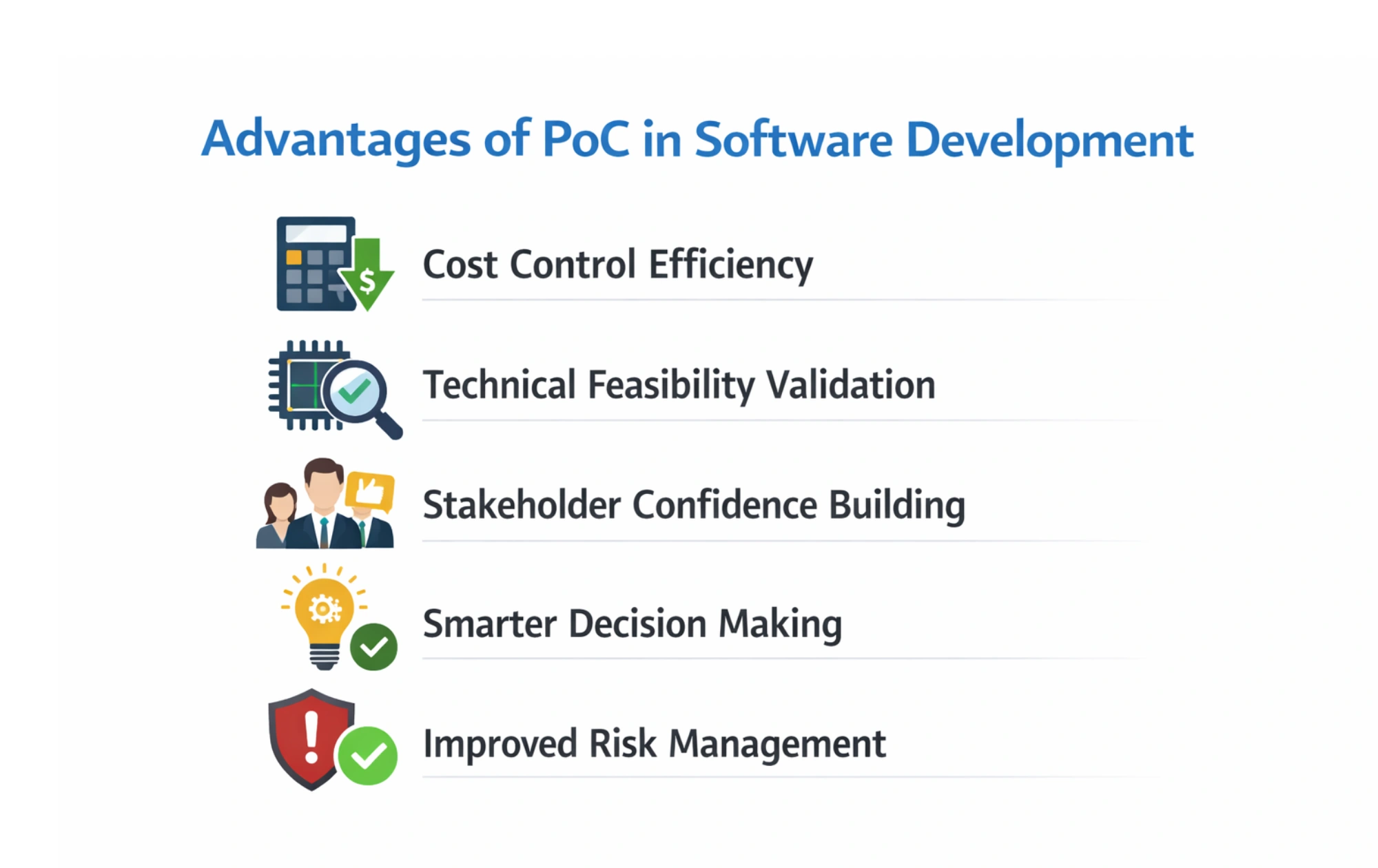
A Proof of Concept helps decision-makers reduce uncertainty early, control costs, and make smarter product choices. Let’s look at the key advantages of PoC in creating software.
-
Cost Control and Budget Efficiency
One of the key benefits of proof of concept is cost control. By validating feasibility early, teams can reduce software development cost, avoid unnecessary features, prevent budget overruns, and allocate resources more strategically across critical development priorities.
-
Technical Feasibility Validation
A PoC helps validate technical feasibility before scaling. It supports early software risk assessment by testing the architecture, integrations, and performance assumptions in real-world conditions. This reduces dependency risks and avoids fragile technical foundations.
-
Stronger Stakeholder and Investor Confidence
PoCs build trust among stakeholders. Demonstrating early results improves ROI in software development and supports early-stage investment. It also helps founders demonstrate clarity, credibility, and technical confidence when securing venture capital.
-
Faster and Smarter Decision-Making
With real data from early-stage product validation, teams make quicker go-or-no-go decisions. This clarity serves as a reliable risk-mitigation strategy, enabling leaders to prioritize initiatives and accelerate planning cycles.
-
Improved Risk Management
PoCs enable structured risk management by uncovering limitations early. They help teams pivot sooner, protect huge investments, reduce long-term uncertainty, and strengthen alignment between business goals and technical execution.
When to Choose Proof of Concept Development for Your Software Idea?
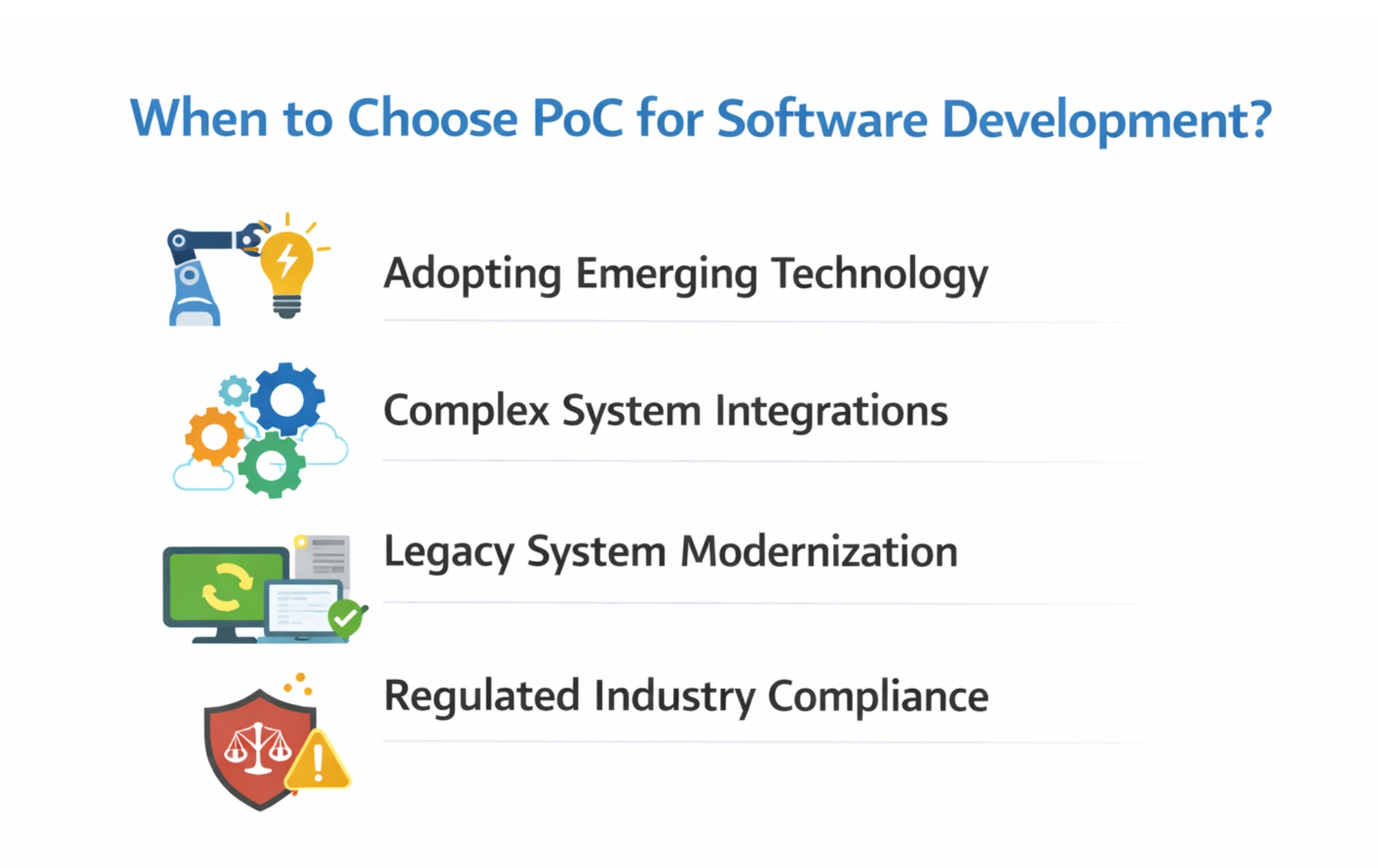
Knowing when to build a proof of concept is critical to avoiding wasted time, budget overruns, and failed expectations. PoC software development is most valuable when uncertainty is high and early validation can significantly reduce long-term risk.
-
Adopting New or Emerging Technologies
When your software idea involves AI, blockchain, IoT, or other emerging technologies, validating new technologies becomes essential. A PoC helps confirm whether the technology can meet performance, scalability, and data requirements before full-scale implementation.
-
Managing Complex System Integrations
If your project depends on multiple systems, APIs, or third-party platforms that must work together, choosing a PoC helps validate integrations early. It ensures data flow, security, and interoperability function as expected in complex environments.
-
Planning Legacy System Modernization
For organizations undergoing legacy system modernization, a PoC tests how modern frameworks, cloud platforms, or microservices interact with existing systems. This reduces migration risk and uncovers compatibility challenges before large investments are made.
-
Operating in Regulated or High-Risk Industries
In industries such as healthcare, fintech, or government, regulatory compliance and security are non-negotiable. A PoC allows teams to validate compliance, reliability, and risk controls early within enterprise app development initiatives.
PoC in Software Development: A Step-by-Step Process
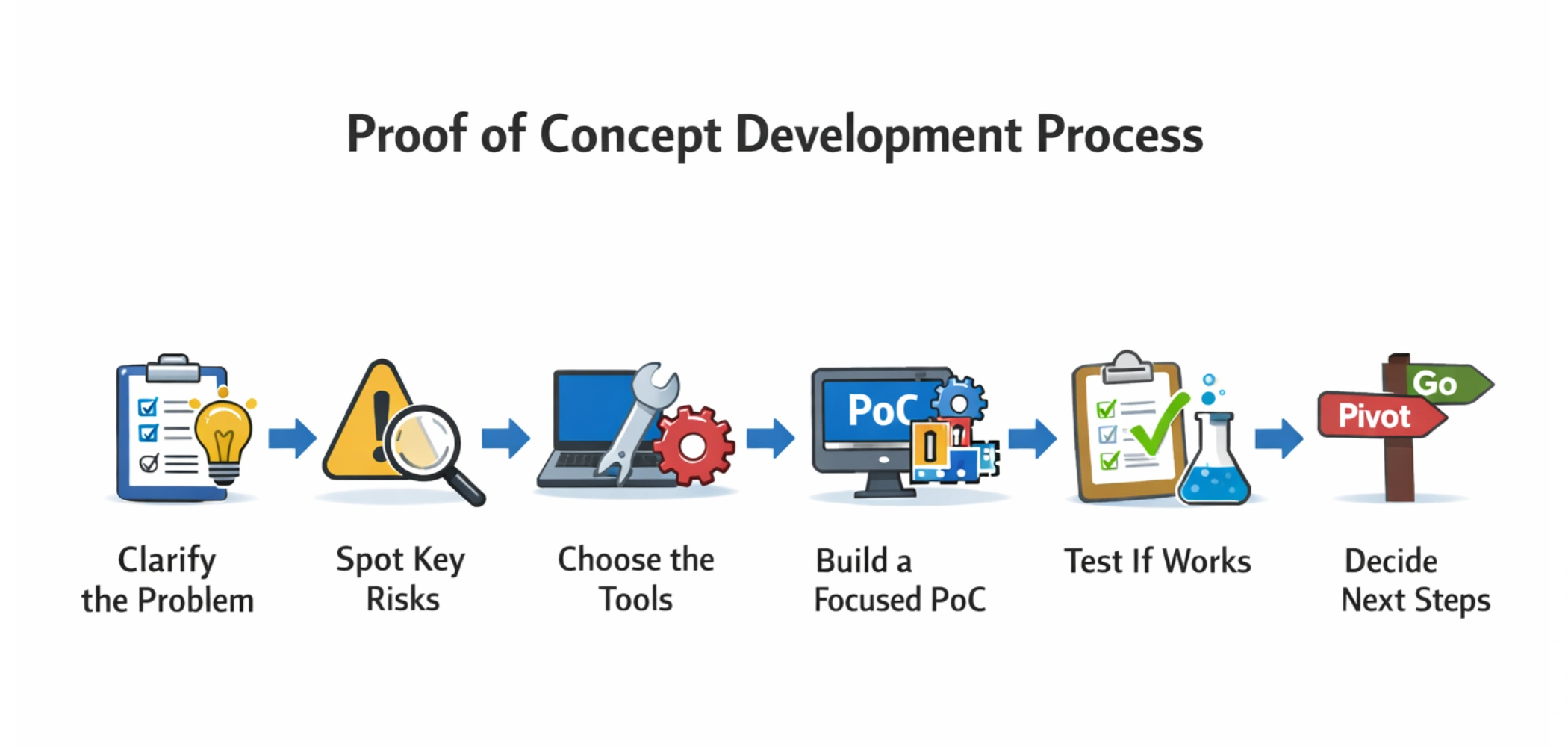
A Proof of Concept is only effective when it follows a structured and outcome-driven approach. Skipping steps or rushing execution often leads to misleading results. This step-by-step process helps teams make confident decisions before end-to-end development begins.
-
Define the Problem and Objective
Before any code is written, it is essential to define the goals clearly. A PoC should focus on answering one or two critical questions, not solving everything at once. Clear PoC objectives align technical exploration with business goals and prevent scope creep.
This step also involves early software requirements analysis to identify what must be tested and what can be excluded. When aligned with the broader software design process, this clarity ensures the PoC remains focused, measurable, and decision-oriented rather than becoming an unfinished product experiment.
-
Identify Key Assumptions and Risks
Every software idea is built on assumptions. A strong PoC makes those assumptions explicit and tests the riskiest ones first. This includes identifying technical risks such as performance limits, third-party dependencies, or data constraints.
Clear documentation of software assumptions helps teams avoid false confidence and biased decision-making. Early risk identification enables teams to quickly validate or invalidate ideas, reducing the risk of discovering critical flaws after major investments have already been made.
-
Choose the Right Technology Stack
The success of a proof of concept in software development heavily depends on smart technology stack selection. The goal is not long-term optimization but fast and reliable validation. Teams should choose tools that enable quick experimentation while supporting software architecture validation.
This step tests whether the selected frameworks, platforms, or services can meet core requirements under realistic conditions. Preference should be given to proven, scalable technologies that can evolve into later stages if the PoC succeeds, avoiding rework during the transition to prototype development services or MVP.
-
Build a Focused PoC (Not a Full Product)
The goal of PoC development is to validate feasibility, not to build a market-ready solution. Teams should focus only on the minimal functionality required to test core assumptions. This lean approach supports rapid software development and prevents unnecessary complexity.
Following an agile methodology workflow, teams can iterate quickly, test hypotheses, and refine outcomes without overengineering. A focused PoC saves time, reduces cost, and ensures effort is spent answering the most critical technical questions rather than building features that may never be used.
-
Test, Measure, and Validate Results
Once the PoC is built, structured proof of concept testing is essential. This step focuses on performance validation under realistic conditions, such as load handling, response time, or integration behavior.
Effective feasibility testing compares results against the original objectives defined earlier. Clear metrics and documented outcomes help teams determine whether the concept works as intended or only appears functional in controlled scenarios, reducing the risk of false positives.
-
Evaluate Outcomes and Decide Next Steps
The final step involves a thorough PoC evaluation to assess results against business and technical goals. Based on findings, teams make a clear go/no-go decision or identify areas requiring refinement.
This step directly informs product roadmap planning, ensuring future development is grounded in evidence. Strong cross-functional team collaboration among product, engineering, and business stakeholders ensures alignment and enables confident decision-making.
Proof of Concept Examples in Software Development
Real-world examples of PoC show how different teams validate feasibility early, reduce risk, and make informed decisions before scaling development, budgets, and long-term commitments across diverse software initiatives.
-
SaaS Platform Proof of Concept
A SaaS platform PoC focuses on validating multi-tenant architecture, authentication flows, and performance under concurrent usage. This software PoC example supports early SaaS product validation and confirms readiness for scalable SaaS-based product development.
-
AI Proof of Concept
An AI proof-of-concept tests data quality, model accuracy, and processing performance using limited datasets. It helps teams confirm whether AI outputs meet business goals before investing in full pipelines or infrastructure.
-
Mobile App Proof of Concept
A mobile app PoC validates platform compatibility, API communication, offline behavior, and device limitations. It reduces risk early without heavy UI investment, allowing teams to refine technical feasibility before full mobile app design.
-
Enterprise Integration Proof of Concept
In enterprise PoC development, the focus is on validating integrations between systems such as ERP, CRM, and legacy platforms. This PoC confirms secure data flow, performance stability, and interoperability across complex enterprise environments.
Common Mistakes to Avoid While Developing a Proof of Concept
Many PoC mistakes happen when teams rush execution or lose focus. Understanding these pitfalls helps prevent wasted effort, misaligned outcomes, and avoidable software development mistakes early.
-
Overbuilding the PoC
One major mistake is overbuilding. Adding features beyond feasibility can lead to scope creep, dilute focus, and complicate project management, making it harder to achieve clear, decision-ready outcomes.
-
Ignoring Business Goals
A PoC must align with business objectives. Ignoring them turns technical success into strategic failure, undermines informed decision-making, and weakens long-term value throughout the iterative development cycle.
-
Choosing the Wrong Metrics
Using vanity metrics instead of feasibility indicators leads to false confidence. The right metrics support PoC best practices, guide validation, and enable meaningful technical and business evaluation.
-
Treating PoC as an MVP
Confusing PoC with building a minimum viable product increases risk. This mistake inflates effort, delays learning, and adds unnecessary complexity instead of supporting technical debt reduction through focused validation.
-
Skipping Stakeholder Feedback
Excluding stakeholders limits insight. Regular feedback strengthens alignment, improves decision quality, and ensures the PoC supports shared goals across business, product, and engineering teams.
Cost, Timeline, & Team Required for PoC Development
Understanding proof of concept cost, timelines, and team needs helps businesses plan realistically and avoid surprises. Whether you build in-house or use POC development services, clear expectations ensure better budgeting and smoother decision-making from the start.
| Aspect | Typical Range / Details |
| PoC Cost | ($5,000–$15,000), depending on complexity, technology, and integrations |
| PoC Development Timeline | 3–8 weeks, based on scope, validation depth, and iteration cycle |
| PoC Development Team | Product manager, solution architect, 1–2 developers, QA support |
| Cost-Driving Factors | New technologies, third-party integrations, compliance needs, and data availability |
| Timeline Influencers | Clarity of requirements, stakeholder availability, and feedback cycles |
- A smaller PoC with focused objectives keeps costs low and timelines short.
- More complex ideas, such as AI models or enterprise integration,s require larger teams and longer validation cycles.
Carefully planning the scope and choosing the right PoC development team helps control costs, accelerate outcomes, and set a strong foundation for the next stage of product development.
The Future of Proof of Concept in Software Development
The future of PoC in software development is being shaped by speed, automation, and accessibility. As businesses push for faster innovation, proof of concept strategies for new technologies are transforming how teams validate ideas, reduce risk, and shorten the concept-to-market timeline.
-
AI Agents in PoC Development
AI in software development is redefining how PoCs are built and tested. AI agents can auto-generate code, simulate user behavior, and run rapid experiments across multiple scenarios.
This significantly reduces manual effort and speeds up scalability assessment by identifying performance bottlenecks early. As a result, teams can validate feasibility within days rather than weeks.
-
Low-Code and No-Code Platforms
Low-code platforms are making early-stage technical validation accessible to non-technical teams. By enabling rapid workflows, integrations, and UI creation, low-code and no-code tools allow businesses to test ideas quickly without heavy engineering effort.
This approach reduces costs, encourages experimentation, and enables faster iteration during early validation.
How SparxIT Delivers High-Impact PoC in Software Development
As a leading PoC development company, we help businesses turn ideas into validated solutions through outcome-driven PoC execution. With deep domain expertise and a focus on feasibility, SparxIT ensures every Proof of Concept delivers clarity, speed, and measurable value.
How we create high-impact PoCs:
- We clearly understand the problem and what the business wants to achieve
- Our PoC professionals quickly test the idea to see if it can actually work
- Bring together the right people, including business and technical experts
- Identify possible issues early so better decisions can be made
- Help move smoothly from testing the idea to building the real product
By focusing on validation over assumptions, our PoC experts reduce risk and accelerate decision-making. Our approach ensures that Proof of concept in software development is not an experiment but a strategic enabler that guides product direction, optimizes investment, and lays the groundwork for successful software development.

Partner with Experts
Frequently Asked Questions
What should be included in a proof of concept plan?


A proof of concept plan should define the problem statement, objectives, assumptions, success metrics, and scope. It should also outline risks, technology choices, and validation criteria.
Is a proof of concept framework necessary for every software project?
Not every project requires a PoC. However, it is highly valuable for complex, innovative, or high-risk initiatives where early validation can prevent costly mistakes.
What is the typical timeline of a poc?
A standard PoC timeline ranges from 3 to 8 weeks. The duration depends on complexity, technology stack, and the depth of validation required.
What happens if the proof of concept methodology fails?
A failed PoC is not a loss. It provides insights that help teams pivot, refine requirements, or avoid unnecessary software development costs altogether.
Can a proof of concept application be reused as an MVP?
In most cases, no. PoCs are built for feasibility, not scalability or user experience. Reusing them often increases technical debt and rework.