Think about how you learned to ride a bicycle. You stored facts like “pedals make the wheels move” and rules like “lean left to turn left.” You also used experience to balance better over time. Now imagine teaching all of that to a machine. That is exactly the challenge knowledge representation in AI tries to solve.
AI systems need more than raw data. They need organized, structured knowledge to reason, decide, and act intelligently. Knowledge representation is the method that makes this possible. It sits at the heart of every intelligent system, from expert systems that diagnose diseases to AI chatbots that answer your questions.
This blog covers everything you need to know about knowledge representation in AI, including its types, techniques, cycle, applications, challenges, and future trends.
What is Knowledge Representation in AI?
Knowledge representation in artificial intelligence refers to the process of organizing information in a way that an AI system can understand, process, and use to make decisions. It is not just about storing data. It is about giving AI the ability to reason, the same way humans use knowledge to solve problems.
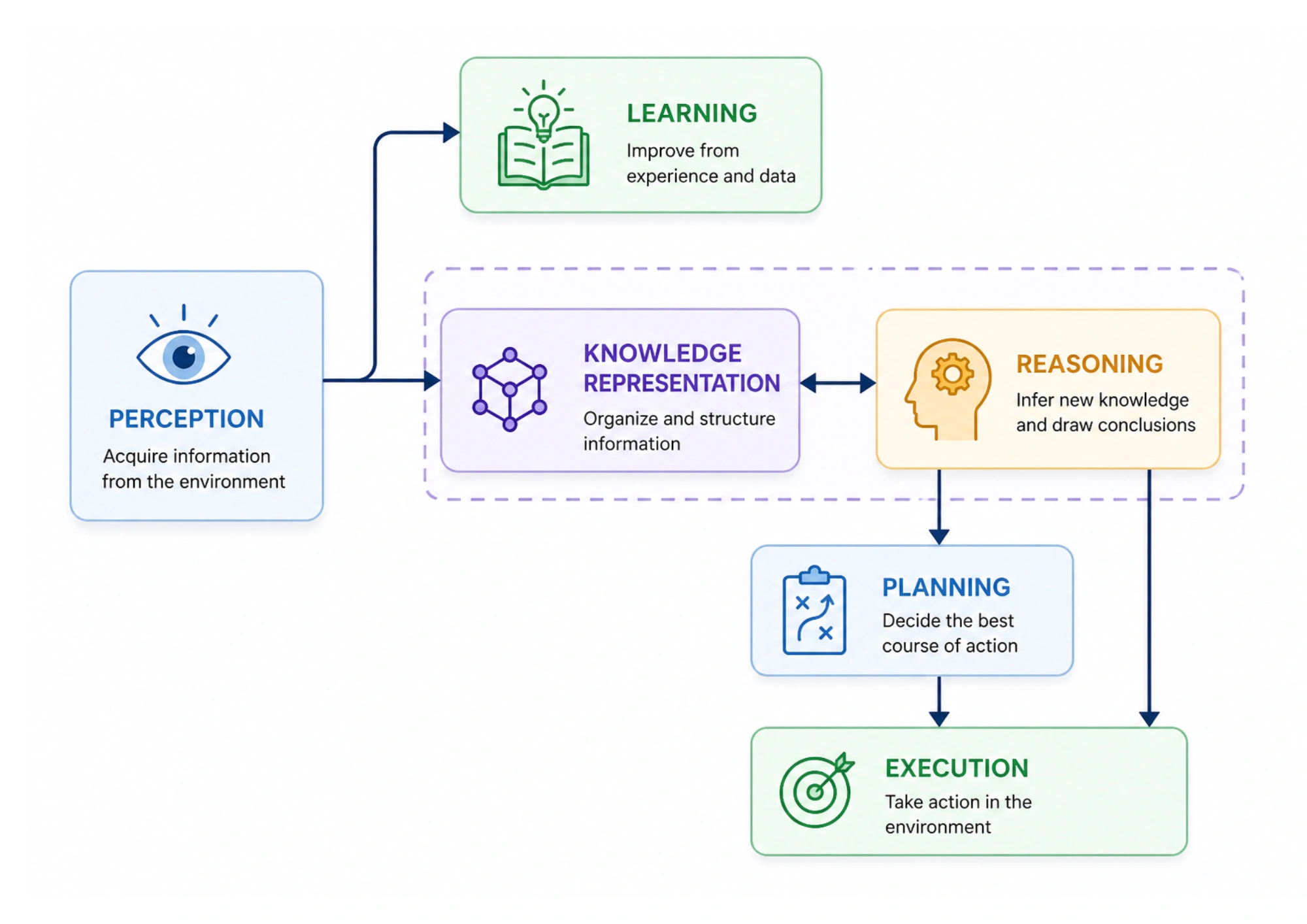
Think of AI representation as a library system. In a good library, books are not thrown into a pile. They follow a structure, by subject, author, and genre, so you can find what you need quickly. Similarly, AI knowledge representation methods create structures that enable an AI system to efficiently find, connect to, and use information.
A knowledge representation example would be a medical expert system that stores symptoms, diseases, and treatment rules in a structured format. When a patient describes their symptoms, the system uses that structure to suggest a diagnosis, much like a doctor would.
Relationship Between Knowledge and Intelligence
Knowledge and intelligence are deeply linked. Understanding one helps you understand the other.
-
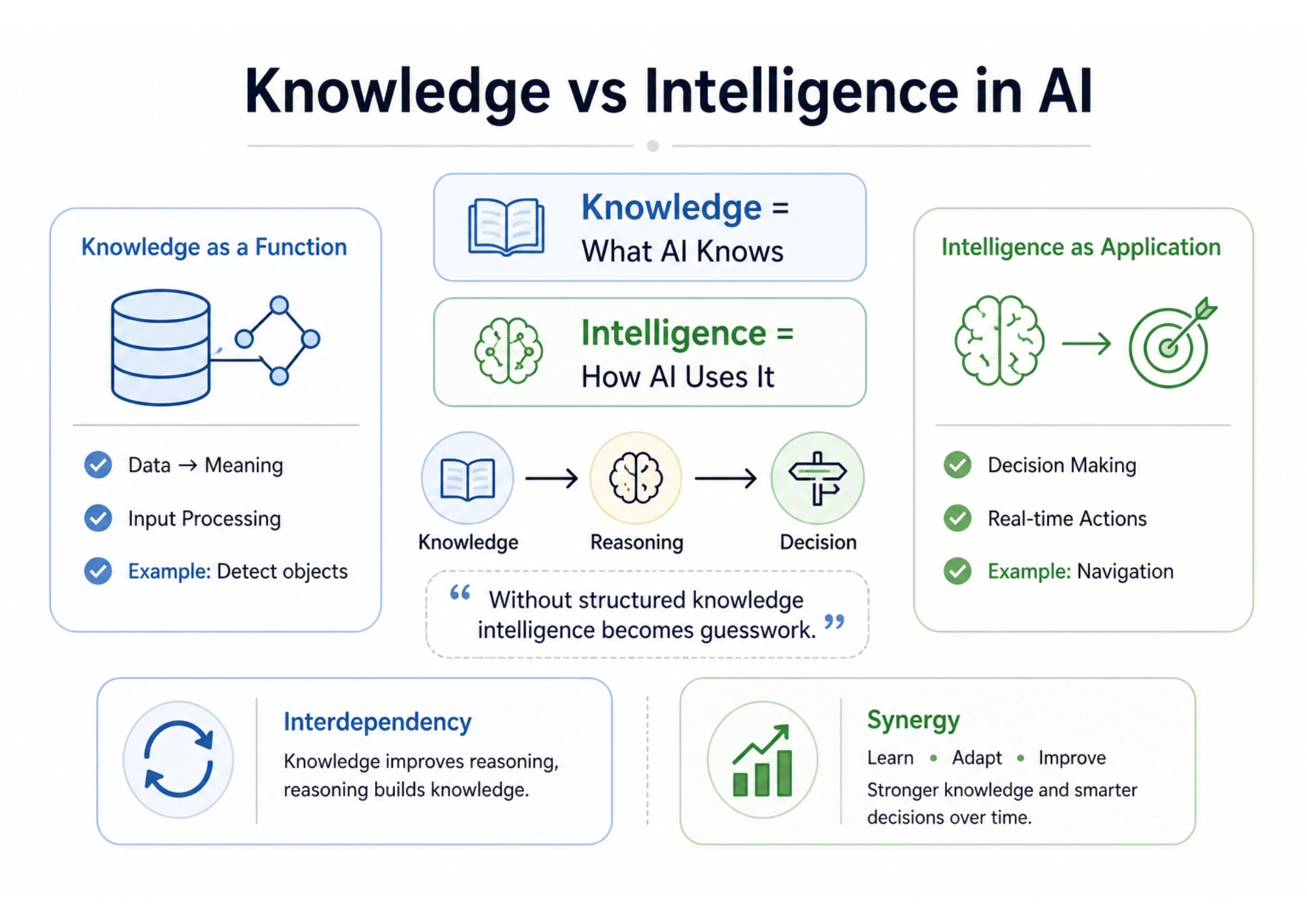
Knowledge as a Function
Knowledge acts as a function in AI. It takes input (raw data or sensory information) and transforms it into something meaningful. For example, a self-driving car receives thousands of sensor readings every second. Knowledge in AI processes those readings and decides: is that a pedestrian or a lamppost?
-
Intelligence as an Application
Intelligence is what happens when knowledge gets applied. An AI system that stores traffic rules, road patterns, and obstacle types can apply that knowledge intelligently in real-time to navigate safely.
| “Without structured knowledge, intelligence becomes guesswork.” |
-
Interdependency
Knowledge and intelligence depend on each other. More structured knowledge enables better reasoning, and better reasoning helps an AI system build even richer knowledge over time. One feeds the other. An inference engine, the component that draws conclusions from stored knowledge, is the clearest example of this interdependency in action.
-
Synergy
When knowledge and intelligence work together, the result is an intelligent system that can learn, adapt, and make better decisions over time. This synergy is what separates a basic rule-following program from a truly cognitive computing system.
| “Knowledge gives AI something to work with, and intelligence is what it does with that knowledge.” |
Why is Knowledge Representation in Artificial Intelligence Important?
Without knowledge representation (KR), AI systems would be like a student who memorizes millions of random facts but cannot apply any of them to solve a problem. Here is why knowledge representation in AI matters:
- Enables machines to simulate human-like reasoning and decision-making, which is the foundation of AI decision-making in fields like healthcare, finance, and logistics.
- Provides a structured foundation for building intelligent AI agents that can operate with minimal human intervention.
- Bridges the gap between raw data and meaningful, actionable information, turning structured vs unstructured knowledge into something AI can actually use.
- Facilitates efficient knowledge retrieval and inference in complex AI systems, allowing an inference engine to draw accurate conclusions quickly.
- Supports interoperability across different AI tools, platforms, and domains, making it easier to build scalable intelligent systems.
Together, these capabilities make AI truly useful, not just powerful on paper.
What Information is Represented in AI?
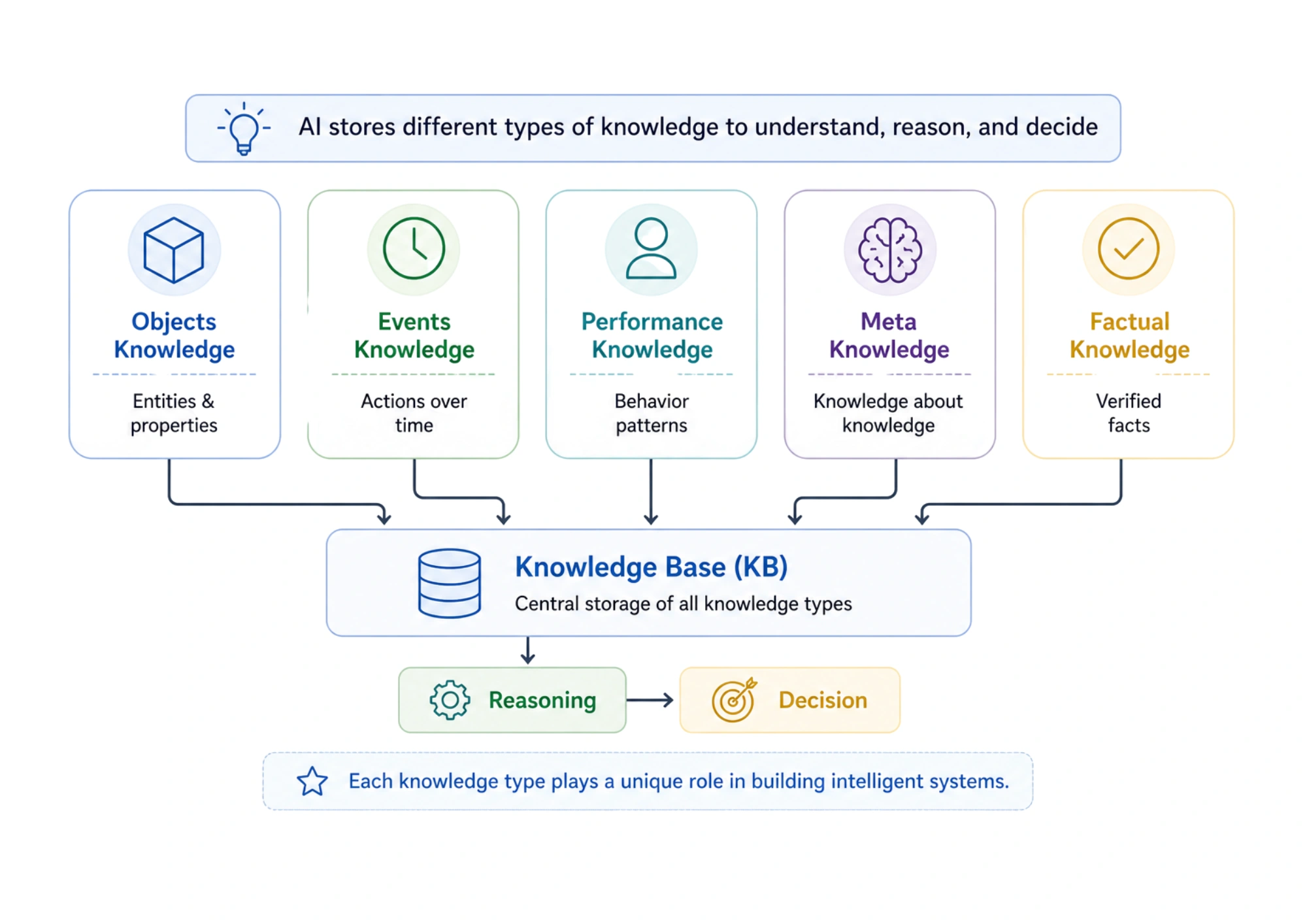
Before an AI system can reason, it needs to know what to store. Different kinds of information serve different purposes in an AI system. Here are the main categories:
-
Objects Knowledge
It covers facts about physical or abstract objects in the world. For example: “A car has four wheels” or “A hospital has doctors.” AI systems use object knowledge to understand entities and their properties.
-
Events Knowledge
This includes actions and happenings that occur over time. For example, “The patient was admitted on Monday” or “A file was uploaded at 3 PM.” Event knowledge helps AI track sequences and timelines.
-
Performance Knowledge
It covers how humans or agents behave in certain situations. It helps AI model human reactions and is useful in systems that need to anticipate user behavior or provide personalized recommendations.
-
Meta Knowledge
This is knowledge about knowledge itself. It tells the AI system which knowledge to use in a given situation. Think of it as a smart index that helps AI avoid wasting time on irrelevant information.
-
Factual Knowledge
These are verified, real-world facts. For example, “The Earth revolves around the Sun” or “Water boils at 100 degrees Celsius.” Factual knowledge provides AI with a reliable foundation for reasoning.
-
Knowledge Base (KB)
A knowledge base is a structured repository that stores all the above types of information in one place. It is the central storage system that an inference engine queries to produce answers or make decisions.
Each information type plays a unique role in building a complete, functional AI knowledge system.
Types of Knowledge Representation in AI
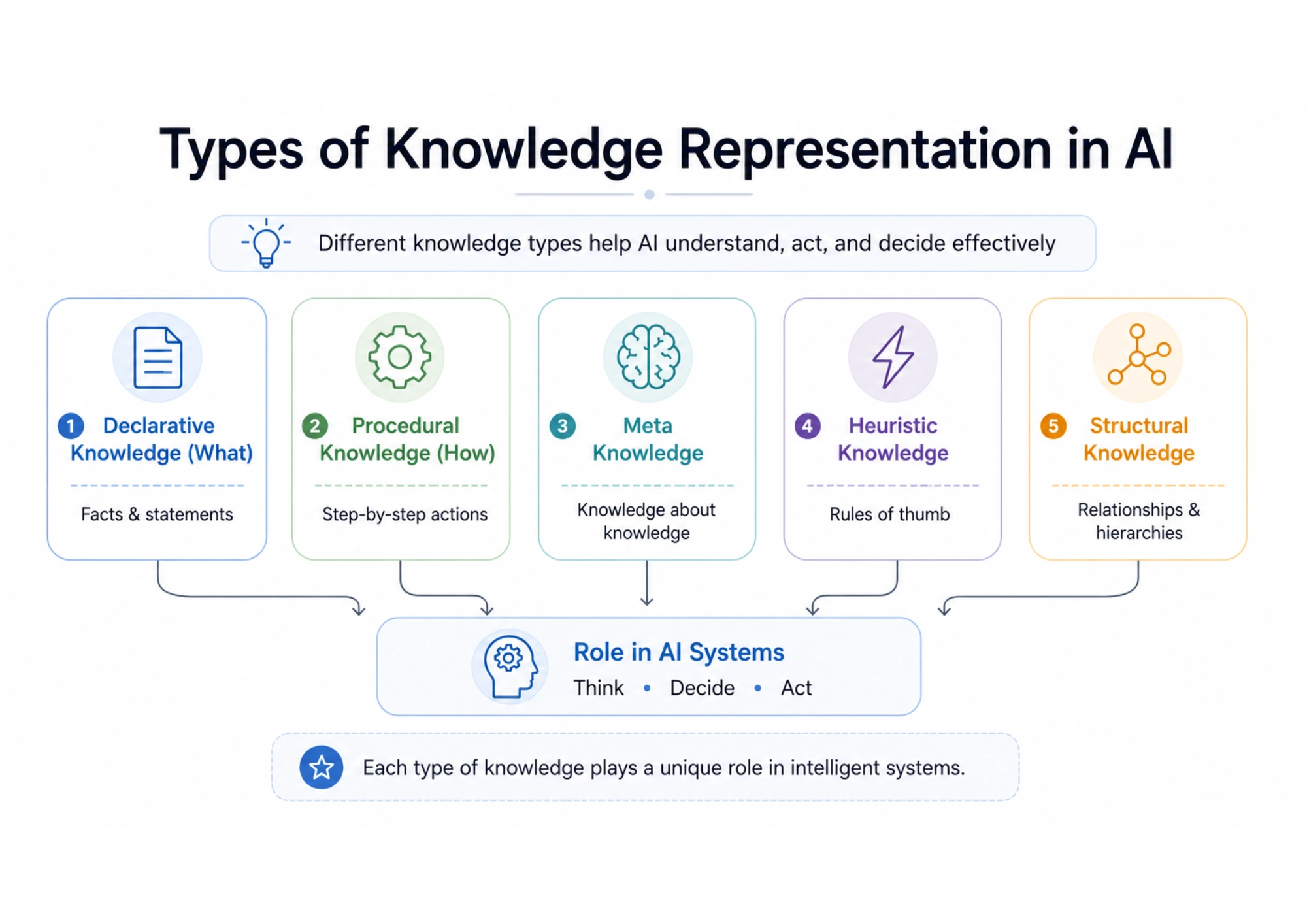
AI systems handle different kinds of knowledge depending on the task. Understanding the types of knowledge in AI helps in choosing the right representation strategy.
Declarative Knowledge
Declarative knowledge is the “what” of knowledge. It consists of facts and statements about the world. It does not describe how to do something; it simply states that something is true.
- Example: “Paris is the capital of France.” This is a fact, not a process.
- Use Case: Expert systems in medicine store declarative knowledge like “A fever above 104°F requires immediate attention” to help doctors make faster decisions.
Procedural Knowledge
Procedural knowledge is the “how” of knowledge. It describes step-by-step processes and methods to complete a task. It is dynamic and action-focused.
- Example: The steps to solve a math equation or the process a robot follows to pick up an object.
- Use Case: Robotics systems use procedural knowledge to execute physical tasks, like assembling a product in a factory.
Meta Knowledge
Meta knowledge is knowledge about other knowledge. It helps an AI system decide which knowledge to use when multiple options exist. Think of it as the AI’s awareness of its own knowledge.
- Example: Knowing that “for chest pain, cardiac knowledge is more relevant than neurological knowledge.”
- Use Case: AI agents use meta knowledge to prioritize actions in complex environments with multiple possible responses.
Heuristic Knowledge
Heuristic knowledge is experience-based knowledge. It uses rules of thumb or shortcuts to reach good-enough solutions quickly, even when complete information is not available. This is also called control knowledge in AI.
- Example: “If a website loads slowly, try refreshing it.” It is not always right, but it works most of the time.
- Use Case: AI-powered search engines use heuristic knowledge to rank results quickly without analyzing every possible webpage.
Structural Knowledge
Structural knowledge defines how concepts and objects relate to each other. It organizes knowledge into hierarchies, networks, and frameworks.
- Example: “A poodle is a type of dog, and a dog is a type of animal.” This is a hierarchy of relationships.
- Use Case: Knowledge graphs in AI use structural knowledge to map relationships between entities, powering tools like Google’s Knowledge Graph.
Each type of knowledge plays a unique role in helping AI systems think, decide, and act intelligently.
Knowledge Representation Techniques in AI
Now that you know the types of knowledge, let us explore the techniques of knowledge representation in AI that engineers use to actually store and structure that knowledge.
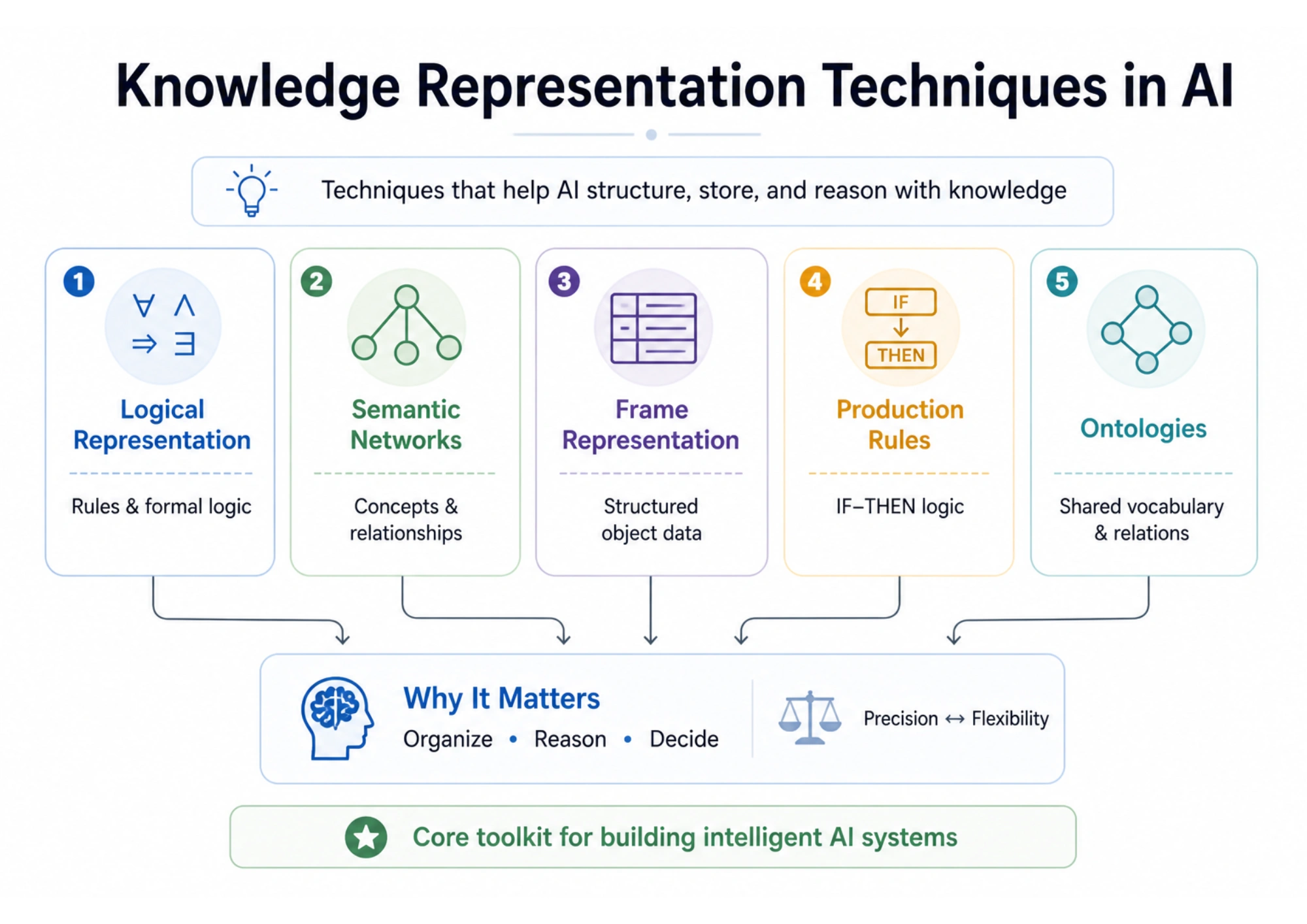
Logical Representation
Logical representation uses formal logic to store knowledge as statements and rules. It is one of the most precise AI knowledge representation methods available. Logic-based representation gives AI an unambiguous language to describe the world.
Syntax: Syntax defines the structure of valid statements. For example, in first-order logic, a statement might look like: “For all X, if X is a bird, then X can fly.”
Semantics: Semantics defines what those statements mean in the real world. It ensures that the AI interprets the logic correctly.
Advantages:
- Highly precise and unambiguous.
- Supports formal reasoning and proof generation.
Disadvantages:
- Difficult to handle uncertainty and real-world complexity.
- Creating and maintaining logic rules for large systems takes enormous effort.
Semantic Network Representation
Semantic networks in AI represent knowledge as a graph. Nodes represent concepts, and edges represent relationships between them. It is a visual and intuitive way to show how ideas connect.
IS-A Relation: Defines category membership. Example: “A dog IS-A animal.”
Kind-of Relation: Defines hierarchy. Example: “A poodle is a KIND-OF dog.”
Advantages:
- Easy to visualize and understand.
- Great for representing taxonomies and classification hierarchies.
Disadvantages:
- Becomes complex and hard to manage in large systems.
- Not suitable for representing uncertain or dynamic knowledge.
Frame Representation
Frames in AI are data structures that group related knowledge about an object or concept into a single unit. Think of a frame as a form with slots that you fill in with specific information.
Example: A frame for “Car” might look like:
Frame: Car
- Color: [Red]
- Wheels: [4]
- Engine: [Petrol]
- Owner: [John]
Advantages:
- Intuitive and easy to extend with new properties.
- Supports default values, so AI does not need complete information to function.
Disadvantages:
- Becomes rigid when knowledge changes frequently.
- Not ideal for reasoning tasks that require strict logical inference.
Production Rules
Production rules, also called rule-based systems, represent knowledge as a set of IF-THEN rules. Each rule has a condition and an action. If the condition matches, the system performs the action.
Example: IF temperature > 38.5 AND symptoms include cough THEN suggest flu test.
Advantages:
- Easy to understand and modify.
- Transparent reasoning makes them great for explainable AI.
Disadvantages:
- Rule sets can grow very large and become difficult to manage.
- Conflicts between rules can slow down or confuse the inference engine.
Ontologies
Ontology in AI defines a shared vocabulary of concepts and the relationships between them within a specific domain. It serves as a common language that different AI systems can use to understand one another. Ontologies are essential for semantic interoperability, meaning multiple systems can share and understand the same knowledge.
Example: OWL (Web Ontology Language) is a standard language for defining ontologies on the web. It helps build the Semantic Web, where machines can read and interpret web content.
Advantages:
- Enables knowledge sharing across systems and organizations.
- Supports automated reasoning across large, interconnected knowledge bases.
Disadvantages:
- Designing ontologies requires deep domain expertise.
- Can become overly complex for large domains.
Together, these five techniques form the toolkit of every AI engineer working with smart systems.
Cycle of Knowledge Representation in Artificial Intelligence
Knowledge representation is not a one-time activity. It follows a continuous cycle that keeps the AI system updated, accurate, and useful. Here are the key stages:
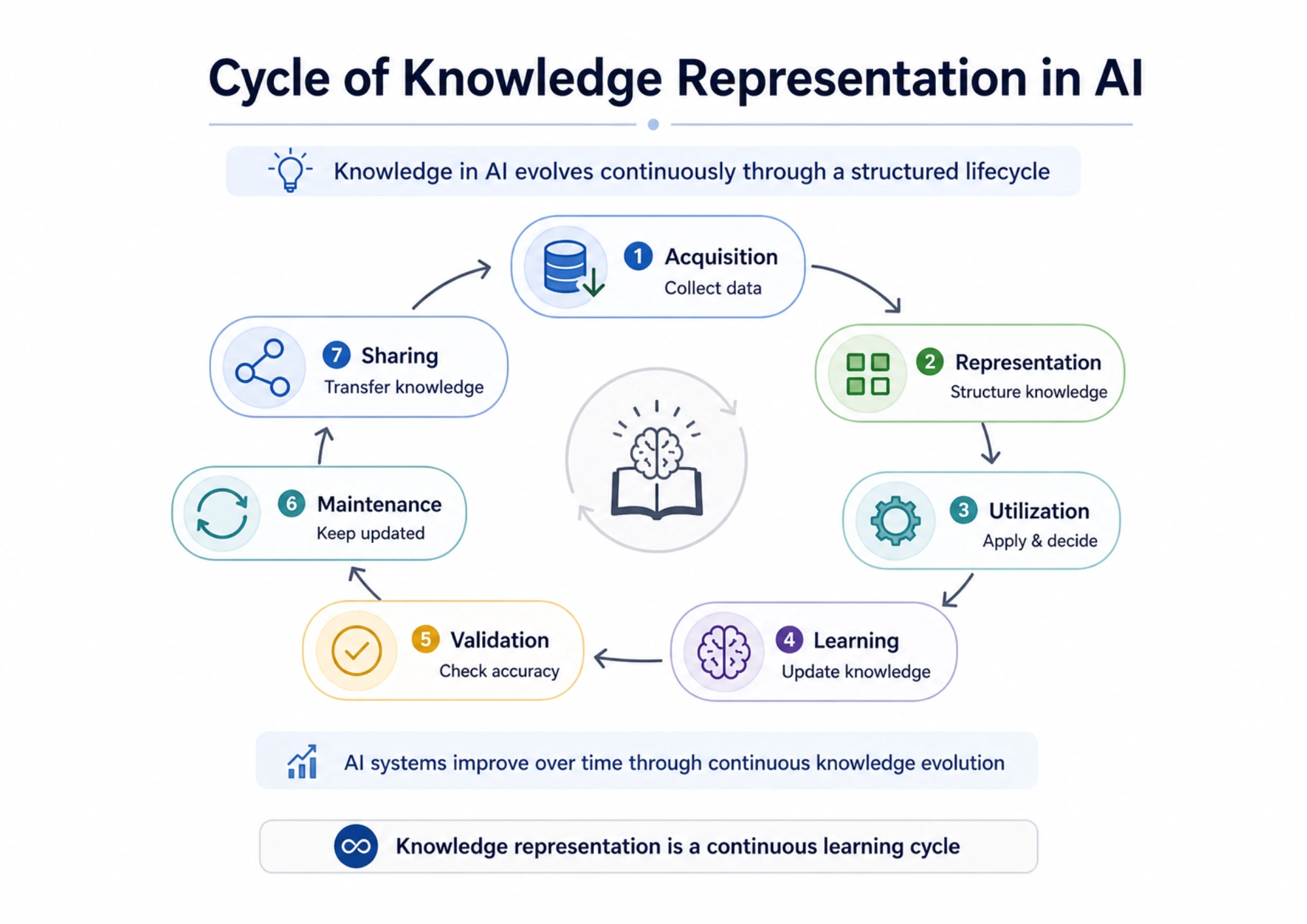
1. Knowledge Acquisition
The AI system gathers information from various sources such as databases, documents, sensors, or human experts. This is where raw data transforms into organized information.
2. Knowledge Representation
Then the acquired knowledge gets structured using one of the techniques we covered above, such as logic, frames, or ontologies. This makes the knowledge machine-readable.
3. Knowledge Utilization
After that, the AI system actively uses the stored knowledge to answer questions, make decisions, or perform tasks. The inference engine drives this stage.
4. Knowledge Learning
Once that is completed, the system learns from new data and experiences. It updates its knowledge base through machine learning or manual updates from domain experts.
5. Knowledge Validation and Verification
Engineers test the knowledge base for accuracy, consistency, and completeness. Faulty or outdated knowledge gets corrected or removed.
6. Knowledge Maintenance
As the world changes, knowledge must stay current. This stage handles updates, deletions, and additions to keep the system up to date.
7. Knowledge Sharing
Validated knowledge can transfer to other systems or teams. This is especially useful in multi-agent systems or enterprise AI environments.
This cycle ensures that AI systems do not just learn once and stop. They grow smarter over time.
Applications of Knowledge Representation in AI
Knowledge representation powers some of the most impactful AI systems in use today. Here are the key application areas:
-
Expert Systems
Expert systems store domain-specific knowledge in a structured knowledge base and use an inference engine to mimic a human expert’s decision-making. Medical diagnosis platforms, legal advisory tools, and financial risk assessors all use expert systems powered by knowledge representation.
-
Natural Language Processing (NLP)
NLP development service providers use knowledge representation to understand context, meaning, and intent in human language. When you ask a chatbot a question, it queries a structured knowledge base to give you a relevant answer. Semantic networks and ontologies play a major role here.
-
Robotics
Robots use procedural and declarative knowledge to interact with their environment. A warehouse robot, for example, uses knowledge about object locations, movement rules, and task sequences to pick and place items without human guidance.
-
Semantic Web
The Semantic Web is an extension of the internet where machines can read and interpret web content, not just humans. Ontologies like OWL and languages like RDF make this possible by giving web data a shared, machine-readable structure.
-
Cognitive Computing
Cognitive computing systems aim to simulate human thought processes. They use knowledge graphs and reasoning engines to connect across large datasets, just as a human expert connects the dots across different fields.
These use cases show why knowledge representation sits at the center of modern AI development.
Benefits of Knowledge Representation and Reasoning in AI
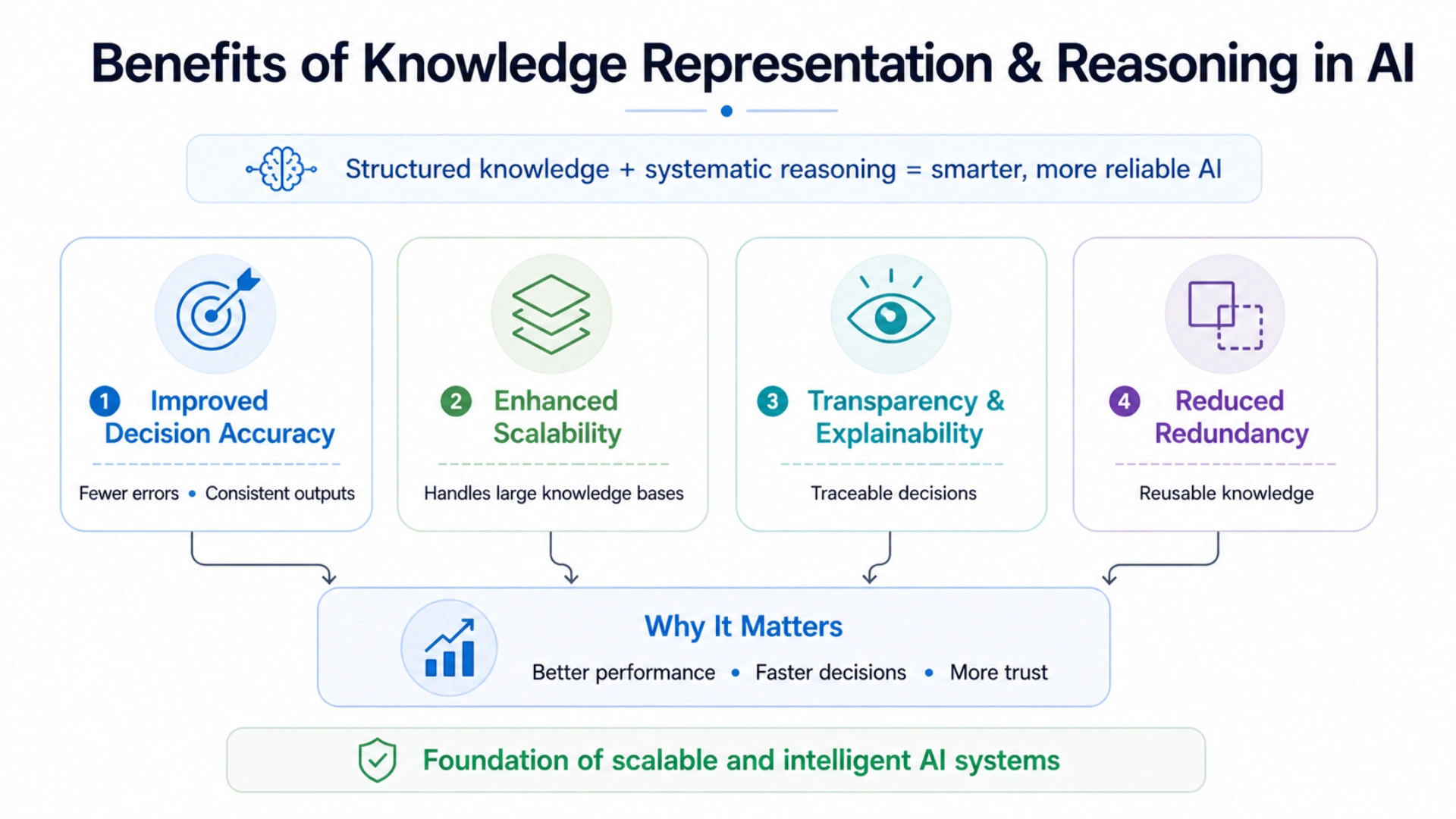
Good knowledge representation does more than organize information. It actively makes AI systems better in measurable ways:
-
Improved Decision-Making Accuracy
When knowledge is structured and reasoning is systematic, AI systems make fewer errors. An inference engine working with a well-organized knowledge base delivers reliable, consistent outputs for AI decision making.
-
Enhanced Scalability
AI integration in systems can handle large, complex knowledge bases without performance degradation when knowledge is modular and well-structured. This scalability is critical for enterprise-level intelligent systems.
-
Greater Transparency and Explainability
Rule-based systems and logical representation make it easy to trace how an AI system reached a conclusion. This transparency builds trust and supports compliance across industries such as healthcare and finance.
-
Reduced Redundancy
Organizing knowledge into reusable, modular structures prevents the same information from being stored and processed multiple times, saving computational resources and reducing errors.
These advantages make knowledge representation and reasoning (KRR) a foundational investment for any serious AI development project.
Challenges of Knowledge Representation in AI
Despite its importance, knowledge representation faces several real-world challenges. These issues in knowledge representation in AI deserve attention from developers and businesses alike:
-
Complexity
Real-world knowledge is vast and interconnected. Representing all of it in a structured way is incredibly difficult. The more complex a domain is, the harder it becomes to build a complete, accurate knowledge base.
-
Ambiguity and Vagueness
Human language is full of ambiguity. The word “bank” can mean a financial institution or a riverbank. AI systems struggle to resolve these ambiguities without extensive context-aware knowledge structures.
-
Scalability
As knowledge bases grow, retrieving and reasoning over large amounts of information becomes slower and more resource-intensive. This is a major bottleneck in production-scale AI systems.
-
Knowledge Acquisition
Gathering and encoding expert knowledge is time-consuming and expensive. Experts must translate what they know into structured formats, and that process requires ongoing effort. This challenge in knowledge acquisition is one of the oldest problems in the field.
-
Reasoning and Inference
Even with a perfect knowledge base, the inference engine must reason efficiently. Complex inference chains can take too long to compute, especially in time-sensitive applications like autonomous vehicles or real-time fraud detection.
Acknowledging these challenges is the first step toward building more robust and realistic AI systems.
Future Trends in Knowledge Representation
Knowledge representation is evolving fast. The next generation of AI systems will rely on more powerful and flexible approaches to storing and reasoning with knowledge:
-
Knowledge Graphs Meet LLMs
Integration of knowledge graphs with large language models (LLMs) will enable richer, more grounded reasoning. LLMs generate fluent language, while knowledge graphs provide verified facts. Together, they reduce hallucinations and improve accuracy.
-
Neuro-Symbolic AI
The rise of neuro-symbolic AI combines the pattern-recognition power of neural networks with the logical precision of symbolic knowledge representation. This approach bridges the gap between machine learning and symbolic AI, delivering systems that are both flexible and explainable.
-
Automated Knowledge Acquisition
Automated knowledge acquisition using NLP and machine learning will reduce the manual effort required to build knowledge bases. Generative AI development will read documents, extract facts, and update its own knowledge bases with minimal human intervention.
-
Federated Knowledge Bases
Growth of federated knowledge bases will enable decentralized, privacy-preserving AI systems. Instead of centralizing all knowledge in one place, different organizations can contribute to a shared knowledge ecosystem without exposing sensitive data.
The future of knowledge representation points toward AI systems that are smarter, more autonomous, and more trustworthy.
Conclusion
Knowledge representation is the backbone of every intelligent AI. Without it, AI is just a calculator that processes numbers. With it, AI becomes a reasoning system that understands context, draws conclusions, and solves real-world problems.
From the foundational types of knowledge to advanced techniques like ontologies and knowledge graphs, every element in this field works together to enable machines to think more like humans. Knowledge representation will remain the core, driving better AI transformation, more explainable outputs, and smarter systems.
Whether you are a student, a developer, or a business decision-maker, understanding knowledge representation in AI gives you a meaningful advantage in navigating the AI-driven world.
How Can SparxIT Help With Knowledge Representation in AI Systems
Building a knowledge representation system from scratch requires deep expertise in AI architecture, domain knowledge, and technical implementation. SparxIT brings all three together.
Take Supergas, for example. We simplified their data synchronization through API upliftment and implemented a knowledge graph that reduced query resolution time by 40%. This made their systems faster and more responsive at scale.
As a leading AI development company, SparxIT designs and deploys intelligent solutions that use advanced knowledge representation techniques, from expert systems and NLP development to AI agent development and LLM integration.
Whether you want to build a knowledge graph for your enterprise, design a rule-based decision system, or integrate an inference engine into your existing platform, SparxIT has the team and the expertise to deliver.
Talk to our AI consulting team today and turn your knowledge into intelligent action.

Partner with Experts
Frequently Asked Questions
What is the difference between a knowledge base and a database in AI?


A knowledge base stores structured facts, rules, and relationships that an AI system uses to reason and make decisions. A database simply stores raw data for retrieval. The key difference is reasoning: a knowledge base supports inference, while a database does not.
Can an AI system update its knowledge representation automatically over time?
Yes. Through machine learning and automated knowledge acquisition, AI systems can read new data, extract facts, and update their knowledge bases without requiring manual intervention. This happens during the Knowledge Learning stage of the knowledge representation cycle.
How is knowledge stored in artificial intelligence?
AI stores knowledge in structured formats such as knowledge bases, ontologies, semantic networks, and production rule sets. Each format suits different tasks. For example, ontologies work well for interconnected domain knowledge, while production rules suit decision-heavy applications.
How is knowledge representation different in symbolic AI versus modern deep learning systems?
Symbolic AI uses explicit, human-readable rules and structures like frames, logic, and semantic networks. Deep learning encodes knowledge implicitly inside neural network weights, which makes it powerful but less interpretable. The current direction in AI, called neuro-symbolic AI, tries to combine the strengths of both approaches.