The real estate industry is undergoing rapid digital transformation. From AI-powered property search to automated lease management, modern real estate businesses are replacing generic tools with platforms built around their specific operational needs.
These custom platforms help real estate companies streamline operations, meet compliance requirements, and scale without the limitations of off-the-shelf software.
If you are planning to invest in proptech solutions, one question matters most: how much will custom real estate software development cost in 2026?
This guide breaks down the costs of real estate software by platform type, feature complexity, AI capabilities, and team structure so you can plan your budget accordingly. The article will also help you enter vendor discussions and budget meetings with clear expectations.
What is Custom Real Estate Software Development and Why Build It?
Custom real estate software is built around your business model, giving you more flexibility, control, and scalability than generic SaaS platforms. Unlike off-the-shelf software, a custom platform gives you full control over user experience, integrations, workflows, and business data as your operations grow.
Businesses typically choose tailored software development when standard solutions cannot meet their specific operational needs.
- Off-the-shelf tools do not support your niche workflows, such as multi-market brokerage operations, fractional ownership, or commercial lease management.
- You need deep integration with MLS/IDX, a proprietary CRM for real estate business, or third-party APIs.
- Compliance requirements in your region demand specific data handling or audit trails.
- You are building a proptech product to sell or license to other businesses.
- In many cases, long-term SaaS subscription costs eventually become higher than owning a custom-built platform.
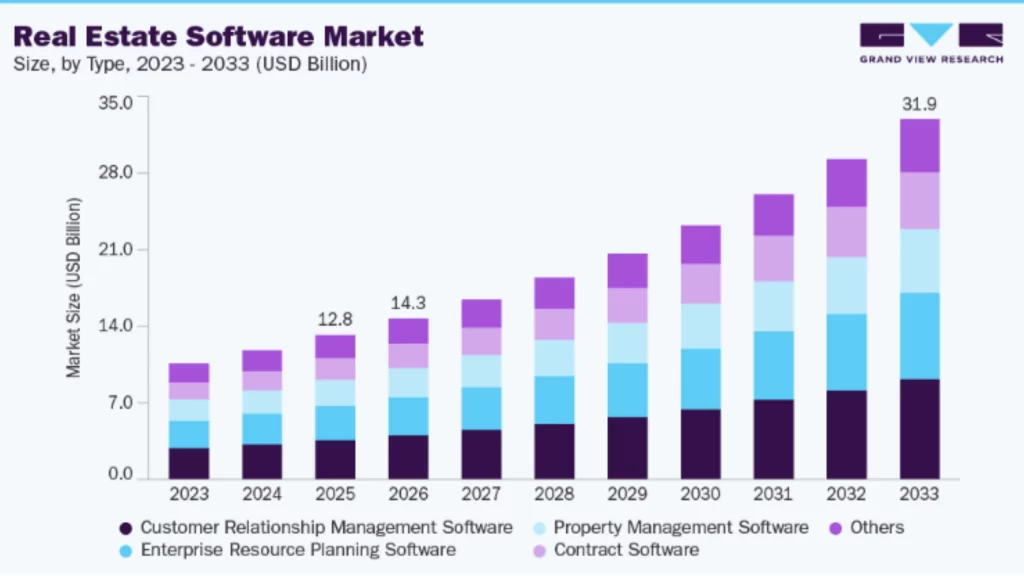
According to the Grand View Research report, the global real estate software solutions market is projected to grow from $12.79 billion in 2025 to $31.96 billion by 2033, at an 12.2% CAGR. Custom real estate software development is a major contributor to that growth as enterprises move away from one-size-fits-all tools.
Custom Real Estate Software Development Cost: At a Glance
Before diving into the specifics, here is a snapshot of what custom real estate software development costs in 2026 across complexity tiers:
| Platform tier | Typical cost range | Best for |
| MVP / Basic platform | $20,000 – $35,000 | Startups, proof-of-concept builds |
| Mid-range platform | $35,000 – $80,000 | Growing brokerages, proptech products with AI features |
| Enterprise-grade platform | $80,000 – $200,000+ | Large-scale operations, multi-market platforms, full AI stack |
These figures cover design, real estate app development, QA, and launch. However, they do not include ongoing maintenance, which typically adds 15–35% of the initial build cost annually, depending on platform complexity and hosting infrastructure.
Key Factors That Determine Your Real Estate Software Development Cost
The price of real estate software development varies significantly by platform requirements. The variables below are the primary drivers of your final budget.
i) Platform Type and Scope
The type of platform you build has the biggest influence on your overall development budget. Here are the most common categories and their cost ranges:
| Software type | Cost estimate | Core complexity |
| Real estate CRM software | $20,000 – $80,000 | Lead pipelines, agent workflows, and client portal |
| Property management software | $30,000 – $120,000 | Tenant management, rent collection, maintenance |
| Real estate listing portal | $40,000 – $150,000 | MLS/IDX integration, map search, filters |
| Brokerage management system | $50,000 – $180,000 | Commission tracking, compliance, and document management |
| Commercial real estate platform | $80,000 – $300,000 | Financial modeling, lease abstraction, and enterprise security |
| Full-stack proptech platform | $150,000 – $300,000+ | All of the above, combined with AI and analytics |
ii) Feature Complexity and AI Capabilities
Your feature set directly impacts app development cost, especially when advanced AI capabilities are part of the platform roadmap. Here is how key feature categories affect your real estate app development cost:
- Property search and listing: $8,000 to $25,000, depending on the scope of MLS/IDX and map complexity.
- AI chatbot for real estate: $12,000 to $30,000 for a conversational AI chatbot development with lead qualification.
- Predictive analytics real estate: $15,000 to $40,000 for valuation models using CoreLogic or HouseCanary APIs.
- Generative AI for real estate: $20,000 to $50,000 for listing description generation, market summaries, or document drafting.
- CRM and pipeline automation: $10,000 to $35,000 for lead routing, drip campaigns, and activity tracking.
- Payment processing and escrow: $8,000 to $20,000, including Stripe or third-party gateway integration.
- Virtual tours and 3D media: $15,000 to $40,000 for Matterport or custom AR/VR integration.
- Natural language property search: Enabling queries like a 3-bedroom with a garden near a top school under $500K adds $10,000 to $25,000.
- Automated valuation models (AVM): Integration with CoreLogic or HouseCanary APIs adds $15,000 to $30,000 in setup cost plus API licensing fees.
| Industry Insight: A 2025 survey found that over 90% of leading firms are currently piloting or using AI in real estate, with more than 60% running active, specialized pilot programs to improve efficiency. Platforms without AI integration services may struggle to compete with those that offer more intelligent, personalized user experiences. |
iii) UI/UX Design Investment
UI/UX design typically accounts for 15–25% of the total development budget. Investing in reliable UI/UX design services improves user adoption, conversion rates, and long-term platform usability.
Poor design increases churn, reduces conversion rates, and creates support overhead. Budget for user research, wireframing, responsive design, and usability testing from the outset.
iv) Team Structure and Location
Your proptech software development team’s location and structure directly affect your real estate software platform cost:
| Team model | Typical hourly rate | Best for |
| US / UK in-house or agency | $120 – $200/hr | Complex enterprise builds, sensitive data handling |
| Eastern Europe agency | $50 – $100/hr | Strong technical quality at mid-range cost |
| South Asia agency | $25 – $60/hr | Budget-conscious MVPs and maintenance |
| Blended delivery model | $60 – $120/hr | Most common: offshore dev with onshore PM/QA |
v) Cloud Infrastructure and Third-Party Integrations
Cloud based real estate software relies heavily on third-party integrations and external data services. Your costs should account for:
- MLS/IDX data licensing and RESO Web API integration: $5,000 to $20,000 setup plus $500 to $2,000 per month in ongoing data fees.
- Cloud hosting on AWS or Azure: $500 to $5,000 per month based on traffic and storage.
- Google Maps or Mapbox API: $200 to $2,000 per month, depending on request volume.
- Third-party CRM connectors, payment gateways, and e-signature tools: $200 to $1,500 per month combined.
Real Estate App Development Cost: Mobile vs Web
Most buyer-facing and agent-facing platforms require mobile apps, which increases the cost of custom real estate software development depending on your platform strategy.
| Approach | Additional cost | Notes |
| Web-only (responsive) | $0 additional | Suitable for admin panels and property portals |
| Cross-platform (React Native / Flutter) | $20,000 – $60,000 | Single codebase for iOS and Android; most common for proptech |
| Native iOS + Android | $40,000 – $120,000 | Best for map-heavy or media-intensive apps; higher performance |
For most 2026 proptech launches, hybrid app development offers the best balance of cost efficiency and performance. Native app development is better suited for platforms with heavy real-time map interactions or large media uploads.
Property Management Software Development: Cost Breakdown
Property management platforms are among the most common custom real estate software projects, with costs varying based on features and operational complexity. A modern property management software development streamlines tenant onboarding, rent collection, maintenance requests, lease management, and financial reporting through a single centralized system. Below is the table for the costs related to various modules of property management software:
| Module | Development cost |
| Tenant portal and onboarding | $10,000 – $25,000 |
| Online rent collection and payment | $8,000 – $20,000 |
| Maintenance request and ticketing | $6,000 – $15,000 |
| Lease management and e-signatures | $8,000 – $18,000 |
| Owner reporting and financial dashboard | $10,000 – $22,000 |
| Multi-property management dashboard | $12,000 – $30,000 |
A mid-tier property management platform covering all of the above typically costs between $55,000 and $130,000 for a first version. Enterprise builds with advanced analytics and multi-region compliance can exceed $250,000.
| Benchmark reference: To develop a real estate app like Zillow with full MLS integration, AI-powered property recommendations, and a buyer-seller marketplace, a phased approach is required. The cost starts at $150,000 for mid-scale software and scales to $300,000+ for a production-grade build. |
Hidden Costs Real Estate Software Buyers Overlook
Enterprise real estate software development cost is only one part of the total investment. These are the hidden costs that most buyers overlook:
-
Post-launch Maintenance
Plan for 20-25% of build cost annually for bug fixes, security patches, and platform updates.
-
Data Compliance and Security
GDPR, CCPA, and local real estate data regulations require ongoing legal review and technical implementation. Budget $5,000 to $15,000 upfront and $2,000 to $5,000 per year.
-
QA and Testing
Proper quality engineering across devices, browsers, and edge cases adds 15-20% to development timelines and cost. Functional testing helps prevent costly post-launch issues and improves long-term platform stability.
-
Performance Optimization
Map-heavy and media-intensive platforms require CDN configuration, caching strategies, and performance testing. Budget an additional $5,000 to $15,000 for this.
-
User Onboarding and Training
For enterprise deployments, onboarding materials, training sessions, and change management add $5,000 to $20,000, depending on team size.
How to Choose the Right Real Estate App Development Company
The success of your commercial real estate software development depends not only on budget, but also on choosing the right development partner. Here is what to evaluate:
-
Proven Proptech Portfolio
Ask for case studies demonstrating expertise in platforms that include MLS integration, CRM modules, or custom AI solution development, rather than relying solely on portfolios featuring generic web applications.
-
Domain Knowledge
Choose a real estate software development services provider with proven experience in workflows, compliance requirements, and property data architecture.
-
Tech Stack Alignment
In 2026, the dominant stack for real estate platforms is React Native or flutter for mobile, Node.js or Python for the backend, PostgreSQL for the database, and AWS or Azure for the cloud. Make sure the company has the experts working on these technologies.
-
Transparent Pricing Model
Fixed-price contracts work for well-scoped MVPs; time-and-materials contracts work better for complex, evolving builds. You can also hire mobile app developers on an hourly basis to complete your project.
-
Post-launch Support
Confirm the team offers a minimum of 3-6 months of support engagement with defined SLAs for critical issues.
| Due Diligence Tip: Request a technical product discovery sprint before signing any development contract. A credible real estate app development company will invest two to four weeks in scoping, architecture design, and cost estimation. |
Real Estate Software Development Cost: Summary
See the critical elements that influence development costs before you begin project planning.
| Planning dimension | Range/Guidance |
| MVP build (core features only) | $20,000 – $35,000 |
| Mid-range platform with AI | $35,000 – $80,000 |
| Enterprise / full-stack proptech | $80,000 – $200,000+ |
| Mobile app add-on (cross-platform) | $20,000 – $60,000 additional |
| Annual maintenance cost | 15–35% of the build cost per year |
| UI/UX design allocation | 15–25% of the total budget |
| AI feature integration | $12,000 – $50,000 per capability |
| Recommended team model | Blended delivery (onshore PM + offshore dev) |
Conclusion
The custom real estate software development cost in 2026 spans a wide range, from lean MVPs at $20,000 to enterprise-grade platforms exceeding $250,000. The most valuable investment is not the cheapest quote. It is the platform your users adopt, your team can maintain, and your business can confidently scale.
Real estate digital transformation is becoming a standard competitive requirement across the industry. Businesses investing in purpose-built software today are better positioned to adapt, scale, and compete in the evolving real estate market.
Start with a clear project scope, choose an experienced real estate app development company, and allocate a budget for AI capabilities and long-term maintenance. Your real estate software platform should be treated as a strategic business asset, not just an IT expense.
Why SparxIT Is the Right Real Estate Software Development Company for Your Business
SparxIT has over a decade of experience building custom proptech solutions, from startup MVPs to enterprise-scale real estate platforms. Our team understands MLS/IDX architecture, CRM workflows, lease management logic, and compliance requirements from day one.
We deliver end-to-end: UI/UX design, full-stack product development, AI integration, QA, and post-launch support, all under one roof. Every engagement begins with a structured discovery sprint, giving you a clear understanding of the project scope, architecture, and estimated cost before website or mobile app development begins.
Whether you are looking for real estate management software development, a listing portal, or an AI-powered proptech solution, SparxIT helps you launch scalable software aligned with your business goals and budget.

Partner with Experts
Frequently Asked Questions
How much does it cost to build a custom real estate software platform?


Costs range from $20,000 for a basic MVP to $250,000+ for enterprise platforms. Most production-ready builds with AI integration fall between $60,000 and $150,000.
How long does it take to develop a real estate software platform?
Basic MVPs take 3 to 5 months. Mid-range platforms with AI and mobile apps take 6 to 10 months. Enterprise builds with compliance modules can take 12 to 18 months.
Should I build custom real estate software or use an off-the-shelf SaaS tool?
Use SaaS for standard workflows and small teams. Choose custom development when you have unique business logic, compliance requirements, or are building a proptech product for other businesses.
What AI features should I prioritize in a real estate software development?
Prioritize an AI chatbot for lead qualification first. It delivers the fastest revenue impact. Add predictive analytics and automated listing content generation in your second development phase.
How do I reduce real estate software development cost without compromising quality?
Launch an MVP first, use a blended offshore team, choose cross-platform mobile development, leverage existing APIs, and invest in thorough scoping upfront to avoid costly mid-project changes.