The global vacation rental market size surpassed $101.69 billion in 2025, and it continues to grow. According to Airbnb’s Q4 2025 Shareholder Letter, Airbnb alone reported over 533 million nights and experiences booked in 2025. These numbers do not just tell you the market is big. They show that travelers now prefer renting private homes over booking hotel rooms.
That shift has created new opportunities for entrepreneurs, real estate firms, and travel startups to create a website like Airbnb and generate recurring revenue from rental bookings.
Building a rental marketplace like Airbnb requires more than replicating features. Custom web development services demand the right business model, technology foundation, and user experience strategy.
In this guide, we will walk you through everything: how Airbnb works, why the model scales, what features you need for Airbnb clone website development, how long it takes, and what it costs.
What Is Airbnb and How Does It Work?
Airbnb is an online accommodation booking platform that connects people with space to rent with those who need a place to stay. The platform does not own any properties. It acts as a marketplace between hosts and guests.
Hosts list their properties. Guests search, filter, book, and pay through the platform. Airbnb handles the transaction and takes a fee from both sides.
Overview of Airbnb’s Business Model
Airbnb runs on a two-sided marketplace model. Hosts provide the supply, while travelers generate demand within the marketplace ecosystem. The platform earns money every time a booking happens. This means Airbnb does not carry inventory risk as a hotel chain does.
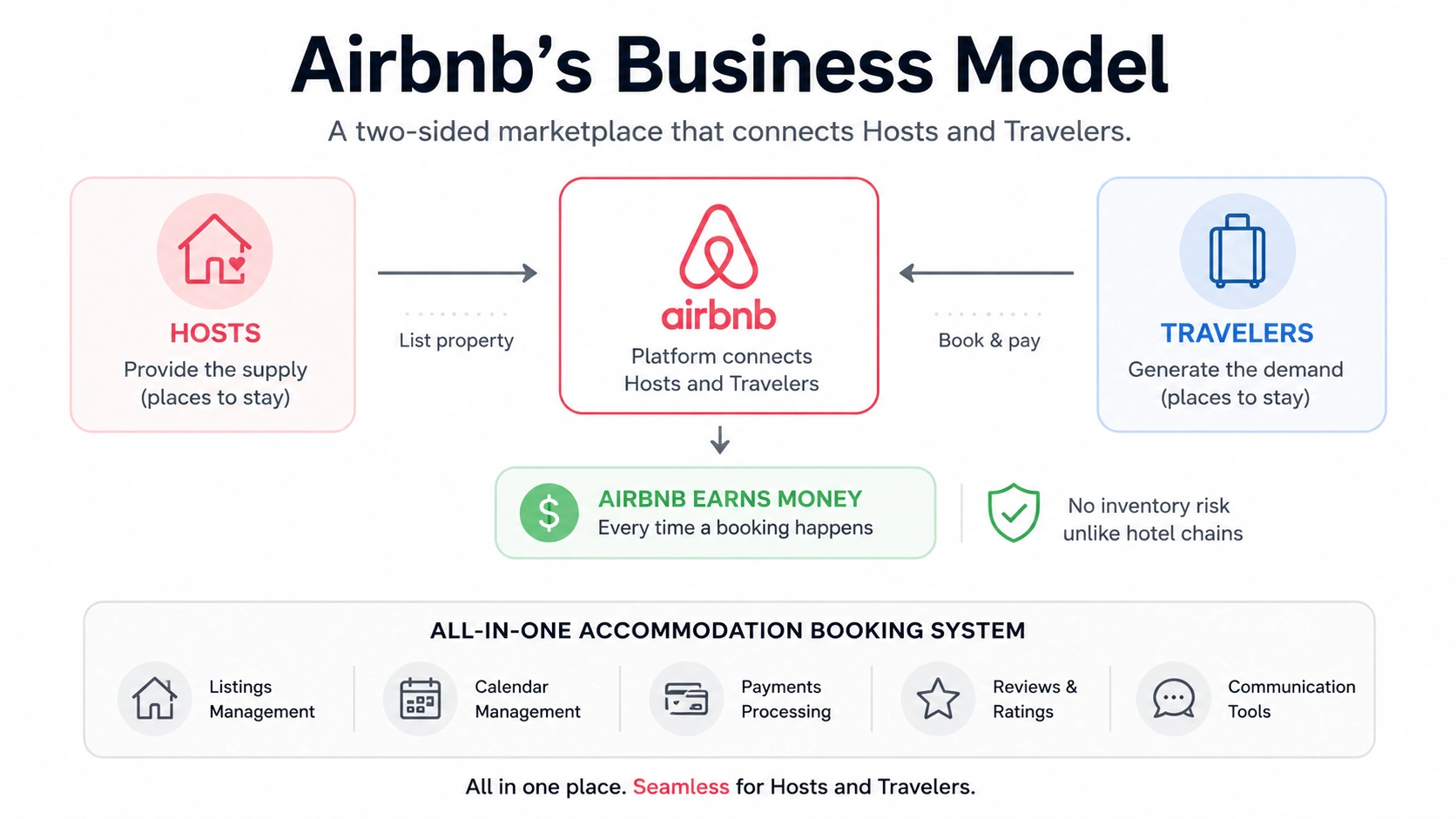
The accommodation booking system manages listings, calendars, payments, and reviews all in one place. That is what makes it different from a simple listing directory.
How Airbnb Connects Hosts and Travelers
A host creates a free account and lists their property with photos, pricing, and availability. A traveler searches by location, dates, and filters like pet-friendly or entire apartment. When a guest books, Airbnb holds the payment and releases it to the host 24 hours after check-in.
Revenue Streams Used by Airbnb
Airbnb generates revenue through four main channels:
- Service fees: Guests pay a service fee of 14-20% of the booking subtotal.
- Host commissions: Hosts pay a 3% commission on each completed booking.
- Premium services: AirCover protection plans and cleaning service partnerships generate additional revenue.
- Experiences: Hosts can sell guided tours and activities beyond accommodation.
Why Create a Website Like Airbnb?
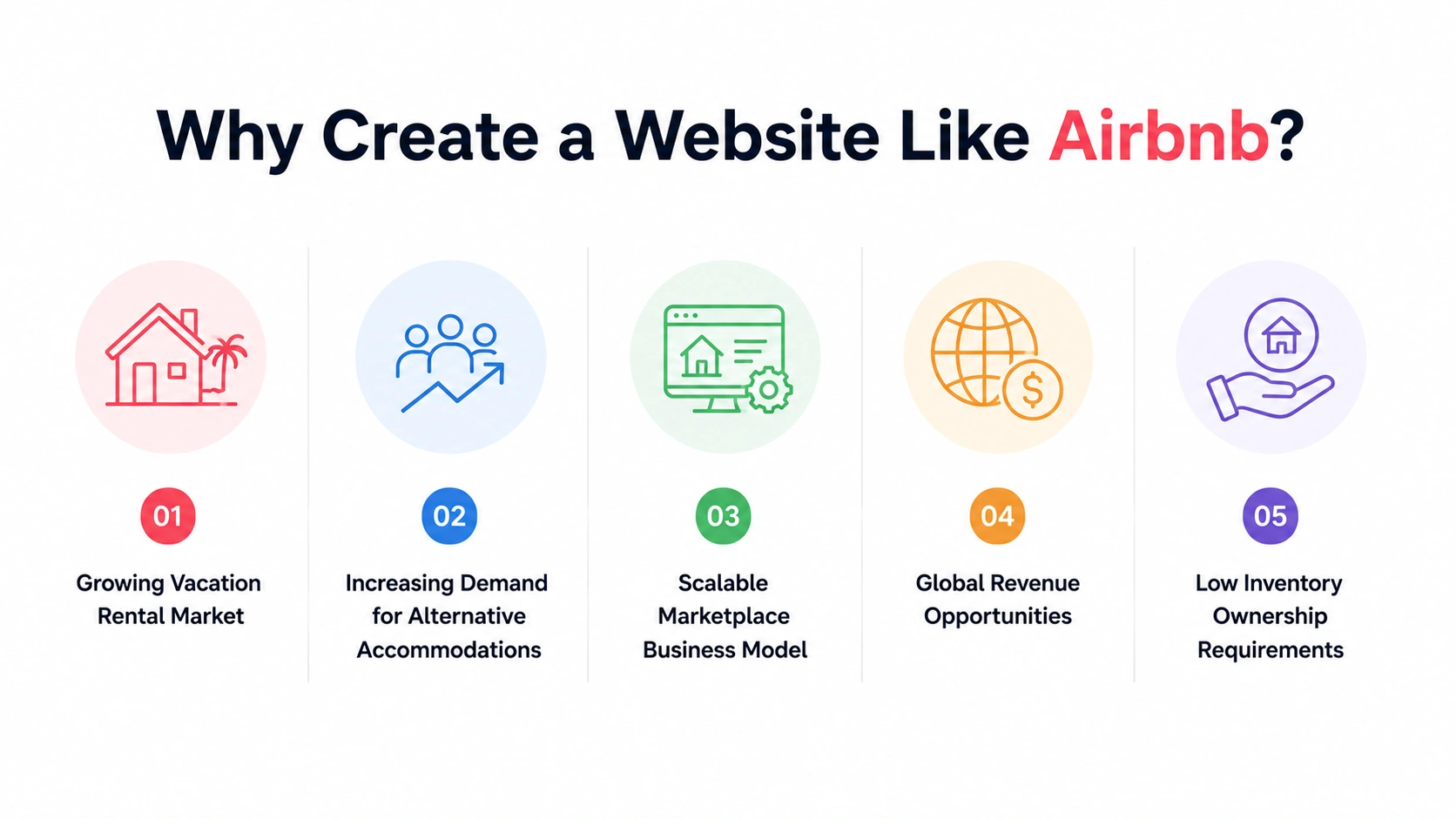
The short-term rental website development market is not just about copying Airbnb. It is about solving real problems for specific communities. Here is why the business model works.
-
Growing Vacation Rental Market
According to Fortune Business Insights, the global vacation rental market is projected to reach $481.8 billion by 2034, growing at 10.42% annually. More travelers want options that hotels cannot offer, such as full kitchens, private pools, and local neighborhoods.
-
Increasing Demand for Alternative Accommodations
A 2024 survey found that 63% of travelers prefer alternative accommodations over traditional hotels for trips longer than three nights. That demand is not shrinking. It is moving into niche markets like pet-friendly rentals, luxury villas, and corporate housing.
-
Scalable Marketplace Business Model
You do not manage the properties. Hosts do. Your job is to build a website like Airbnb and run it. This asset-light structure means you can grow the platform without growing costs at the same rate. That is what makes the rental marketplace development model attractive to investors.
-
Global Revenue Opportunities
A well-built platform can serve users in multiple countries from day one. Add local payment gateways and language support, and your platform can handle cross-border bookings.
-
Low Inventory Ownership Requirements
Traditional hotel businesses require years of construction and millions in capital. A rental marketplace website like Airbnb can launch with zero owned properties. This model also reduces market entry barriers and enables businesses to launch faster than traditional hospitality ventures, helping them validate demand and generate revenue sooner.
Key Benefits of Developing an Airbnb Like Website
Developing a property rental marketplace offers several advantages that support long-term growth and profitability. Let’s look at them one by one below:
-
Recurring Revenue Generation
Every booking triggers a commission. More hosts and guests mean more transactions and more income without adding inventory.
-
Global User Reach
A digital marketplace has no geographic ceiling. Language localization and multi-currency support open markets across continents.
-
Easy Property Management
Calendar sync, automated messaging, and pricing tools reduce manual work for hosts. That means less support burden for your team.
-
Improved Customer Experience
Reviews, secure payments, and identity verification build trust between strangers. Trust drives repeat bookings.
-
Business Scalability
Cloud-based architecture means your platform can handle 100 users or 100,000 users without a full rebuild.
-
Data-Driven Decision Making
Booking patterns, peak seasons, and high-demand locations provide actionable data to improve the platform and inform host pricing.
Must-Have Features to Include in a Clone Website Like Airbnb
Feature planning often determines whether an Airbnb clone website succeeds or struggles after launch. Teams either build too much or skip what matters. Here is a breakdown of what a rental marketplace website like Airbnb needs across three user types.
Host Features
| Host Registration and Verification | Identity checks and document uploads establish trust. Verified hosts get a badge on their listings. |
| Property Listing Management | Hosts need to add photos, write descriptions, set house rules, and update availability without contacting support. |
| Pricing Controls | Manual pricing, seasonal adjustments, and weekend rates let hosts maximize income. |
| Booking Management | Hosts can use a dedicated dashboard to accept, decline, or request modifications to incoming booking requests. |
| Calendar Synchronization | Sync with Google Calendar or iCal, so hosts do not get double-booked across platforms. |
| Revenue Dashboard | Hosts can access earnings summaries, payout history, and upcoming booking details from a centralized dashboard. |
Guest Features
| User Registration | Guests can register using email credentials or social logins and complete their profiles in a few simple steps. |
| Advanced Search Filters | Location, price range, property type, amenities, and guest count filters speed up decision-making. |
| Interactive Maps | Map-based search lets guests see property clusters in a neighborhood before committing. |
| Property Details Page | Photos, host bio, house rules, cancellation policy, and nearby attractions on one page. |
| Wishlist Functionality | Guests save properties to compare later. Wishlists also drive re-engagement notifications. |
| Instant Booking | No approval waiting. Guests confirm and pay in one step. |
| Secure Payments | PCI-compliant payment processing with support for cards, digital wallets, and local methods. |
| Reviews and Ratings | Two-way reviews build accountability. Guests rate hosts. Hosts rate guests. |
Admin Features
| User Management | View, suspend, or verify any guest or host account. |
| Property Moderation | Review flagged listings and approve new property types. |
| Commission Management | Set different commission rates by region, property type, or host tier. |
| Payment Management | Track all transactions, issue refunds, and resolve payment disputes. |
| Analytics Dashboard | Administrators can track platform revenue, active listings, and geographic demand trends through a centralized analytics dashboard. |
| Content Management System | Update homepage banners, promotional content, and help articles without developer support. |
| Customer Support Management | Ticket routing, response templates, and escalation workflows for guest-host disputes. |
Advanced Features to Differentiate Your Airbnb Clone Website Development
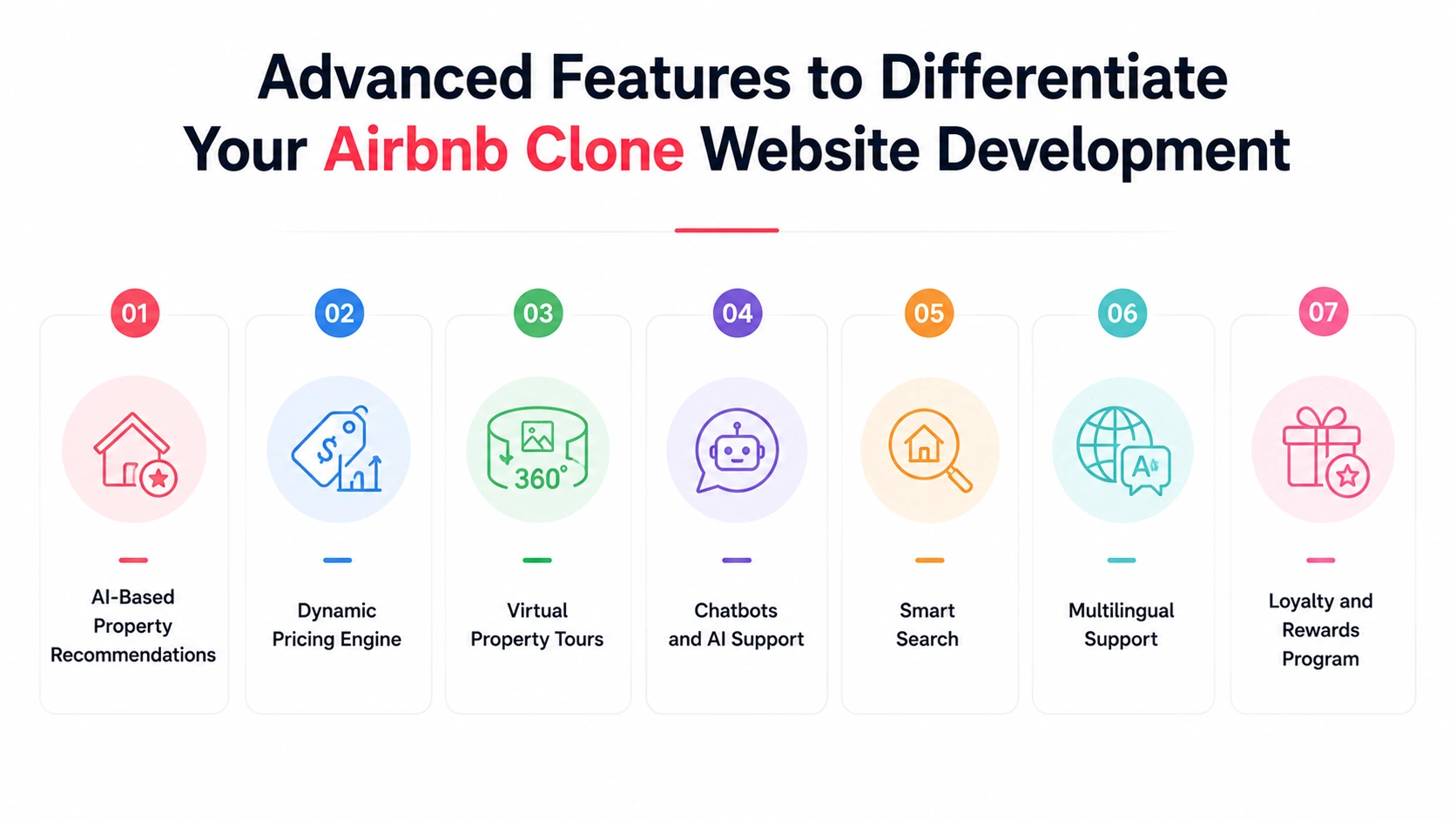
Standard features help launch your platform, but advanced capabilities, such as AI development, create competitive differentiation and improve user retention. These advanced features help you with innovative rental marketplace website development.
- AI-Based Property Recommendations: Machine learning models surface properties based on a user’s search history, past bookings, and filters.
- Dynamic Pricing Engine: Automated pricing that adjusts based on local events, demand patterns, and competitor rates.
- Virtual Property Tours: 360-degree photo walkthroughs let guests explore a property before booking. This reduces cancellations.
- Chatbots and AI Support: Handle booking FAQs, cancellation requests, and check-in instructions by building conversational chatbots.
- Smart Search: Natural-language queries like “find a cabin near a lake under $150 a night” return accurate results.
- Multilingual Support: Auto-translate listings and UI for guests browsing from different countries.
- Loyalty and Rewards Program: Points for bookings, badges for reviews, and discounts for returning guests improve retention.
- Fraud Detection System: Flag suspicious booking patterns, fake reviews, and duplicate listings before they affect trust.
How to Build a Website like Airbnb? Step-by-Step Process
Building a property booking website like Airbnb is a structured process. Skipping steps early creates expensive problems later. Here is a simple, strategic process for developing a website like Airbnb.
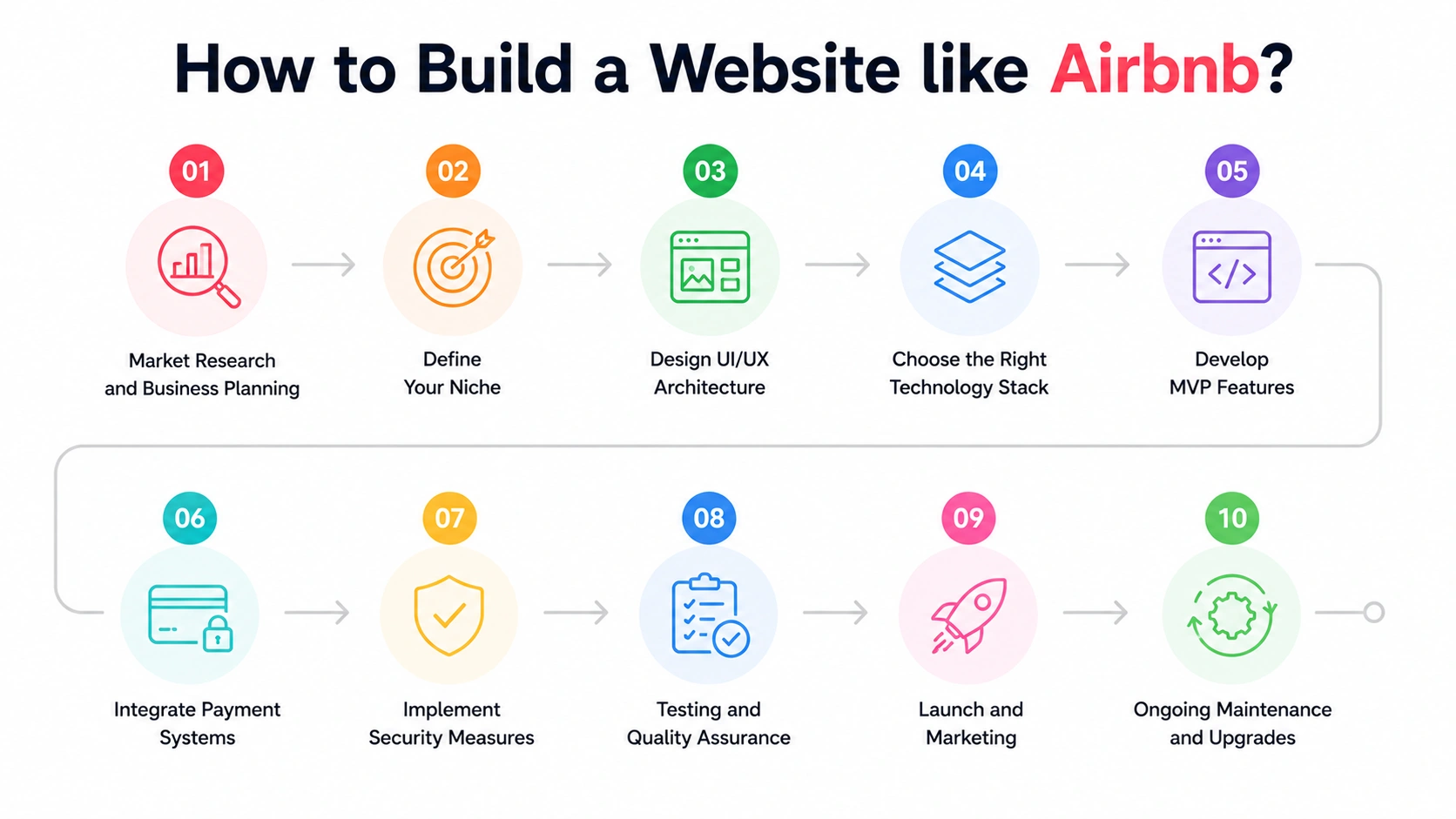
Step 1: Market Research and Business Planning
Every successful Airbnb-like website starts with a clear product discovery and strategy. Identify your target audience, geographic focus, niche market, and revenue model before development begins.
Step 2: Define Your Niche
While Airbnb serves a broad audience, new platforms often achieve faster growth by focusing on a specific niche market. Consider luxury rentals, vacation homes, corporate stays, student housing, or pet-friendly properties. A focused niche means a smaller but more loyal early user base.
Step 3: Design UI/UX Architecture
Well-designed UI/UX can significantly influence booking conversions and user retention. Create wireframes and interactive prototypes for the guest booking journey, host listing workflow, and admin dashboard to visualize how users will interact with the platform.
Step 4: Choose the Right Technology Stack
The technology stack you choose directly influences your platform’s performance, scalability, security, and long-term maintenance costs. Selecting the right combination ensures your platform can handle increasing traffic, support new features, and deliver a seamless user experience as your business grows.
Step 5: Develop MVP Features
Build only the features required to facilitate real bookings, such as registration, search, listings, booking, and payments. An MVP-first development approach accelerates time-to-market, reduces development costs, and helps validate the business model before investing in advanced functionality.
Step 6: Integrate Payment Systems
A secure and seamless payment experience is essential for building trust between hosts and guests. Integrate reliable payment gateways such as Stripe, Braintree, or PayPal to process transactions efficiently. You should also support local payment methods, multiple currencies, and automated payouts to accommodate users across different regions.
Step 7: Implement Security Measures
Security should be a priority from day one, not an afterthought. Implement SSL certificates, two-factor authentication, data encryption, secure APIs, and PCI-DSS compliance to protect sensitive user information and payment data. Strong cybersecurity measures help build user trust, reduce business risks, and ensure regulatory compliance before launch.
Step 8: Testing and Quality Assurance
Before launch, thoroughly test every aspect of the platform to ensure a seamless user experience. Conduct functional, performance, usability, and security testing across devices and browsers. Validating booking flows, payment processing, search functionality, and user interactions helps identify issues early and ensures a reliable platform at launch.
Step 9: Launch and Marketing
Launching in a single city or region helps concentrate supply, build marketplace liquidity, and validate your business model faster. Run host acquisition campaigns first. Supply-side growth drives guest interest.
Step 10: Ongoing Maintenance and Upgrades
Regular maintenance, security updates, infrastructure monitoring, and feature enhancements are essential for keeping the platform secure, competitive, and aligned with evolving user expectations. A proactive website maintenance strategy helps improve reliability, user satisfaction, and long-term scalability.
Technology Stack Required for Airbnb Like Website Development
Your technology stack choices affect how fast the platform loads, how much it costs to run, and how easy it is to add features later.
| Layer | Recommended Tools | Why It Works |
| Frontend | React.js or Next.js | Fast rendering, SEO-friendly, component reuse |
| Backend | Node.js or Python (Django) | Handles high concurrency, large developer talent pool |
| Database | PostgreSQL + Redis | Relational data for bookings, Redis for session caching |
| Search | Elasticsearch | Location-based, filter-heavy searches at scale |
| Payments | Stripe, Braintree, Razorpay | PCI compliance, multi-currency, instant payouts |
| Maps | Google Maps API or Mapbox | Property clustering, geocoding, distance filters |
| Cloud Hosting | AWS or Google Cloud | Auto-scaling, global CDN, 99.9% uptime SLA |
| Real-Time | WebSockets (Socket.io) | Live chat, instant booking confirmations |
How Much Does It Cost to Build a Website Like Airbnb?
The Airbnb clone website development cost depends on what you build, where your development team is located, and how fast you need to ship. Below are the cost drivers that determine the cost of making a website like Airbnb.
- UI/UX complexity: Custom animations, branded design systems, and accessibility compliance add 20-30% to design costs.
- Feature set: Each advanced feature adds development time. A dynamic pricing engine alone can take 3-4 weeks to build correctly.
- Development team location: US-based agencies charge $100- $200 per hour. An India-based travel app development agency with comparable experience charges $25-$35 per hour.
- Third-party Integrations: Payment gateways, map APIs, SMS providers, and email services add licensing and integration costs.
- Security requirements: PCI-DSS compliance, vulnerability & penetration testing, and GDPR data handling add to the base estimate.
- Post-Launch Maintenance: Budget 15-20% of the initial development cost annually for updates and hosting.
Estimated Airbnb Clone Development Cost
| Platform Type | Estimated Cost | Timeline |
| MVP Development | $20,000 – $40,000 | 3-5 months |
| Mid-Level Platform | $40,000 – $80,000 | 5-8 months |
| Advanced Marketplace | $80,000 – $150,000 | 8-14 months |
Ongoing Maintenance Costs
Ongoing maintenance costs typically range from $1,500 to $5,000 per month, depending on server load, the number of active users, security updates, and how frequently new features ship.
Challenges in Building a Similar Website to Airbnb and Their Solutions
Most Airbnb-like marketplace projects encounter these common challenges during development and scaling. Plan for them early.
-
Challenge 1: User Trust and Verification
Strangers renting from strangers only works when both sides trust the platform. Build identity verification with government ID checks, integrate with third-party KYC services such as Stripe Identity or Jumio, and display trust badges prominently on host profiles.
-
Challenge 2: Regulatory Compliance
Short-term rental rules vary city by city. San Francisco requires host registration. Barcelona has restricted new rentals. Create your platform to collect host permit numbers and flag listings in regulated zones.
-
Challenge 3: Payment Security
Never store raw card data on your servers. Use tokenization through Stripe or Braintree. Add 3D Secure authentication for high-value bookings and monitor for fraud patterns using rule-based triggers.
-
Challenge 4: Scalability Management
A viral moment or peak season can triple your traffic overnight. Use cloud auto-scaling on AWS or Google Cloud. Cache frequently accessed data in Redis. Separate your search service from your booking service so one spike does not crash the other.
-
Challenge 5: Data Privacy
The GDPR in Europe, the CCPA in California, and the PDPA in India all have different data-handling rules. Build data consent flows into registration, give users a way to download or delete their data, and work with a legal team familiar with each target market.
-
Challenge 6: Marketplace Liquidity
Marketplace liquidity remains critical because both hosts and guests expect active participation before committing to the platform. Launch in one city. Recruit hosts before guests. Offer a free listing period and a lower commission for early hosts. Once you have 100+ properties in one area, organic guest search starts to work.
Monetization Strategies for an Airbnb Like Platform
A vacation rental marketplace platform offers more revenue options beyond transaction fees.
| Commission-Based Revenue | Take a percentage from every booking. This scales with platform volume automatically. |
| Featured Listings | Charge hosts a monthly fee to appear at the top of search results in their city. |
| Subscription Plans | Offer a Pro Host tier with advanced analytics, priority support, and lower commission rates. |
| Advertising Revenue | Sell banner space to travel insurance companies, luggage brands, and airport transfer services. |
| Premium Host Services | Offer professional photography, pricing optimization, and property management tools as paid add-ons |
| Experience Bookings | Let local guides and hosts sell tours, cooking classes, and activities alongside their properties. |
Future Trends in Vacation Rental Marketplace Development
Emerging technologies and user expectations are shaping the future of vacation rental marketplace development.
-
AI-Powered Experiences
Recommendations that learn from a guest’s taste over time. The more someone books, the better the suggestions get.
-
Smart Property Management
IoT integrations with smart locks, thermostats, and noise monitors let hosts manage properties remotely.
-
Blockchain-Based Payments
Stablecoin payments reduce cross-border transaction fees and settlement times from days to minutes.
-
Voice Search Integration
Alexa and Google Assistant integrations let users search and book without opening an app.
-
Hyper-Personalization
Platforms that show different homepages, pricing, and promotions to different user segments based on behavior data will outperform generic experiences.
Conclusion
The vacation rental market is mature enough to have clear demand, but fragmented enough that a focused platform can still build a strong position. Success comes from adapting Airbnb’s proven marketplace principles to a niche audience and a unique business proposition. It is to learn from how Airbnb built trust and revenue mechanics, then apply those lessons to a niche you understand better than they do.
When you are ready to create a website like Airbnb, start with a sharp niche, a lean MVP, and a custom marketplace development services provider who has built marketplaces before. The features above give you a complete blueprint. The cost tables give you a realistic budget. The rest comes down to execution.
How Can SparxIT Help You Develop an Airbnb Like Website
SparxIT has built custom marketplace platforms for clients across travel, real estate, and rental sectors. Our teams have experience with both Airbnb clone web development and ground-up custom builds that go well beyond template-based solutions.
We handle the end-to-end development, including business analysis, UI/UX design, frontend and backend development, payment integration, security audits, and post-launch support. Whether you need an MVP in three months or a full-featured platform with AI recommendations and dynamic pricing, we build to your unique roadmap.
Our approach to creating a website like Airbnb starts with understanding your niche and your users. We do not hand you a pre-built template and call it done. We architect a system that can scale from your first 100 hosts to your first 100,000.

Partner with Experts
Frequently Asked Questions
How much does clone Airbnb website development cost?


The cost typically ranges from $20,000 to $150,000+, depending on the platform’s complexity, feature set, technology stack, integrations, and development team’s location.
How long does it take to build an Airbnb-like website?
An MVP version can take approximately 3–5 months, while a fully featured vacation rental marketplace like Airbnb may require 7–12 months or longer.
What are the essential features of an Airbnb clone website?
Key features include user registration, property listings, advanced search filters, booking management, payment gateway integration, reviews and ratings, host dashboards, and admin controls.
Can I customize an Airbnb-like website for a specific niche?
Yes. An Airbnb-inspired platform can be tailored for vacation rentals, luxury stays, coworking spaces, student housing, corporate accommodations, RV rentals, or any niche rental marketplace.
What technology stack is best for Airbnb website development?
Popular choices include React or Next.js for the frontend, Node.js or Python for the backend, PostgreSQL for database management, and AWS or Google Cloud for hosting and scalability.