Today, the global online grocery marketplace is growing at an exponential pace. By 2030, it is projected to surpass the $2,158.53 billion threshold and is expanding at a steady CAGR of 25.3% from 2022 to 2030. Well, this unabated growth has been more than just a trend. It is a market transformation that leaders study today, because this shift presents a global opportunity for them.
Mainly, this structural shift has been driven by how consumers buy essentials today. Here, convenience, speed, and real-time access are baseline expectations that they have. However, building a platform that delivers these expectations is not simple. It is a complex IT process that delivers real-time logistics, price updates, system notifications, inventory availability updates, and fast doorstep delivery.
For businesses, the real challenge lies in integrating these features into the app framework while controlling grocery app development costs. And this can be smartly done by building a custom, scalable solution that is aligned with your business goals. Generally, it may include developing capabilities like automatic inventory synchronization, AI-driven recommendations, intelligent searches, and, of course, secure payment integrations.
Well, there is another factor that needs consideration. It is that each feature directly influences both user experience and development cost. So, this is where cost becomes a strategic investment, not just a regular expense.
In this blog, we will study a detailed breakdown of the grocery delivery app development cost. Additionally, this blog covers the platform’s key cost drivers, must-have features, platform choices, and more. With this comprehensive study, our aim is to help leaders make informed, ROI-driven decisions aligned with both your budget and long-term growth.
So, let’s jump right into the blog to study these aspects in detail.
What is a Grocery Delivery App Solution?
In essence, a grocery delivery app solution is more than a traditional application. For users, it is an intelligent digital commerce solution that integrates product search, logistics, and grocery delivery in real-time.
And, for grocery vendors, this platform allows them to manage their products easily so that users can get access to faster and fresher essential deliveries today.
- That being said, this application serves four different sets of users. It includes the admin, customers, vendors, and delivery partners.
- And, all these parties work in sync.
- Here, the front-end architecture helps users to browse and order products.
- And the back-end framework manages inventory updates and supplies done by vendors and delivery agents.
In this way, every piece plays a key role in making the app work.
For business leaders, this means providing seamless grocery deliveries, improved user retention and satisfaction, and higher operational excellence.
Thus, a custom grocery app solution is a valuable investment for businesses as it is a great way to hook customers for their daily essential purchases, which promises higher sales and retention.
Why Businesses Should Build a Grocery Delivery App in 2026?
As we build leaders’ knowledge on this topic, the next logical step is understanding why investing in a modern grocery app can give leaders a powerful edge in the business landscape.
For decision makers, this means deciding why investing in them can be profitable in 2026. And there are many strategic reasons to imply that this is the right choice. They are shared in detail below:
-
Demand for fast and fresh groceries is real.
Today, modern customers expect instant order deliveries at their doorstep. This is why developing a connected ecosystem that can manage this operational workflow can be a great way to optimize this business opportunity.
-
This industry is growing, but the window of early advantage is closing.
What this means is that this marketplace is still expanding, but any business that waits to invest any longer has to deal with intense competition, higher acquisition costs, and dynamic differentiation.
-
Need to invest in modular architectures to support this business framework.
As we know, traditional systems would break under such high demand. So, a leader that can invest in a modular grocery app architecture can support higher order volumes, multiple vendors, and much more that this industry operates with.
-
Increasing cost pressures.
From a cost perspective, the logistics function is becoming more expensive. So, leaders must focus on a well-built platform that can help them optimize routes, automate workflows, and reduce inefficiencies. This makes investing in grocery app development valuable and more cost-effective.
-
Faster time-to-market
Talking about first-mover advantage, businesses can move towards optimizing costs and improving profits by focusing on faster app launches. With the right grocery app developer, teams can quickly move from building an app from scratch to winning customer trust through these apps.
-
Data is your key competitive asset
Well, as customer behavior is rapidly evolving. For a business, this means that apps need to be data-driven. This helps a custom grocery delivery app development to meet diverse user needs, while providing personalized experiences and increasing your customer retention over time.
Top 3 Business Models that Define Your Grocery App Development Costs
So, as you make up your mind towards investing in a grocery delivery app solution, the next step is deciding how your business will operate. And this decision is primarily dependent on your ideal architecture framework, integrations, infrastructure, and the goals in mind.
Generally, a standard grocery app can be categorized into three core models, which are shared below:
-
Inventory-Based Model
In this model, leaders purchase and manage the inventory. This means that they manage the warehouses and the entire fulfillment process on their own.
From a development standpoint, this means creating a grocery app solution that has technical elements such as:
- Inventory management systems (IMS) with real-time stock updates
- Complex warehouse and order management workflows
- Delivery and logistics coordination
Additionally, as everything is managed in-house, your system must be highly reliable and synchronized to deliver consistent performance. From a cost perspective, this means higher upfront development costs and better control over margins and workflows.
-
Marketplace-Based Model
In this model, the business offers a multi-vendor marketplace platform where they don’t need to own the inventory. They only need to manage the platform architecture, while the vendors take care of product listings, stock updates, and order fulfillments.
Technically, this online grocery marketplace model needs to integrate elements like:
- Vendors dashboards and onboarding systems
- Product management workflows
- Commission-based payments
Here, as your app’s complexity is higher, the focus shifts from managing inventory alone to managing and assisting vendors and delivery partners on the platform. Cost-wise, this means a moderate and higher cost structure, which supports multi-vendor architecture and integrations.
-
Micro Fulfillment-Based Model
Coming to the third model, we have a hybrid format that offers localized fulfillment centers and vendor support to enable faster grocery deliveries. Mainly, here, technical aspects such as real-time inventory management work better.
Other key elements in this on-demand grocery app development include:
- Use of demand forecasting and stock placement analytics
- Route optimization for hyperlocal delivery
What’s more, speed and precision are more in focus here, and a hybrid model needs a more sophisticated ecosystem. That being said, the application development cost in this case rises as predictive systems are in use to ensure seamless deliveries and a premium user experience.
Understanding How an On-Demand Grocery Delivery App Functions
At its core, an on-demand grocery delivery app is a real-time orchestration system. What this means is that it connects users, inventory channels, and delivery operations into a single, synchronized workflow and performs dynamically to serve each customer well.
So, for a leader working on grocery delivery app development, the goal is not just to develop a user-friendly app. Rather, it is to ensure that every workflow is measured, seamless, and instant.
This makes the system a real-time engine that offers users live product availability updates and price notifications, and supports all aspects from order placement to delivery completion.
Mainly, it covers the following steps:
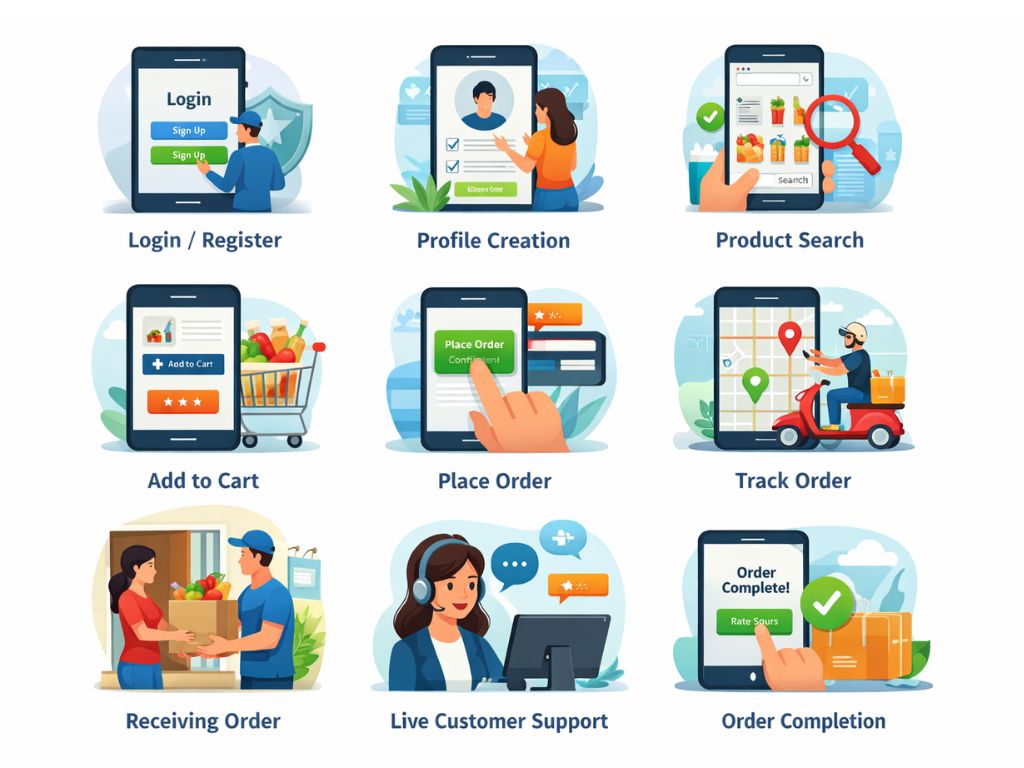
So, we can say that an on-demand grocery app works to deliver continuous user orders while handling dynamic data and operations in its backend architecture.
Essential Features in an On-Demand Grocery App Solution
Going beyond the basic app solution capabilities, an advanced on-demand grocery app solution works for different panels in real-time. These include the end-users, admin, vendors, and delivery partners.
Here, each panel gains access to some unique app features that work in sync to complete each order. That being said, these features can be better understood in the table below:
Must-Have and AI-Powered Features for all Panels
| Panels | Must-Have Features | AI-Powered Features |
| Customer / User Panel |
|
|
| Admin Panel |
|
|
| Vendor Panel |
|
|
| Delivery Partner’s Panel |
|
|
Through these features, a custom grocery app solution, which is a contribution of AI development experts, helps in intelligently allowing the panels to sync their tasks. So, this is how, when leaders smartly analyze and invest in AI-driven capabilities, they can move from a basic transactional app to a data-driven, self-optimizing platform.
How to Determine the Cost of a Modern Grocery Delivery App Solution
Well, coming to the segment of cost analysis, this is not a fixed figure; it is actually based on multiple aspects. Realistically, it depends on your goals, project complexity, and many other critical factors, which are shared descriptively in this section.
-
Cost Based on Project Complexity
When we talk about cost, its biggest driver is project complexity. In simple terms, this means that the more features and integrations an app has, the higher its investment will be. For leaders, this means that project complexity aligns with both your business goals and the cost factor. Many grocery app developers recommend that leaders start with lean and necessary features and move towards scaling gradually.
| Level of Complexity | Description | Average Cost Range |
| Basic MVP |
| $35,000 – $50,000 |
| Intermediate |
| $50,000 – $90,000 |
| Advanced |
| $90,000 – $1,40,000 |
| Enterprise-Grade Solution |
| $1,40,000 – $2,70,000+ |
-
Cost Based on Platform Selection
Another important consideration to determine the development cost of a grocery delivery app is its platform choice. Here, leaders analytically decide which platform they can build, maintain, and scale the app on. So, the trade-off here is in terms of its cost, performance, and time-to-market. That being said, the cost of each platform choice is presented in a table below for leaders’ informed decision-making.
| Platform Choice | Description | Average Cost Range |
| iOS |
| $25,000 – $90,000 |
| Android |
| $25,000 – $90,000 |
| Hybrid |
| $30,000 – $1,00,000 |
-
Cost Based on Design Complexity
Coming to the next important factor that affects grocery app development, UI/UX Design is not just a visual aspect. It actually impacts user experience, engagement, development effort, and its cost. So, in terms of cost, this can be simply understood by the table below:
| Design Complexity | UI/UX Elements | Average Cost Range |
| Basic UI/UX |
| $10,000 – $25,000 |
| Custom UI/UX |
| $25,000 – $60,000 |
-
Cost Based on Backend Architecture
There is no doubt that the backend architecture is the core engine of your grocery delivery app solution. It is because it handles data, orders, users, and system logic. From a cost perspective, backend development can be simply examined through the following table.
| Backend Architecture | Description | Average Cost Range |
| Basic Level |
| $10,000 – $25,000 |
| Moderate Level |
| $25,000 – $60,000 |
| Advanced Level |
| $60,000 – $1,20,000 |
-
Cost Based on Features and Third-Party Integrations
Well, there is no doubt that features and integrations directly add to your app’s functionality and cost sheet. And in terms of cost, this table highlights how features and integrations add up to present an average cost range.
| Features and Integrations | Description | Average Cost Range |
| Basic Level |
| $20,000 – $35,000 |
| Moderate Level |
| $35,000 – $50,000 |
| Advanced Level |
| $50,000 – $1,20,000+ |
-
Cost Based on Platform Security
Well, security is not an afterthought anymore. It is an essential part of any app’s framework as they handle payments, user data, and transactions all the time.
That being said, the grocery delivery app development cost for this factor can be ascertained through the following table.
| Platform Security Levels | Description | Average Cost Range |
| Basic Level |
| $5,000 – $15,000 |
| Standard Level |
| $15,000 – $40,000 |
| Advanced Level |
| $40,000 – $1,00,000+ |
So, for leaders, cost is a vast IT subject that needs critical research and analysis. Ideally, it is better to start small and scale later (in terms of features and other aspects to control the cost of grocery app development.
Monetization Strategies for Future-Ready Grocery Delivery App Solutions
For a leader, building an app and looking at its cost always coincides with its monetization and ROI. In this case, let us explore the monetization strategies for an on-demand grocery delivery app solution that also impacts user experiences and company growth.
| Monetization Methods | Description |
| Commission on Orders |
|
| Delivery Fees |
|
| Subscription Models |
|
| Vendor Fees |
|
| Direct Sales |
|
| Promotions |
|
Overall, this simply demonstrates that there is a mix of strategies that can help you maximize revenue while keeping the platform highly competitive.
How to Smartly Avoid Cost Overruns in Grocery Delivery App Development?
Finally, we reach the key highlight of our extensive research, where leaders can critically analyse what happens if a solution is poorly planned or misaligned. And this means that controlling cost also includes avoiding common errors that lead to its overruns. That being said, here are some of the points that can help leaders with the same.
-
Avoiding Undefined Scope and Feature Creep
This means that we need to work out a clear roadmap, starting with MVP, to avoid unnecessary features.
-
Planning the engineering aspects of app development in the early stages
Well, it is important that the architecture planning is done early to avoid rework and system inefficiencies.
-
Selecting a suitable tech stack
It is necessary to choose the right ecommerce tech stack based on your scalability and long-term goals.
-
Ensuring UI/UX simplicity
Expert designers recommend that companies keep the UI/UX simple and navigational, as it helps users avoid confusion, thereby helping them take action faster.
-
Smart inclusions of Features and Third-Party Integrations
Well, every feature and integration adds to your cost. So, in the beginning, keep it lean and simple, and you can scale as you grow later.
-
Investing Rightly in QA and Testing
Indeed, skipping testing can be costly later. So, to ensure the app’s success, make sure that it is bug-free prior to deployment itself, and test its quality early to keep the development process smooth.
-
Choosing the Right Partner for Your App Development Success
Finally, collaborating with an experienced mobile app development company would be an ideal choice. The right partner can reduce your worries and help you build the project faster, better, and within your budget.
How can SparxIT Help You Create a On-Demand Grocery Delivery App Solution?
As we realise that cost control is not about cutting corners. It is actually about making smarter choices from the start. So, as a provider, we can help you with services like:
- End-to-end expertise in development and design
- Building custom solutions with a strong technical foundation
- Developing cost-effective grocery app solutions
- Providing all-around security, maintenance, and support
In fact, our team of professionals has handled multiple app development projects, among which grocery app development has been prominent. Some of them also range in the ecommerce industry, which includes building a powerful storefront for Hisense, Eefendi online marketplace development, and others.
In these industry-specific studies, our focus has been on goals, clarity, structure, and support. This ensures that we can certainly help you with your range of projects measurably. In fact, our teams’ solution-focused approach can help reduce rework, cost overruns, feature creep, and much more.
So, you can consult us for building your ideal, scalable grocery app solution today.

Want to Build a Grocery Delivery App?
Frequently Asked Questions
What are Grocery delivery apps?


These platforms allow users to order fresh groceries and household items online, offering faster doorstep delivery.
What is the cost overview of a grocery delivery app?
The cost for an on-demand grocery delivery app development typically ranges from $15,000 to $150,000+, depending on features, platform, security, complexity, and other aspects. While a basic MVP will cost less, an advanced app will be relatively higher, as we keep integrating more features.
What is the cost of maintaining a grocery delivery app?
Well, maintenance of the app is a critical part of your total cost of ownership (TCO), and it can range from 15% to 25% of your initial development cost annually.
How long does it take to build an on-demand grocery app solution?
Usually, a grocery delivery app may take from 3 to 9 months to develop, depending on the company’s goals. However, smartly leveraging an MVP development approach can help your teams to ensure faster app launches.
Is it better to build a custom app or use a ready-made solution?
This ideally depends on your company’s goals and ROI. While a custom solution may be better in the long run, an off-the-shelf solution can be good to start with if you have a limited scope and budget.
What is the ROI of a grocery delivery app?
The ROI of a grocery delivery app is based on your order volume, customer retention, and operational efficiency. Most businesses can attain a higher ROI in about 6 to 18 months after the app launch, which makes it a strong digital investment.