Buildings used to be predictable in a boring way. You walked in, and the lights were already on, the AC followed a fixed timetable, and maintenance crews only showed up when something broke. That era is ending fast. Today, IoT in real estate is turning every square foot of a building into a live stream of useful information.
Sensors track room occupancy in real time. Climate systems adjust temperatures before tenants notice a draft. Doors unlock with a tap on your smartphone. Energy is used where it is needed rather than wasted in empty spaces. The result is less waste, lower bills, and a smoother experience for people who live in, work in, or run a building.
Demand for connected living solutions continues to accelerate, with the global smart home market projected to grow from $162.8 billion in 2025 to $887.4 billion by 2033, creating new opportunities for IoT app development in real estate. That is not a fringe technology story anymore. It is a business imperative for anyone building, owning, or managing property at scale.
This blog breaks down exactly what is happening, who is benefiting, and what you need to know to get started.
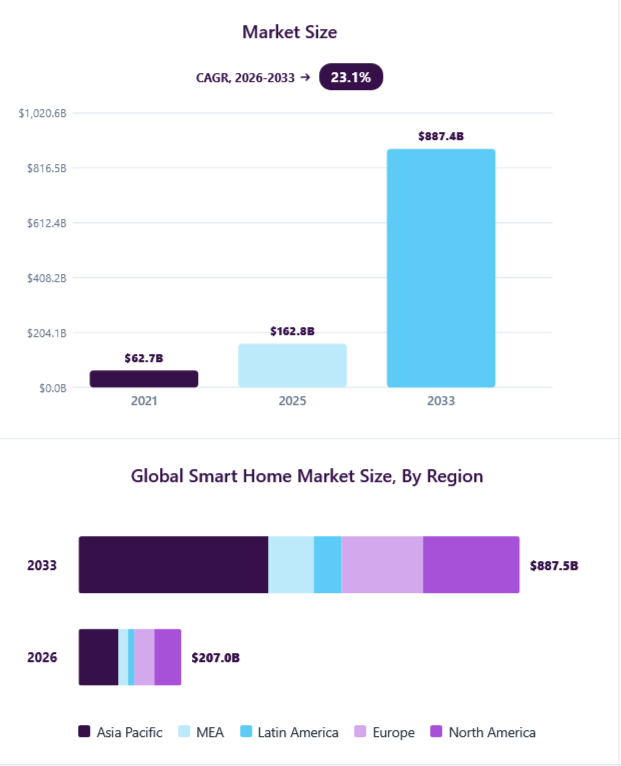
Source: Grand View Research
What Is IoT in Real Estate?
The Internet of Things in real estate refers to a network of connected devices embedded in buildings and properties. At its core, connected building technology in real estate links physical infrastructure to digital systems, so every floor, room, and asset generates data that drives smarter decisions. Each device collects data, communicates with other devices, and often takes automated action based on the data it receives.
For example, a traditional office has a thermostat on the wall. An IoT-enabled office has dozens of sensors that measure temperature, occupancy, humidity, and air quality across every floor. Those sensors talk to a central system. That system adjusts the HVAC not on a schedule, but based on who is actually in the building at any given moment.
The technology applies equally to commercial and residential properties, where IoT software helps automate operations, monitor assets, and improve tenant experiences.
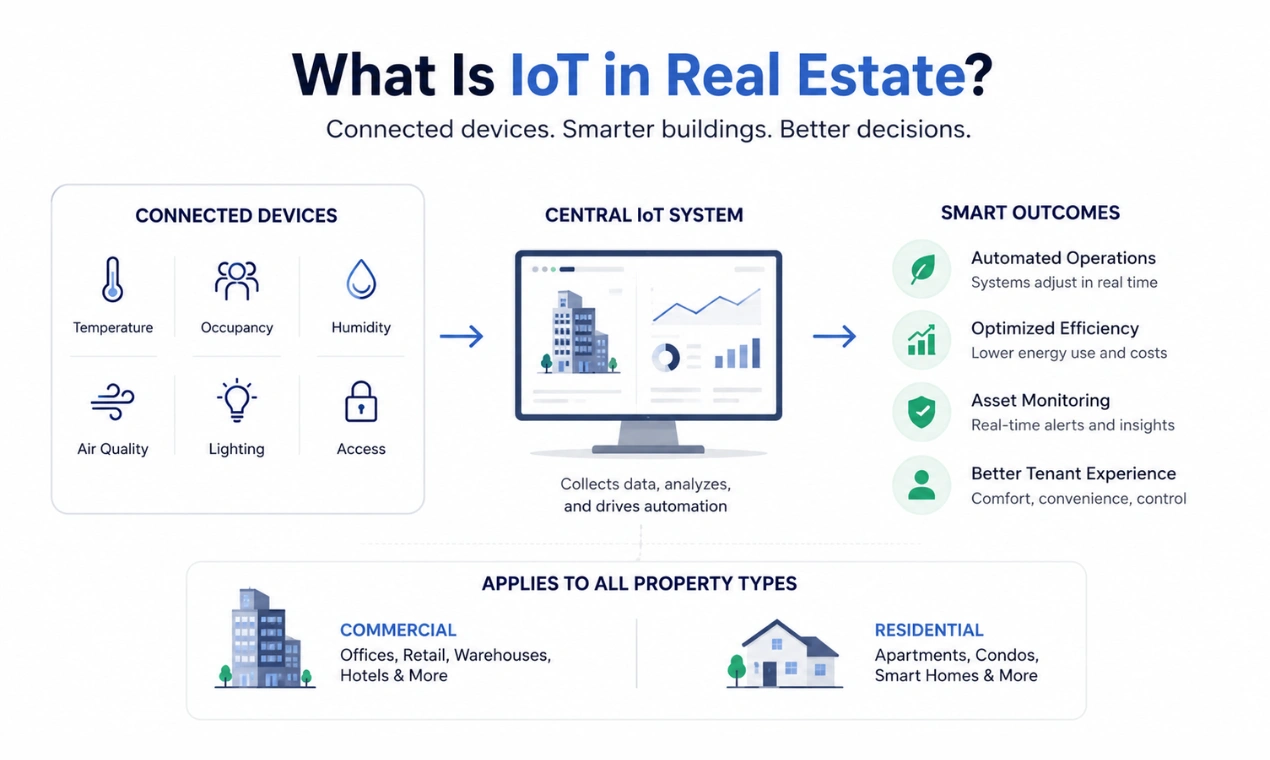
The key components of any IoT real estate setup include:
- Sensors: Devices that measure physical conditions like motion, temperature, light, air quality, or energy draw
- Connectivity: Wi-Fi, Zigbee, LoRaWAN, or 5G networks that carry data between devices and platforms
- Platforms: Software systems that collect, process, and display sensor data
- Actuators: Devices that respond to instructions, such as smart locks, automated blinds, or valve controls
Key Benefits of Internet of Things in Real Estate
In this section, we’ll look at how IoT helps property owners save money, improve security, and manage buildings more efficiently.
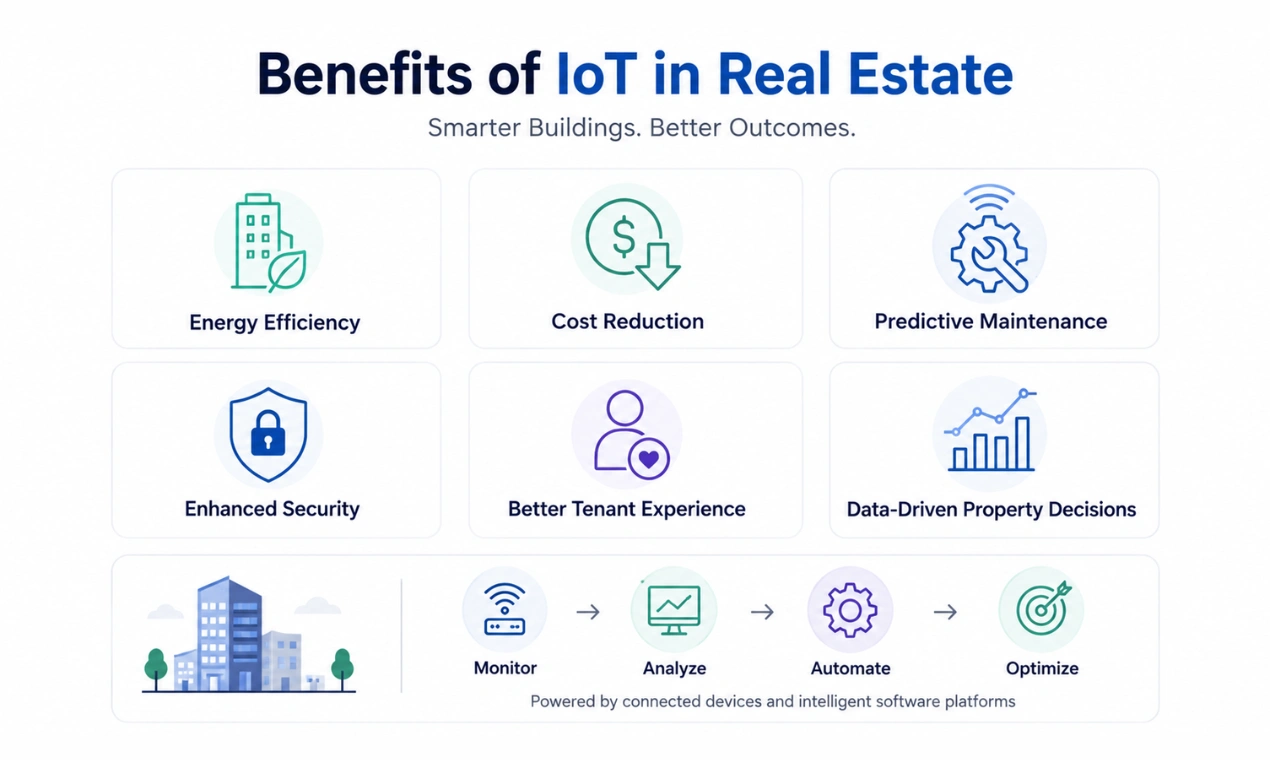
-
Energy Efficiency and Cost Reduction
Energy is typically the largest operating expense in any commercial property. IoT energy management for commercial property systems can cut energy use by 20 to 30 percent by automating lighting, HVAC, and other systems based on real occupancy data
Buildings only heat, cool, and light the spaces they serve. Sensors detect when a conference room is empty and adjust accordingly. That sounds simple. Multiply it across a 50-floor office tower and the savings become substantial.
Real-world Use Case: The Empire State Building reduced energy consumption by 38% through a technology-driven retrofit, generating approximately $4.4 million in annual energy savings.
-
Predictive Maintenance
Predictive maintenance in real estate buildings is one of the highest-ROI applications of IoT. Traditional maintenance is reactive: something breaks, someone calls, a technician arrives. IoT flips that model.
For example:
- Vibration sensors on elevator motors detect unusual patterns weeks before a failure occurs.
- Water leak sensors in pipe systems alert facilities teams before flooding causes damage.
- HVAC sensors flag filter degradation before airflow drops.
The financial case is straightforward. Emergency repairs cost significantly more than planned maintenance. Unplanned downtime in commercial properties also affects tenant satisfaction and, eventually, lease renewals.
-
Enhanced Security and Access Control
Modern IoT smart building solutions include smart locks, biometric access systems, video analytics, and perimeter monitoring. These systems do not just record who enters a building. They analyze patterns, flag anomalies, and alert security teams in real time.
For residential properties marketed as smart homes, advanced security systems have become a major selling point. Buyers in the premium segment routinely expect smartphone-controlled entry, video doorbells, and integrated alarm systems as standard features.
-
Better Tenant Experience
Tenant retention drives property revenue. IoT tenant experience platforms give residents and office occupants control over their environment through mobile apps. They can adjust lighting, set comfort preferences, book shared spaces, and report maintenance issues from their phones.
When tenants can access services through dedicated property management apps, they are more likely to stay satisfied and renew leases. Lower vacancy rates directly improve net operating income for property owners.
-
Data-Driven Property Decisions
Every connected device generates data that IoT software analyzes to improve operational and investment decisions. Aggregated over time, that data reveals occupancy patterns, peak usage windows, energy anomalies, and maintenance cycles. Smart building data analytics platforms turn this raw information into decisions.
Property managers can answer questions like:
- Which floors are underutilized?
- Which assets are approaching end-of-life?
- What is the actual cost-per-square-foot of running this building?
This feeds directly into IoT-enabled property valuation discussions, where sensor-backed efficiency metrics increasingly influence appraised values.
Use Cases of IoT in Commercial and Residential Real Estate
Here, we’ll explore how IoT is being used in homes, apartments, offices, and commercial buildings to improve daily operations.
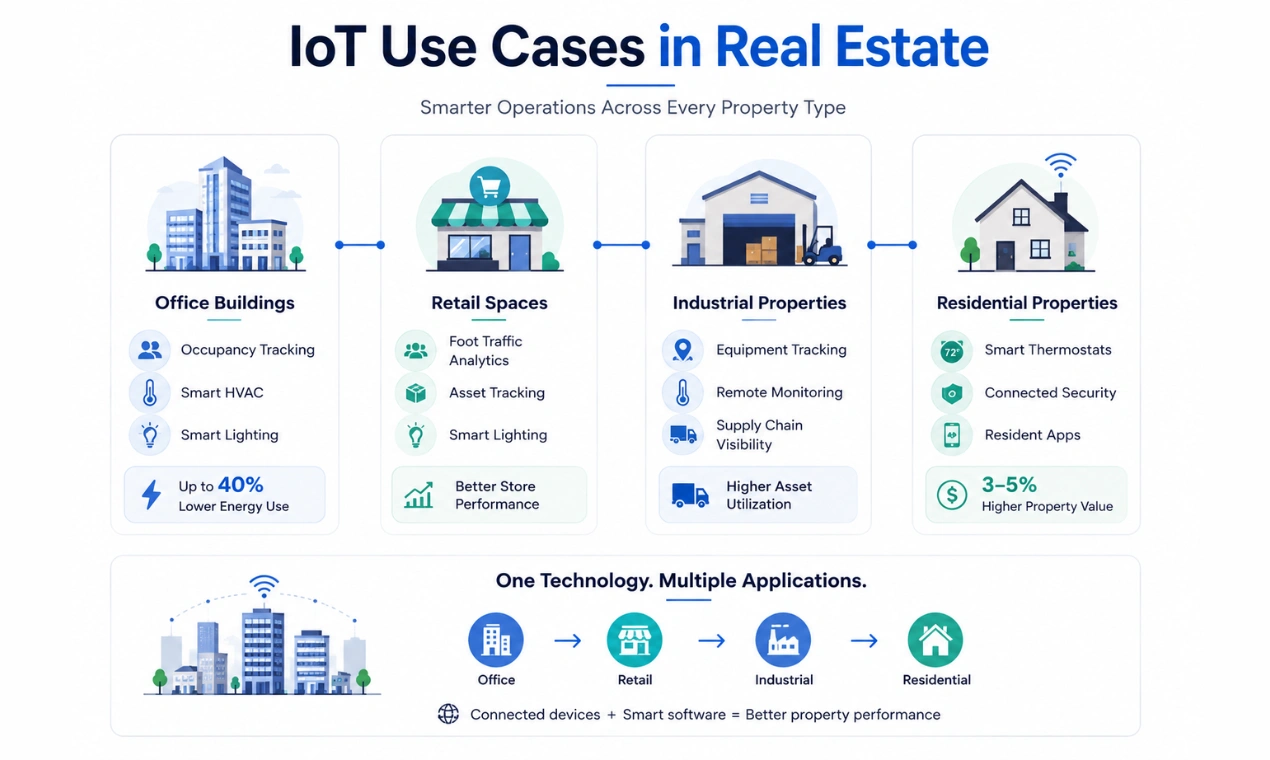
-
Office Buildings
Office buildings are the most mature IoT deployment environment. Occupancy sensor technology for office buildings enables hot-desking at scale. Space planners know exactly which floors, zones, and meeting rooms get used and when.
HVAC zoning based on real-time occupancy cuts energy waste without affecting comfort. Smart lighting systems that respond to natural light levels reduce electricity consumption by up to 40 percent in well-designed deployments.
-
Retail Spaces
Retail IoT applications use integrated software platforms to analyze customer behavior, optimize operations, and improve store performance. Real-time asset tracking in commercial buildings helps retailers monitor inventory movement, reduce shrinkage, and optimize store layouts based on foot traffic data.
Smart lighting in retail environments adjusts brightness based on time of day, occupancy zones, and product display requirements. This affects both energy costs and the shopping experience.
-
Warehouses and Industrial Properties
For logistics and industrial real estate, remote property monitoring through IoT is critical. Temperature-sensitive goods require constant environmental monitoring. Equipment tracking reduces loss and improves fleet utilization.
The convergence of IoT with warehouse robotics and supply chain systems makes industrial real estate one of the fastest-growing verticals for proptech IoT integration in 2026.
-
Residential Properties and Smart Home Technology
Smart home technology in real estate has moved from a premium differentiator to a buyer expectation in many markets. According to the National Association of Realtors (2024), homes with smart features sell faster and at a premium of 3 to 5 percent over comparable non-smart properties.
Smart home real estate listings now routinely include smart thermostats, connected security cameras, smart irrigation systems, and EV charging infrastructure as standard features.
Developers working in the residential segment are investing in a cost analysis of real estate mobile app development early in the planning process. A purpose-built resident app adds tangible value to both new developments and property management workflows.
Smart Homes IoT Solutions: What They Include
Smart homes in real estate are more than a collection of sensors. It is an integrated stack that covers data collection, transmission, processing, visualization, and action.
-
Building Automation Systems (BAS)
Smart sensor building automation takes this further by using real-time readings from dozens of device types to adjust HVAC, lighting, and access systems without any manual input. IoT for smart buildings extends BAS capabilities by incorporating granular sensor data and machine-learning-driven optimization.
For large commercial portfolios, this level of integration is what separates reactive facilities management from proactive operations. Advanced augmented reality development also provide visual asset mapping and maintenance insights, helping facilities teams resolve issues faster.
-
IoT Smart Building Use Cases in Facilities Management
Smart building IoT use cases in facilities management include:
- Automated fault detection: Systems identify and log equipment anomalies without human intervention
- Compliance monitoring: Air quality and water safety sensors ensure regulatory compliance in commercial properties
- Energy benchmarking: Real-time consumption data feeds directly into sustainability reporting frameworks like LEED and BREEAM
- Space utilization reporting: Occupancy data informs long-term space planning and lease decisions
Smart Real Estate Software and Platform Integration
The IoT hardware layer only delivers value when connected to the right smart real estate software. Modern IoT property management systems pull data from sensors across the entire building and feed it into a single operational dashboard, giving property managers visibility they simply did not have before
Key capabilities to evaluate in any smart real estate platform:
- API integration: Clean connections to existing ERP, CRM, and lease management systems
- Real-time alerting: Push notifications for maintenance triggers, security events, or energy anomalies
- Reporting and compliance: Built-in templates for sustainability and operational reporting
- Scalability: Architecture that handles single properties and large portfolios without performance degradation
For property owners considering the technology stack, reviewing construction software development capabilities is a logical starting point. The best platforms are built to handle the complexity of real estate operations from the ground up, rather than retrofitted from generic IoT tools.
AI in digital transformation are increasingly enhancing IoT real estate platforms by identifying patterns and predicting operational issues. Platforms increasingly use machine learning to move from descriptive reporting to predictive recommendations.
Challenges in Integrating IoT in Real Estate
This section covers the common challenges of adopting IoT, including costs, security concerns, and connecting different systems.
Challenge 1: Data Privacy and Cybersecurity
Connected buildings collect enormous volumes of data about tenant behavior, movement patterns, and energy usage. That data has real value and real risk. Without proper encryption, access controls, and data governance policies, IoT-enabled properties become targets for cyberattacks.
The Solution
The legal landscape around building IoT data is still developing. Property owners and managers need to work with legal counsel to understand their obligations under the GDPR, the CCPA, and local data protection laws.
Challenge 2: Legacy Infrastructure and Integration Costs
Most existing commercial buildings were not designed with IoT in mind. Retrofitting sensors into older properties means working around legacy HVAC systems, outdated electrical infrastructure, and limited network connectivity.
The Solution
Understanding digital transformation services that cover legacy software modernization is important before committing to an IoT rollout. A phased approach, starting with high-impact, easy-to-deploy sensors such as occupancy and energy monitors, reduces upfront costs and complexity.
Challenge 3: Upfront Investment
The initial cost of IoT app deployment for real estate ranges widely depending on building size, existing infrastructure, and the scope of integration. Smaller deployments for a single-floor office can start from $15,000 to $50,000. Large commercial rollouts can run into millions.
The Solution
Reduce upfront costs by implementing IoT in stages, starting with high-impact areas like energy management and predictive maintenance. This approach delivers early ROI, lowers financial risk, and allows investments to scale as benefits are realized.
ROI and Cost of Implementing IoT in Real Estate
One question stops more IoT projects than any technical challenge: what does it actually cost, and when does the investment pay off? For property owners evaluating where to invest in 2026, understanding real estate IoT ROI comes down to three variables: deployment scope, building size, and which operational problems cost the most right now
Typical Implementation Costs
Costs break down across three categories: hardware, software, and platform licensing, and integration or installation.
| IoT App and Platform Development Costs | Property Size | Estimated Cost | Typical Inclusions |
| Basic | Single floor or small office (under 5,000 sq. ft.) | $15,000 – $50,000 | Occupancy monitoring, smart thermostat controls, basic access management, and real-time dashboards. |
| Mid-Level | Commercial buildings (20,000–100,000 sq. ft.) | $50,000 – $200,000 | HVAC automation, predictive maintenance, energy monitoring, tenant management features, and third-party software integrations. |
| Enterprise-Grade | Large commercial properties or multi-building portfolios | $200,000+ | End-to-end building automation, AI-powered analytics, digital twins, custom platform development, multi-property management, and advanced security controls |
For property developers, integrating smart home technology for real estate at the construction stage costs significantly less than retrofitting. Smart home packages for new builds typically add $5,000 to $20,000 per unit, depending on the feature set.
Total Cost of Ownership Considerations
The upfront hardware cost is only part of the investment, as software development, platform licensing, and ongoing support also contribute to total ownership costs.
A practical way to approach budget planning is to start with a cost-benefit model specific to your property type. Teams assessing real estate mobile app development cost alongside IoT infrastructure often find that a unified resident or tenant app adds measurable ROI on top of the base building automation investment.
Most successful IoT deployments in real estate follow a three-phase approach.
Phase 1: Audit and Prioritize
Before purchasing any hardware, audit the building or portfolio. Identify the highest-cost operational problems. For most commercial properties, energy waste and reactive maintenance are the top two. Start with IoT solutions that address those specific problems.
Phase 2: Pilot in One Property or Zone
Deploy IoT in a single building or a defined zone within a building before scaling. This controls cost, allows the team to learn the integration challenges specific to that property, and generates the performance data needed to justify broader investment.
Phase 3: Scale with a Technology Partner
Scaling IoT across a portfolio requires a leading IoT development company that understands both the technology and the operational realities of property management. The right partner does not just deploy sensors. They design systems that integrate with existing workflows, train the facilities team, and evolve the platform as the portfolio grows.
Organizations without internal IoT expertise often partner with experienced development teams to manage implementation, integration, and platform optimization.
How SparxIT Helps You Build IoT-Enabled Solutions for Real Estate
Building an IoT app for a real estate environment involves more than installing sensors and subscribing to a dashboard. The technology has to fit the building’s existing infrastructure, align with your operational workflows, and scale as the portfolio grows. That requires a partner who has done this before.
SparxIT is a leading IoT development company that helps real estate businesses build custom IoT platforms, tenant applications, and property management solutions that improve operational efficiency. Our team works with property developers, commercial landlords, and facilities management firms to design and build IoT software that solves specific operational problems, not generic deployments copied from a template.
What the Engagement Looks Like
- Discovery and audit: SparxIT starts with product discovery and strategy to map existing systems, identify integration points, and prioritize use cases based on ROI potential.
- Architecture design: The team creates an intuitive UI/UX design and prototype suited to the business type, whether that is a new commercial development, a residential tower, or an industrial facility.
- Custom platform development: Off-the-shelf IoT dashboards rarely fit the way real estate teams actually work. SparxIT builds or configures platforms that connect to your property management system, lease management tools, and reporting workflows.
- App development: From tenant-facing mobile apps to facilities management portals, the team handles full-stack real estate app development, including IoT infrastructure.
- Ongoing support and iteration: IoT systems need tuning. SparxIT provides managed support contracts and continues optimizing the platform as usage data reveals new opportunities.
If you are evaluating whether to build in-house or partner externally, the fastest path to a working system is to hire dedicated IoT developers who bring both the technical depth and real estate domain knowledge to get deployment right the first time.

Partner with Experts
Frequently Asked Questions
What is IoT in real estate?


IoT in real estate refers to connected sensors and devices embedded in properties that collect data and automate building operations like energy, security, and maintenance.
How much does IoT implementation cost in real estate?
Costs range from $15,000 for small deployments to several million for large commercial portfolios. Payback typically occurs in two to five years.
How does smart home technology affect real estate value?
Smart home technology in real estate typically raises property value by 3 to 5 percent and reduces time on market, according to NAR research.
What are the best IoT smart building use cases for commercial properties?
The highest-ROI smart building IoT use cases are energy management, predictive maintenance, occupancy tracking, and automated access control.
What is smart real estate software?
Smart real estate software integrates data from IoT sensors with property management systems, enabling real-time monitoring, predictive alerts, and operational reporting across a building portfolio.