A software developer builds specific applications and features, turning requirements into working, tested code. A software engineer is accountable for the system those features live in: its architecture, scalability, security, reliability and the process used to build and run it over years. Many companies use the titles interchangeably, so in the software engineer vs developer debate, the responsibilities listed in a job description tell you more than the label on it.
Getting this right has real consequences. If you are choosing a career, it shapes which skills you build, how you will be interviewed and where you can grow. If you are hiring, it decides whether your product scales smoothly or works at launch and buckles under its first real growth. And as AI assistants take over more routine coding, the gap between writing code and engineering systems is becoming the gap that matters most.
Below, we break down the software developer vs software engineer comparison across responsibilities, skills, education, salary, career paths and the impact of AI, then help you decide which path to take or which role to hire.
What is a Software Developer?
A software developer is a professional who designs, writes, tests and maintains the code behind applications. Their work is usually centred on a specific product or feature: a mobile app’s checkout flow, a reporting dashboard, an integration with a third-party API. They turn requirements into working software and keep improving it after release.
Developers are often closest to the end user’s experience. They take a user story or a design, choose how to implement it within the existing codebase, write the code, fix the bugs that surface, and ship updates. The role leans toward hands-on building and creative problem-solving at the level of the application.
Common specializations include front-end developers (user interfaces), back-end developers (servers, databases and business logic), full-stack developers (both), mobile developers (iOS and Android), and game or embedded developers. If you are weighing generalists against specialists for a team, our guide on whether to hire a full-stack or a specialised developer covers the trade-offs.
What is a Software Engineer?
A software engineer applies engineering principles, such as systematic design, measurement, testing and risk management, to the creation and operation of software systems. They write code too, often a great deal of it, but their responsibility extends beyond a single feature to how the whole system is structured, how its parts interact, and how it will behave under load, failure and change over many years.
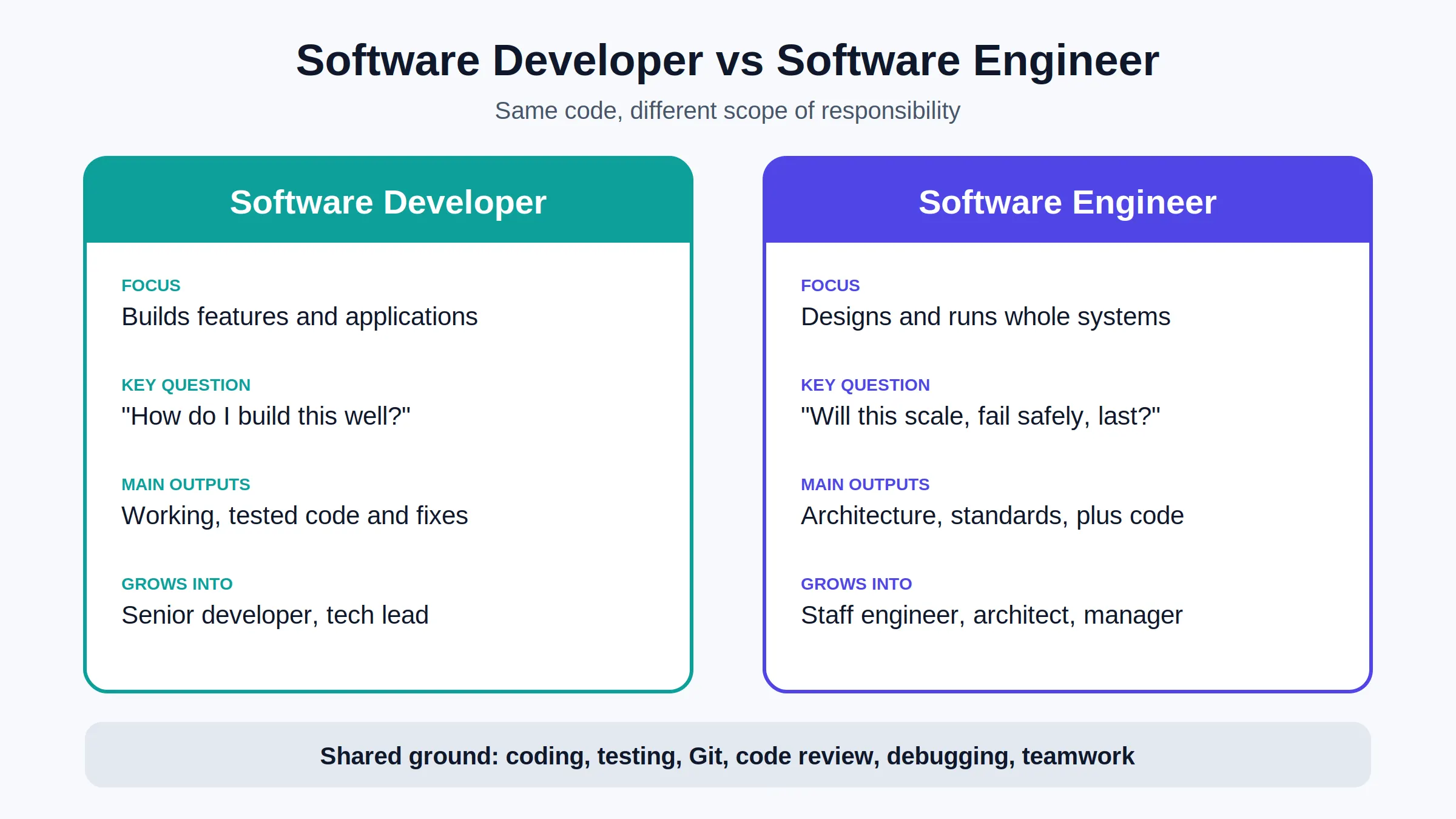
Where a developer asks “how do I build this feature well?”, an engineer is also asking “how does this fit into the system, what happens when ten times as many users arrive, how will we test and deploy it safely, and what will it cost to maintain?” That system-level view covers architecture, scalability, reliability, security, performance and the development process itself.
The discipline has a formal body of knowledge. The IEEE Computer Society’s Software Engineering Body of Knowledge (SWEBOK) defines the areas a software engineer is expected to understand, including requirements, design, construction, testing, maintenance, configuration management, engineering management, process and quality.
Are Software Developers and Software Engineers the Same Thing?
Sometimes yes, sometimes no, and this is the root of most confusion in the software engineer vs developer discussion.
In many companies, especially startups and smaller product teams, the two titles describe the same job. People write code, review each other’s work, contribute to design decisions and deploy to production regardless of what their business card says. Large technology companies often standardize on “software engineer” for all coding roles, while agencies and enterprises in other sectors frequently prefer “developer.” Title choice can come down to company culture, recruiting trends or salary banding rather than any difference in the work.
The distinction becomes meaningful in three situations:
• In large or complex systems. When software spans many services, teams and infrastructure components, someone has to own the architecture, standards and trade-offs. That system-level ownership is engineering work, whatever the title.
• In regulated or safety-critical fields. Medical devices, aerospace, automotive and financial systems demand formal requirements, traceability, verification and risk analysis. These are engineering practices, and roles in these fields tend to require them explicitly.
• Where “engineer” is a protected title. In some jurisdictions, using the title “engineer” is regulated. In Canada, for example, the engineering profession is regulated provincially and territorially, and Engineers Canada coordinates the national framework. Employers there are more careful about calling a role “software engineer” unless it meets professional requirements.
In the United States, the title is largely unregulated for software. The NCEES Principles and Practice of Engineering exam for software engineering was discontinued after its April 2019 administration because of low candidate numbers, so very few software engineers hold a professional engineering license.
The practical rule: treat the title as a hint, and read the responsibilities. A “developer” role that asks you to design distributed systems is an engineering role. An “engineer” role focused entirely on building UI components is a development role.
Software Development vs Software Engineering: The Two Disciplines
It helps to separate the people from the practices. Software development vs software engineering is less a contest than a question of scope: development is one activity inside the broader engineering discipline.
Software development is the activity of creating software: gathering requirements for a feature, designing its implementation, writing the code, testing it and maintaining it. It is focused on producing working functionality.
Software engineering is the discipline of building and running software systems systematically and predictably. It includes development, but also covers architecture, quality assurance, process models such as Agile or DevOps, project estimation, risk management, operations and long-term maintainability.
A useful analogy is house building. A skilled carpenter builds excellent rooms, cabinets and staircases. An architect and structural engineer decide how the whole house is laid out, whether the foundations will hold, how plumbing and wiring run through it, and whether it meets building codes. Both are essential, and many people do both. But the scope of responsibility differs.
In a well-run project, the two come together across the full lifecycle, from discovery and design through build, testing, release and maintenance. Our software product development guide walks through those stages end to end, and our breakdown of the software design process covers the design decisions where engineering thinking matters most.
Difference Between Software Developer and Software Engineer
The table below summarizes the main difference between software developer and software engineer roles where companies do distinguish them. Treat it as a description of typical emphasis, not a strict rule; many professionals sit somewhere between the two columns.
| Dimension | Software developer | Software engineer |
| Primary focus | Building specific features and applications | Designing and running whole systems |
| Scope | A module, product or feature set | Architecture across services, teams and infrastructure |
| Typical question | “How do I implement this well?” | “How does this behave at scale, under failure, over years?” |
| Approach | Iterative, hands-on, often creative | Systematic, measured, principle-driven |
| Core outputs | Working code, features, bug fixes | Architecture decisions, standards, technical designs, plus code |
| Collaboration | Designers, product managers, QA | Other engineering teams, DevOps, security, leadership |
| Testing emphasis | Unit and feature testing | Test strategy, integration, performance and reliability |
| Typical background | Degree, bootcamp or self-taught | Often a computer science or software engineering degree |
| Career direction | Senior developer, tech lead, specialist | Senior or staff engineer, architect, engineering manager |
Roles and Responsibilities
Day-to-day work overlaps heavily. Both write code, review pull requests, debug production issues and attend planning meetings. The difference shows up in what each is accountable for.
What a software developer does day to day
- Translates user stories, designs and requirements into working code.
- Builds and refines features within an existing architecture.
- Writes unit tests and fixes bugs reported by QA or users.
- Integrates third-party APIs, libraries and services.
- Collaborates closely with UI/UX designers and product managers on how features behave.
- Maintains and improves code after release, including small refactors and performance fixes.
What a software engineer does day to day
- Designs system architecture and defines how components communicate.
- Makes technology choices: languages, frameworks, databases, cloud services.
- Sets coding standards, review practices and technical guidelines for the team.
- Plans for scalability, fault tolerance, security and performance.
- Designs test strategies, CI/CD pipelines and release processes, often with DevOps teams.
- Estimates effort, identifies technical risk and communicates trade-offs to stakeholders.
- Writes code, frequently for the most complex or foundational parts of the system.
On a large project, these responsibilities are usually spread across a team: developers deliver most features, while engineers (often senior ones) shape the structure those features live in. Our web application architecture guide shows the kind of structural decisions that typically fall to engineers.
Skills: Software Developer vs Engineer
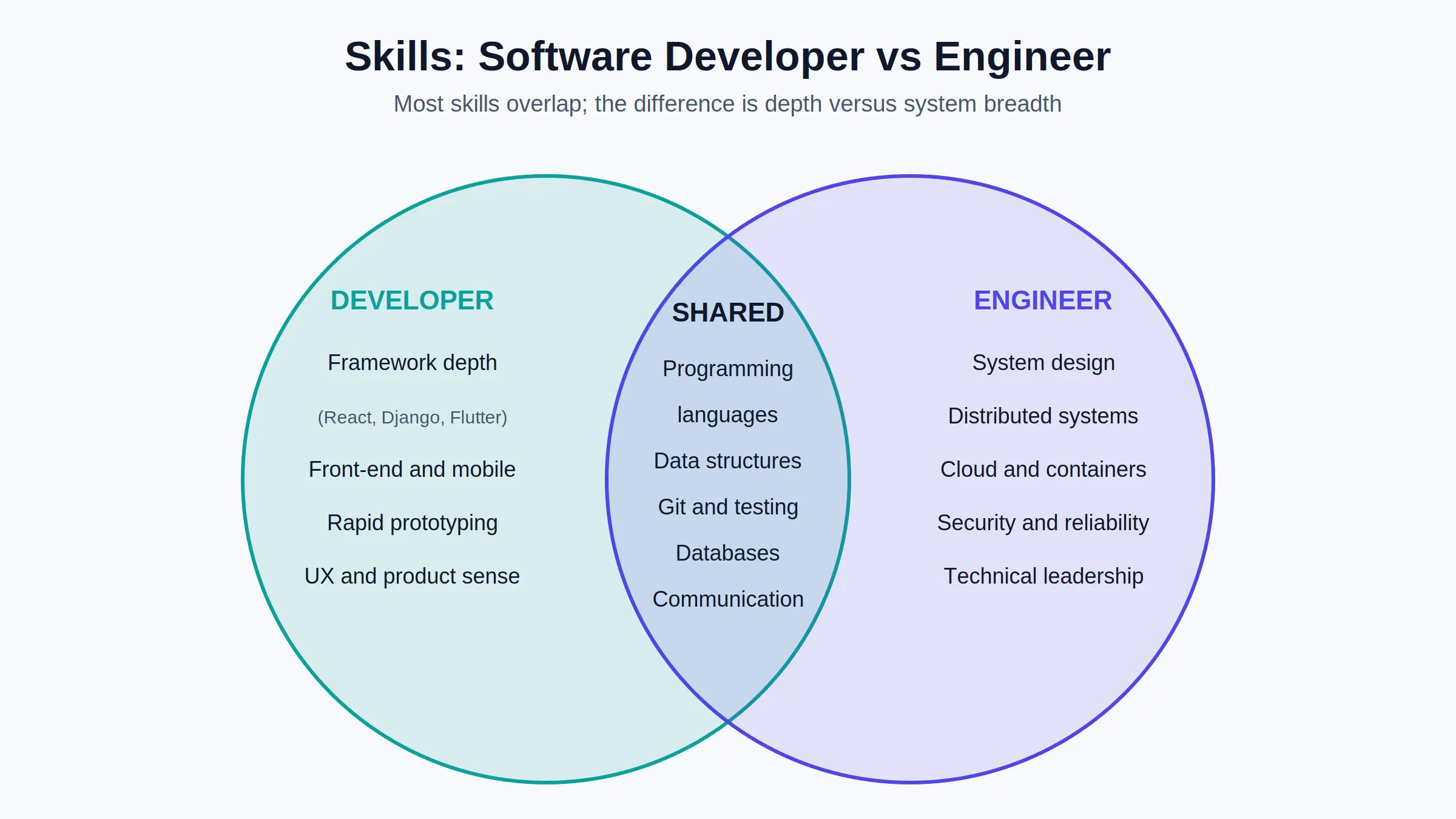
The technical foundations are shared. The software developer vs engineer distinction appears mostly in depth and breadth: developers go deep on the tools of a particular stack, while engineers add system-level and process knowledge on top.
Shared core skills
- Proficiency in one or more programming languages, such as JavaScript or TypeScript, Python, Java, C#, Go or Swift.
- Data structures and algorithms.
- Version control, usually Git.
- Testing and debugging.
- Databases and SQL.
- Communication, teamwork and the ability to explain technical decisions.
Skills that weigh more for developers
- Deep knowledge of specific frameworks (React, Angular, Django, Spring, Flutter and similar).
- Front-end, mobile or platform-specific expertise.
- Rapid prototyping and feature delivery.
- Close attention to user experience and product behavior.
Skills that weigh more for engineers
- System design and architecture patterns, such as microservices, event-driven design and caching.
- Distributed systems, concurrency and performance engineering.
- Cloud infrastructure, containers and orchestration.
- Security engineering and threat modeling.
- Software development lifecycle (SDLC) process, quality assurance strategy and reliability practices.
- Technical leadership: mentoring, design reviews and cross-team coordination.
Education, Degrees and Certifications
Neither role legally requires a specific degree in most countries, but the typical routes differ.
Software developers come from varied backgrounds. A computer science degree is common, but bootcamps, self-taught paths and portfolio-based hiring are widely accepted, particularly for web and mobile development. Employers often weigh demonstrable work, such as shipped apps, open-source contributions and code samples, as heavily as credentials.
Software engineers more often hold a bachelor’s degree in computer science, software engineering or computer engineering, especially at large technology companies and in regulated industries. Software engineering programs in the United States can be accredited by ABET, which reviews whether a program meets engineering education standards. Coursework typically covers systems design, formal methods, software process and project management alongside programming.
Certifications are optional for both but can signal specialist skills. Cloud certifications from AWS, Microsoft Azure and Google Cloud are popular with engineers working on infrastructure-heavy systems; Kubernetes and security certifications serve similar purposes. Developers often favor platform- or framework-specific credentials. For either role, certifications complement experience rather than replace it.
Salary and Job Outlook
Official labor statistics do not separate the two titles. The US Bureau of Labor Statistics groups both under software developers, quality assurance analysts and testers. According to the BLS, the median annual wage for software developers was $133,080 in May 2024, and overall employment in the occupation group is projected to grow 15% from 2024 to 2034, much faster than the average for all occupations.
Because the government data combines both titles, pay differences between “developer” and “engineer” postings mostly reflect seniority, scope and employer type rather than the label itself. Roles that carry system-level ownership, such as senior engineer, staff engineer or architect, tend to command higher pay because they carry more responsibility and risk. Large technology firms, which favor the “engineer” title, also tend to pay above market. A senior developer with deep specialist skills can out-earn a junior engineer by a wide margin.
Location, industry and specialization matter more than title. Cloud, security, machine learning and distributed systems skills consistently command premiums, whichever title is on the offer letter.
Career Paths and Progression
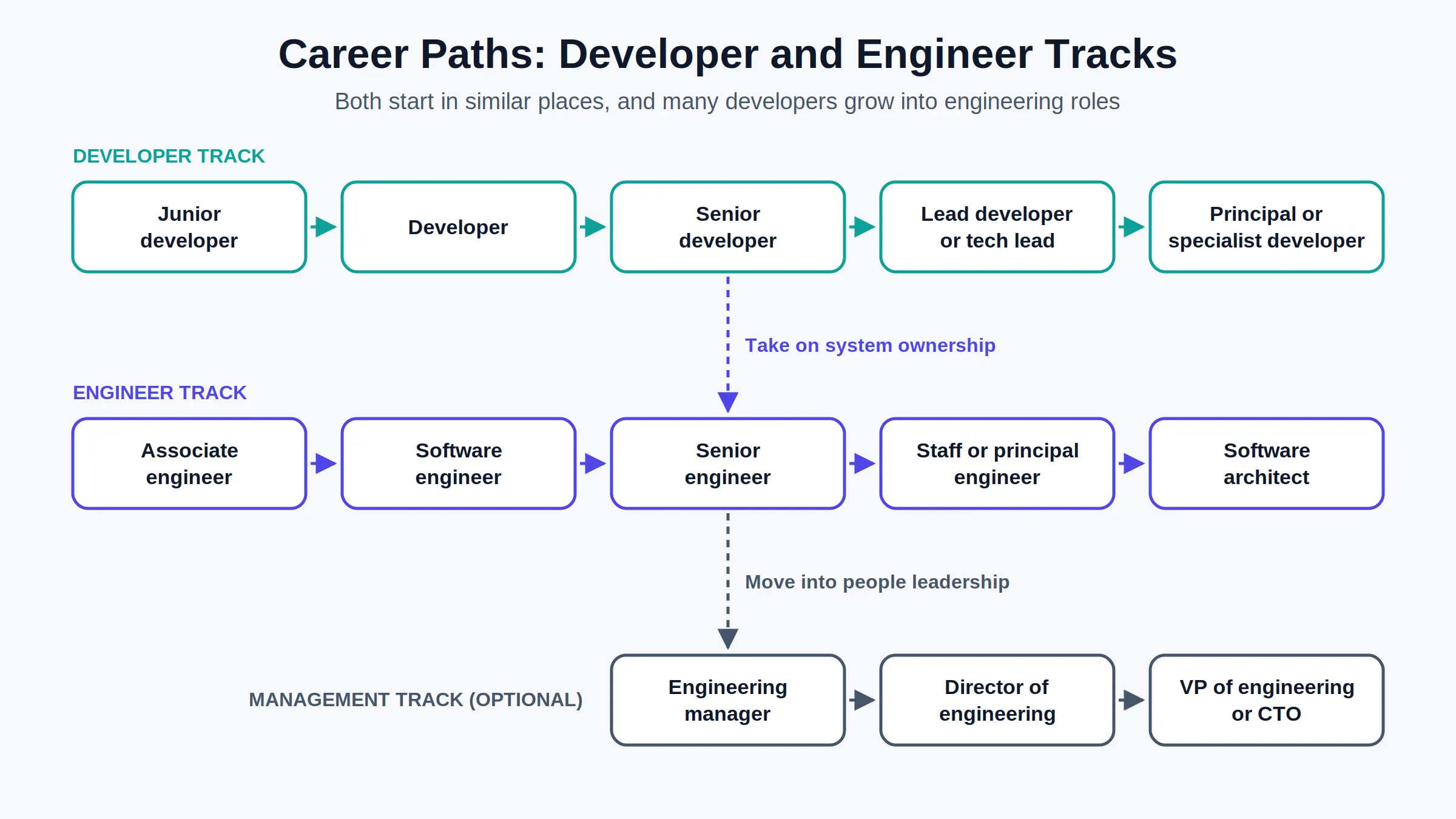
Both tracks start in similar places and can converge at senior levels.
A typical developer path: junior developer → developer → senior developer → lead developer or tech lead. From there, developers can specialize further (for example, principal mobile developer), move into product-focused roles, or shift toward engineering and architecture.
A typical engineer path: junior or associate engineer → software engineer → senior engineer → staff or principal engineer → software architect or distinguished engineer. Many companies also offer a parallel management track: engineering manager → director of engineering → VP of engineering or CTO.
Moving from developer to engineer is common and requires no formal step. The usual route is to take on more system-level responsibility: contributing to design reviews, owning a service end to end, learning infrastructure and reliability practices, and mentoring others. Over time, that broader ownership is what turns a developer into an engineer in practice, whatever the title.
What is a Software Development Engineer (SDE)?
The title “software development engineer”, often shortened to SDE and sometimes written as software developer engineer, combines both labels. It was popularized by large technology companies such as Amazon, which use levels like SDE I, SDE II and SDE III to show seniority.
In practice, an SDE is a software engineer: someone expected to write production code and to contribute to design, testing, operations and system quality. The hybrid title reflects the reality this guide keeps returning to: in modern product teams, building features and engineering systems are two sides of the same job. Related titles you may see include SDET (software development engineer in test), which focuses on test automation and quality engineering, and SRE (site reliability engineer), which focuses on production reliability.
How AI is Changing Both Roles
AI coding assistants have changed what both developers and engineers spend their time on. They speed up boilerplate code, generate tests, explain unfamiliar codebases and suggest fixes. Stack Overflow’s annual Developer Survey tracks how quickly these tools have moved into everyday professional use.
The effect is not the same on both roles. When AI can draft much of a routine feature, the value of a developer shifts toward judgment: understanding requirements, reviewing generated code critically, and knowing when a suggestion is subtly wrong. The value of engineering grows, because someone still has to design systems that are secure, maintainable and testable, and to decide where AI-generated code is safe to use. Our guides on AI in software testing and vibe coding security look at both sides of that shift.
For anyone choosing between the paths, the practical takeaway is that system-level skills, such as architecture, security, testing strategy and reliability, are becoming more valuable, not less.
Software Developer vs Software Engineer: Which Career is Right for You?
Neither path is objectively better. The right choice depends on what kind of problems you enjoy and how you like to work. These questions help.
Do you prefer building things people use, or designing how things fit together?
If the satisfaction comes from shipping a feature and seeing users interact with it, development will likely suit you. If you are drawn to questions of structure, scale and reliability, such as why one design survives traffic spikes and another does not, engineering is a better fit.
How do you feel about ambiguity and trade-offs?
Engineering roles involve more decisions without a single right answer: cost against performance, speed against maintainability. Some people find that energizing; others prefer clearer problems with visible results.
What is your educational background?
A bootcamp or self-taught route leads naturally into development roles, and from there into engineering through experience. A computer science or software engineering degree opens both doors from the start, particularly at large technology companies.
Where do you want to be in ten years?
If you see yourself as an architect, staff engineer or engineering leader, you will need engineering skills eventually, whatever title you start with. If you want to become a deep specialist in a platform, such as iOS, game development or front-end performance, the developer track lets you go deep.
For most people, the decision is not permanent. Many careers follow the same arc: start by building features as a developer, then grow into system ownership as an engineer.
Which Role Does Your Software Project Need?
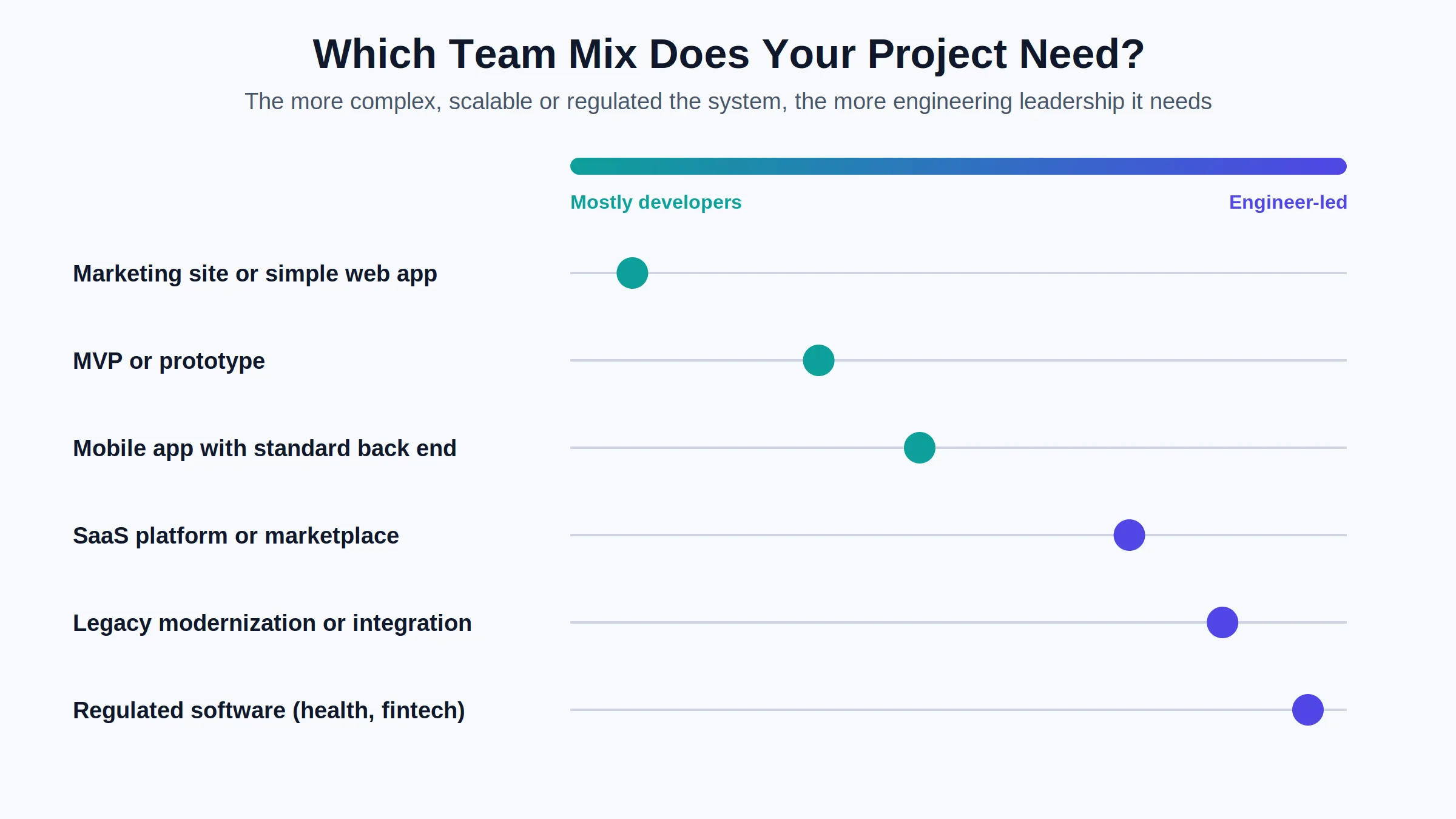
For business leaders, the engineer vs developer question is a staffing decision with cost and risk attached. Hiring only feature builders for a complex platform tends to produce software that works at launch and struggles as it grows. Hiring only senior engineers for a simple app can be more expensive than the project needs.
The table below maps common project types to the mix that usually works best.
| Project type | Typical needs | Recommended mix |
| Marketing website or simple web app | Fast delivery, good UI, standard stack | Mostly developers, light engineering oversight |
| MVP or prototype | Speed, validated learning, room to change | Developers led by one experienced engineer who keeps the architecture extensible |
| Mobile app with a standard back end | Platform expertise, polished UX | Mobile and back-end developers, plus an engineer for API and data design |
| SaaS platform or marketplace | Multi-tenancy, scalability, security, integrations | Engineers own architecture; developers build features |
| Enterprise system integration or legacy modernization | Complex dependencies, data migration, reliability | Engineer-led team with developers for implementation |
| Regulated software (healthcare, fintech, automotive) | Compliance, traceability, verification | Engineer-led, with formal process and QA engineering |
If you are building a first product, our guides to MVP development and software development for startups explain how to keep early teams lean without creating technical debt that becomes expensive later.
Questions to Ask When Hiring
Because titles are unreliable, interview for the work, not the label:
- For developer roles: Can they show shipped features? How do they test their code? How do they work with designers and product managers?
- For engineer roles: Can they walk through a system they designed and explain the trade-offs? How did they handle scaling, failures or security? How do they make decisions other teams depend on?
- For both: How do they review AI-generated code? How do they document decisions? How do they handle disagreement?
In-House, Outsourced or Augmented: How to Staff the Work
Once you know the mix of skills you need, the next decision is how to source them. There are three common models.
In-house hiring gives you full control and long-term knowledge retention, but takes the longest and costs the most to scale up or down. It suits core products you will develop for years.
Outsourcing to a development partner gives you a ready-made team, including both developers and engineers, with established processes. It suits defined projects, new products and organizations without a large engineering function. Our guide to choosing a software development outsourcing partner explains how to evaluate vendors on capability rather than headline rate, and our offshore software development hiring guide covers the additional considerations for distributed teams.
Staff augmentation adds individual developers or engineers to your existing team. It fills skill gaps quickly while you keep project ownership. The differences between this model and fully managed delivery are covered in our comparison of staff augmentation vs managed services.
Whichever model you choose, check that the team includes engineering leadership, not just coding capacity. Ask who owns architecture decisions, how code quality is enforced, and how the system will be tested, deployed and maintained after launch.
How SparxIT Structures Engineering Teams
At SparxIT, project teams are built around the distinction this guide describes. Engineers with system-design experience define the architecture, technology choices and quality standards early in a project, and developers specializing in web, mobile, cloud or data deliver features within that structure. QA engineers and DevOps specialists are involved from the start rather than added before launch.
That approach draws on more than 19 years of software delivery and 2,000+ completed projects across industries including healthcare, fintech, retail and automotive. If you are planning a product and want a view on the right mix of developers and engineers, our custom software development company team can help you scope it.
Conclusion
The software developer vs software engineer question has a simple answer and a practical one. The simple answer is scope: developers focus on building features and applications, while engineers take responsibility for how entire systems are designed, scaled, secured and maintained. The practical answer is that many companies use the titles interchangeably, so the responsibilities in a job description tell you far more than the title.
For professionals, both paths are well paid and in demand, and they often lead to the same place: experienced developers commonly grow into engineering roles as they take on system-level ownership. As AI handles more routine coding, the skills associated with engineering, including architecture, security, testing strategy and sound judgment, are becoming more valuable.
For businesses, the useful question is not “developer or engineer?” but “what mix does this project need?” Simple products can be built mostly by skilled developers. Complex, scalable or regulated systems need engineering leadership from day one. Getting that balance right early is one of the cheapest ways to avoid expensive rework later.

Partner with Experts
Frequently Asked Questions
Can a software developer become a software engineer?


Yes, and it is one of the most common career transitions in the industry. There is usually no exam or license involved. Developers grow into engineering roles by taking on system-level responsibility: contributing to architecture and design reviews, owning services end to end, learning cloud infrastructure, testing strategy and reliability practices, and mentoring others. Many companies formalize this through promotion to a software engineer or senior engineer title.
What are the educational requirements for software engineers vs software developers?
Neither role has a universal legal requirement in most countries. Software developers commonly enter through computer science degrees, coding bootcamps or self-taught routes backed by a strong portfolio. Software engineers more often hold a degree in computer science, software engineering or computer engineering, particularly at large technology companies and in regulated industries. In some jurisdictions, such as Canadian provinces, using the title “engineer” may require professional registration.
Do software engineers and software developers earn different salaries?
Official data does not separate them: the US Bureau of Labor Statistics reports both under one occupation, with a median annual wage of $133,080 in May 2024. In job postings, roles titled “engineer” often pay more, but that mostly reflects seniority, system-level responsibility and the employers that favor the title, such as large technology companies, rather than the label itself.
Which is better, software engineer or software developer?
Neither is better in absolute terms. Development suits people who enjoy building features and seeing users interact with them. Engineering suits people who enjoy designing systems, weighing trade-offs and owning reliability and scale. Engineering roles typically carry broader responsibility and higher pay at senior levels, but many careers move between the two, and the skills overlap heavily.
Is a software development engineer the same as a software engineer?
Generally, yes. Software development engineer (SDE) is a title used by companies such as Amazon for engineers who write production code and contribute to design, testing and operations. Levels such as SDE I, II and III indicate seniority. The title reflects that in modern teams, development and engineering responsibilities are usually combined in one role.
Should a startup hire software developers or software engineers?
Most early-stage startups benefit from a small team of strong developers led by at least one experienced engineer. The developers deliver features quickly, while the engineer keeps the architecture simple but extensible, so the product can scale without a costly rewrite. As the product and user base grow, the share of engineering work increases.