Launching a startup is no longer just about having a disruptive idea. The ability to transform that idea into a reliable, scalable, and customer-centric digital product often determines whether a business gains market traction or fades before reaching its potential.
Regardless of whether you’re building a SaaS platform, an AI-powered application, a fintech solution, or a multi-vendor marketplace, your product must solve a real problem while adapting to evolving customer expectations and market dynamics.
Software development for startups is fundamentally different from building enterprise applications. Startups operate with limited budgets, lean teams, shorter timelines, and a constant need to validate assumptions before making large investments.
Executing a resilient software strategy requires striking a delicate balance between speed-to-market and architectural longevity. This startup software development guide provides a framework for founders, CTOs, and product leaders to validate ideas, define the right product strategy, select appropriate technologies, manage development costs, and create software for startups that supports sustainable business growth.
Whether you are preparing to launch your first product or planning your next phase of expansion, the insights in this guide will help you make informed business and technical decisions.
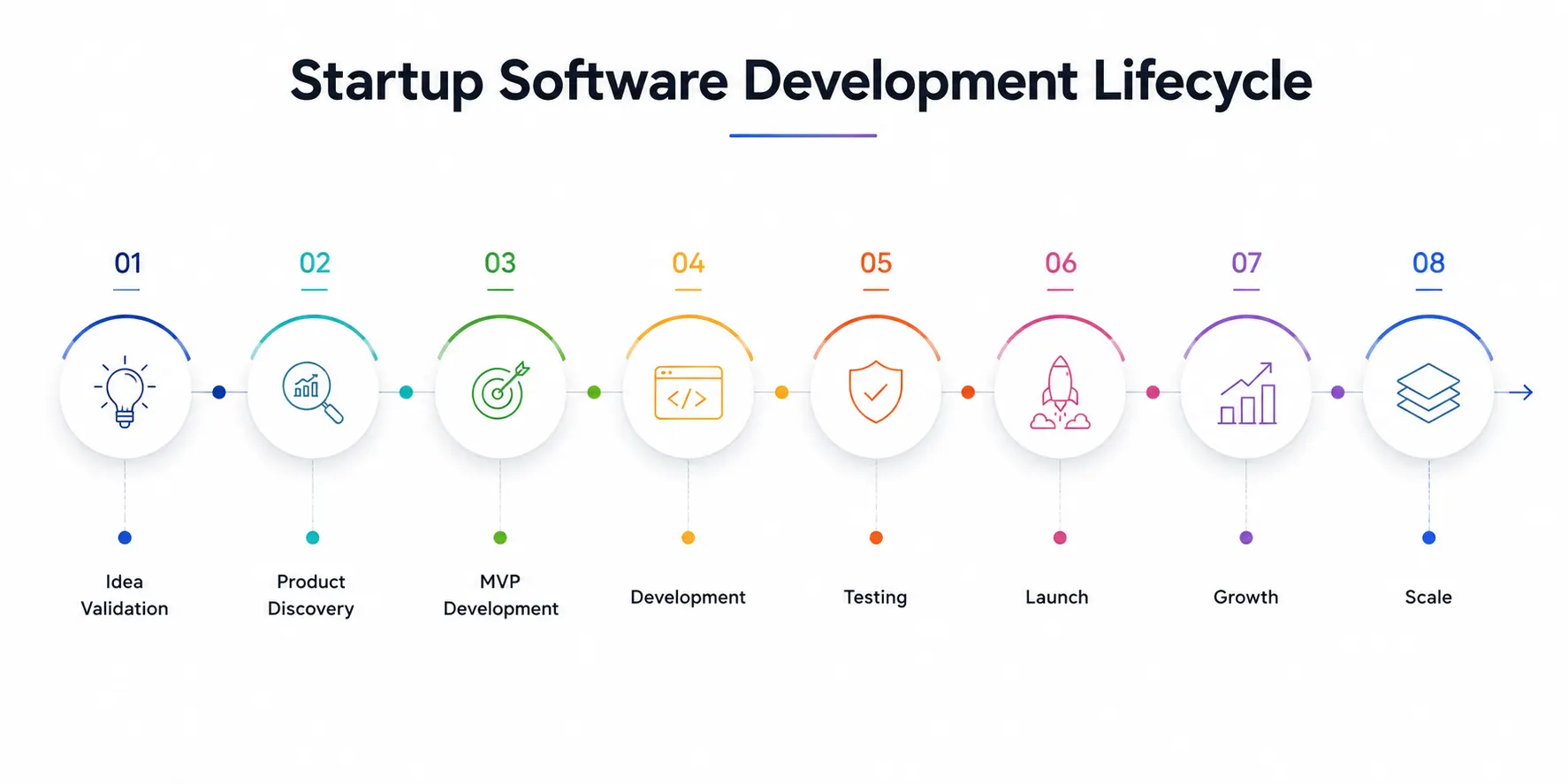
Key Takeaways
|
Why Startup Software Development Requires a Different Approach
Explore how startups differ from enterprises in priorities, budgets, timelines, technology decisions, product validation, and scalability requirements.
-
A Tricky Trade-off
For an early-stage company, every sprint spent on software product engineering consumes money it can’t easily recoup. Unlike an enterprise with predictable, multi-year cash flow, a startup must validate hypotheses rapidly under real cash constraints.
Every line of code written before problem-solution alignment is confirmed represents capital risk. Engineering leadership must treat software product development for startups as a capital allocation exercise, optimizing for speed of learning over theoretical architectural perfection.
-
Startup vs. Enterprise Engineering
Compare how startups and enterprises approach engineering, from development speed and budgets to architecture, risk, scalability, and decision-making.
| Dimension | Startup Development | Enterprise Development |
| Primary goal | Discover if the idea works and find product-market fit | Optimize and protect a proven, revenue-generating process |
| Planning horizon | Days to weeks | Quarters of cross-team alignment |
| Definition of “done” | Proves or disproves a hypothesis | Matches an approved specification |
| Risk & debt posture | High willingness to incur intentional debt to validate fast | Risk-averse and multi-committee governance and approval boards |
| System design | Evolutionary, modular and built for fast pivots | Complex distributed systems across legacy, hybrid-cloud estates |
| Resource constraints | Tied directly to funding milestones | Multi-year capital budgets backed by predictable revenue |
| Biggest risk | Building something nobody wants | Breaking something that already works |
Deploying enterprise-style governance inside an early-stage company creates crippling operational friction. Going fully ad hoc, with no architectural boundaries at all, creates unmanaged technical debt that halts scaling the moment funding lands. The right posture sits deliberately in between.
| Insight: Startups don’t need less discipline than enterprises. They need a different kind of discipline, focused on validated learning rather than process compliance. |
-
Aligning Engineering With Funding Milestones
Technical roadmaps should mirror funding stages, not run on an independent timeline:
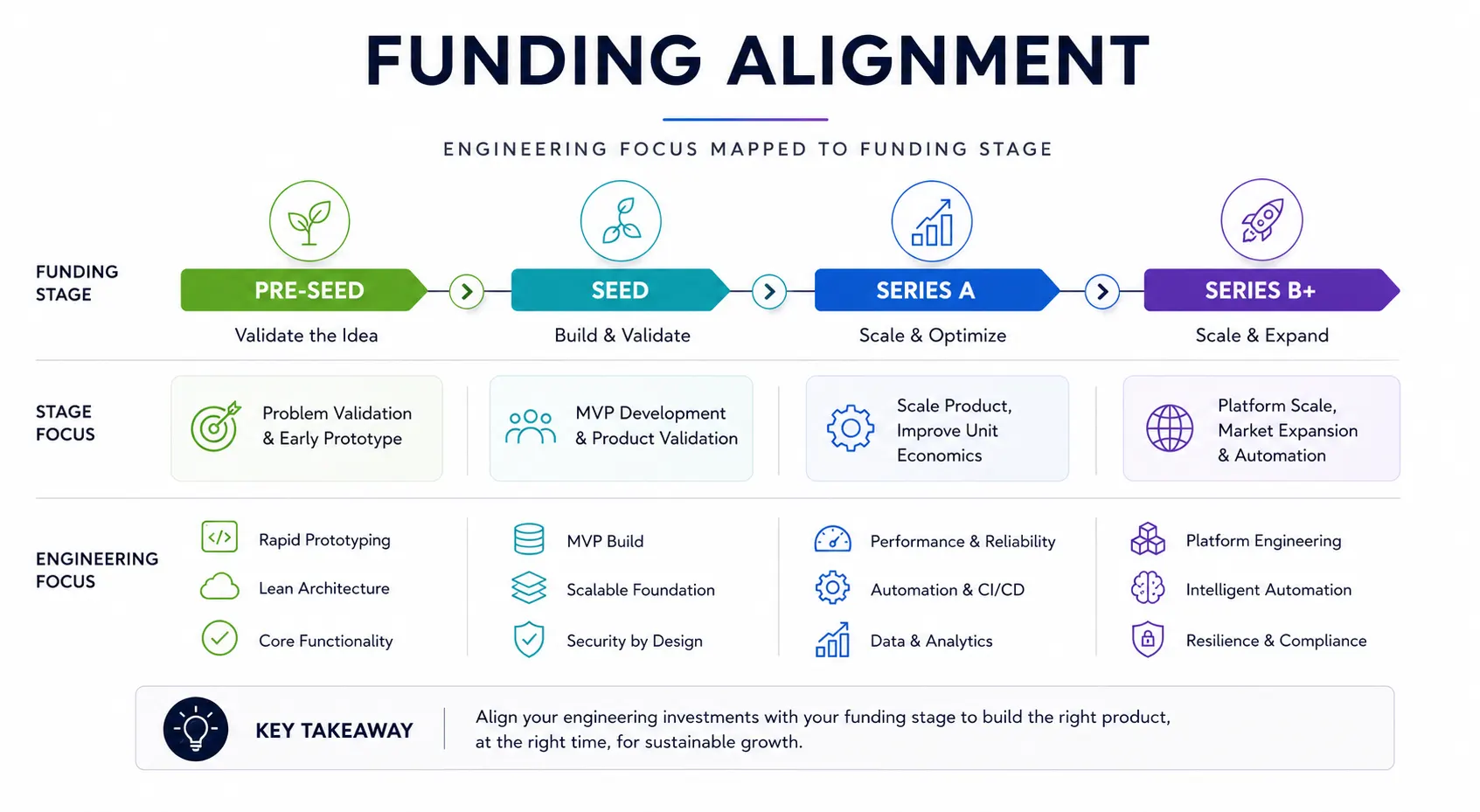
| Stage | Engineering Focus | Primary Deliverable |
| Pre-Seed | Rapid wireframing and interactive user flows | Clickable prototypes to secure angel investment |
| Seed | Core value delivery, instrumentation, telemetry | Working MVP with usage data capture |
| Series A | Eliminate bottlenecks, refactor core services, automate infrastructure | Hardened architecture and security compliance |
| Series B+ | Multi-region availability, high-throughput data, observability | Global-scale platform and public APIs |
How Can De-Risking Help Startups Avoid Costly Development Mistakes?
Startup software development before validating demand remains one of the most frequently cited causes of early-stage failure. Product discovery and strategy function as a financial de-risking mechanism. It ensures capital goes toward features customers actually want, not features a founder assumes they want.
The Discovery Sequence
- Problem identification: Articulate the specific problem in customer terms, not solution terms
- User interviews: Structure conversations that surface real behavior, not hypothetical preference
- Competitive feature-matrix audits: Map what alternatives already do well and poorly
- Architecture blueprint: An early technical sketch of how the solution could work
- SRS (Software Requirements Specification) baseline: Document non-functional targets such as latency limits, concurrent-user capacity, and compliance baselines.
From Vision to Engineering Software
Translating a business concept or mobile app ideas into buildable scope follows a structured path:
Customer Personas → User Journey Maps → System ERD & API Contracts → Non-Functional SRS
- Persona definition establishes explicit behavioral profiles for each key platform actor
- Journey mapping traces operational workflows to find and remove friction points
- Architecture blueprints outline database entity-relationship diagrams (ERDs), system dependency graphs, and initial API contracts
Completing this sequence helps founders learn how to build software for a startup without drifting into scope creep or budget bloat.
What an MVP Actually Is and Isn’t
A minimum viable product (MVP) is not:
- A cheaper, buggier version of the full product vision
- A checklist of “must-have” features shipped all at once
- The final product with fewer bells and whistles
An MVP software development for startups is:
- The smallest set of features that tests your core hypothesis
- A tool for moving toward genuine product-market fit
- Disposable, if the data proves the underlying assumption wrong
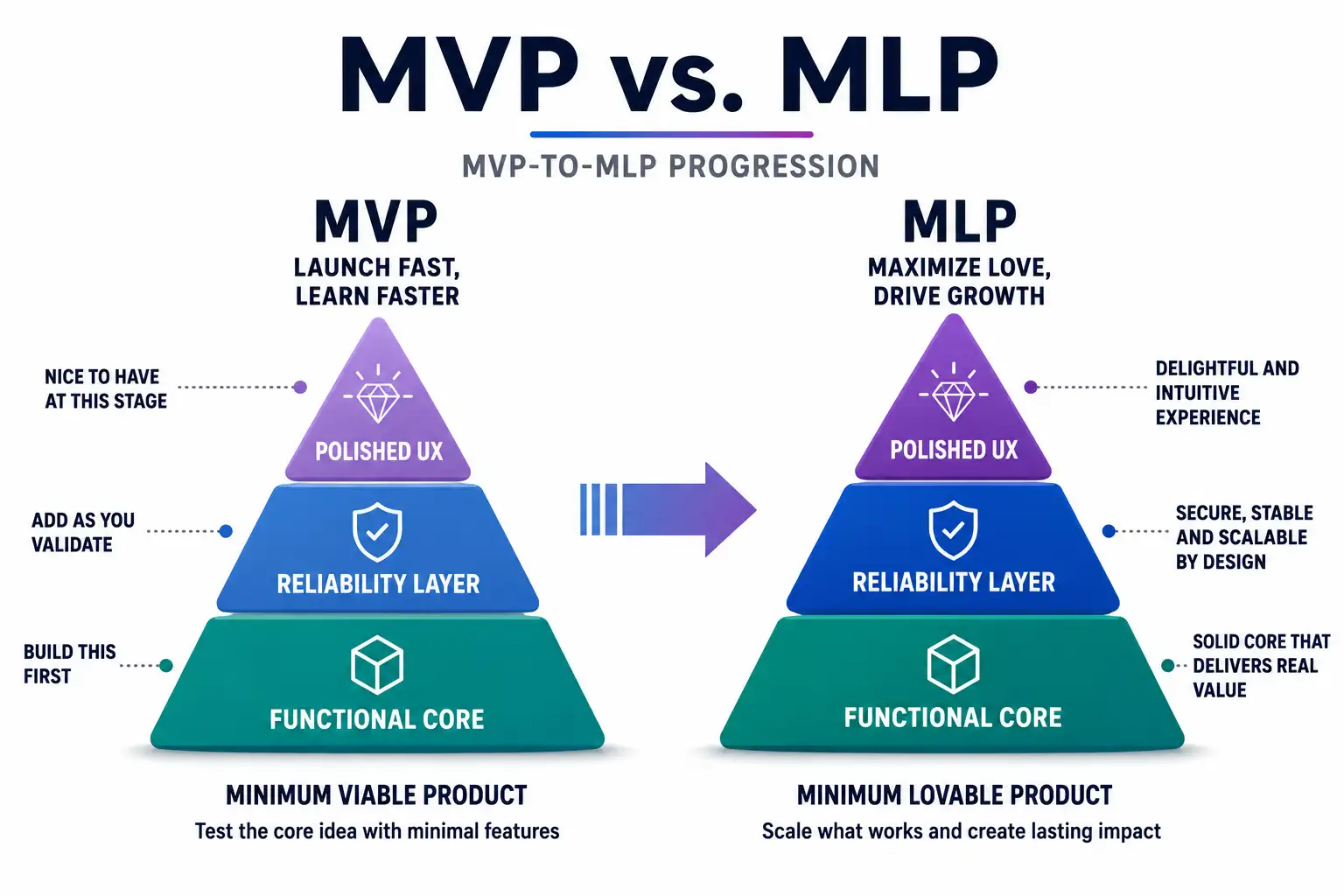
MVP vs. MLP: The Difference
Functional completeness alone often isn’t enough to win modern users. A Minimum Loved Product (MLP) builds on the MVP by layering polished UX and emotional engagement on top of functional core logic and a reliable performance baseline.
To decide what belongs in v1 without over-engineering, most teams apply the MoSCoW framework: Must have, Should have, Could have, Won’t have. This isolates the features that deliver immediate customer experience and value from everything that can safely wait.
Teams that specialize in this kind of product development deliver MVP development for startups in 8 to 16 weeks, depending on complexity. This is helpful in gathering real feedback while assumptions are still cheap to change.
How the Software Development Process for Startups Balances Speed and Quality
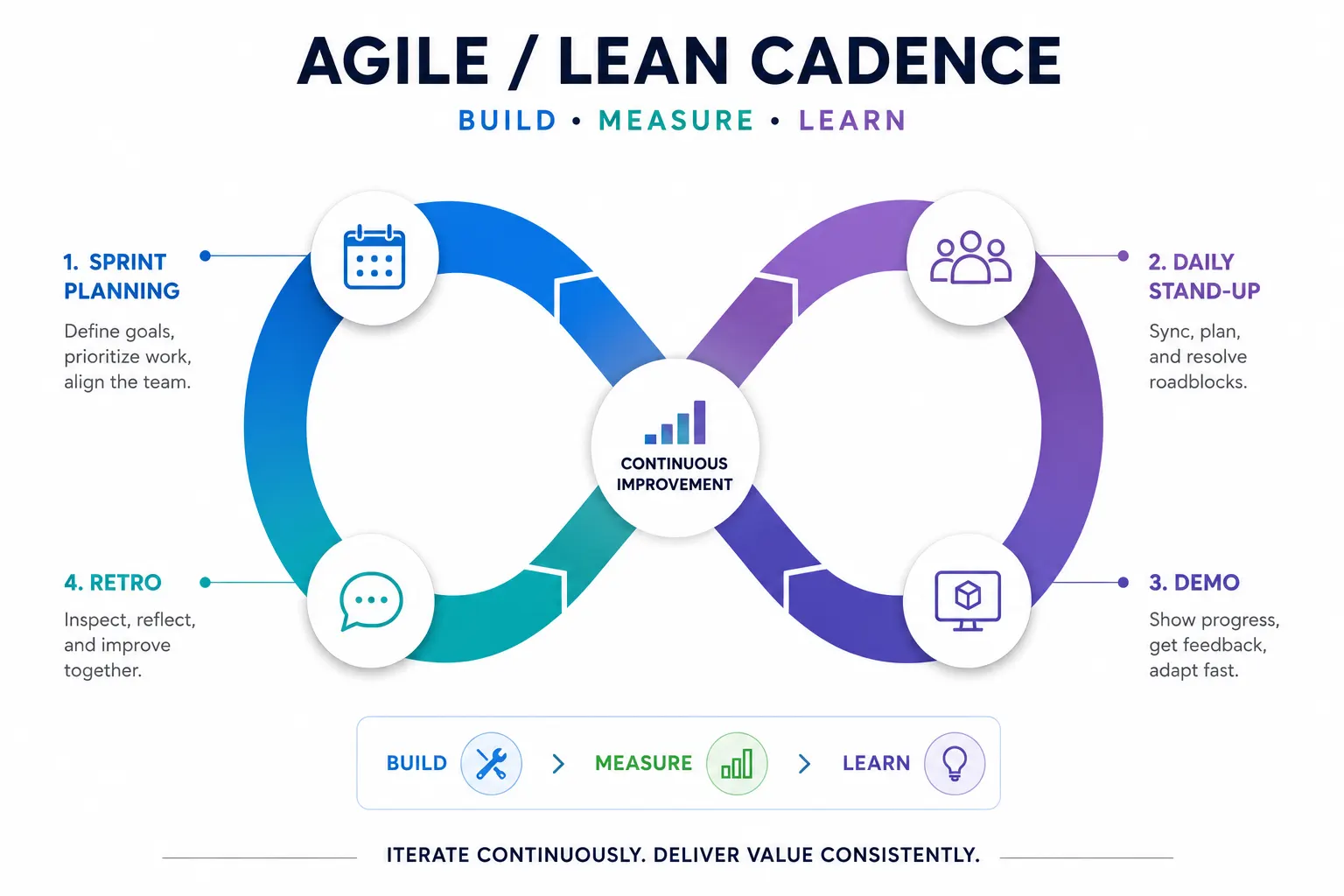
The wrong development methodology can burn months of hard work before a founder notices. Startups need a cadence and software design process for changing requirements, not one built for large, stable teams.
-
Methodology
The right methodology keeps development focused, flexible, and aligned with your startup’s priorities. Let’s look at different software development methodologies that can help you build startup software faster without compromising quality.
| Methodology | Best For | Cadence | Risk Tolerance |
| Agile | Agile Development Methodology for startups helps with early-stage products with evolving requirements | 1–2 week sprints | High, welcomes change |
| Lean | Lean startup software engineering offers pre-product-market-fit validation | Continuous build-measure-learn loops | High, minimizes wasted effort |
| Waterfall / phased | Regulated industries with fixed compliance scope | Sequential phases | Low, requirements fixed upfront |
| Kanban (continuous) | Teams balancing planned sprints with reactive fixes | Continuous flow | Medium |
Most high-performing early-stage teams combine two-week sprint iterations with continuous Kanban execution. It inevitably leads to a stream of bugs, support requests, and small fixes that can’t wait for the next planning cycle.
-
Set Clear “Definition of Done” Criteria
A strong Definition of Done (DoD) keeps standards consistent across fast iterations. These include:
- Code review: Mandatory peer review by a senior engineer before merging to main.
- Test automation: Unit coverage meeting a baseline standard on core business logic
- Security scans: Static analysis clear of unaddressed high-severity vulnerabilities
- Documentation: Updated OpenAPI/Swagger schemas and internal API references
-
Utilize DORA Metrics to Ship Better Software
Rather than tracking raw lines of code, software development services for startups measure delivery health using the four DORA (DevOps Research and Assessment) metrics:
- Deployment frequency: how often code reaches production
- Lead time for changes: time from commit to production release
- Change failure rate: the share of deployments requiring an immediate hotfix or rollback
- Mean time to restore (MTTR): how quickly the team recovers from an unplanned outage
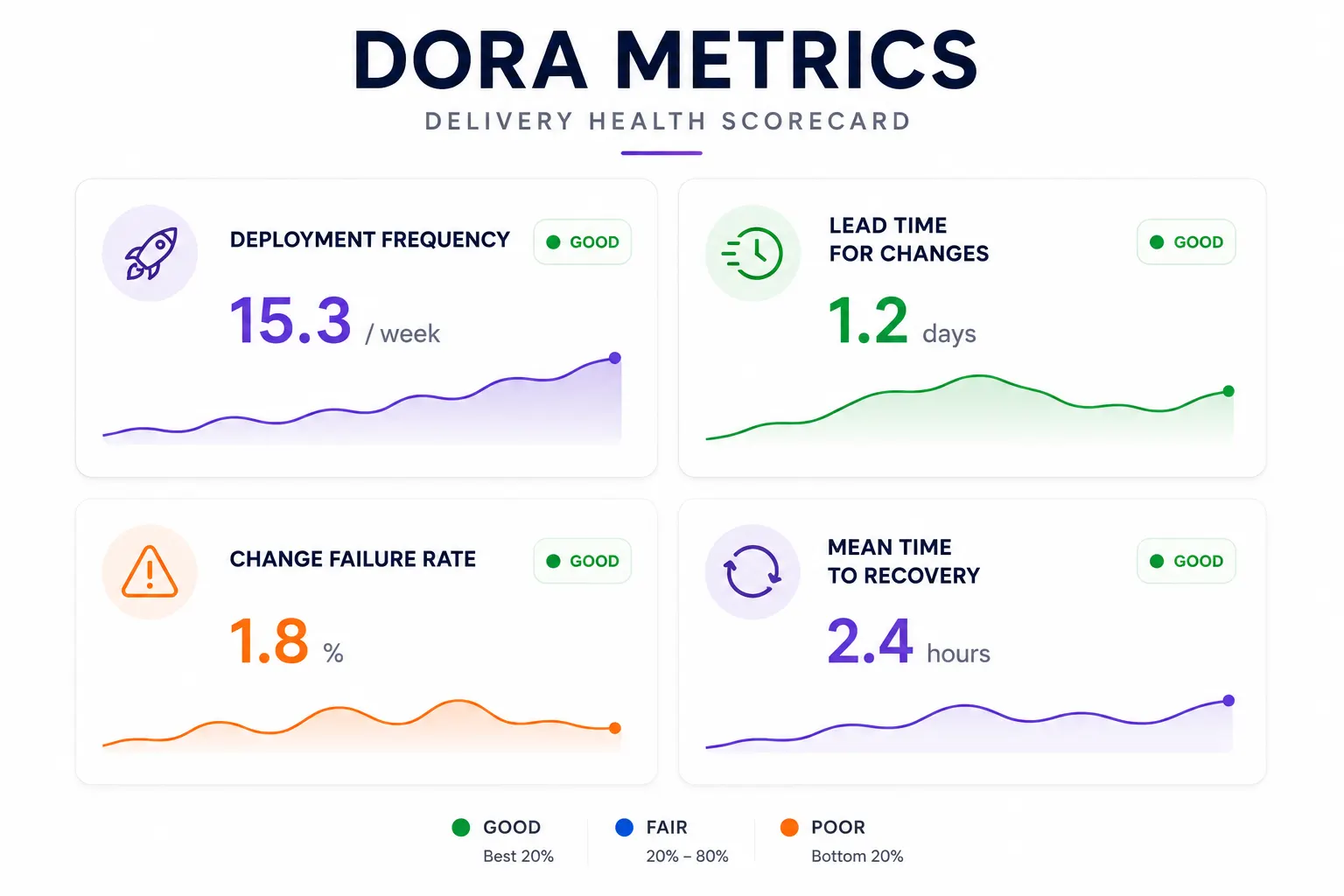
These four numbers, tracked over time, tell a founder more about the health of software architecture than any status report.
Technology Stack for Software Development for Startups
In this section, we’ll break down how to choose technologies that balance startup product development speed, scalability, security, performance, and long-term maintainability.
Monolith, Microservices, or Serverless
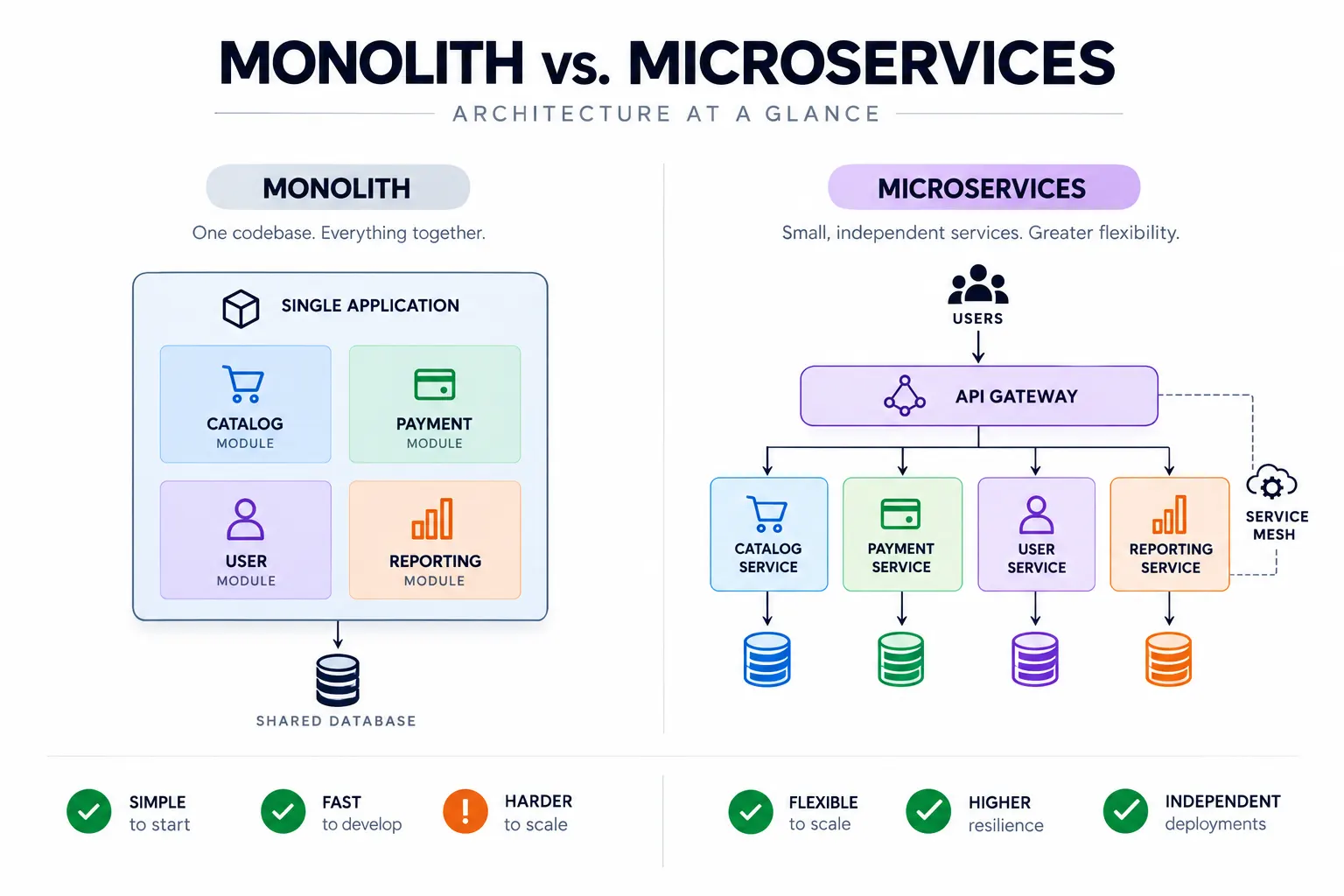
A frequent early-stage mistake is implementing complex distributed systems prematurely. For most early applications, the right call is a modular monolith. It is a single, well-organized codebase with clear internal domain boundaries.
They are fast to build, easy to reason about, and structured so individual modules can be extracted into independent microservices later, once scale genuinely demands it, without a full rewrite.
Serverless execution platforms (AWS Lambda, Google Cloud Functions) are worth layering in early for background jobs and event-driven workloads. They provide elastic scaling without ongoing infrastructure management overhead.
| Modular Monolith | Microservices | |
| Speed to build | Fast | Slower and more upfront design |
| Complexity | Low to moderate | High, needs orchestration |
| Best for | Most early-stage products | Products with proven, demonstrated scale needs |
| Common mistake | Letting it become unstructured over time | Adopting too early, before scale actually demands it |
Selecting the Modern Technology Stack
Startup technology stack selection should weigh talent availability, ecosystem maturity, developer velocity, and long-term maintenance overhead, not which framework is trending this quarter.
| Layer | Strategic Choices | Business Rationale |
| Front-end | React, Next.js, Vue.js, Flutter | High component reusability; strong SSR support for SEO; fast cross-platform execution |
| Back-end | Node.js (TypeScript), Python, Go | TypeScript shares types across the full stack; Python accelerates AI integration; Go handles high concurrency |
| Data persistence | PostgreSQL, Redis, Vector DBs | PostgreSQL offers enterprise-grade reliability; Redis manages caching; vector databases support semantic search |
| Infrastructure | AWS, Google Cloud, Azure (managed services) | Removes the burden of physical server management |
| Mobile | React Native, Flutter | One codebase across iOS, Android, and web |
A structured technology stack selection process, run deliberately once, prevents the costly re-platforming that occurs when a startup outgrows a framework chosen for the wrong reasons.
AI-First Integration Strategy
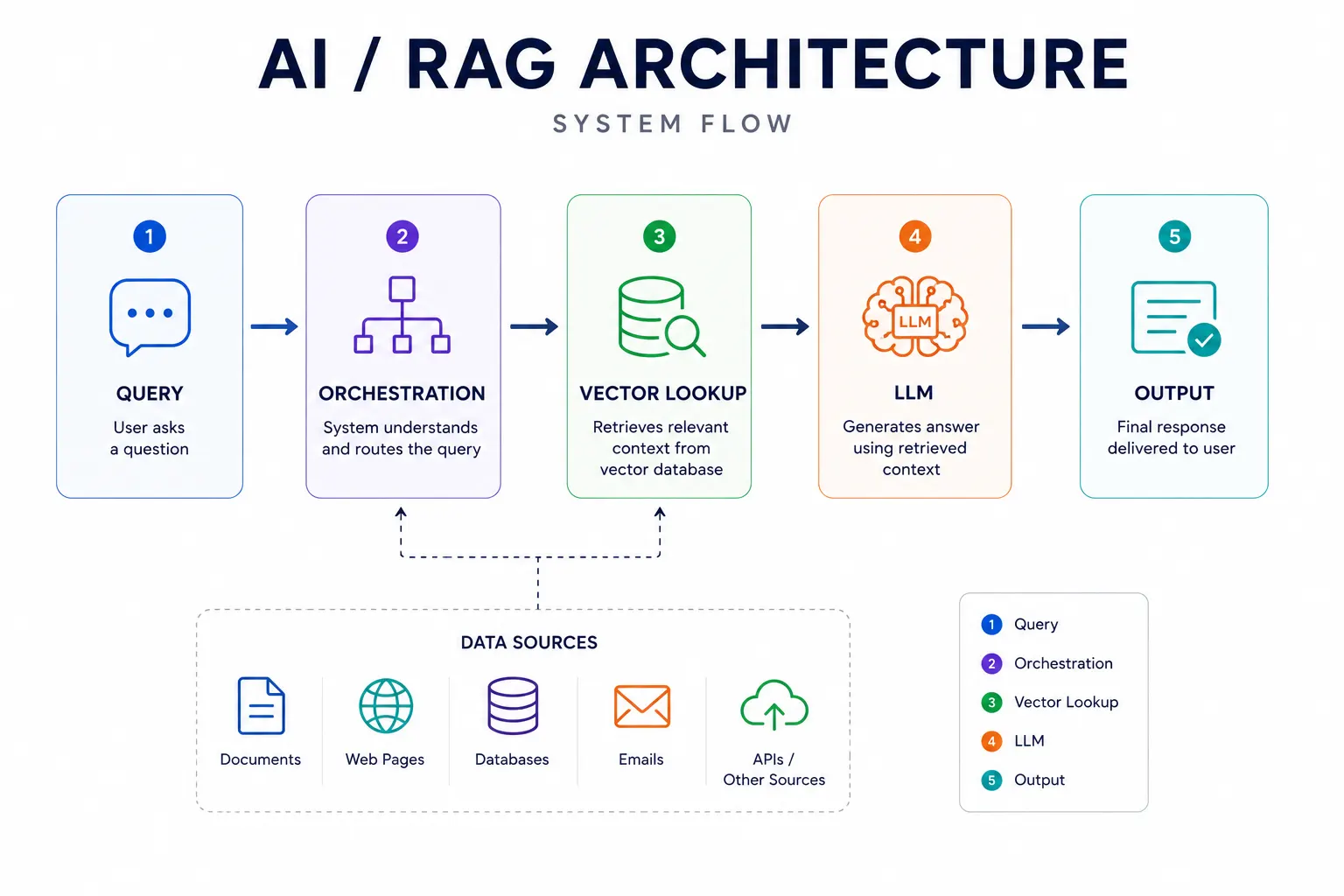
Modern products increasingly need embedded artificial intelligence development services rather than AI added as an afterthought. A flexible AI integration strategy typically connects models, agents, APIs, data sources, and business workflows through an orchestration pipeline.
User Prompt → LLM Orchestrator → Vector Database (RAG) → Model Response
- LLM orchestration: Frameworks like LangChain, LlamaIndex, or native model APIs to embed automation
- Retrieval-Augmented Generation (RAG): Connects vector databases (Pinecone, Qdrant) to proprietary data so responses are grounded without expensive model retraining
- Agentic AI workflows: Autonomous background agents that execute multi-step tasks on a user’s behalf
CI/CD and Infrastructure as Code
A reliable CI/CD pipeline removes deployment risk and accelerates release cadence. It follows the sequence:
Code Commit → Static Analysis → Automated Testing → Staging Build → Production Deploy
Pairing this with Infrastructure-as-Code tools (Terraform, AWS CDK) keeps cloud infrastructure version-controlled, auditable, and reproducible across every environment.
Data, APIs, and SaaS-Specific Considerations
Here, we’ll look at how data architecture, API development, integrations, and SaaS app development shape a reliable, scalable, and secure startup product
- Relational databases remain the right default for transactional products. They enforce data integrity as schemas evolve.
- Versioned APIs, designed from the first release, prevent painful cloud migrations once other systems depend on current behavior
- Separate dev/staging/production environments should exist from week one.
- Subscription and usage-based products need multi-tenancy, metered billing, and role-based access control designed in from the start.
Building or Outsourcing Software Development for Startups
We’ll compare team combination, technical leadership, and sourcing models to help you choose the right balance of expertise, speed, control, flexibility, and cost.
Core Team Structure
A balanced early-stage team combines a small number of complementary roles rather than narrow specialists:
- Lead Architect / Tech Lead: Owns system design, sets technical standards, performs code reviews
- Full-Stack Engineers (2–3): Drive feature velocity across data models, APIs, and interfaces
- DevOps / Infrastructure Lead: Manages CI workflows, cloud computing, monitoring, and security controls
- UI/UX Product Designer: Translates user feedback into interfaces, prototypes, and a coherent design system
Technical Leadership: Fractional CTO vs. Co-Founder
Not every startup needs a technical co-founder from day one. The right leadership model depends on your product complexity, funding stage, technical roadmap, and long-term ambitions.
| Fractional CTO (Pre-Seed / Seed) | Full-Time Technical Co-Founder (Series A+) | |
| Strategic value | High-level strategy, vendor oversight, system-design advice | Deep, daily execution ownership |
| Capital cost | Low, no full-time compensation, minimal or no equity | High, typically 20–50% equity allocation |
| Time to onboard | Fast | Slow, extended recruitment timeline |
| Best fit | Early validation, before product-market fit | Long-term cultural and technical anchor post-validation |
Choosing a Sourcing Model
From building an internal team to partnering with external software development companies for startups, your sourcing decision can shape software development velocity, costs, ownership, and your ability to scale.
| Model | Strengths | Challenges | Best Use Case |
| In-house team | Deep product ownership, strong cultural alignment, direct control | High recruiting overhead, long hiring cycles, fixed burn | Core domain logic, post-validation |
| Freelance / staff augmentation | Rapid access to specific skills, easy to scale capacity | Needs internal management oversight, integration friction | Filling targeted skill gaps |
| Dedicated outsourced team/agency | Full delivery pod, predictable capacity, fast onboarding, built-in QA and process | Requires clear governance and communication cadence | MVP build and pre-revenue phase; full product delivery and scaling |
Software development outsourcing has become a mainstream, credible path rather than a compromise. It gives founders access to senior talent without the overhead of full-time hires, and most teams shift toward a blended or in-house model only once product and funding have matured.
What to Look For in a Software Development Company for Startups
Founders who build strong teams consistently weigh communication skills and product judgment as highly as raw technical ability, because a top custom software development agency makes product decisions constantly. In interviews, you should do the following:
- Ask candidates to walk through a past decision they disagreed with, and how they handled it
- Watch for comfort with “I don’t know yet, let me find out” over confident guessing
- Prioritize context-holders over interchangeable task-executors
How Startups Can Strengthen Security and Software IP Protection
Security gaps can become costly liabilities as your product grows. Strong access controls, secure development practices, software composition analysis, and clear IP ownership help protect both your application and your business.
Manage Technical Debt Deliberately
Technical debt behaves like financial debt: taken on intentionally. It buys speed to market, but if left unmanaged, it creates long-term friction. Martin Fowler’s Technical Debt Quadrant is the clearest way to classify it:
| Prudent | Reckless | |
| Deliberate | “We must ship now to validate the market.” Intentional debt | “We don’t have time for test automation.” Reckless debt |
| Inadvertent | “We didn’t anticipate this scaling load.” Architectural decay | “What are design patterns?” Incompetent debt |
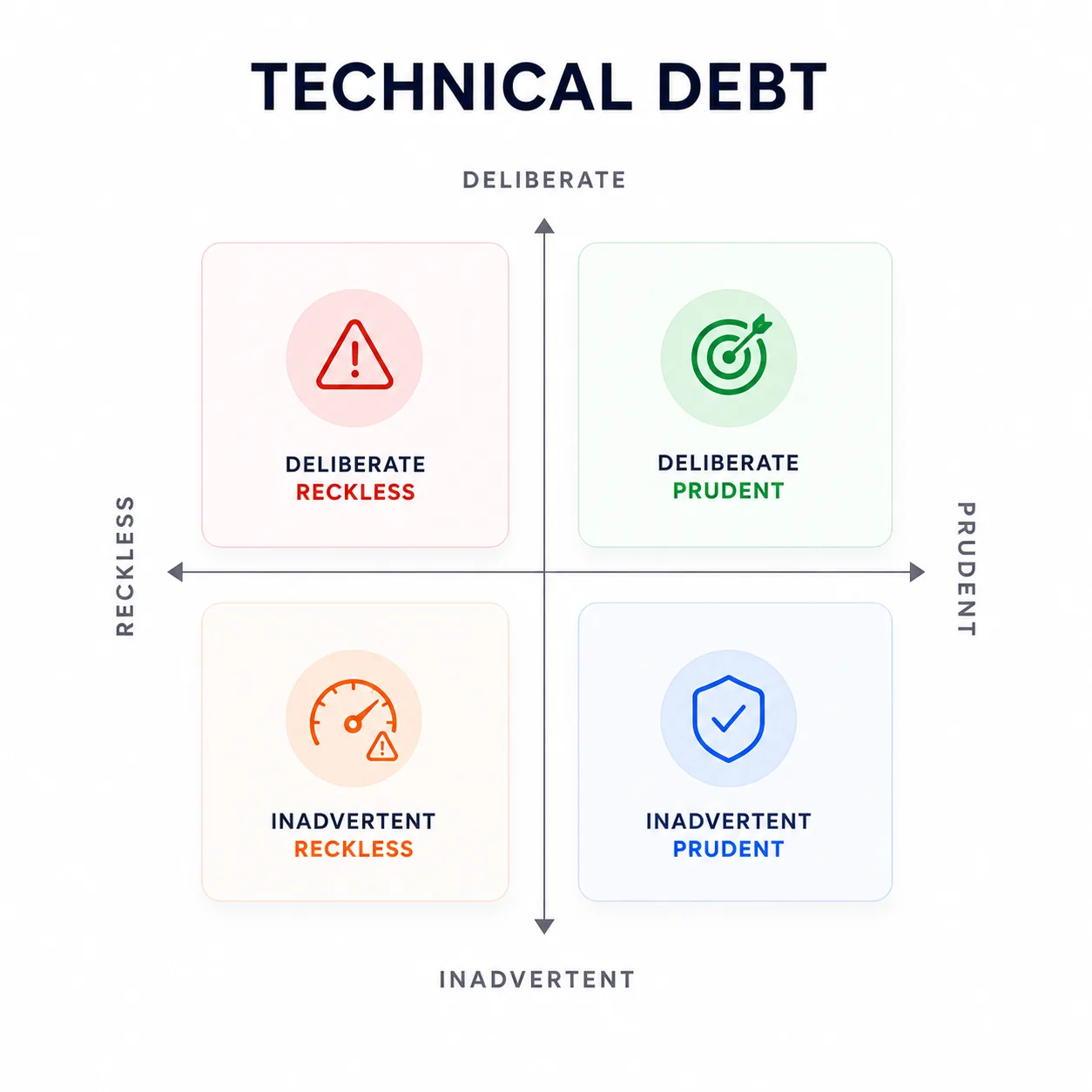
Only the top-left quadrant deliberate, prudent debt belongs in a healthy startup’s playbook, and even then it must be logged in the backlog and refactored systematically after key funding events, rather than left to compound indefinitely.
Follow Foundational Cybersecurity Rules
Early-stage breaches destroy user trust and investor confidence disproportionately fast. Core cybersecurity controls to implement from day one:
- Zero trust access: Mandatory multi-factor authentication and strict role-based access controls
- Data encryption: TLS 1.3 for data in transit, AES-256 for sensitive data at rest
- Secrets management: Configuration keys and API credentials in a dedicated secrets store, never in source code
Adhere to Intellectual Property and Compliance
Protecting IP is essential to valuation accuracy, not just legal hygiene. You must protect the following:
- Contributor IP assignment: Every employee, founder, and contractor signs complete IP-transfer documentation
- Open-source license audits: Scan third-party libraries regularly to prevent copyleft licenses (like GPL v3) from compromising proprietary code
- Compliance frameworks: Align early with SOC 2, GDPR, or HIPAA baselines to simplify future enterprise sales cycles
Beyond internal IP hygiene, sign a well-drafted NDA before sharing detailed plans with any outside developer. Additionally, confirm your software development contract explicitly transfers all code and design IP upon payment. Secure trademark and domain names early to avoid a costly rebrand if a competitor with a similar name emerges after you’ve gained traction.
Prepare for Technical Due Diligence
Institutional investors conduct technical diligence before leading a Series A. A clean, ready data room accelerates the raise:
- Architecture diagrams and domain data-flow schemas
- Third-party Software Bill of Materials (SBOM)
- Automated vulnerability and penetration-test reports
- Disaster recovery protocols and system SLA logs
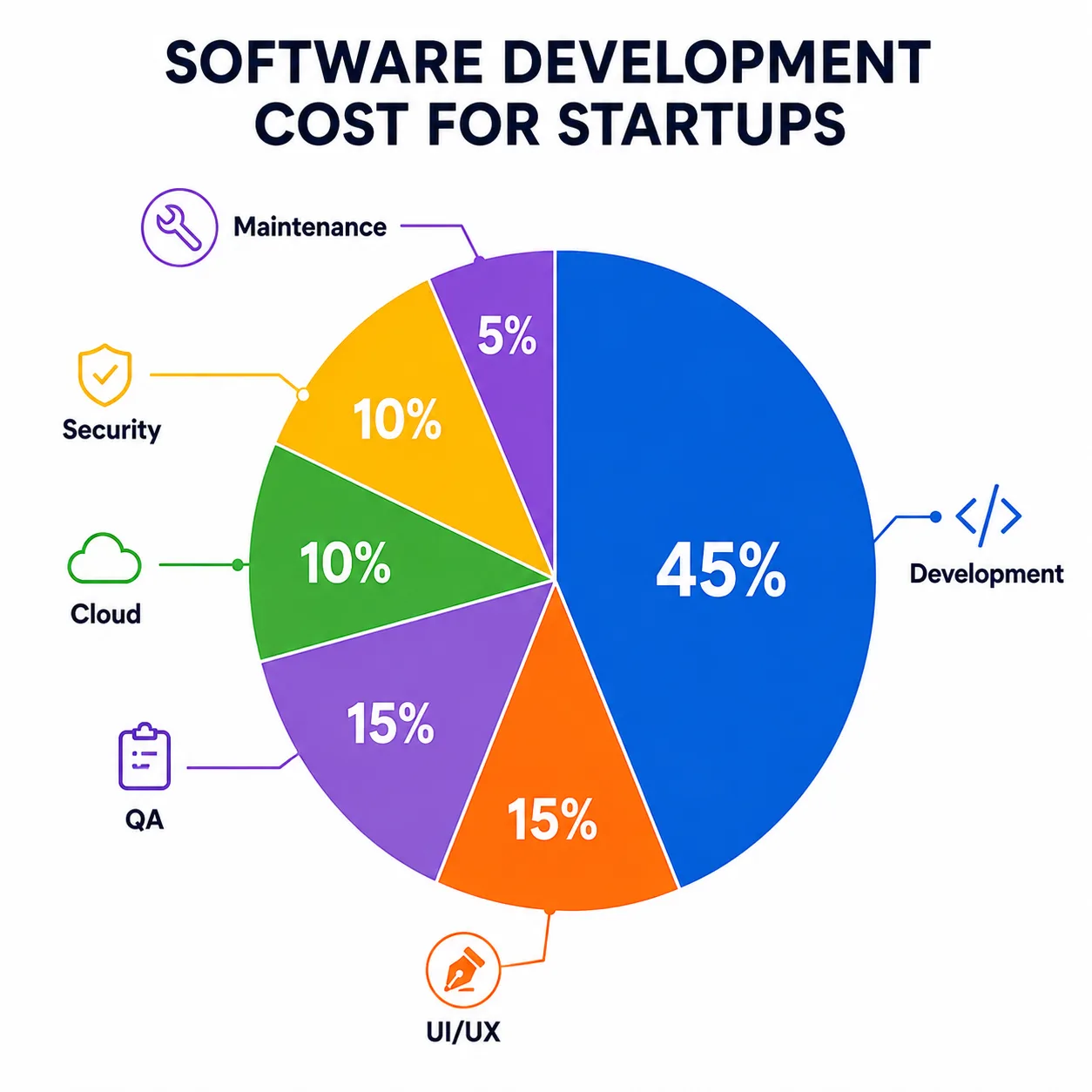
Software Development Cost for Startups and Capital Efficiency
Every development decision has a financial impact. Smart scope control, technology choices, and delivery planning can help you build scalable software without compromising product quality.
Capital Benchmarks by Development Phase
| Phase | What’s Included | Typical Range |
| Interactive prototype | Clickable UI designs and user-journey flows for seed fundraising | $10,000 – $25,000 |
| MVP | Core functional software, security configuration, telemetry, deployment infrastructure | $25,000 – $75,000 |
| Scalable platform | Domain microservices, AI pipelines, multi-region availability, automated compliance tracking | $75,000 – $300,000+ |
What Actually Moves an Estimate
Beyond raw complexity tier, three factors move a quote more than any others:
- The number of user roles and permission levels the product must support
- The number and complexity of third-party integrations (payments, messaging, identity)
- How much custom design work is required versus using a proven component library
The Cost Founders Forget
Ongoing maintenance, hosting, monitoring, and iterative improvement typically run 15–20% of the original build cost annually. A category that shows up only after launch and routinely catches founders off guard.
Common hidden line items include third-party managed APIs (Stripe, Twilio, OpenAI), production database and log storage, observability licensing (Datadog, Sentry, New Relic), and annual security audits.
Capital Preservation Techniques
- Cloud credit programs: Accelerator partnerships (AWS Activate, Google for Startups) offset infrastructure spend
- Serverless computing: Pay for execution, not idle server capacity
- Managed open source: Use battle-tested frameworks rather than custom-building common utilities
- Strategic partnerships: External development teams reduce fixed payroll liability during early validation
Budgeting with a contingency reserve of at least 15% for the unknowns every project encounters. Scoping the three cost drivers above before requesting quotes gets founders dramatically more accurate, comparable app development costs from vendors.
How Do You Scale Software Development for Startups After Launch
Launching the product is only the beginning. Post-launch insights, performance data, customer feedback, and engineering improvements determine how effectively your product grows.
Close the Feedback Loop
User Interaction → Telemetry Analytics → Performance Logs → Roadmap Refinement
- Product telemetry: Event-tracking platforms (Mixpanel, PostHog, Amplitude) to measure activation, retention, and feature usage
- System observability: Real-time monitoring (Sentry, Datadog) to catch errors, latency spikes, and regressions before users report them
Treat the weeks immediately after launch as an extension of discovery. The data should drive the next round of prioritization, not a predetermined roadmap.
Scale Infrastructure Under Growth
As transaction volume grows, teams typically execute performance work in this order:
- Database query optimization: Add targeted indexes and simplify complex queries.
- Multi-tier caching: Use CDNs for static assets and Redis for frequent reads
- Elastic auto-scaling: Automatically add or remove resources based on CPU and memory usage.
Protect Long-Term Velocity
High-performing engineering organizations reserve roughly 20% of every sprint’s capacity for refactoring technical debt, updating dependencies, patching security libraries, and strengthening test automation. You should treat maintenance as a standing line item, not an occasional catch-up project.
Common Mistakes to Avoid in Custom Software Development for Startups
The wrong development decisions can drain budgets and delay growth. Here are the mistakes that often create avoidable product, technical, and business risks.
| Mistake | Why It Happens | The Fix |
| Overbuilding the first version | Adding features “just in case” | Ship the smallest thing that proves the concept |
| Skipping discovery | Pressure to start building fast | Validate assumptions before writing code |
| Choosing a vendor on price alone | Budget pressure, unclear evaluation criteria | Check references and review real code samples |
| Underinvesting in testing and security | Speed feels more urgent than risk | Bake QA and security into every sprint’s Definition of Done |
| Treating early architecture as permanent | Sunk-cost attachment | Revisit decisions when usage data suggests a better path |
| Letting intentional debt go untracked | No backlog discipline | Log every deliberate shortcut and schedule its repayment |
How to Choose a Software Development Company for Startups
Selecting digital transformation and software product development services for startups is as much a relationship decision as a technical one. It deserves the same diligence as a key hire.
Four Questions to Ask Before Signing
- Who specifically will work on your project, and what’s their availability?
- What does the escalation path look like if a sprint slips?
- How are change requests priced once the contract is signed?
- What happens to your code, credentials, and documentation if you ever switch providers?
A genuine software development agency for startups walks you through their process before asking for a signature, offers transparent, itemized pricing, and is candid about trade-offs. A software development partner who asks sharp questions about your users and business model is thinking like a product partner, not an order-taker.
Match the Engagement Model to the Need
- Strategy first: Some teams need digital consulting to define the roadmap and technical strategy before any code is written.
- Full lifecycle execution: Others are ready to move straight into build mode with a dedicated development team for startups, owning design through deployment.
- Location: Teams that value overlapping time zones and in-person collaboration may prioritize local providers. Many strong cross-border teams operate successfully with mature remote practices.
- Specialization: SaaS platforms, AI-integrated products, and mobile-first products each benefit from a partner with direct, demonstrated experience in that specific delivery pattern
Hire software developers for startups that function less like a vendor and more like an extension of the founding team.
Conclusion
Building successful startup software requires more than excellent engineering. It requires strategic planning, disciplined execution, customer-centric thinking, and continuous improvement.
Founders who validate ideas before development, prioritize measurable business outcomes, adopt scalable engineering practices, and invest in long-term product quality. These can significantly improve chances of scalable software development for startups that succeed in competitive markets.
Whether you’re planning a new digital platform or legacy software modernization, selecting the right technology approach today will influence your ability to innovate, scale, and compete tomorrow.
How SparxIT Can Help You Build Software for Your Startup
Turning a startup idea into a market-ready product requires the right balance of speed, innovation, scalability, and cost efficiency. SparxIT helps startups move from product discovery and MVP planning to scalable software development services, launch, and continuous optimization with cross-functional engineering expertise.
We have expertise in web and mobile product development, UI/UX design, cloud integration, AI capabilities, API development, quality engineering, and post-launch support, all tailored to evolving business requirements.
Our experience across digital products includes solutions such as Niva Bupa UNO, a digital insurance platform, Kisan Konnect, an eCommerce solution, and Ezi Ride, a mobility platform, demonstrating capabilities across diverse product environments.
Whether you’re validating an idea or preparing to scale an established product, SparxIT can help build a technology foundation aligned with your business goals and growth roadmap.

Partner with Experts
Frequently Asked Questions
What is the difference between startup software and enterprise software?


Startup software focuses on validating business ideas, achieving customer adoption, and supporting rapid growth. Enterprise software typically optimizes established business operations through mature processes and governance.
When should founders consider custom software development for startups?
Custom development becomes valuable when off-the-shelf solutions cannot meet unique business requirements, enable competitive differentiation, support scalability, or accommodate specialized workflows.
How can startups estimate software development costs accurately?
Project scope, feature complexity, technology choices, integrations, security requirements, and team structure all influence total investment. Breaking projects into smaller milestones produces more reliable cost estimates than budgeting for the entire product upfront.
What makes a successful MVP?
A successful MVP solves one core customer problem, provides measurable business value, collects user feedback, and establishes a foundation for future product improvements.
Should startups build software internally or hire offshore software developers?
The decision depends on available expertise, funding, timelines, and long-term business strategy. Some startups establish internal engineering teams, while others collaborate with external specialists to accelerate delivery and access broader technical capabilities.
What factors should founders evaluate before selecting a software development company?
Business understanding, technical expertise, communication practices, startup experience, security standards, scalability planning, and post-launch support are often more important than hourly development rates.
Can artificial intelligence benefit early-stage startups?
Yes. AI software development for startups can improve customer experiences through intelligent automation, personalized recommendations, predictive analytics, conversational assistants, and workflow optimization. The most effective AI initiatives solve clearly defined business problems rather than implementing AI solely for innovation’s sake.