


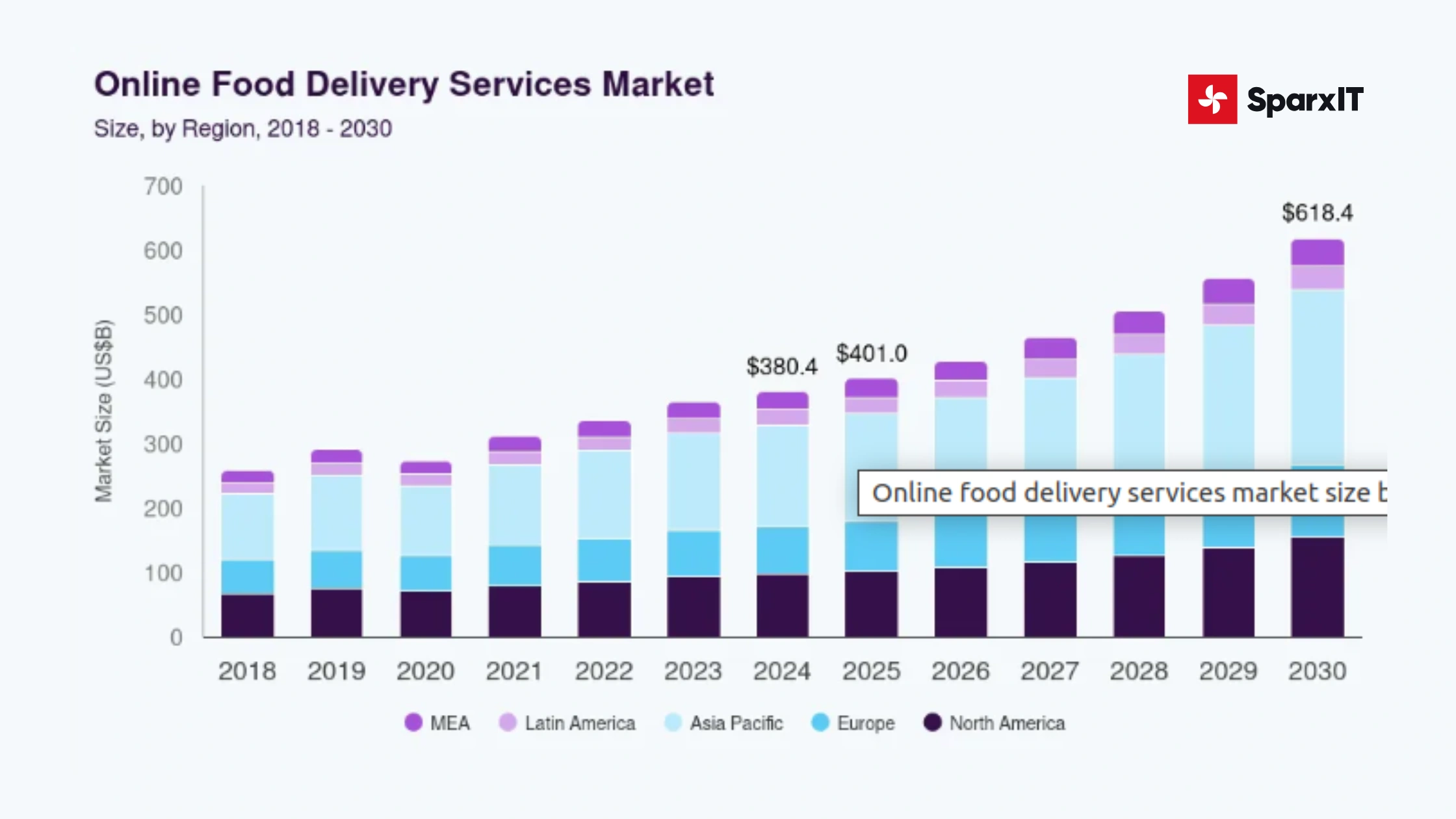
The global online food delivery market has entered a new era of digital acceleration. According to Grand View Research, it was valued at $380.43 billion in 2024. It is expected to grow to $618.36 billion by 2030, with a 9% CAGR from 2025 to 2030. This growth is driven by mobile apps and a generation that prefers tapping a screen over waiting in line.
Today, convenience is the new norm, along with speed. Additionally, personalization provides a competitive edge. Customers want an experience that feels effortless, intuitive, and tailored to their tastes. The shift has forced restaurants and F&B enterprises to rethink how they serve, engage, and scale.
This is where food delivery app development offers immense digital transformation solutions for the industry. They unify operations, reduce human error, automate workflows, and unlock new revenue channels. More importantly, they provide an immersive brand experience that third-party aggregators can never match.
In this guide, we will walk through a comprehensive process for developing a food delivery mobile app. We will explore essential features, technology stack, cost structures, business models, and trends shaping the future of the online food ordering app. Our goal is to help you build a high-performance platform that grows with your business.
Food Delivery App Development: Market Outlook & Opportunities
The worldwide food delivery market in China, the United States, India, and Southeast Asia contributes the highest volumes. These markets show strong demand for food delivery app development services.
The surge is fueled by significant shifts in how people discover, order, and receive food. Customers rely on mobile apps to make quick decisions. AI is shaping personalized menus and dynamic pricing. Apart from that, hyperlocal delivery networks are making fast fulfillment possible in crowded urban areas.
Let’s look at some promising stats that support the above statement.
- China was the world’s largest food delivery market, with a value of $40.2 billion in 2024.
- Uber Eats is the most widely used food delivery app worldwide.
- In the United States, DoorDash dominates the market with more than 65 percent share.
- In China, Meituan is the top food delivery app, followed by Ele.me.
For restaurants and F&B enterprises, investing in a food delivery application creates long-term strategic value. It reduces dependency on aggregator commissions and improves operational efficiency. A custom food delivery application development strategy positions businesses for higher margins, deeper loyalty, and competitive strength in a digital-first market.
Key Advantages of Food Delivery Apps
Now, let’s move ahead and look at the benefits of food delivery apps in detail.
-
Enhanced Customer Convenience and Experience
A food delivery app enhances convenience through AI-driven recommendations, smart search filters, and real-time GPS tracking. These features reduce ordering friction and deliver a personalized, faster, and more predictable experience.
-
Higher Order Volume and Business Scalability
Restaurant food delivery app development helps in scaling orders through automated workflows, load-balanced servers, and multi-location menu management. This helps restaurants handle high traffic, expand service areas, and increase revenue without placing undue strain on operations.
-
Improved Operational Efficiency Through Automation
Automation syncs orders, inventory, and kitchen workflows in real time. It assigns deliveries using algorithm-based routing and manages customer communication to reduce manual work and speed up the entire fulfillment cycle.
-
Increased Brand Visibility and Customer Loyalty
A food delivery mobile app development boosts visibility through personalized offers, automated marketing journeys, push notifications, and loyalty programs. These tools strengthen brand recall and consistently bring users back.
-
Data-Driven Insights for Better Decision-Making
Analytics dashboards track customer behavior, delivery performance, menu trends, and operational bottlenecks. You can use this data to refine pricing, optimize routes, enhance service quality, and make profitable decisions.
Food Delivery App Business Models: Types and Examples
The business model of food delivery defines how platforms attract customers, manage operations, and generate revenue. Each model supports different expansion plans, cost structures, and market strategies. Let’s look at them.
-
Aggregator Model
This model connects customers to multiple restaurants through a single digital marketplace. It allows users to browse menus, compare prices, and place orders through a unified interface.
Ideal For: Startups or enterprises building large multi-restaurant platforms.
Popular Examples: Uber Eats and Zomato
-
Delivery Service Model
The delivery service model manages both the ordering process and last-mile delivery using an in-house fleet. It gives businesses more control over delivery accuracy, speed, and customer satisfaction.
Ideal For: Companies that want to operate a full-stack food delivery service with better control over operational performance.
Popular Examples: DoorDash, Swiggy Instamart
-
Cloud Kitchen Model
The model focuses on delivery-only restaurants that operate without dine-in locations. Orders come entirely through online food ordering software. This model is beneficial because it reduces real estate costs and allows operators to run multiple virtual brands from a single kitchen.
Ideal For: F&B businesses looking to scale quickly or test new culinary ideas with minimal overhead.
Popular Examples: Rebel Foods and Faasos
-
Direct-to-Customer(D2C) Model
It allows restaurants and franchises to build their own branded food delivery app. This gives complete control over customer experience, promotions, and loyalty programs. The model benefits by reducing aggregator commissions and strengthening customer relationships.
Ideal For: Established restaurants and multi-location chains that want to expand their digital presence.
Popular Examples: Domino’s Pizza and McDonald’s
-
Subscription-Based or Membership Model
The model charges users a recurring fee for exclusive benefits such as reduced delivery fees, priority service, or special offers. It helps businesses generate predictable revenue and increase customer retention through ongoing perks.
Ideal For: This model works well for platforms with a large active user base.
Popular Examples: Swiggy One and Uber One
Must-Have Features Every Successful Food Delivery App Needs
1. Customer Panel
The customer panel manages ordering, personalization, payments, and tracking. It creates a smooth, convenient experience that improves engagement, repeat purchases, and overall customer satisfaction.
-
User registration, profile management
It helps users save preferences, store details, and personalize future ordering experiences.
-
Smart search & filters (cuisine, price, ratings)
Allows customers to find dishes faster, refine results instantly, and discover new restaurants.
-
Menu browsing, item customization, and add-ons
Enables users to personalize meals, view options clearly, and reduce ordering mistakes.
-
Real-time order tracking via GPS
Shows order location instantly, reduces support queries, and improves delivery transparency.
-
Secure payments (UPI, cards, wallets, COD)
It helps in faster checkout, minimizes cart drop-offs, and protects sensitive payment data.
-
Reviews and ratings
Builds trust quickly, guides customer choices, and encourages restaurants to maintain quality.
-
Push notifications & offers
Drives repeat orders, boosts engagement, and delivers timely personalized promotions.
-
Reorder, repeat purchase, favorites
Supports faster repeat ordering, increases loyalty, and improves app stickiness.
-
Multi-address support
Let users switch delivery locations, support multiple addresses, and improve convenience.
2. Restaurant Panel
The restaurant panel streamlines menu updates, order management, inventory control, and earnings tracking. It helps restaurants operate efficiently and deliver consistent service quality across locations.
-
Menu management (add, delete, update dishes)
Allows restaurants to update items instantly, highlight bestsellers, and manage availability.
-
Order acceptance/rejection
Helps manage kitchen load, control order flow, and maintain delivery accuracy.
-
Order preparation time settings
Improves delivery estimates, supports drivers, and enhances customer satisfaction.
-
Earnings dashboard, settlement history
Tracks restaurant revenue clearly, helps plan operations, and simplifies financial reporting.
-
Inventory alerts
Prevents stock issues, reduces customer complaints, and improves kitchen planning.
-
Promo and discount management
Boosts visibility, attracts customers, and supports targeted promotional campaigns.
3. Delivery Agent Panel
The delivery agent panel supports route navigation, task management, availability control, and safety features. It enables faster deliveries and improves driver productivity and reliability.
-
On/off availability toggle
Allows drivers to manage their hours, reduce idle time, and improve order-assignment accuracy.
-
Order pickup and delivery workflow
Guides drivers smoothly, reduces mistakes, and speeds up delivery completion.
-
GPS navigation and optimized routing
Helps drivers find locations faster, avoid delays, and reduce fuel use.
-
Daily earnings, incentives, and ratings
Shows earnings instantly, motivates drivers, and encourages service quality improvement.
-
SOS and safety features
Supports driver safety, builds trust, and improves emergency response reliability.
4. Super Admin Panel
The super admin panel oversees platform operations, commissions, analytics, fraud detection, and payouts. It ensures smooth coordination between customers, restaurants, and drivers at scale.
-
Manage users, restaurants, and drivers
Streamlines profile control, resolves issues quickly, and keeps operations organized.
-
Commissions setup
Enables flexible pricing, supports revenue growth, and scales with business needs.
-
Order and delivery analytics
Highlights performance gaps, improves decisions, and strengthens operational efficiency.
-
Promo code & banner management
Improves user engagement, supports marketing campaigns, and boosts targeted visibility.
-
Fraud detection alert
Identifies suspicious activities, protects transactions, and strengthens platform security.
-
Automated payout system
Simplifies settlements, improves reliability, and reduces manual financial workload.
Future-Ready Food Delivery App Features That Give Your Business an Advantage
Features of food delivery apps help businesses outperform competitors by improving user experience, reducing delivery errors, and enabling more intelligent decision-making. Let’s look at the features below:
-
AI-based Personalized Recommendations
It uses customer behavior, order history, and real-time preferences to deliver tailored menu suggestions. An AI transformation services provider helps make your food ordering app smarter so users discover meals faster and enjoy a more tailored ordering experience.
-
ML-based Route Optimization
Utilizes machine learning services to calculate the fastest delivery paths by analyzing traffic, distance, and order priority. Moreover, it ensures users receive their orders quickly, with more consistent, predictable delivery timelines.
-
Voice Ordering (Alexa/Google)
Enables hands-free ordering through voice commands for a faster, more accessible experience. It helps users browse menus, reorder favorites, and complete purchases without having to manually interact with the app.
-
Chatbots for Customer Support
It provides users with instant responses to common queries while reducing wait times. Additionally, chatbots in food delivery apps resolve issues faster, improve ordering confidence, and deliver a consistent support experience across every interaction.
-
Multi-language and Multi-currency Support
This feature creates a seamless ordering experience for global and local audiences by offering content in native languages and payments in preferred currencies. It enables users to feel understood and reduces friction across markets.
-
Geofencing for Location-based Notifications
Delivers timely, location-aware messages when users enter targeted zones. It helps customers discover nearby restaurants, unlock hyperlocal offers, and stay updated on relevant deals based on real-world movement.
-
Vendor Performance Analytics
Gives users better service reliability by helping platforms identify slow fulfillment, service gaps, or quality issues. Ensures customers receive consistently high-quality experiences backed by data-driven performance tracking.
Best Tech Stack for Food Delivery App Development
Choosing the best technology stack ensures faster performance, reliable scalability, secure transactions, and smooth delivery workflows. A strong foundation helps food delivery apps handle high traffic, real-time tracking, and complex multi-user operations efficiently.
| Category | Technologies |
| Frontend (Mobile Apps) | Swift, Kotlin, Flutter, React Native |
| Frontend (Web Admin Panel) | React.js, Next.js, Vue.js |
| Backend Frameworks | Node.js, Python (Django/Flask), Java Spring Boot |
| Databases | PostgreSQL, MySQL, MongoDB, Firebase |
| Real-Time Technologies | WebSockets, Socket.io, MQTT |
| Cloud & DevOps | AWS, Google Cloud, Azure, Docker, Kubernetes |
| Payment Gateways | Stripe, PayPal, Razorpay, Braintree |
| Maps & Location Services | Google Maps API, Mapbox, OpenStreetMap |
| Security Tools | JWT, OAuth 2.0, AES Encryption |
| Analytics & Observability | Mixpanel, Google Analytics, Grafana, Elastic Stack |
How to Create a Food Delivery App: Step-by-Step Process
Let’s take a closer look at the mobile app development process to build a food delivery app. Understanding these steps helps you see how an idea turns into a fully functional platform that customers, restaurants, and delivery partners can rely on every day.
1. Discovery & Strategy
Every successful food ordering mobile app development starts with a clear direction. This begins with understanding your market and creating user personas that reflect real customer behavior. You explore competitors to see what works and where the gaps are. Then choose a business model and revenue strategy that align with your goals.
2. UI/UX Design
Next comes the design stage. Here, your chosen mobile app development company will map user flows to ensure that customers, restaurants, and drivers can navigate the app easily. Wireframes, UI/UX design and prototypes help you visualize the experience before building anything.
3. Development (Frontend + Backend)
This is where the software product development takes shape. In this, food delivery app developers build APIs, set up the database, and create the core modules for customers, restaurants, and delivery agents. The objective is to create a food delivery app interface that can handle real traffic.
4. Testing Phase
Before launch, the app undergoes a comprehensive mobile app testing. These tests will help you with-
- Functional testing confirms that features work as expected.
- Security testing protects the platform from threats.
- Performance testing ensures the app can handle busy hours without slowing down.
- Usability testing ensures the experience feels smooth for every user type.
5. Deployment
Once the food delivery app solution is ready, it is published on the App Store and Google Play. The backend is deployed to a reliable cloud environment that supports scale, uptime, and strong security. This makes sure the platform is ready for real customers on day one.
6. Post-Launch Support & Maintenance
The journey continues after launch. The food delivery app development company fixes bugs, adds new features, and keeps the app up to date with the latest OS. Servers are scaled as your user base grows. Continuous support ensures your food delivery app stays fast, secure, and competitive in the long run.
How Much Does Food Delivery App Development Cost?
The cost to develop an app varies based on features, scalability needs, integrations, and design requirements. Understanding these factors helps businesses plan budgets and make informed investment decisions for end to end food delivery app development.
Key Cost Factors
- App complexity
One of the significant factors in on-demand delivery app development is app complexity. More complex features require extra development time and deeper engineering work.
- Number of modules
More user panels mean longer development timelines and stronger system architecture.
- Technology used
Your chosen tech stack influences speed, performance, and overall grocery delivery app development cost.
- Third-party integrations
Payments, maps, and logistics APIs require additional integration time and testing.
- Design complexity
Advanced visuals or animations need more design effort and refinement.
- Developer location and hourly rate
The on-demand app development cost also depends on where your development team is based and their expertise.
Estimated Cost Range
| App Type | Estimated Cost |
| Basic food delivery app | $25,000 – $40,000 |
| Mid-level feature app | $40,000 – $80,000 |
| Advanced multi-module platform | $100,000 – $250,000+ |
Note: Ongoing maintenance typically costs 15–25 percent of the yearly development budget.
Revenue Models for On Demand Food Delivery App Development
Food delivery software applications generate revenue through multiple streams that scale with user growth. These models help platforms improve profitability, strengthen retention, and create predictable long-term income.
-
Commission Per Order
With this model, you earn a small percentage from every order placed through your platform. It is simple and predictable, which is why most food delivery startups begin here. As orders grow, so does your revenue.
-
Delivery Charges
Delivery fees let you recover logistics costs while keeping driver payouts fair. You can adjust pricing based on distance, location, or urgency. This gives you the flexibility to maintain strong margins.
-
Surge Charges or Time-based Pricing
When demand spikes, you can introduce surge pricing to keep deliveries moving. Higher fees encourage more drivers to get online during peak hours or bad weather. This helps your cross-platform app development maintain fast delivery times when customers need it most.
-
Subscription or Membership Plans
Membership plans are a great way to build loyalty and create dependable revenue. Customers pay a monthly or annual fee for perks such as free delivery or exclusive discounts. Once users subscribe, they tend to order more often, which directly boosts your order volume.
-
In-app Advertising and Sponsored Listings
You can offer premium placement to restaurants seeking greater visibility. Sponsored listings and banner ads help them attract more orders while giving you an additional revenue stream. It is a win for both sides.
-
Partnerships with Grocery and Cloud Kitchen Brands
Partnering with grocery stores or cloud kitchens helps you expand beyond restaurant delivery. You can offer essentials, beverages, and ready-to-cook meals right within your multi vendor food delivery app solution.
Latest Trends Shaping the Future of Food Delivery App Development
New mobile app development trends and changing consumer behavior are reshaping how modern food delivery apps operate and compete in a fast-changing market.
-
AI-powered Dynamic Pricing
AI helps you adjust prices based on demand, location, and order patterns. Apart from that, AI integration services offer smarter pricing strategies, improve margins, and give customers more personalized and fair food delivery app development costs.
-
Sustainable Delivery (Eco-packaging, EV fleets)
Sustainable delivery options help you reduce environmental impact while appealing to eco-conscious customers. Using EV fleets and eco-packaging also lowers long-term costs and strengthens brand reputation.
-
Drone and Autonomous Delivery
Drones and autonomous vehicles help you speed up deliveries, reduce reliance on drivers, and offer customers futuristic convenience. These technologies also improve efficiency during peak hours and in hard-to-reach areas.
-
Social Ordering and Group Food Carts
Social ordering makes mealtime more collaborative by allowing groups to build a shared cart. This increases average order value and makes the overall experience more fun and engaging.
-
In-App Gamification for Customer Retention
Gamification keeps customers returning by rewarding consistent orders with points, badges, or challenges. It increases engagement and helps you develop deeper, more loyal customer relationships.
Common Challenges in Food Delivery Mobile App Development and Their Solutions
The food delivery app development process comes with operational, technical, and user experience challenges. Addressing these early helps businesses build scalable, reliable, and profitable platforms.
| Challenge | Practical Solution |
| Balancing supply and demand | Use AI forecasting, dynamic driver onboarding, and incentives to maintain balance during peak and off-peak hours. |
| Real-time order tracking accuracy | Implement high-precision GPS APIs, frequent location refresh, and predictive routing for reliable tracking. |
| Maintaining app performance | Use scalable cloud computing services, caching layers, and microservices to support high traffic and smooth operations. |
| High customer acquisition cost | Boost retention with loyalty programs, personalized offers, and referral rewards to reduce reliance on paid marketing |
| Ensuring delivery partner safety | Add SOS tools, verified navigation paths, real-time monitoring, and insurance support to improve driver safety. |
Final Thought
Building a custom food delivery app gives businesses more control, stronger customer relationships, and scalable revenue opportunities. The market continues to grow as consumers expect faster, smarter, and more personalized experiences. Now is the right time to explore your next steps, whether that means validating your mobile app ideas with an MVP, refining your technology strategy, or planning for full-scale growth. With the right approach, your food delivery platform can become a powerful driver of long-term success.
Why Choose SparxIT to Build a Custom Food Delivery App Solution?
SparxIT brings deep expertise in food delivery application development and helps businesses build secure, scalable, and high-performance platforms. Our team understands real-time logistics, multi-module workflows, and the AI tech stack required to handle high order volumes.
As a leading on-demand app development company, we follow a strategic approach that covers discovery, design, development, testing, and post-launch support. You get a food delivery app development service built around your business model, revenue goals, and operational needs.
We also offer strong DevOps, cloud transformation services, and modernize your legacy software with AI capabilities to help you scale confidently. Partner with us to launch a future-ready food delivery app that grows with your business.

Partner with Experts
Frequently Asked Questions
Can I launch an MVP first to validate my food delivery app idea?


Yes. Launching an MVP is a smart way to test your food delivery app concept. It helps you assess market demand, collect user feedback, reduce development costs, and refine the product before full-scale development.
What are the essential integrations for a food delivery software?
Food delivery apps rely on seamless integrations to improve ordering, delivery accuracy, user experience, and operational efficiency across all stakeholders. Major integrations include:
- Payments (UPI, wallet, subscription billing)
- Logistics & route optimization APIs
- CRM & marketing automation tools
- Restaurant POS systems
- Analytics systems like Mixpanel and Google Analytics
How much does it cost to develop a food delivery app?
Food delivery app development typically costs $25,000 to $250,000+, depending on features, app complexity, tech stack, user modules, integrations, and development team location.
How long does it take to build a food delivery app?
A basic MVP takes 8–12 weeks, while a full-featured, multi-module food delivery platform usually requires 4–8 months, depending on scope and complexity.
Can I integrate AI and ML in my food delivery software solutions?
Yes, you can integrate AI and ML in your food app to enable personalized recommendations, intelligent delivery routing, demand forecasting, dynamic pricing, and automated support. It will significantly improve efficiency and user experience.
How to scale your online food ordering app development?
Scaling an app for food delivery requires strong architecture, optimized performance, and strategic expansion to handle growing demand and improve user satisfaction. Here are a few scaling metrics you could consider:
- Multi-city rollout strategies
- Microservices architecture for scaling
- Performance optimization techniques like CDNs
- Partner onboarding automation
- Advanced data analytics and machine learning
How do I ensure the security of a food delivery application?
Food delivery app security requires strong data protection measures, safe transactions, and continuous monitoring to prevent breaches and maintain user trust. Below are the security measures you should implement:
- Data encryption (AES, TLS)
- Secure payment compliance (PCI DSS)
- Role-based access
- Fraud prevention tools, such as device fingerprinting
- Protection from DDoS, SQL injection, and data leaks